

CVE-2026-53291 is a newly published Linux kernel vulnerability, added to NVD on June 26, 2026, that fixes a missing error check in the ALSA HDA Conexant audio driver’s jack-detection setup path, where failed callback registration could later trigger a kernel crash. The bug is not a glamorous remote-code-execution headline, and that is precisely why it matters. It is a reminder that modern operating-system reliability still depends on small driver contracts being honored in code paths most users never see. For WindowsForum readers who live between Windows fleets, WSL desktops, dual-boot laptops, Linux servers, and hardware troubleshooting, this is the kind of CVE that separates theoretical severity from operational reality.
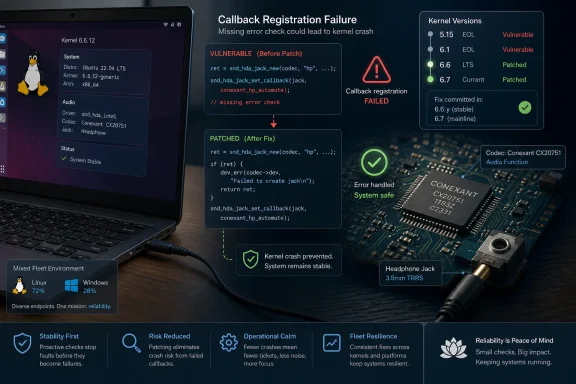
The vulnerable code sits in the Linux kernel’s sound subsystem, specifically the Conexant codec support used by the High Definition Audio driver stack. During probing, the driver calls a function intended to enable jack-detection callbacks. That function can fail and return an encoded error pointer, but the affected code path did not check the return value before continuing.
On paper, this is mundane C housekeeping. In kernel space, mundane C housekeeping is where machines go to die. A callback registration that silently fails can leave later code assuming that a structure exists, a handler is wired, or a state transition is safe when none of those things is true.
The published description says the result can be a kernel crash when jack events are handled or when the driver accesses an uninitialized structure. That phrasing matters: this is described as a stability and availability problem, not as a known privilege-escalation exploit. But a kernel crash is still a security-relevant failure when the affected machine is a kiosk, workstation, lab system, thin client, or appliance that is expected to remain available.
The fix is also revealing. The driver now checks the returned pointer with the standard kernel error-pointer test and propagates the error back to the probe caller. In other words, if the jack-detection setup fails, the driver should fail cleanly rather than letting a half-initialized device limp into service.
But the Linux kernel is not a neat stack of high-risk and low-risk zones. A codec driver is still kernel code. A hardware event is still an asynchronous input into privileged logic. A callback pointer that is assumed valid is still a promise that the kernel must keep.
High Definition Audio support has spent years accumulating quirks for laptops, desktops, docking stations, combo jacks, vendor codecs, and board-specific wiring. That is not a criticism; it is what hardware enablement looks like in the real world. The audio stack has to translate messy physical behavior into software state that desktop environments, mixers, PulseAudio, PipeWire, and applications can understand.
That complexity is why a missing check in a probe routine deserves attention. It is not because Conexant jack detection is suddenly the new front line of cyberwar. It is because driver initialization is one of the places where the kernel decides whether later events will be handled by valid structures or by wishful thinking.
That gap is not unusual, but it is increasingly important for administrators to understand. A CVE identifier is not the same thing as a finished risk assessment. It is a tracking handle, a coordination object, and a way for scanners and advisories to converge on the same defect.
For vulnerability-management tools, the missing CVSS score can create awkward behavior. Some dashboards may bury the issue because it lacks a numerical severity. Others may inflate it because “kernel crash” sounds serious and the kernel is inherently privileged. The right response is neither panic nor dismissal; it is to map the affected kernel versions against the systems that actually carry Conexant HDA hardware or ship the vulnerable code.
The affected ranges listed in the record span several stable kernel lines, including 5.15, 6.1, 6.6, and the 6.7-to-6.8 transition window, with fixed points in later stable releases. That matters more than the absence of a score. If your distribution has already pulled the relevant stable updates, this becomes routine patch hygiene. If you pin kernels, build custom images, or run long-lived appliance kernels, the record is a prompt to check your branch.
Still, denial of service is not academic. Kernel crashes interrupt work, corrupt user confidence, and can turn unattended systems into support tickets. On Linux desktops, especially laptops and workstations used by developers, audio hotplug events are frequent enough that a broken jack-detection path can become visible in daily use rather than only in a lab.
The triggering condition also appears dependent on an earlier allocation or registration failure. That makes the vulnerability less deterministic than bugs where a simple malformed packet can crash the system. But kernel robustness is judged precisely by how it behaves when allocation fails, hardware reports odd state, or initialization cannot complete.
This is where small fixes earn their security label. The patch does not redesign the audio stack. It does not add mitigation technology. It merely refuses to proceed after a dependency failed. In kernel code, that is not pedantry; it is the difference between controlled failure and undefined behavior.
Some administrators dislike this trend because it makes vulnerability dashboards noisier. They are not wrong. A kernel CVE for an audio driver on machines with no affected hardware can look silly beside an internet-facing authentication flaw.
But the counterargument is stronger than it first appears. Kernel fixes move through distributions, embedded vendors, cloud images, and downstream appliances at different speeds. A CVE gives patch-management systems a common language for tracking whether a fix is present, even when the issue is not a five-alarm breach.
The trick is to stop treating every CVE as a self-contained emergency. CVE-2026-53291 should be triaged through asset context. A developer laptop running a vulnerable kernel with Conexant audio hardware is a different risk from a headless server image that happens to include the source-level affected range but never loads the driver.
Developers run Linux laptops next to Windows desktops. Sysadmins maintain Linux-based network appliances from Windows workstations. Security teams scan WSL-adjacent developer environments, container hosts, CI runners, dual-boot machines, and hypervisor guests from the same dashboards that monitor Windows 11 and Server estates. The old mental model — Windows over here, Linux over there — no longer matches how many organizations actually work.
This CVE also touches a familiar Windows-world lesson: driver quality is security quality. Microsoft has spent years hardening kernel-mode driver handling, code signing, and crash isolation because kernel drivers sit at the edge of hardware and privilege. Linux solves different parts of that problem differently, but the underlying danger is the same.
For desktop users who dual-boot Windows and Linux on older business laptops, Conexant audio hardware is not exotic. Many corporate-era laptops and workstations shipped with Conexant codecs or vendor-specific HDA implementations. The practical concern is not that every such system is doomed, but that hardware-specific bugs often live longer than headline bugs because they hide in the inventory.
Those ranges may look strange to users who expect vulnerability records to say “all versions before X.” Kernel history is messier than that. Bugs can be introduced by specific commits, backported into stable branches, fixed in mainline, and then fixed again in each maintained stable series. A version number alone can be less precise than a distribution’s changelog or the exact commit set in a vendor kernel.
That is why distribution status matters. Ubuntu, Debian, Fedora, Arch, SUSE, Red Hat-family distributions, and appliance vendors do not all expose upstream kernel versions in the same way. Enterprise kernels often carry backported fixes while retaining an older-looking version string, which can confuse naïve scanners.
For administrators, the safest workflow is not to manually compare every upstream commit hash. It is to check the distribution’s kernel advisory, confirm whether the ALSA HDA Conexant fix has landed in the shipped package, and verify that affected endpoints have actually rebooted into the updated kernel. Kernel patching is one of the places where “installed” and “running” are not synonyms.
That is the kernel equivalent of locking the door when the hinge breaks rather than pretending the door is still attached. The driver should not advertise a partially initialized capability to the rest of the system. It should stop, report failure, and let the kernel’s device-management machinery decide what to do next.
This is also why the bug is a useful teaching case for developers writing kernel modules or low-level system components. Defensive programming is not just about validating attacker-controlled strings. It is about validating every contract at privilege boundaries, including internal contracts between helper functions and probe routines.
The phrase error pointer can sound like kernel arcana, but the idea is simple enough: some kernel APIs encode failure information in pointer-shaped return values rather than returning a separate integer. That convention is powerful and compact, but only if every caller remembers to test the return before using it as though it were a valid object.
A future score, if one appears, may land in a moderate or low range if the impact remains limited to denial of service and the trigger conditions are constrained. It might also vary depending on how analysts interpret local access, user interaction, attack complexity, and availability impact. CVSS is useful, but it is not omniscient.
The better question is whether this fix arrives inside the kernel updates your organization would already deploy. For most Linux desktops and general-purpose systems, the answer should be yes. The patch is small, upstreamed, and carried through stable references, so the operational burden is mainly the normal one: apply the kernel update and reboot.
The harder cases are custom kernels, frozen images, embedded devices, and specialized Linux workstations where audio support is present but updates are intentionally delayed. There, a low-drama CVE can become an audit finding precisely because the environment lacks a routine path for kernel refreshes.
CVE-2026-53291 sits adjacent to that world but is more serious than a broken mixer profile. It is not merely that a jack might fail to detect. It is that a failed attempt to register detection machinery can leave the driver in a state where later events crash the kernel.
That distinction is important when troubleshooting. If a user sees audio instability on a machine with Conexant HDA hardware, the fix is not to pile on userspace workarounds, reset PipeWire, or keep editing ALSA configuration forever. The right place to look may be the kernel version and whether the relevant stable fix has landed.
This is especially true for rolling distributions and testing branches, where users may run kernels in the affected range before their distribution catches up with a stable point release. It is also true for conservative distributions that backport fixes silently. In both cases, the visible version string may not tell the whole story.
Linux gives administrators the tools to narrow the problem. Inventory systems can collect kernel versions, loaded modules, PCI audio devices, codec names, and distribution package revisions. That data turns a vague kernel CVE into a smaller set of systems where the code path is plausible.
The challenge is cultural as much as technical. Many organizations have mature Windows hardware inventory but weaker Linux endpoint telemetry, especially for developer machines. Those machines are often powerful, privileged, and lightly standardized — exactly the combination that makes boring kernel bugs linger.
A sensible response is not to create a special emergency process for this CVE. It is to improve the normal one. If your asset database cannot tell you which Linux laptops have HDA audio devices, which kernels are running, and which machines have pending reboots, CVE-2026-53291 is a low-stakes warning about a higher-stakes blind spot.
That is the boring machinery Linux depends on. A bug is found, a patch is proposed, maintainers review it, stable branches receive tailored commits, and downstream distributions eventually consume them. Users usually experience this as a kernel update with a long changelog and little fanfare.
The system is imperfect. Downstream lag exists. Some vendors cherry-pick slowly. Some users never reboot. But the presence of stable references is materially better than a vulnerability record that points only to a mainline fix with no obvious path for production users.
It is also a reminder that kernel security is not only about spectacular mitigations like control-flow integrity, memory tagging, or exploit detection. It is about keeping thousands of small subsystem fixes flowing through branches that real machines actually run.
Scanners may report the CVE based on package version, upstream version, or vendor advisory mapping. Some will understand distribution backports; some will not. Some will flag systems that have installed the fixed package but are still running the old kernel because no reboot occurred. Others may lack the hardware context to distinguish a loaded Conexant audio path from an irrelevant code path.
This is why remediation notes should be written carefully. “Patch Linux” is too vague. “Update to a distribution kernel containing the ALSA HDA Conexant jack-detection error-check fix and reboot into it” is much more useful. It tells operations teams what state they need to achieve, not merely what package they need to touch.
The most common false sense of completion in kernel patching is seeing the new package in the package manager and assuming the machine is fixed. Until the machine boots the new kernel, the old code remains in charge. That distinction has burned Windows administrators after driver updates and firmware staging, too; Linux simply makes it more visible.
The bug is better understood as a maintenance defect in a specific driver path. It does not imply that plugging in headphones is broadly dangerous. It does not mean Conexant codecs are uniquely unsafe. It does not mean users should disable audio devices across Linux fleets.
The right lesson is narrower and more useful. Hardware support code must treat initialization failures as first-class events. If a callback cannot be registered, the driver should not pretend it can handle the callback later. That principle applies just as much to network cards, webcams, fingerprint readers, USB controllers, and storage devices.
Security maturity is partly the ability to resist theatrical conclusions. CVE-2026-53291 deserves patching, but it does not deserve mythology. Its value is that it exposes a real failure mode without requiring us to invent a dramatic one.
For desktop users, the advice is even simpler: install your distribution’s kernel updates and restart. If you are running a manually pinned kernel for hardware compatibility, check whether your pinned branch includes the fix. If not, decide whether the pin is still worth the exposure and the potential instability.
For developers maintaining kernel-adjacent code, the lesson is to audit similar helper calls where pointer-returning APIs can encode errors. Missing
For security teams, the best response is to tune scanners with distribution intelligence and runtime context. A finding that cannot distinguish fixed backports from vulnerable upstream versions will create unnecessary churn. A finding that cannot tell whether the code is loaded will still be useful, but only if triaged as a possibility rather than a certainty.
 A Tiny Audio Bug Shows How Kernel Risk Really Works
The vulnerable code sits in the Linux kernel’s sound subsystem, specifically the Conexant codec support used by the High Definition Audio driver stack. During probing, the driver calls a function intended to enable jack-detection callbacks. That function can fail and return an encoded error pointer, but the affected code path did not check the return value before continuing.On paper, this is mundane C housekeeping. In kernel space, mundane C housekeeping is where machines go to die. A callback registration that silently fails can leave later code assuming that a structure exists, a handler is wired, or a state transition is safe when none of those things is true.
The published description says the result can be a kernel crash when jack events are handled or when the driver accesses an uninitialized structure. That phrasing matters: this is described as a stability and availability problem, not as a known privilege-escalation exploit. But a kernel crash is still a security-relevant failure when the affected machine is a kiosk, workstation, lab system, thin client, or appliance that is expected to remain available.
The fix is also revealing. The driver now checks the returned pointer with the standard kernel error-pointer test and propagates the error back to the probe caller. In other words, if the jack-detection setup fails, the driver should fail cleanly rather than letting a half-initialized device limp into service.
The Headphone Jack Became a Kernel Boundary
There is something almost comic about a CVE whose trigger path involves audio jack detection. Security teams are trained to think about browsers, identity providers, VPNs, hypervisors, and exposed daemons. The headphone jack does not usually appear on the threat model diagram.But the Linux kernel is not a neat stack of high-risk and low-risk zones. A codec driver is still kernel code. A hardware event is still an asynchronous input into privileged logic. A callback pointer that is assumed valid is still a promise that the kernel must keep.
High Definition Audio support has spent years accumulating quirks for laptops, desktops, docking stations, combo jacks, vendor codecs, and board-specific wiring. That is not a criticism; it is what hardware enablement looks like in the real world. The audio stack has to translate messy physical behavior into software state that desktop environments, mixers, PulseAudio, PipeWire, and applications can understand.
That complexity is why a missing check in a probe routine deserves attention. It is not because Conexant jack detection is suddenly the new front line of cyberwar. It is because driver initialization is one of the places where the kernel decides whether later events will be handled by valid structures or by wishful thinking.
NVD Has a Name, Not Yet a Verdict
The NVD entry currently gives CVE-2026-53291 a formal place in the vulnerability ecosystem, but it does not yet provide a CVSS score from NIST. The record is in the “received” stage, meaning the CVE has been published and imported, while enrichment such as scoring and weakness classification may lag behind the kernel.org description.That gap is not unusual, but it is increasingly important for administrators to understand. A CVE identifier is not the same thing as a finished risk assessment. It is a tracking handle, a coordination object, and a way for scanners and advisories to converge on the same defect.
For vulnerability-management tools, the missing CVSS score can create awkward behavior. Some dashboards may bury the issue because it lacks a numerical severity. Others may inflate it because “kernel crash” sounds serious and the kernel is inherently privileged. The right response is neither panic nor dismissal; it is to map the affected kernel versions against the systems that actually carry Conexant HDA hardware or ship the vulnerable code.
The affected ranges listed in the record span several stable kernel lines, including 5.15, 6.1, 6.6, and the 6.7-to-6.8 transition window, with fixed points in later stable releases. That matters more than the absence of a score. If your distribution has already pulled the relevant stable updates, this becomes routine patch hygiene. If you pin kernels, build custom images, or run long-lived appliance kernels, the record is a prompt to check your branch.
The Exploit Story Is Less Dramatic Than the Reliability Story
Nothing in the public description indicates an active exploit campaign, a remote attack vector, or a straightforward path from unprivileged user action to arbitrary code execution. The stated consequence is a possible kernel crash after failed callback registration. That should keep the story grounded.Still, denial of service is not academic. Kernel crashes interrupt work, corrupt user confidence, and can turn unattended systems into support tickets. On Linux desktops, especially laptops and workstations used by developers, audio hotplug events are frequent enough that a broken jack-detection path can become visible in daily use rather than only in a lab.
The triggering condition also appears dependent on an earlier allocation or registration failure. That makes the vulnerability less deterministic than bugs where a simple malformed packet can crash the system. But kernel robustness is judged precisely by how it behaves when allocation fails, hardware reports odd state, or initialization cannot complete.
This is where small fixes earn their security label. The patch does not redesign the audio stack. It does not add mitigation technology. It merely refuses to proceed after a dependency failed. In kernel code, that is not pedantry; it is the difference between controlled failure and undefined behavior.
Linux Security Now Includes the Boring Plumbing
The Linux kernel CVE process has grown more aggressive about assigning identifiers to resolved bugs across stable branches. That has produced a firehose of records, many of which look underwhelming compared with branded vulnerabilities or enterprise product advisories. CVE-2026-53291 fits that modern pattern: narrow bug, small patch, multiple stable backports, formal vulnerability tracking.Some administrators dislike this trend because it makes vulnerability dashboards noisier. They are not wrong. A kernel CVE for an audio driver on machines with no affected hardware can look silly beside an internet-facing authentication flaw.
But the counterargument is stronger than it first appears. Kernel fixes move through distributions, embedded vendors, cloud images, and downstream appliances at different speeds. A CVE gives patch-management systems a common language for tracking whether a fix is present, even when the issue is not a five-alarm breach.
The trick is to stop treating every CVE as a self-contained emergency. CVE-2026-53291 should be triaged through asset context. A developer laptop running a vulnerable kernel with Conexant audio hardware is a different risk from a headless server image that happens to include the source-level affected range but never loads the driver.
Windows Shops Should Still Care About a Linux Audio CVE
At first glance, this is not a Windows story. The affected component is in the Linux kernel, not Windows, and the vulnerable file lives in the ALSA HDA Conexant driver code. But WindowsForum’s audience increasingly operates in mixed environments where the boundary between Windows and Linux is procedural rather than philosophical.Developers run Linux laptops next to Windows desktops. Sysadmins maintain Linux-based network appliances from Windows workstations. Security teams scan WSL-adjacent developer environments, container hosts, CI runners, dual-boot machines, and hypervisor guests from the same dashboards that monitor Windows 11 and Server estates. The old mental model — Windows over here, Linux over there — no longer matches how many organizations actually work.
This CVE also touches a familiar Windows-world lesson: driver quality is security quality. Microsoft has spent years hardening kernel-mode driver handling, code signing, and crash isolation because kernel drivers sit at the edge of hardware and privilege. Linux solves different parts of that problem differently, but the underlying danger is the same.
For desktop users who dual-boot Windows and Linux on older business laptops, Conexant audio hardware is not exotic. Many corporate-era laptops and workstations shipped with Conexant codecs or vendor-specific HDA implementations. The practical concern is not that every such system is doomed, but that hardware-specific bugs often live longer than headline bugs because they hide in the inventory.
Version Ranges Are the Only Detail That Really Counts
The affected data published with the CVE points to several stable kernel version ranges. In the 5.15 long-term line, versions beginning at 5.15.149 are listed as affected before the fixed 5.15.209 point. In the 6.1 line, the affected range begins at 6.1.77 and runs below 6.1.175. In 6.6, the affected range begins at 6.6.16 and runs below 6.6.141. The 6.7.4 to pre-6.8 range is also listed.Those ranges may look strange to users who expect vulnerability records to say “all versions before X.” Kernel history is messier than that. Bugs can be introduced by specific commits, backported into stable branches, fixed in mainline, and then fixed again in each maintained stable series. A version number alone can be less precise than a distribution’s changelog or the exact commit set in a vendor kernel.
That is why distribution status matters. Ubuntu, Debian, Fedora, Arch, SUSE, Red Hat-family distributions, and appliance vendors do not all expose upstream kernel versions in the same way. Enterprise kernels often carry backported fixes while retaining an older-looking version string, which can confuse naïve scanners.
For administrators, the safest workflow is not to manually compare every upstream commit hash. It is to check the distribution’s kernel advisory, confirm whether the ALSA HDA Conexant fix has landed in the shipped package, and verify that affected endpoints have actually rebooted into the updated kernel. Kernel patching is one of the places where “installed” and “running” are not synonyms.
The Patch Is a Lesson in Failing Closed
The interesting engineering point is not the audio subsystem; it is the pattern. A function that can fail returns an error pointer. The caller ignores it. Later code assumes setup succeeded. The fix checks the value, converts the encoded pointer into an error code, and returns that error to the probe path.That is the kernel equivalent of locking the door when the hinge breaks rather than pretending the door is still attached. The driver should not advertise a partially initialized capability to the rest of the system. It should stop, report failure, and let the kernel’s device-management machinery decide what to do next.
This is also why the bug is a useful teaching case for developers writing kernel modules or low-level system components. Defensive programming is not just about validating attacker-controlled strings. It is about validating every contract at privilege boundaries, including internal contracts between helper functions and probe routines.
The phrase error pointer can sound like kernel arcana, but the idea is simple enough: some kernel APIs encode failure information in pointer-shaped return values rather than returning a separate integer. That convention is powerful and compact, but only if every caller remembers to test the return before using it as though it were a valid object.
The CVSS Vacuum Should Not Become a Policy Vacuum
Because NVD has not yet assigned a CVSS score, organizations may be tempted to wait. That is understandable, especially in environments where monthly patch meetings are driven by severity thresholds. But waiting for a score is a poor substitute for understanding exposure.A future score, if one appears, may land in a moderate or low range if the impact remains limited to denial of service and the trigger conditions are constrained. It might also vary depending on how analysts interpret local access, user interaction, attack complexity, and availability impact. CVSS is useful, but it is not omniscient.
The better question is whether this fix arrives inside the kernel updates your organization would already deploy. For most Linux desktops and general-purpose systems, the answer should be yes. The patch is small, upstreamed, and carried through stable references, so the operational burden is mainly the normal one: apply the kernel update and reboot.
The harder cases are custom kernels, frozen images, embedded devices, and specialized Linux workstations where audio support is present but updates are intentionally delayed. There, a low-drama CVE can become an audit finding precisely because the environment lacks a routine path for kernel refreshes.
The Desktop Linux Angle Is Quiet but Real
Desktop Linux users are used to audio bugs being filed under annoyance rather than security. Headsets not detected, microphones mapped incorrectly, speakers muted after suspend, docks changing profile state — these are common enough that many users treat them as part of the cost of admission.CVE-2026-53291 sits adjacent to that world but is more serious than a broken mixer profile. It is not merely that a jack might fail to detect. It is that a failed attempt to register detection machinery can leave the driver in a state where later events crash the kernel.
That distinction is important when troubleshooting. If a user sees audio instability on a machine with Conexant HDA hardware, the fix is not to pile on userspace workarounds, reset PipeWire, or keep editing ALSA configuration forever. The right place to look may be the kernel version and whether the relevant stable fix has landed.
This is especially true for rolling distributions and testing branches, where users may run kernels in the affected range before their distribution catches up with a stable point release. It is also true for conservative distributions that backport fixes silently. In both cases, the visible version string may not tell the whole story.
Enterprise Fleets Need Hardware-Aware Triage
Security teams often scan by software package, but driver vulnerabilities demand hardware-aware triage. A vulnerable driver sitting dormant on a headless server is not equivalent to the same code loaded on a fleet of laptops with matching audio codecs. Treating those cases identically wastes time.Linux gives administrators the tools to narrow the problem. Inventory systems can collect kernel versions, loaded modules, PCI audio devices, codec names, and distribution package revisions. That data turns a vague kernel CVE into a smaller set of systems where the code path is plausible.
The challenge is cultural as much as technical. Many organizations have mature Windows hardware inventory but weaker Linux endpoint telemetry, especially for developer machines. Those machines are often powerful, privileged, and lightly standardized — exactly the combination that makes boring kernel bugs linger.
A sensible response is not to create a special emergency process for this CVE. It is to improve the normal one. If your asset database cannot tell you which Linux laptops have HDA audio devices, which kernels are running, and which machines have pending reboots, CVE-2026-53291 is a low-stakes warning about a higher-stakes blind spot.
The Stable Kernel Machine Did Its Job
One reassuring part of this story is that the fix appears to have moved through the stable kernel process rather than languishing as an isolated mailing-list patch. The NVD record lists multiple stable commit references, reflecting the reality that maintained kernel branches each need their own backport.That is the boring machinery Linux depends on. A bug is found, a patch is proposed, maintainers review it, stable branches receive tailored commits, and downstream distributions eventually consume them. Users usually experience this as a kernel update with a long changelog and little fanfare.
The system is imperfect. Downstream lag exists. Some vendors cherry-pick slowly. Some users never reboot. But the presence of stable references is materially better than a vulnerability record that points only to a mainline fix with no obvious path for production users.
It is also a reminder that kernel security is not only about spectacular mitigations like control-flow integrity, memory tagging, or exploit detection. It is about keeping thousands of small subsystem fixes flowing through branches that real machines actually run.
Scanner Noise Will Be the First Symptom
For many organizations, the first encounter with CVE-2026-53291 will not be a crash. It will be a vulnerability scanner flagging Linux kernels across a mixed estate. That is where the confusion begins.Scanners may report the CVE based on package version, upstream version, or vendor advisory mapping. Some will understand distribution backports; some will not. Some will flag systems that have installed the fixed package but are still running the old kernel because no reboot occurred. Others may lack the hardware context to distinguish a loaded Conexant audio path from an irrelevant code path.
This is why remediation notes should be written carefully. “Patch Linux” is too vague. “Update to a distribution kernel containing the ALSA HDA Conexant jack-detection error-check fix and reboot into it” is much more useful. It tells operations teams what state they need to achieve, not merely what package they need to touch.
The most common false sense of completion in kernel patching is seeing the new package in the package manager and assuming the machine is fixed. Until the machine boots the new kernel, the old code remains in charge. That distinction has burned Windows administrators after driver updates and firmware staging, too; Linux simply makes it more visible.
This Is Not a Reason to Fear ALSA
It would be easy, and wrong, to turn this CVE into an indictment of ALSA or Linux audio. The Advanced Linux Sound Architecture is old, intricate, and sometimes maddening, but it is also the reason Linux supports a vast spread of audio hardware across consumer, enterprise, and embedded systems.The bug is better understood as a maintenance defect in a specific driver path. It does not imply that plugging in headphones is broadly dangerous. It does not mean Conexant codecs are uniquely unsafe. It does not mean users should disable audio devices across Linux fleets.
The right lesson is narrower and more useful. Hardware support code must treat initialization failures as first-class events. If a callback cannot be registered, the driver should not pretend it can handle the callback later. That principle applies just as much to network cards, webcams, fingerprint readers, USB controllers, and storage devices.
Security maturity is partly the ability to resist theatrical conclusions. CVE-2026-53291 deserves patching, but it does not deserve mythology. Its value is that it exposes a real failure mode without requiring us to invent a dramatic one.
The Practical Playbook Is Shorter Than the Advisory
For administrators, the concrete response is mercifully straightforward. Identify Linux systems running affected kernel lines, prioritize systems with Conexant HDA audio or loaded relevant sound modules, apply the vendor’s fixed kernel package, and reboot. For custom kernels, pull the stable fix appropriate to the branch and rebuild.For desktop users, the advice is even simpler: install your distribution’s kernel updates and restart. If you are running a manually pinned kernel for hardware compatibility, check whether your pinned branch includes the fix. If not, decide whether the pin is still worth the exposure and the potential instability.
For developers maintaining kernel-adjacent code, the lesson is to audit similar helper calls where pointer-returning APIs can encode errors. Missing
IS_ERR() checks are not rare in large C codebases, and they tend to produce exactly this kind of delayed failure.For security teams, the best response is to tune scanners with distribution intelligence and runtime context. A finding that cannot distinguish fixed backports from vulnerable upstream versions will create unnecessary churn. A finding that cannot tell whether the code is loaded will still be useful, but only if triaged as a possibility rather than a certainty.
The Real Fix Is Knowing Which Kernel Is Actually Running
The important details fit into a small operational frame: this is a kernel availability bug, the fix is already defined, and the hard part is making sure the right machines actually receive and boot the corrected code. That may not make for a blockbuster vulnerability, but it is exactly the kind of maintenance work that keeps fleets boring in the best possible way.- CVE-2026-53291 affects the Linux kernel’s ALSA HDA Conexant driver path for jack-detection callback registration.
- The failure mode described publicly is a possible kernel crash after a callback setup failure, not a confirmed remote-code-execution path.
- NVD has published the record but has not yet provided a NIST CVSS score, so organizations should triage by exposure rather than waiting for a number.
- Affected stable ranges include portions of the 5.15, 6.1, 6.6, and 6.7 kernel lines, with fixed releases and stable commits available upstream.
- The most reliable remediation is to install the distribution’s fixed kernel package and reboot into it, then verify the running kernel rather than only the installed package.
- Mixed Windows and Linux shops should treat this as another reminder that endpoint inventory must include hardware, loaded drivers, kernel versions, and pending reboots.
References
- Primary source: NVD / Linux Kernel
Published: 2026-06-28T01:03:52-07:00
NVD - CVE-2026-53291
 nvd.nist.gov
- Security advisory: MSRC
Published: 2026-06-28T01:03:52-07:00
Original feed URL
Security Update Guide - Microsoft Security Response Center
 msrc.microsoft.com
- Official source: nist.gov
National Vulnerability Database
NIST maintains the National Vulnerability Database (NVD), a repository of information on software and hardware flaws that can compromise computer security. This is a key piece of the nation’s cybersecurity infrastructure.www.nist.gov - Related coverage: spinics.net
Re: [PATCH] ALSA: hda/conexant: Fix missing error check for jack detection — Linux Kernel
Linux Kernel: Re: [PATCH] ALSA: hda/conexant: Fix missing error check for jack detection www.spinics.net
- Related coverage: git.zx2c4.com
- Related coverage: alsa-project.org
- Related coverage: labs.cloudsecurityalliance.org
NVD Enrichment Triage: Enterprise Vulnerability Programs Must Adapt
PDF documentlabs.cloudsecurityalliance.org
