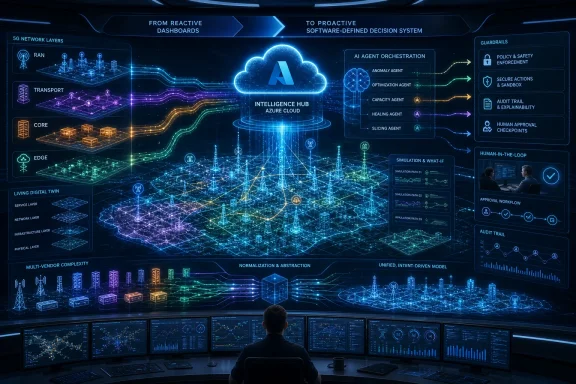
Microsoft and Tech Mahindra expanded their telecom partnership on June 30, 2026, with an AI-driven 5G network digital twin that combines Azure, Microsoft Fabric, Azure Digital Twins, Microsoft Foundry, Fabric IQ, and agentic AI frameworks for operators trying to simulate, predict, and automate network operations. The announcement is not just another partner badge on Microsoft’s cloud wall. It is a wager that the next phase of telecom cloud spending will be won less by hosting network functions and more by owning the operational intelligence around them. For WindowsForum readers, the story matters because it shows Microsoft applying the same enterprise platform logic behind Azure, Fabric, and Foundry to one of the most demanding infrastructure domains on earth.
The telecom industry has spent years talking about cloud-native networks, open RAN, private 5G, edge computing, and network slicing. The results have been uneven, because the hard part was never simply moving workloads into virtual machines or containers. The hard part was turning sprawling, vendor-diverse, real-time infrastructure into something operators can reason about quickly enough to improve service and make money from it.
That is the opening Microsoft is trying to exploit with Tech Mahindra. The new network digital twin is pitched as a live, AI-ready representation of a 5G network, fed by high-volume telemetry and connected to simulation and predictive modeling. In plain English, Microsoft and Tech Mahindra want operators to test what might happen before they touch the production network.
The idea is familiar to anyone who has watched digital twins mature in manufacturing, energy, logistics, and building management. A twin is not merely a dashboard. It is a model of a real environment, usually structured as relationships among assets, states, events, and business rules. In telecom, that means the twin has to understand radio access networks, core network behavior, service quality, customer experience, spectrum, topology, configuration drift, and faults that may not announce themselves politely.
Microsoft’s pitch is that Azure provides the cloud foundation, Fabric provides the data estate, Azure Digital Twins provides the modeling graph, and Foundry provides the AI orchestration layer. Tech Mahindra supplies the telecom domain knowledge, service integration, and operator-facing solution packaging. That division of labor is telling: Microsoft does not want to become a telecom managed services provider in the old sense, but it very much wants to become the default substrate for the data and AI layer that managed services increasingly require.
That is why the digital twin angle matters. A network agent that directly changes live routing, radio parameters, slicing policies, or capacity allocation is both appealing and terrifying. A network agent that first evaluates its proposed action against a model of the network is easier to sell to cautious operators and regulators.
Nvidia made a similar argument at Mobile World Congress this year, emphasizing digital twins as validation environments for AI-led changes before those changes hit production. Microsoft and Tech Mahindra are now wrapping that same logic in Azure and Fabric language. The practical ambition is closed-loop operations: observe the network, reason about the state, simulate possible interventions, act where confidence is high, and feed the outcome back into the model.
That loop is simple to describe and hard to operate. Telemetry is noisy. Vendor systems disagree. Some network failures are social, commercial, or operational rather than purely technical. An outage may begin as a bad software rollout, worsen because of a capacity assumption, and become a business crisis because premium customers are affected first. A useful network twin has to connect those layers without becoming a science project.
This is where Microsoft’s broader enterprise AI strategy surfaces. Foundry is not being presented as a chatbot wrapper. It is being positioned as a place to build, govern, evaluate, and deploy agents that can reason over business context. In telecom, that context is everything.
That matters because hyperscalers have repeatedly learned that telecom is not just another enterprise vertical. Carriers buy slowly, test obsessively, negotiate brutally, and expect systems to operate under regulatory, reliability, and interoperability constraints that most corporate IT environments never face. The cloud provider that thinks a carrier network is merely a distributed application has already lost the room.
Tech Mahindra gives Microsoft a way to translate Azure’s generic platform capabilities into telecom-specific architecture. The earlier March collaboration between the two companies focused on an ontology-driven agentic AI platform for telecom and enterprise data modernization. That was not a throwaway prelude. Ontology work is the unglamorous foundation that lets AI systems understand whether two data points are actually related, whether a metric belongs to a customer, a cell site, a slice, a billing domain, or a fault domain, and whether a proposed action makes sense in context.
The June digital twin announcement builds naturally on that. If the March platform was about giving AI agents a governed semantic foundation, the network twin is about giving those agents a living environment to reason over. The two ideas belong together: without a shared data model, the twin becomes an expensive visualization; without the twin, the agentic platform risks becoming a recommendation engine without operational teeth.
This is also why the term “techco,” awkward as it is, keeps appearing around Tech Mahindra. The company is trying to be seen not merely as a contractor that executes telecom transformation, but as a provider of reusable, platform-like capabilities. Microsoft benefits from that shift because every “techco” offer built on Azure is also an Azure consumption story.
Fabric is Microsoft’s answer to that problem across industries. For telecom, the promise is a real-time data estate that can ingest telemetry, contextualize it, support analytics, and feed AI systems. If Microsoft can make Fabric the place where network, customer, operational, and business data converge, it gains a durable position even when individual AI models, agents, or visualization tools change.
That is the same strategy Microsoft has used repeatedly in enterprise software. Own the identity layer. Own the productivity layer. Own the developer platform. Own the data estate. Then let partners and customers build specialized applications on top. The telecom digital twin fits this pattern neatly.
There is also a practical WindowsForum angle here. Many IT pros know the pain of observability sprawl from enterprise infrastructure: logs in one platform, metrics in another, incident tickets elsewhere, inventory in a CMDB that may or may not reflect reality, and executives asking why the dashboard did not predict the outage. Telecom is that problem at national scale, with stricter uptime expectations and more expensive failure modes.
Fabric gives Microsoft a way to claim that the data mess can be brought under a single governance and analytics umbrella. The risk is that this promise sounds familiar because every data platform vendor has made some version of it. The difference in telecom will be whether the platform can ingest and contextualize live network telemetry fast enough, accurately enough, and cheaply enough to justify the migration.
In traditional operations, monitoring systems tell humans what happened or what might be happening. Automation systems execute predefined responses. Agentic AI tries to occupy the space between them: interpreting signals, selecting actions, coordinating tools, and adapting to outcomes. In a telecom network, that could mean service assurance, anomaly detection, capacity tuning, root-cause analysis, ticket triage, or eventually more direct network optimization.
The problem is that the industry’s vocabulary is racing ahead of its trust model. Operators will not hand over production control simply because a vendor calls an AI “agentic.” They will ask how the agent was evaluated, what data it used, how decisions are logged, who approves actions, how rollback works, and whether the model can explain its reasoning in a way that satisfies auditors and engineers.
Microsoft knows this, which is why governance has become central to Foundry positioning. The earlier Tech Mahindra platform explicitly emphasized explainability, auditability, semantic grounding, and secure deployment of agents. Those are not decorative features. They are the price of admission.
Even then, the first wave of agentic telecom operations is likely to be conservative. Expect recommendation workflows before full autonomy, human-in-the-loop approvals before closed-loop control, and limited-domain agents before anything that touches broad network policy. The marketing may say autonomous. The procurement documents will say controlled, logged, reversible, and measurable.
AWS has leaned heavily into telecom infrastructure partnerships, including work with Nokia around autonomous network operations and 5G-Advanced network slicing. Google Cloud has emphasized data, AI, and telecom APIs, including work around Nokia’s Network-as-Code ecosystem and agentic AI for autonomous network operations. Microsoft, meanwhile, is trying to make its AI-and-data platform story feel inevitable for operators already invested in Azure, Microsoft 365, Dynamics, security tooling, and enterprise identity.
This is the larger shift: hyperscalers are no longer just asking carriers to run workloads on their clouds. They are asking to become part of the carrier’s operational nervous system. That is a much deeper, more strategic, and more politically sensitive role.
For operators, the attraction is obvious. Building this stack alone is expensive. Recruiting enough AI, data engineering, cloud architecture, and telecom-domain talent is difficult. Integrating old OSS/BSS systems with new AI tooling is worse. A joint Microsoft-Tech Mahindra solution offers a packaged path through that complexity.
The danger is equally obvious. Once the telemetry, twin model, AI agents, governance workflows, and operational applications sit inside a hyperscaler-aligned architecture, switching costs rise. Telecom operators have spent years trying to avoid vendor lock-in at the network equipment layer. They may now be recreating it at the data and AI layer.
This competition explains the urgency behind announcements like the Tech Mahindra digital twin. Telecom operators are under pressure to monetize 5G investments that have not always produced the revenue lift vendors promised. Enhanced mobile broadband alone did not transform carrier economics. Enterprise 5G, private networks, network slicing, edge services, and differentiated service assurance remain works in progress.
A network digital twin is attractive because it speaks to both sides of the operator income statement. On the cost side, it promises better automation, fewer outages, faster root-cause analysis, and more efficient planning. On the revenue side, it promises confidence in advanced services: if an operator can simulate and assure a slice, enterprise SLA, or private network configuration, it can sell that service more credibly.
But “monetization” is doing a lot of work here. Operators cannot monetize a twin directly. They monetize better services, faster provisioning, lower churn, stronger enterprise guarantees, and fewer operational failures. The twin is infrastructure for those outcomes, not the outcome itself.
That distinction matters because telecom has a habit of turning enabling technologies into business fantasies. 5G was going to unlock everything. Edge was going to become a vast new distributed cloud. Open RAN was going to reset vendor economics overnight. Some of these shifts are real, but all of them have moved slower and messier than their best conference-stage versions.
That is why the ontology piece is so important. Telecom systems are full of overlapping vocabularies. A “customer,” “service,” “site,” “slice,” “cell,” “incident,” or “degradation” can mean different things depending on whether the speaker comes from network engineering, customer care, billing, enterprise sales, or security. AI systems trained on raw enterprise data inherit that confusion unless the data is modeled with discipline.
Azure Digital Twins brings a graph-based approach to representing environments and relationships. Fabric brings the data platform. Foundry brings the AI development and governance layer. But none of those removes the need for painstaking integration work. A telecom digital twin is only as good as the quality, freshness, and semantic coherence of the systems feeding it.
There is also the question of simulation fidelity. A model that can predict the impact of a configuration change in one part of the network may not predict customer experience under unexpected load, weather disruption, device diversity, roaming behavior, or vendor-specific quirks. Simulation is useful precisely because production is dangerous, but simulation becomes dangerous if executives treat it as prophecy.
The best operators will use digital twins as decision-support systems before treating them as control systems. They will measure whether recommendations improve outcomes. They will compare simulated results with production outcomes. They will keep humans in the approval chain for high-risk actions until the evidence justifies otherwise.
That is the same broad arc behind Microsoft’s security strategy, endpoint management strategy, Copilot strategy, and Azure observability strategy. First comes visibility. Then comes recommendation. Then comes automation. Then comes agentic action, wrapped in policy and governance.
Telecom networks are simply a higher-stakes version of that story. If Microsoft can persuade carriers that Foundry-backed agents can reason safely across live network environments, the argument becomes easier in less specialized enterprise infrastructure. Conversely, if telecom operators remain cautious, that caution will be a useful reality check for the broader AI-agent boom.
There is a lesson here for enterprise IT teams evaluating agentic AI in their own environments. The impressive demo is not the system. The system is the data model, the governance workflow, the rollback plan, the access controls, the audit trail, and the operational metrics that prove automation is helping rather than merely acting.
Microsoft and Tech Mahindra are selling a future where AI agents do not just summarize logs but participate in operations. That future may arrive. It will arrive first in constrained domains where the blast radius is understood, the data foundation is clean, and the business case is obvious.
This is where Microsoft has an advantage. The company’s enterprise muscle is built around identity, compliance, policy, security, and management. It understands how to sell control to organizations that are frightened of both chaos and lock-in. In telecom, that language resonates.
AWS and Google Cloud are not weak here, but Microsoft’s installed base in enterprise software gives it a different route into carrier organizations. A telecom operator is also a large enterprise with employees, devices, directories, compliance obligations, developers, security teams, and data estates. Microsoft can connect the network operations story to the broader enterprise stack in a way that feels less like a standalone bet.
The danger for Microsoft is overpackaging. The more the company threads together Azure, Fabric, Foundry, Digital Twins, Fabric IQ, Work IQ, governance frameworks, and partner IP, the more buyers may wonder whether they are purchasing an architecture or a vocabulary. Microsoft’s platform story is powerful, but it is also sprawling.
Tech Mahindra’s job is to make that sprawl feel like an implementable telecom solution. If it can do that, Microsoft gets a stronger telco beachhead. If it cannot, the announcement becomes another entry in the industry’s long catalog of intelligent-network promises.
That is where network digital twins either become operationally valuable or dissolve into dashboard theater. Telecom engineering culture is skeptical for good reasons. Networks fail in ways that embarrass confident abstractions. Anyone who has managed large infrastructure knows that the map is useful, but the territory still wins arguments.
The strongest version of Microsoft and Tech Mahindra’s pitch is not that AI will replace network engineers. It is that engineers need better instruments for networks that have become too complex for passive monitoring and manual correlation. If the twin helps humans make faster, safer decisions, it earns its place. If it tries to leap directly to autonomy without trust, it will meet resistance.
That resistance should not be dismissed as Luddism. It is operational memory. Every admin, network engineer, and SRE has seen automation amplify a bad assumption. The promise of agentic AI must be judged against that history.
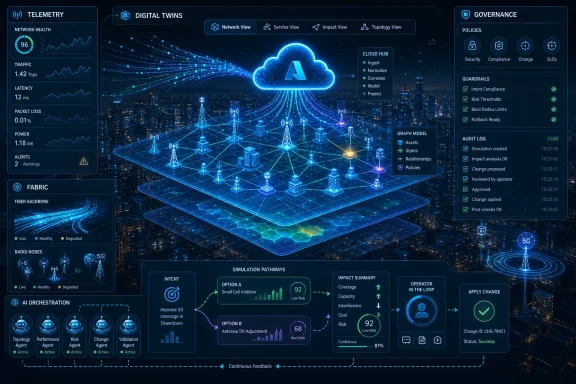 Microsoft Is Selling the Brain Around the Network
The telecom industry has spent years talking about cloud-native networks, open RAN, private 5G, edge computing, and network slicing. The results have been uneven, because the hard part was never simply moving workloads into virtual machines or containers. The hard part was turning sprawling, vendor-diverse, real-time infrastructure into something operators can reason about quickly enough to improve service and make money from it.That is the opening Microsoft is trying to exploit with Tech Mahindra. The new network digital twin is pitched as a live, AI-ready representation of a 5G network, fed by high-volume telemetry and connected to simulation and predictive modeling. In plain English, Microsoft and Tech Mahindra want operators to test what might happen before they touch the production network.
The idea is familiar to anyone who has watched digital twins mature in manufacturing, energy, logistics, and building management. A twin is not merely a dashboard. It is a model of a real environment, usually structured as relationships among assets, states, events, and business rules. In telecom, that means the twin has to understand radio access networks, core network behavior, service quality, customer experience, spectrum, topology, configuration drift, and faults that may not announce themselves politely.
Microsoft’s pitch is that Azure provides the cloud foundation, Fabric provides the data estate, Azure Digital Twins provides the modeling graph, and Foundry provides the AI orchestration layer. Tech Mahindra supplies the telecom domain knowledge, service integration, and operator-facing solution packaging. That division of labor is telling: Microsoft does not want to become a telecom managed services provider in the old sense, but it very much wants to become the default substrate for the data and AI layer that managed services increasingly require.
Digital Twins Have Become the New Safe Word for Autonomous Networks
The phrase autonomous network has been overused enough to deserve suspicion. Operators have heard promises about self-healing infrastructure for decades, often from vendors whose automation worked beautifully inside a slide deck and less beautifully across live, messy networks. What is different now is not that AI agents have magical judgment. It is that a digital twin gives those agents a safer place to make mistakes.That is why the digital twin angle matters. A network agent that directly changes live routing, radio parameters, slicing policies, or capacity allocation is both appealing and terrifying. A network agent that first evaluates its proposed action against a model of the network is easier to sell to cautious operators and regulators.
Nvidia made a similar argument at Mobile World Congress this year, emphasizing digital twins as validation environments for AI-led changes before those changes hit production. Microsoft and Tech Mahindra are now wrapping that same logic in Azure and Fabric language. The practical ambition is closed-loop operations: observe the network, reason about the state, simulate possible interventions, act where confidence is high, and feed the outcome back into the model.
That loop is simple to describe and hard to operate. Telemetry is noisy. Vendor systems disagree. Some network failures are social, commercial, or operational rather than purely technical. An outage may begin as a bad software rollout, worsen because of a capacity assumption, and become a business crisis because premium customers are affected first. A useful network twin has to connect those layers without becoming a science project.
This is where Microsoft’s broader enterprise AI strategy surfaces. Foundry is not being presented as a chatbot wrapper. It is being positioned as a place to build, govern, evaluate, and deploy agents that can reason over business context. In telecom, that context is everything.
Tech Mahindra Gives Microsoft a Telecom Shortcut It Cannot Build Overnight
Tech Mahindra is not a random consulting partner in this story. The company’s roots are deeply tied to telecom, and its customer list has long included major operators and communications providers. Even when the company is described as an IT services firm, telecom is one of the sectors where that description understates its operational footprint.That matters because hyperscalers have repeatedly learned that telecom is not just another enterprise vertical. Carriers buy slowly, test obsessively, negotiate brutally, and expect systems to operate under regulatory, reliability, and interoperability constraints that most corporate IT environments never face. The cloud provider that thinks a carrier network is merely a distributed application has already lost the room.
Tech Mahindra gives Microsoft a way to translate Azure’s generic platform capabilities into telecom-specific architecture. The earlier March collaboration between the two companies focused on an ontology-driven agentic AI platform for telecom and enterprise data modernization. That was not a throwaway prelude. Ontology work is the unglamorous foundation that lets AI systems understand whether two data points are actually related, whether a metric belongs to a customer, a cell site, a slice, a billing domain, or a fault domain, and whether a proposed action makes sense in context.
The June digital twin announcement builds naturally on that. If the March platform was about giving AI agents a governed semantic foundation, the network twin is about giving those agents a living environment to reason over. The two ideas belong together: without a shared data model, the twin becomes an expensive visualization; without the twin, the agentic platform risks becoming a recommendation engine without operational teeth.
This is also why the term “techco,” awkward as it is, keeps appearing around Tech Mahindra. The company is trying to be seen not merely as a contractor that executes telecom transformation, but as a provider of reusable, platform-like capabilities. Microsoft benefits from that shift because every “techco” offer built on Azure is also an Azure consumption story.
Fabric Is the Quiet Center of the Announcement
The headline words are digital twin and agentic AI, but Microsoft Fabric may be the more important part of the stack. Telecom operators do not lack data. They lack unified, governed, usable data that can be queried, modeled, and operationalized without sending every team into its own integration swamp.Fabric is Microsoft’s answer to that problem across industries. For telecom, the promise is a real-time data estate that can ingest telemetry, contextualize it, support analytics, and feed AI systems. If Microsoft can make Fabric the place where network, customer, operational, and business data converge, it gains a durable position even when individual AI models, agents, or visualization tools change.
That is the same strategy Microsoft has used repeatedly in enterprise software. Own the identity layer. Own the productivity layer. Own the developer platform. Own the data estate. Then let partners and customers build specialized applications on top. The telecom digital twin fits this pattern neatly.
There is also a practical WindowsForum angle here. Many IT pros know the pain of observability sprawl from enterprise infrastructure: logs in one platform, metrics in another, incident tickets elsewhere, inventory in a CMDB that may or may not reflect reality, and executives asking why the dashboard did not predict the outage. Telecom is that problem at national scale, with stricter uptime expectations and more expensive failure modes.
Fabric gives Microsoft a way to claim that the data mess can be brought under a single governance and analytics umbrella. The risk is that this promise sounds familiar because every data platform vendor has made some version of it. The difference in telecom will be whether the platform can ingest and contextualize live network telemetry fast enough, accurately enough, and cheaply enough to justify the migration.
Agentic AI Is Being Rebranded as Operational Control
The most aggressive part of Microsoft and Tech Mahindra’s language is not “AI-ready data estate” or “predictive modeling.” It is the claim that operators can move from passive monitoring to active, intelligent decisioning. That is the boundary line between analytics and control.In traditional operations, monitoring systems tell humans what happened or what might be happening. Automation systems execute predefined responses. Agentic AI tries to occupy the space between them: interpreting signals, selecting actions, coordinating tools, and adapting to outcomes. In a telecom network, that could mean service assurance, anomaly detection, capacity tuning, root-cause analysis, ticket triage, or eventually more direct network optimization.
The problem is that the industry’s vocabulary is racing ahead of its trust model. Operators will not hand over production control simply because a vendor calls an AI “agentic.” They will ask how the agent was evaluated, what data it used, how decisions are logged, who approves actions, how rollback works, and whether the model can explain its reasoning in a way that satisfies auditors and engineers.
Microsoft knows this, which is why governance has become central to Foundry positioning. The earlier Tech Mahindra platform explicitly emphasized explainability, auditability, semantic grounding, and secure deployment of agents. Those are not decorative features. They are the price of admission.
Even then, the first wave of agentic telecom operations is likely to be conservative. Expect recommendation workflows before full autonomy, human-in-the-loop approvals before closed-loop control, and limited-domain agents before anything that touches broad network policy. The marketing may say autonomous. The procurement documents will say controlled, logged, reversible, and measurable.
The Hyperscaler Fight Has Moved Beyond Hosting the Core
Microsoft is not operating in a vacuum. AWS and Google Cloud have both been pushing hard into telecom, and their strategies increasingly sound similar at a high level: combine cloud infrastructure, AI, data platforms, network automation, and partner ecosystems. The differences are in emphasis, existing customer relationships, and how each hyperscaler packages telecom credibility.AWS has leaned heavily into telecom infrastructure partnerships, including work with Nokia around autonomous network operations and 5G-Advanced network slicing. Google Cloud has emphasized data, AI, and telecom APIs, including work around Nokia’s Network-as-Code ecosystem and agentic AI for autonomous network operations. Microsoft, meanwhile, is trying to make its AI-and-data platform story feel inevitable for operators already invested in Azure, Microsoft 365, Dynamics, security tooling, and enterprise identity.
This is the larger shift: hyperscalers are no longer just asking carriers to run workloads on their clouds. They are asking to become part of the carrier’s operational nervous system. That is a much deeper, more strategic, and more politically sensitive role.
For operators, the attraction is obvious. Building this stack alone is expensive. Recruiting enough AI, data engineering, cloud architecture, and telecom-domain talent is difficult. Integrating old OSS/BSS systems with new AI tooling is worse. A joint Microsoft-Tech Mahindra solution offers a packaged path through that complexity.
The danger is equally obvious. Once the telemetry, twin model, AI agents, governance workflows, and operational applications sit inside a hyperscaler-aligned architecture, switching costs rise. Telecom operators have spent years trying to avoid vendor lock-in at the network equipment layer. They may now be recreating it at the data and AI layer.
The Economics Are as Important as the Engineering
The SDxCentral report cites analyst estimates placing 2025 hyperscale telecom revenues at roughly $4.2 billion for Amazon, $3.85 billion for Microsoft, and $3 billion for Alphabet. Whether those numbers are exact or directional, the ranking is less interesting than the convergence. Google appears to be closing ground, Microsoft is defending a large enterprise position, and AWS remains formidable.This competition explains the urgency behind announcements like the Tech Mahindra digital twin. Telecom operators are under pressure to monetize 5G investments that have not always produced the revenue lift vendors promised. Enhanced mobile broadband alone did not transform carrier economics. Enterprise 5G, private networks, network slicing, edge services, and differentiated service assurance remain works in progress.
A network digital twin is attractive because it speaks to both sides of the operator income statement. On the cost side, it promises better automation, fewer outages, faster root-cause analysis, and more efficient planning. On the revenue side, it promises confidence in advanced services: if an operator can simulate and assure a slice, enterprise SLA, or private network configuration, it can sell that service more credibly.
But “monetization” is doing a lot of work here. Operators cannot monetize a twin directly. They monetize better services, faster provisioning, lower churn, stronger enterprise guarantees, and fewer operational failures. The twin is infrastructure for those outcomes, not the outcome itself.
That distinction matters because telecom has a habit of turning enabling technologies into business fantasies. 5G was going to unlock everything. Edge was going to become a vast new distributed cloud. Open RAN was going to reset vendor economics overnight. Some of these shifts are real, but all of them have moved slower and messier than their best conference-stage versions.
The Hardest Twin to Build Is the One Operators Actually Need
A useful network digital twin must be more than a pretty 3D map of towers and fiber routes. It must represent dynamic state, not just static assets. It must understand relationships across domains that are often managed by different teams, tools, and vendors. It must tolerate incomplete data and still produce useful recommendations without hallucinating certainty.That is why the ontology piece is so important. Telecom systems are full of overlapping vocabularies. A “customer,” “service,” “site,” “slice,” “cell,” “incident,” or “degradation” can mean different things depending on whether the speaker comes from network engineering, customer care, billing, enterprise sales, or security. AI systems trained on raw enterprise data inherit that confusion unless the data is modeled with discipline.
Azure Digital Twins brings a graph-based approach to representing environments and relationships. Fabric brings the data platform. Foundry brings the AI development and governance layer. But none of those removes the need for painstaking integration work. A telecom digital twin is only as good as the quality, freshness, and semantic coherence of the systems feeding it.
There is also the question of simulation fidelity. A model that can predict the impact of a configuration change in one part of the network may not predict customer experience under unexpected load, weather disruption, device diversity, roaming behavior, or vendor-specific quirks. Simulation is useful precisely because production is dangerous, but simulation becomes dangerous if executives treat it as prophecy.
The best operators will use digital twins as decision-support systems before treating them as control systems. They will measure whether recommendations improve outcomes. They will compare simulated results with production outcomes. They will keep humans in the approval chain for high-risk actions until the evidence justifies otherwise.
Windows Admins Should Recognize the Pattern
This may sound far removed from the day-to-day work of Windows admins, but the architectural pattern is familiar. Microsoft is taking data from messy operational environments, normalizing it into a governed platform, adding AI tooling, and asking customers to trust the resulting system with more consequential decisions over time.That is the same broad arc behind Microsoft’s security strategy, endpoint management strategy, Copilot strategy, and Azure observability strategy. First comes visibility. Then comes recommendation. Then comes automation. Then comes agentic action, wrapped in policy and governance.
Telecom networks are simply a higher-stakes version of that story. If Microsoft can persuade carriers that Foundry-backed agents can reason safely across live network environments, the argument becomes easier in less specialized enterprise infrastructure. Conversely, if telecom operators remain cautious, that caution will be a useful reality check for the broader AI-agent boom.
There is a lesson here for enterprise IT teams evaluating agentic AI in their own environments. The impressive demo is not the system. The system is the data model, the governance workflow, the rollback plan, the access controls, the audit trail, and the operational metrics that prove automation is helping rather than merely acting.
Microsoft and Tech Mahindra are selling a future where AI agents do not just summarize logs but participate in operations. That future may arrive. It will arrive first in constrained domains where the blast radius is understood, the data foundation is clean, and the business case is obvious.
The Telecom Cloud War Is Becoming a Governance War
The more AI touches operations, the more governance becomes the product. That may sound dull, but it is the heart of the matter. Telecom operators do not merely need smarter agents; they need agents they can permit, restrict, inspect, and blame.This is where Microsoft has an advantage. The company’s enterprise muscle is built around identity, compliance, policy, security, and management. It understands how to sell control to organizations that are frightened of both chaos and lock-in. In telecom, that language resonates.
AWS and Google Cloud are not weak here, but Microsoft’s installed base in enterprise software gives it a different route into carrier organizations. A telecom operator is also a large enterprise with employees, devices, directories, compliance obligations, developers, security teams, and data estates. Microsoft can connect the network operations story to the broader enterprise stack in a way that feels less like a standalone bet.
The danger for Microsoft is overpackaging. The more the company threads together Azure, Fabric, Foundry, Digital Twins, Fabric IQ, Work IQ, governance frameworks, and partner IP, the more buyers may wonder whether they are purchasing an architecture or a vocabulary. Microsoft’s platform story is powerful, but it is also sprawling.
Tech Mahindra’s job is to make that sprawl feel like an implementable telecom solution. If it can do that, Microsoft gets a stronger telco beachhead. If it cannot, the announcement becomes another entry in the industry’s long catalog of intelligent-network promises.
The Real Test Will Be in the Change Window
The only honest way to judge this kind of platform is to watch what happens during a real operational change. Can the twin ingest current conditions? Can it model the proposed action? Can the agent explain the risk? Can the operator approve, modify, or reject the recommendation? Can the system monitor the outcome and roll back if reality diverges from simulation?That is where network digital twins either become operationally valuable or dissolve into dashboard theater. Telecom engineering culture is skeptical for good reasons. Networks fail in ways that embarrass confident abstractions. Anyone who has managed large infrastructure knows that the map is useful, but the territory still wins arguments.
The strongest version of Microsoft and Tech Mahindra’s pitch is not that AI will replace network engineers. It is that engineers need better instruments for networks that have become too complex for passive monitoring and manual correlation. If the twin helps humans make faster, safer decisions, it earns its place. If it tries to leap directly to autonomy without trust, it will meet resistance.
That resistance should not be dismissed as Luddism. It is operational memory. Every admin, network engineer, and SRE has seen automation amplify a bad assumption. The promise of agentic AI must be judged against that history.
The Signal Inside Microsoft’s Telecom Twin Push
Microsoft and Tech Mahindra’s announcement is less about one product launch than about where telecom cloud value is migrating. The money is moving toward data, simulation, AI governance, and operational control.- Microsoft and Tech Mahindra are extending a March 2026 agentic AI telecom data partnership into a June 2026 network digital twin aimed at 5G operations.
- The solution combines Azure, Microsoft Fabric, Azure Digital Twins, Microsoft Foundry, Fabric IQ, and agentic AI frameworks into a telecom-specific operational platform.
- The immediate promise is safer simulation and predictive modeling, not blanket replacement of network engineers.
- The competitive context is a three-way hyperscaler fight in which AWS, Microsoft, and Google Cloud are all trying to own more of the telecom automation layer.
- The biggest implementation risks are data quality, ontology discipline, simulation fidelity, governance, and hyperscaler lock-in.
- The practical test will be whether operators can use the twin to improve real change windows, incident response, service assurance, and 5G monetization.
References
- Primary source: SDxCentral
Published: Wed, 01 Jul 2026 11:21:22 GMT
Microsoft expands 'techco' reach with digital twins - SDxCentral
Telco collaboration powered by Tech Mahindrawww.sdxcentral.com - Related coverage: techmahindra.com
Tech Mahindra, Microsoft Launch Ontology-Driven Agentic AI
Tech Mahindra and Microsoft unveil an ontology-driven Agentic AI platform to accelerate telecom and data mesh transformation with explainable, secure AIwww.techmahindra.com
- Related coverage: telecoms.com
Tech Mahindra, Microsoft deliver AI digital twins for 5G networks
Tech Mahindra partners with Microsoft to deliver AI capabilities with a new digital twin tool for faster 5G monetisation and better service performance.www.telecoms.com - Official source: marketplace.microsoft.com
Telecom Digital Twins: Network Language Model for Diagnostic and Resolution
<p>Tech Mahindra's Telecom digital twin, powered by Nvidia and Azure, offers AI-driven 3D modeling and real-time analytics for telecom infrastructure, network planning, and operations</p>marketplace.microsoft.com
- Official source: blogs.microsoft.com
Microsoft at NVIDIA GTC: New solutions for Microsoft Foundry, Azure AI infrastructure and Physical AI - The Official Microsoft Blog
Microsoft combines accelerated computing with cloud scale engineering to bring advanced AI capabilities to our customers. For years, we’ve worked with NVIDIA to integrate hardware, software and infrastructure to power many of today’s most important AI breakthroughs. What’s new at NVIDIA GTC...blogs.microsoft.com - Related coverage: prnewswire.com
Tech Mahindra Partners with Microsoft to Advance Telecom Modernization with AI-Driven 5G Network Digital Twin
/PRNewswire/ -- Tech Mahindra (NSE: TECHM), a leading global provider of technology consulting and digital solutions to enterprises across industries,... www.prnewswire.com
- Official source: microsoft.com
MWC 2026: Microsoft Helps Telecoms Realize AI ROI | The Microsoft Cloud Blog
At MWC 2026, Microsoft shares new AI investments enabling telecoms to move from pilots to real return on intelligence. Read more. www.microsoft.com
- Related coverage: techtrendske.co.ke
Tech Mahindra, Microsoft Launch AI Network Digital Twin - TechTrendsKE
Tech Mahindra and Microsoft unveil an AI-powered Network Digital Twin platform to help telecom operators automate networks and accelerate 5G services.techtrendske.co.ke - Related coverage: convergence-now.com
Tech Mahindra and Microsoft Launch Agentic AI Platform to Transform Telecom Data Systems
Tech Mahindra partners with Microsoft to launch an ontology-driven agentic AI platform aimed at helping telecom operators modernise networks, unify data systems and accelerate digital transformation.www.convergence-now.com - Related coverage: techcircle.in
TechM, Microsoft to build agentic AI platform for telcos
IT services firm Tech Mahindra on Thursday announced a collaboration with Microsoft to launch an ontology-driven agentic AI platform aimed at accelerating...www.techcircle.in - Related coverage: msp-channel.com
Tech Mahindra and Microsoft introduce AI platform for telecom data
Tech Mahindra partners with Microsoft to launch an AI platform for telecoms, aiming to enhance data insights and operational efficiency.www.msp-channel.com - Related coverage: forgeup.in
Tech Mahindra & Microsoft Agentic AI to Revolutionize Telecom
Tech Mahindra and Microsoft unveil Agentic AI Telecom platform driving Data Mesh automation and smarter real-time decisions for telcos.forgeup.in