

MCBS, LLC, a medical billing support company in Augusta, Georgia, is notifying some patients connected to Stephen W. Brown & Radiology Associates of Augusta after a September 2025 network intrusion may have exposed personal, insurance, and medical information, according to WRDW/WAGT reporting published July 2, 2026. The incident is not remarkable because it is unusual; it is remarkable because it is now ordinary. A local radiology practice, a billing vendor, a months-long forensic review, mailed notices, and a year of identity monitoring have become the standard choreography of modern health-care compromise.
The uncomfortable lesson for patients and IT departments is that the most consequential breach may not happen inside the doctor’s office at all. It may happen in the billing stack, the revenue-cycle vendor, the claims processor, the outsourced workflow that no patient chose but every patient depends on. In health care, the attack surface is no longer the hospital network; it is the business model.
WRDW/WAGT’s account is narrowly local: patients tied to Stephen W. Brown & Radiology Associates of Augusta are receiving letters from MCBS, which says it obtained patient information from the radiology practice to provide medical billing services. The letter says MCBS learned on or about September 25, 2025, that an unauthorized individual may have accessed its network.
The timeline matters. According to the notice described by WRDW/WAGT, the potentially unauthorized acquisition occurred during a window of approximately September 22 through September 26, 2025. MCBS then conducted what it described as an extensive forensic investigation and document review, ultimately determining around May 28, 2026, that files containing personal information may have been affected.
That is roughly eight months between discovery of suspicious access and identification of the affected files. That delay does not automatically mean negligence; large-scale document review in health care is slow, expensive, and legally sensitive. But from the patient’s point of view, the nuance is cold comfort. If your Social Security number, diagnosis information, or insurance identifiers were in the wrong file at the wrong time, the risk clock started in September 2025, not when the letter arrived in the summer of 2026.
The incident also lands in a sector where breach fatigue is now a governance problem. Patients have been trained to expect the same formula: a notice letter, a statement that misuse has not been detected, a recommendation to monitor accounts, and a limited identity protection offer. The repetition dulls the emotional impact, but it should sharpen the policy question. If the same notice template appears after incident after incident, maybe the notice is not the remedy.
Modern medical billing requires a dense flow of identifiers: patient names, dates of birth, addresses, insurance policy numbers, subscriber IDs, health plan beneficiary numbers, diagnosis codes, treatment information, and sometimes Social Security numbers. The data exists because providers need to get paid, insurers need to adjudicate claims, and patients need statements that match the care they received. But the same information that makes the payment system work also creates a concentrated target.
A radiology practice may think of itself as an imaging provider. Its patients may think of it as a place where X-rays, CT scans, mammograms, or MRIs are interpreted. Attackers see something else: an ecosystem of vendors holding medically rich identity data, often in formats that are difficult to segment, encrypt, delete, or audit cleanly.
That is why third-party compromise has become such a persistent feature of health-care cybersecurity. A vendor does not need to provide direct clinical care to hold clinically sensitive data. In fact, billing vendors can be especially attractive because they sit at the intersection of identity, insurance, finance, and diagnosis. A hospital chart may describe your care; a billing file may connect that care to the identifiers needed to impersonate you.
The industry phrase is business associate, but that term understates the dependency. These vendors are not peripheral. They are part of the care delivery machine, even when patients never see their names until something goes wrong.
A stolen credit card can be canceled. A Social Security number cannot be meaningfully replaced. A diagnosis cannot be made untrue. A medical history, once copied outside the institution that collected it, becomes durable in a way most consumer secrets do not.
The inclusion of mental or physical condition information is especially sensitive. Health data can be used for embarrassment, coercion, targeted scams, insurance fraud, and deeply personal inference. Even if no misuse has been detected, affected patients are being asked to live with uncertainty about information that may be intimate, stigmatizing, or financially exploitable.
This is where the language of breach notification becomes too sterile. “Potentially impacted” is legally careful, and sometimes it is the only defensible wording when forensic evidence cannot prove which files were taken or read. But patients do not experience “potential impact” as a legal category. They experience it as a durable doubt: who has this, what will they do with it, and when will I find out?
In practice, that pipeline creates a widening gap between technical compromise and patient awareness. During that period, patients cannot freeze credit in response to a breach they do not know about. They cannot scrutinize Explanation of Benefits statements with the urgency of a known exposure. They cannot decide whether to change account credentials, watch for medical identity theft, or alert elderly relatives who may be more vulnerable to follow-on scams.
The health-care sector often defends long timelines by pointing to the difficulty of determining exactly whose information was involved. That defense is not frivolous. Unstructured file stores, legacy billing exports, scanned documents, spreadsheets, and mixed client data can make breach scoping brutally difficult.
But that explanation also indicts the architecture. If it takes eight months to determine what sensitive data may have been exposed, then the organization did not merely have an intrusion problem. It had a data governance problem. The incident response was slow because the data environment was hard to understand.
For Windows admins and security teams, that is the part worth underlining. The breach investigation does not begin when an attacker enters the network. It begins years earlier, when file shares are created, permissions are inherited, old exports are retained, service accounts are overprivileged, and no one budgets for data minimization because storage is cheap.
“No evidence of misuse” does not mean the data was not accessed. It does not mean the data was not copied. It does not mean the data will not be used later. It means the organization has not observed or confirmed misuse connected to the incident at the time of the notice.
That distinction matters because medical and identity data can have a long afterlife. Criminal use does not always appear immediately after a breach. Data can be bundled, sold, merged with other leaks, held for future fraud, or used in targeted phishing that is difficult to attribute back to a particular incident.
The phrase also reflects an asymmetry. Organizations can say what they know; patients have to manage what nobody knows. A clean misuse statement may reduce panic, but it should not reduce vigilance.
This is not an argument that every breach notice should sound like an alarm siren. It is an argument that breach language should not anesthetize risk. When the exposed categories include Social Security numbers, insurance identifiers, diagnosis information, and treatment history, the practical advice should be more forceful than “keep an eye on things.”
Identity monitoring can alert a person to certain kinds of misuse after the fact. It may help detect new credit activity or identity-related anomalies. It does not prevent medical identity theft, erase stolen files, remove data from criminal marketplaces, or protect against scams that exploit knowledge of a patient’s health history.
The one-year duration is also awkwardly mismatched to the lifespan of the data. A diagnosis does not expire after 12 months. A Social Security number does not become safe in month 13. Insurance identifiers may change, but the combination of name, date of birth, address, medical context, and historical policy information remains valuable.
This is one of the central absurdities of the breach economy: the victim receives a time-limited service for a time-unlimited exposure. The offer is not meaningless, but it is structurally inadequate.
Patients should still enroll if they receive a legitimate notice. They should also consider a credit freeze, review medical statements, scrutinize Explanation of Benefits documents, and treat unexpected billing or insurance communications with suspicion. The monitoring service is one tool. It is not the perimeter.
Some of the answer is operational necessity. Billing vendors need enough information to submit claims, resolve denials, post payments, and handle patient accounts. But “needed for business” too often becomes “retained indefinitely,” “stored broadly,” and “available to more systems than necessary.”
Data minimization is easy to endorse and hard to implement. It requires knowing where sensitive data lives, why it exists, who can access it, how long it should be retained, and whether it can be tokenized, segmented, encrypted, archived, or deleted. Those are not glamorous security projects. They do not demo well in board meetings. They are, however, the difference between an intrusion and a catastrophe.
For Windows-heavy environments, the boring controls matter: least-privilege access to file shares, modern authentication, endpoint detection, audited administrative actions, protected backups, restricted service accounts, conditional access, and aggressive review of stale data repositories. Attackers often succeed not because organizations lack security products, but because sensitive data is spread across ordinary systems with extraordinary permissions.
Health-care organizations also need to stop treating vendor security questionnaires as ritual paperwork. If a billing vendor holds protected health information, the provider’s risk does not end at the contract signature. It extends into the vendor’s logging, segmentation, backup practices, access reviews, incident response maturity, and ability to answer a brutal question quickly: exactly whose data was exposed?
A patient who receives this letter must now become a part-time fraud analyst. They must distinguish legitimate medical bills from suspicious ones, watch insurance statements for unfamiliar services, understand the difference between a fraud alert and a credit freeze, and decide whether a future scam call is connected to the breach. Elderly patients, patients with complex medical histories, and patients with limited digital access face a heavier burden.
Medical identity theft is particularly unpleasant because the correction process can be more complicated than credit-card fraud. False claims, incorrect records, and insurance confusion can bleed into care delivery. A fraudulent financial account is bad; a corrupted medical record can be dangerous.
There is also a psychological cost. Radiology is often tied to moments of anxiety: a scan after symptoms, a cancer screening, a follow-up after treatment, a test ordered because something might be wrong. To have billing data from that experience become part of a security incident adds a second layer of vulnerability to an already vulnerable transaction.
The patient did not choose MCBS. The patient may not have known MCBS existed. Yet the patient now receives the letter and carries the risk.
That is where many organizations still struggle. They buy detection tools but do not tune them. They create incident response plans but do not exercise them. They encrypt laptops but leave network shares sprawling. They require multifactor authentication for email but overlook legacy remote access paths, vendor portals, and administrative consoles.
The MCBS incident, as described publicly, does not disclose the attack method. There is no confirmed ransomware group in the WRDW/WAGT account, no public technical indicators, and no detailed description of the vulnerability used. That limits what can be said about the specific intrusion.
But the broader defensive lessons are clear enough. Health-care vendors handling PHI need identity-centric security, aggressive logging, immutable backups, network segmentation, tested restoration plans, and disciplined data retention. They also need tabletop exercises that assume the worst: a threat actor had access, files may have been copied, and the company must identify affected individuals under legal and public pressure.
The goal is not a fantasy of perfect prevention. The goal is blast-radius reduction. If an attacker gets in, they should not get everything. If they touch one client’s data, they should not automatically touch every client’s data. If they access a file server, the organization should know what was there without hiring an army of reviewers for half a year.
The public often talks about privacy as if it is an individual choice: read the policy, manage your settings, opt out where possible. That model collapses in health care. Patients cannot meaningfully opt out of the billing infrastructure attached to their care. They cannot negotiate a different claims processor at the imaging center desk. They cannot inspect the vendor’s security controls before scheduling a scan.
That makes institutional accountability more important, not less. Providers should be able to explain why a vendor needs specific categories of data, how long that data is retained, how it is protected, and what happens when the relationship ends. Vendors should be able to show that security is not merely certified once and forgotten, but continuously tested against real-world attack paths.
Regulators, insurers, and large provider networks will likely push this harder over time. Cyber insurance questionnaires are already more demanding. Health-care contracts increasingly scrutinize security obligations. But the incentives remain uneven. The cost of better data governance is immediate and internal; the harm of exposure is distributed across patients who did not design the system.
That is why breach notices keep feeling both serious and strangely consequence-free. The patient absorbs risk. The organization offers monitoring. The market moves on.
That does not mean Stephen W. Brown & Radiology Associates of Augusta caused the incident. The public reporting identifies MCBS as the company notifying patients and describing the network security incident. But in the patient’s mind, the care relationship and the billing relationship are bundled.
This is why vendor risk management is not merely a compliance function. It is part of patient trust. Practices that outsource billing, transcription, imaging workflows, records processing, or revenue-cycle management are still accountable to patients for the ecosystem they choose.
That accountability should be practical. Providers should demand breach notification timelines in contracts, require evidence of security controls, review independent assessments, and ensure data return or destruction procedures are real. They should also ask whether vendors can segregate client data well enough to avoid turning one compromise into a multi-practice event.
Small and midsize practices face a difficult reality: they often outsource precisely because they lack the scale to manage complex billing operations themselves. But that makes vendor selection more consequential, not less. Outsourcing work does not outsource patient concern.
A credit freeze is one of the strongest steps for preventing new-account fraud, though it does not stop all forms of identity misuse. A fraud alert can add friction when creditors verify identity. Reviewing Explanation of Benefits statements can help detect medical services billed in a patient’s name. Patients should also be skeptical of calls, texts, or emails that reference medical care, insurance, billing balances, or “verification” of personal information.
The scam risk is worth emphasizing. Breached health data can make phishing more believable. A criminal who knows a patient’s provider, insurer, or type of care may craft a message that feels legitimate. That is especially dangerous for older patients and for families managing care on behalf of relatives.
Patients should use known phone numbers from official provider or insurer materials rather than numbers supplied in unexpected messages. They should avoid giving Social Security numbers, insurance IDs, or payment information to inbound callers. If a bill looks unfamiliar, they should verify it independently before paying.
The health-care industry often frames these steps as common-sense precautions. But common sense depends on context, and many patients only learn the rules after the breach. Notices should be written less like liability documents and more like usable survival guides.
That timeline is the article’s real payload. It shows how an incident can move from technical event to legal review to patient notification across months. It shows why detection alone is insufficient. It shows why file-level visibility and data inventory are not bureaucratic luxuries.
For WindowsForum.com readers, the lesson is familiar but urgent. Directory permissions, endpoint telemetry, identity logs, backup integrity, data classification, and retention policies are not separate chores. They are the machinery that determines whether a breach is containable, explainable, and survivable.
The MCBS notice also reminds us that local incidents are not small incidents to the people inside them. A breach tied to a regional radiology practice may not command national headlines, but the affected patient still faces the same risks as someone caught in a giant hospital-system compromise. Scale matters to regulators and reporters; sensitivity matters to victims.
For providers and vendors, the incident should prompt a harder internal review. Not a performative review that produces another policy binder, but a technical accounting of where patient data resides, who can access it, and how quickly exposure can be scoped. If the answer requires months of manual document review, the environment is already telling you what needs to change.
The hard truth is that breach response has become too normalized. The industry has polished the letter-writing phase while underinvesting in the architectural work that would make the letters less frequent and less frightening. Patients deserve more than elegant notification after preventable sprawl.
The uncomfortable lesson for patients and IT departments is that the most consequential breach may not happen inside the doctor’s office at all. It may happen in the billing stack, the revenue-cycle vendor, the claims processor, the outsourced workflow that no patient chose but every patient depends on. In health care, the attack surface is no longer the hospital network; it is the business model.
 The Breach Was Local, but the Pattern Is National
WRDW/WAGT’s account is narrowly local: patients tied to Stephen W. Brown & Radiology Associates of Augusta are receiving letters from MCBS, which says it obtained patient information from the radiology practice to provide medical billing services. The letter says MCBS learned on or about September 25, 2025, that an unauthorized individual may have accessed its network.The timeline matters. According to the notice described by WRDW/WAGT, the potentially unauthorized acquisition occurred during a window of approximately September 22 through September 26, 2025. MCBS then conducted what it described as an extensive forensic investigation and document review, ultimately determining around May 28, 2026, that files containing personal information may have been affected.
That is roughly eight months between discovery of suspicious access and identification of the affected files. That delay does not automatically mean negligence; large-scale document review in health care is slow, expensive, and legally sensitive. But from the patient’s point of view, the nuance is cold comfort. If your Social Security number, diagnosis information, or insurance identifiers were in the wrong file at the wrong time, the risk clock started in September 2025, not when the letter arrived in the summer of 2026.
The incident also lands in a sector where breach fatigue is now a governance problem. Patients have been trained to expect the same formula: a notice letter, a statement that misuse has not been detected, a recommendation to monitor accounts, and a limited identity protection offer. The repetition dulls the emotional impact, but it should sharpen the policy question. If the same notice template appears after incident after incident, maybe the notice is not the remedy.
Billing Vendors Have Become Health Care’s Soft Underbelly
The most important sentence in the WRDW/WAGT report is not the list of exposed data elements. It is the explanation that MCBS had patient information because it provided billing support. That one operational fact turns a radiology appointment into a data-sharing event.Modern medical billing requires a dense flow of identifiers: patient names, dates of birth, addresses, insurance policy numbers, subscriber IDs, health plan beneficiary numbers, diagnosis codes, treatment information, and sometimes Social Security numbers. The data exists because providers need to get paid, insurers need to adjudicate claims, and patients need statements that match the care they received. But the same information that makes the payment system work also creates a concentrated target.
A radiology practice may think of itself as an imaging provider. Its patients may think of it as a place where X-rays, CT scans, mammograms, or MRIs are interpreted. Attackers see something else: an ecosystem of vendors holding medically rich identity data, often in formats that are difficult to segment, encrypt, delete, or audit cleanly.
That is why third-party compromise has become such a persistent feature of health-care cybersecurity. A vendor does not need to provide direct clinical care to hold clinically sensitive data. In fact, billing vendors can be especially attractive because they sit at the intersection of identity, insurance, finance, and diagnosis. A hospital chart may describe your care; a billing file may connect that care to the identifiers needed to impersonate you.
The industry phrase is business associate, but that term understates the dependency. These vendors are not peripheral. They are part of the care delivery machine, even when patients never see their names until something goes wrong.
The Data List Is a Map of Patient Vulnerability
The MCBS notice described by WRDW/WAGT says the potentially impacted information may include names and addresses, Social Security numbers, dates of birth, health plan beneficiary numbers, insurance policy or subscriber identification numbers, other health insurance information, medical history, mental or physical condition, treatment information, and diagnosis information. That is not merely a privacy incident. It is a dossier.A stolen credit card can be canceled. A Social Security number cannot be meaningfully replaced. A diagnosis cannot be made untrue. A medical history, once copied outside the institution that collected it, becomes durable in a way most consumer secrets do not.
The inclusion of mental or physical condition information is especially sensitive. Health data can be used for embarrassment, coercion, targeted scams, insurance fraud, and deeply personal inference. Even if no misuse has been detected, affected patients are being asked to live with uncertainty about information that may be intimate, stigmatizing, or financially exploitable.
This is where the language of breach notification becomes too sterile. “Potentially impacted” is legally careful, and sometimes it is the only defensible wording when forensic evidence cannot prove which files were taken or read. But patients do not experience “potential impact” as a legal category. They experience it as a durable doubt: who has this, what will they do with it, and when will I find out?
The Long Silence Between Intrusion and Notice Is the New Normal
MCBS reportedly learned of possible unauthorized network access on or about September 25, 2025, and identified the affected files around May 28, 2026. The notices followed after that. On paper, that sequence reflects a familiar incident-response pipeline: detect, contain, investigate, review, identify affected individuals, notify.In practice, that pipeline creates a widening gap between technical compromise and patient awareness. During that period, patients cannot freeze credit in response to a breach they do not know about. They cannot scrutinize Explanation of Benefits statements with the urgency of a known exposure. They cannot decide whether to change account credentials, watch for medical identity theft, or alert elderly relatives who may be more vulnerable to follow-on scams.
The health-care sector often defends long timelines by pointing to the difficulty of determining exactly whose information was involved. That defense is not frivolous. Unstructured file stores, legacy billing exports, scanned documents, spreadsheets, and mixed client data can make breach scoping brutally difficult.
But that explanation also indicts the architecture. If it takes eight months to determine what sensitive data may have been exposed, then the organization did not merely have an intrusion problem. It had a data governance problem. The incident response was slow because the data environment was hard to understand.
For Windows admins and security teams, that is the part worth underlining. The breach investigation does not begin when an attacker enters the network. It begins years earlier, when file shares are created, permissions are inherited, old exports are retained, service accounts are overprivileged, and no one budgets for data minimization because storage is cheap.
“No Evidence of Misuse” Is Not the Reassurance Patients Think It Is
MCBS said it is not aware of misuse or fraudulent activity related to anyone’s personal or health information as a result of the incident, according to WRDW/WAGT. That statement is common, and it may be accurate. It should also be understood narrowly.“No evidence of misuse” does not mean the data was not accessed. It does not mean the data was not copied. It does not mean the data will not be used later. It means the organization has not observed or confirmed misuse connected to the incident at the time of the notice.
That distinction matters because medical and identity data can have a long afterlife. Criminal use does not always appear immediately after a breach. Data can be bundled, sold, merged with other leaks, held for future fraud, or used in targeted phishing that is difficult to attribute back to a particular incident.
The phrase also reflects an asymmetry. Organizations can say what they know; patients have to manage what nobody knows. A clean misuse statement may reduce panic, but it should not reduce vigilance.
This is not an argument that every breach notice should sound like an alarm siren. It is an argument that breach language should not anesthetize risk. When the exposed categories include Social Security numbers, insurance identifiers, diagnosis information, and treatment history, the practical advice should be more forceful than “keep an eye on things.”
Identity Monitoring Is a Bandage, Not a Cure
MCBS is offering 12 months of complimentary identity monitoring services through Kroll, according to WRDW/WAGT. That is useful, and affected patients should take advantage of it. But the offer also illustrates the limited imagination of post-breach remediation.Identity monitoring can alert a person to certain kinds of misuse after the fact. It may help detect new credit activity or identity-related anomalies. It does not prevent medical identity theft, erase stolen files, remove data from criminal marketplaces, or protect against scams that exploit knowledge of a patient’s health history.
The one-year duration is also awkwardly mismatched to the lifespan of the data. A diagnosis does not expire after 12 months. A Social Security number does not become safe in month 13. Insurance identifiers may change, but the combination of name, date of birth, address, medical context, and historical policy information remains valuable.
This is one of the central absurdities of the breach economy: the victim receives a time-limited service for a time-unlimited exposure. The offer is not meaningless, but it is structurally inadequate.
Patients should still enroll if they receive a legitimate notice. They should also consider a credit freeze, review medical statements, scrutinize Explanation of Benefits documents, and treat unexpected billing or insurance communications with suspicion. The monitoring service is one tool. It is not the perimeter.
The Real Failure Is Data Accumulation Without Data Discipline
Every health-care breach notice is also a quiet inventory of data that probably should have been better controlled before the incident. The MCBS list includes exactly the kind of information attackers want: identity, insurance, and clinical context in one place. The natural question is why so much of it was accessible in files that could be subject to unauthorized acquisition.Some of the answer is operational necessity. Billing vendors need enough information to submit claims, resolve denials, post payments, and handle patient accounts. But “needed for business” too often becomes “retained indefinitely,” “stored broadly,” and “available to more systems than necessary.”
Data minimization is easy to endorse and hard to implement. It requires knowing where sensitive data lives, why it exists, who can access it, how long it should be retained, and whether it can be tokenized, segmented, encrypted, archived, or deleted. Those are not glamorous security projects. They do not demo well in board meetings. They are, however, the difference between an intrusion and a catastrophe.
For Windows-heavy environments, the boring controls matter: least-privilege access to file shares, modern authentication, endpoint detection, audited administrative actions, protected backups, restricted service accounts, conditional access, and aggressive review of stale data repositories. Attackers often succeed not because organizations lack security products, but because sensitive data is spread across ordinary systems with extraordinary permissions.
Health-care organizations also need to stop treating vendor security questionnaires as ritual paperwork. If a billing vendor holds protected health information, the provider’s risk does not end at the contract signature. It extends into the vendor’s logging, segmentation, backup practices, access reviews, incident response maturity, and ability to answer a brutal question quickly: exactly whose data was exposed?
Local Patients Are Left to Do Enterprise Risk Management at the Kitchen Table
The WRDW/WAGT report says affected patients are encouraged to review medical records and Explanation of Benefits statements for errors or services not received, report suspicious activity to a health-care provider, consult Federal Trade Commission guidance, and consider steps such as fraud alerts or security freezes. That advice is sound. It is also a transfer of labor.A patient who receives this letter must now become a part-time fraud analyst. They must distinguish legitimate medical bills from suspicious ones, watch insurance statements for unfamiliar services, understand the difference between a fraud alert and a credit freeze, and decide whether a future scam call is connected to the breach. Elderly patients, patients with complex medical histories, and patients with limited digital access face a heavier burden.
Medical identity theft is particularly unpleasant because the correction process can be more complicated than credit-card fraud. False claims, incorrect records, and insurance confusion can bleed into care delivery. A fraudulent financial account is bad; a corrupted medical record can be dangerous.
There is also a psychological cost. Radiology is often tied to moments of anxiety: a scan after symptoms, a cancer screening, a follow-up after treatment, a test ordered because something might be wrong. To have billing data from that experience become part of a security incident adds a second layer of vulnerability to an already vulnerable transaction.
The patient did not choose MCBS. The patient may not have known MCBS existed. Yet the patient now receives the letter and carries the risk.
For IT Pros, the Lesson Is Not “Don’t Get Breached”
No serious security professional believes breaches can be eliminated. The better question is what happens when unauthorized access occurs. Can the organization detect it quickly? Can it contain the intrusion? Can it determine what data was touched? Can it notify affected people without waiting most of a year? Can it prove that sensitive files were encrypted, segmented, or inaccessible to the attacker?That is where many organizations still struggle. They buy detection tools but do not tune them. They create incident response plans but do not exercise them. They encrypt laptops but leave network shares sprawling. They require multifactor authentication for email but overlook legacy remote access paths, vendor portals, and administrative consoles.
The MCBS incident, as described publicly, does not disclose the attack method. There is no confirmed ransomware group in the WRDW/WAGT account, no public technical indicators, and no detailed description of the vulnerability used. That limits what can be said about the specific intrusion.
But the broader defensive lessons are clear enough. Health-care vendors handling PHI need identity-centric security, aggressive logging, immutable backups, network segmentation, tested restoration plans, and disciplined data retention. They also need tabletop exercises that assume the worst: a threat actor had access, files may have been copied, and the company must identify affected individuals under legal and public pressure.
The goal is not a fantasy of perfect prevention. The goal is blast-radius reduction. If an attacker gets in, they should not get everything. If they touch one client’s data, they should not automatically touch every client’s data. If they access a file server, the organization should know what was there without hiring an army of reviewers for half a year.
Health Care’s Vendor Problem Is a Trust Problem
Health care depends on trust, but the data economy underneath it often operates with little patient visibility. A patient trusts a physician. The physician trusts a billing company. The billing company may depend on software vendors, cloud services, subcontractors, consultants, and support tools. Each layer adds efficiency. Each layer also adds exposure.The public often talks about privacy as if it is an individual choice: read the policy, manage your settings, opt out where possible. That model collapses in health care. Patients cannot meaningfully opt out of the billing infrastructure attached to their care. They cannot negotiate a different claims processor at the imaging center desk. They cannot inspect the vendor’s security controls before scheduling a scan.
That makes institutional accountability more important, not less. Providers should be able to explain why a vendor needs specific categories of data, how long that data is retained, how it is protected, and what happens when the relationship ends. Vendors should be able to show that security is not merely certified once and forgotten, but continuously tested against real-world attack paths.
Regulators, insurers, and large provider networks will likely push this harder over time. Cyber insurance questionnaires are already more demanding. Health-care contracts increasingly scrutinize security obligations. But the incentives remain uneven. The cost of better data governance is immediate and internal; the harm of exposure is distributed across patients who did not design the system.
That is why breach notices keep feeling both serious and strangely consequence-free. The patient absorbs risk. The organization offers monitoring. The market moves on.
The Augusta Notice Should Change How Practices See Their Vendors
For a local radiology practice, the reputational hazard is obvious even when the incident occurs at a vendor. Patients do not parse the legal boundary between provider and billing support company with the precision of a business associate agreement. They remember the medical brand connected to the letter.That does not mean Stephen W. Brown & Radiology Associates of Augusta caused the incident. The public reporting identifies MCBS as the company notifying patients and describing the network security incident. But in the patient’s mind, the care relationship and the billing relationship are bundled.
This is why vendor risk management is not merely a compliance function. It is part of patient trust. Practices that outsource billing, transcription, imaging workflows, records processing, or revenue-cycle management are still accountable to patients for the ecosystem they choose.
That accountability should be practical. Providers should demand breach notification timelines in contracts, require evidence of security controls, review independent assessments, and ensure data return or destruction procedures are real. They should also ask whether vendors can segregate client data well enough to avoid turning one compromise into a multi-practice event.
Small and midsize practices face a difficult reality: they often outsource precisely because they lack the scale to manage complex billing operations themselves. But that makes vendor selection more consequential, not less. Outsourcing work does not outsource patient concern.
Patients Need Clearer Advice Than “Monitor Your Accounts”
After a breach involving both identity and medical information, the best patient guidance is concrete. General vigilance is necessary, but it is not enough. People need to know what actions actually reduce risk.A credit freeze is one of the strongest steps for preventing new-account fraud, though it does not stop all forms of identity misuse. A fraud alert can add friction when creditors verify identity. Reviewing Explanation of Benefits statements can help detect medical services billed in a patient’s name. Patients should also be skeptical of calls, texts, or emails that reference medical care, insurance, billing balances, or “verification” of personal information.
The scam risk is worth emphasizing. Breached health data can make phishing more believable. A criminal who knows a patient’s provider, insurer, or type of care may craft a message that feels legitimate. That is especially dangerous for older patients and for families managing care on behalf of relatives.
Patients should use known phone numbers from official provider or insurer materials rather than numbers supplied in unexpected messages. They should avoid giving Social Security numbers, insurance IDs, or payment information to inbound callers. If a bill looks unfamiliar, they should verify it independently before paying.
The health-care industry often frames these steps as common-sense precautions. But common sense depends on context, and many patients only learn the rules after the breach. Notices should be written less like liability documents and more like usable survival guides.
The Calendar Tells the Story Security Teams Should Hear
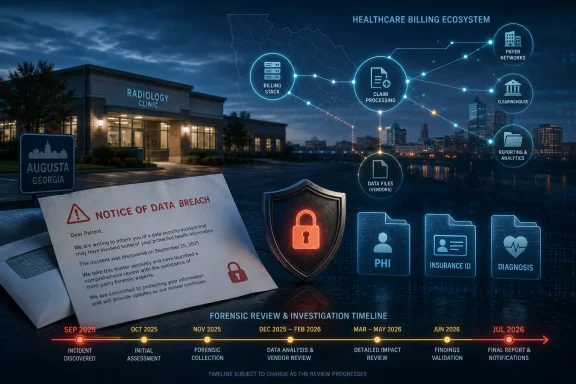
The most concrete facts in this incident form a timeline. The reported unauthorized access window ran from September 22 to September 26, 2025. MCBS learned of possible unauthorized network access on or about September 25, 2025. The company identified potentially affected files around May 28, 2026. Notices followed, with WRDW/WAGT reporting the Augusta patient impact on July 2, 2026.That timeline is the article’s real payload. It shows how an incident can move from technical event to legal review to patient notification across months. It shows why detection alone is insufficient. It shows why file-level visibility and data inventory are not bureaucratic luxuries.
For WindowsForum.com readers, the lesson is familiar but urgent. Directory permissions, endpoint telemetry, identity logs, backup integrity, data classification, and retention policies are not separate chores. They are the machinery that determines whether a breach is containable, explainable, and survivable.
The MCBS notice also reminds us that local incidents are not small incidents to the people inside them. A breach tied to a regional radiology practice may not command national headlines, but the affected patient still faces the same risks as someone caught in a giant hospital-system compromise. Scale matters to regulators and reporters; sensitivity matters to victims.
The Notice Letter Is Only the Beginning of the Work
For affected patients, the practical response should not wait for evidence of misuse. The data categories described in the WRDW/WAGT report are sensitive enough to justify action now, even if the eventual harm never materializes. The point of a freeze, a review, or an alert is to reduce the chance that the first sign of trouble is a denied claim or a fraudulent account.For providers and vendors, the incident should prompt a harder internal review. Not a performative review that produces another policy binder, but a technical accounting of where patient data resides, who can access it, and how quickly exposure can be scoped. If the answer requires months of manual document review, the environment is already telling you what needs to change.
The hard truth is that breach response has become too normalized. The industry has polished the letter-writing phase while underinvesting in the architectural work that would make the letters less frequent and less frightening. Patients deserve more than elegant notification after preventable sprawl.
The Augusta Case Leaves a Checklist Written in Plain Sight
The MCBS incident is not just another entry in the health-care breach ledger. It is a compact illustration of how outsourced billing, sensitive data concentration, slow forensic scoping, and limited patient remedies collide in the real world.- Patients who receive an MCBS notice should treat it as credible and preserve it with their medical and financial records.
- Affected individuals should consider credit freezes or fraud alerts because Social Security numbers and dates of birth may be among the exposed data.
- Patients should review Explanation of Benefits statements and medical bills for unfamiliar services, providers, or insurance activity.
- Health-care practices should reassess whether billing vendors retain more patient information than necessary or keep it longer than required.
- IT teams should prioritize data inventory, least privilege, segmentation, logging, and tested incident-response workflows before the next intrusion.
- Identity monitoring is useful, but it does not neutralize exposed medical histories, diagnosis details, or insurance identifiers.
References
- Primary source: WRDW
Published: Thu, 02 Jul 2026 23:46:00 GMT
Data incident prompts notices to patients of local radiology associate
MCBS said it obtained patient information from the radiology practice to provide medical billing services.www.wrdw.com
- Related coverage: blog.rankiteo.com
MCBS, LLC and Stephen W. Brown & Radiology Associates of Augusta: Data incident prompts notices to patients of local radiology associate
MCBS Data Breach Exposes Sensitive Patient Information in Augusta, GA A network security incident at MCBS, LLC, a medical billing service provider for healthcare practices, has potentially exposed the personal and medical data of patients linked to Stephen W. Brown & Radiology Associates...blog.rankiteo.com - Related coverage: dapeer.com
MCBS Data Breach Lawsuit (June 2026)
MCBS is notifying individuals that personal and health data was exposed in a September 2025 network breach. Affected? Get a free case review from Dapeer Law.www.dapeer.com
- Related coverage: slfla.com
MCBS LLC Breach Investigation – Class Action Litigation | SLFLA
MCBS LLC Breach Investigation In a significant data breach incident, MCBS LLC has reported unauthorized access to sensitive information affecting over 1.2 million individuals. This breach has raised serious concerns regarding data security and the protection of personal... slfla.com
- Related coverage: murphylegalfirm.com
MCBS Data Breach: Protecting Your Information | Murphy Law Firm
Learn about the recent data breach at MCBS and how Murphy Law Firm can help safeguard your sensitive data. Contact us for legal assistance.murphylegalfirm.com - Related coverage: classlawdc.com
Radiology Associates of Richmond Data Breach - M&R
Migliaccio & Rathod LLP is investigating the Radiology Associates of Richmond Data Breach, impacting 266,183 individuals and their information.classlawdc.com
- Related coverage: thecybersignal.com
Radiology Associates, DocketWise, Oncology Institute Breaches
Radiology Associates of Richmond, DocketWise, and the Oncology Institute disclosed breaches in one cycle — three breaches, two structural failures behind 2026. www.thecybersignal.com
- Related coverage: gs-legal.com
Triad Radiology Associates Data Breach Investigation
Triad Radiology Associates (“TRA”) is a North Carolina-based physicians’ practice providing radiology and imaging services to patients across 18 locations. It experienced a breach in 2025, potentially compromising the sensitive data of an undisclosed number of TRA patients. On or around July 30...www.gs-legal.com - Related coverage: securityweek.com
266,000 Affected by Data Breach at Radiology Associates of Richmond - SecurityWeek
Radiology Associates of Richmond has disclosed a data breach impacting the protected health information of 266,000 people.www.securityweek.com
- Related coverage: claimdepot.com
Keys Pathology Associates Data Breach Affects up to 20K People
Data breach at Keys Pathology Associates affects at least 20,000, exposing personal and health information. Check if you're affected and take action.www.claimdepot.com
