

Microsoft’s July 6 Xbox restructuring has now reached Obsidian Entertainment in Irvine, California, where PC Gamer and Kotaku report that roughly 60 to 70 employees were laid off, including veteran developers, recent hires, artists, designers, writers, producers, QA staff, and engineers. The cuts matter because Obsidian was not a failing experiment on the edge of Xbox’s portfolio; it was one of the clearest examples of the Game Pass-era studio Microsoft said it wanted. If even that studio is shedding a reported quarter of its workforce, the Xbox reset is not just pruning underperformers. It is rewriting the promise Microsoft made to its acquired creative teams.
PC Gamer’s account, updated after Kotaku’s reporting, is grim in the way layoff stories often are: not because the numbers are abstractly large, but because the names make the spreadsheet human. Daniel Alpert, an artist with 21 years at Obsidian and credits stretching across Neverwinter Nights 2, Alpha Protocol, Fallout: New Vegas DLC, and The Outer Worlds 2, was among those reportedly affected. So was Wenzheng Huang, an engineer who had only joined in May.
That range tells the story better than any corporate memo could. When a company cuts both two-decade institutional memory and someone barely through onboarding, it is not sending a subtle message about performance management. It is telling the organization that continuity itself has become negotiable.
Obsidian has long occupied a strange, beloved place in PC gaming: too scrappy to be blockbuster-safe, too talented to be dismissed as niche, and too historically important to be treated like just another content mill. It is the studio of Fallout: New Vegas, Pillars of Eternity, Pentiment, Grounded, The Outer Worlds, and Avowed — games that do not all aim at the same audience, but all carry the marks of a developer that knows systems, writing, consequence, and tone.
That made Obsidian an unusually good fit for Microsoft’s subscription pitch. Game Pass did not need every first-party studio to ship a 50-million-unit monolith. It needed a cadence of high-quality reasons to stay subscribed: smaller experiments, durable RPGs, co-op survival hits, narrative oddities, and the occasional big-budget first-person adventure.
By that standard, Obsidian did what it was seemingly asked to do. PC Gamer framed the studio’s recent output as five games in five years, an almost absurd pace in a modern industry where AAA development cycles routinely stretch toward half a decade. Grounded grew from survival curiosity into a real franchise. Pentiment became the sort of prestige object platform holders like to point to when they want to prove they still care about art. Avowed and The Outer Worlds 2 pushed the studio back toward larger RPG territory.
The cruel irony is that this is precisely the type of output Microsoft spent years telling players, regulators, and developers it wanted. The company acquired studios to create a broad first-party library, put those games into Game Pass, and make Xbox less dependent on the old cycle of console exclusives and boxed-unit launches. Obsidian did not miss that assignment. The reported layoffs suggest the assignment itself has changed.
That is the corporate frame: Xbox is being reset because the economics do not work. The problem is not that explanation is implausible. It is that it collides head-on with the last several years of Microsoft’s gaming strategy.
Microsoft spent the late 2010s and early 2020s telling a scale story. It bought studios, bought Bethesda parent ZeniMax, and then closed the $68.7 billion Activision Blizzard acquisition in 2023. The pitch was that Microsoft’s cloud, subscription infrastructure, PC footprint, console base, and balance sheet could create a gaming business with unusual resilience.
Now the message is narrower and harsher. Studios are being judged less like creative engines in a long-term ecosystem and more like cost centers inside a margin-repair program. That may be financially legible from Redmond. It is culturally combustible inside a developer like Obsidian.
A studio’s value is not stored only in its IP catalog or current headcount. It lives in the people who know why certain tools are brittle, which design instincts repeatedly save a project, how a team communicates under deadline, and where the skeletons are buried in a codebase. When Microsoft cuts deeply enough to hit senior artists, writers with BioWare-era experience, area designers, QA testers, and fresh engineering hires, it is not merely reducing expense. It is reducing organizational memory.
Kotaku’s later report complicated that picture by putting the number at roughly 60 to 70 employees, about a quarter of the studio’s previously reported 285-person headcount. Game Developer subsequently summarized Kotaku’s reporting in similar terms, saying the cuts spanned departments across the company.
The discrepancy does not prove wrongdoing. WARN rules are technical, timing-sensitive, and full of distinctions that can turn on worksite, notice date, severance structure, transfer offers, and other legal details invisible to outside observers. But it does show why layoff coverage often begins with scattered LinkedIn posts and only later hardens into a fuller picture.
For workers, that fog is part of the damage. When a restructuring rolls through a studio, the people affected learn quickly whether they are inside or outside the circle. Everyone else is left to triangulate from Slack silences, calendar deletions, LinkedIn updates, and recruiter messages. Public reporting becomes the only rough map of a private earthquake.
For fans, the WARN detail should also temper premature certainty. It is easy to leap from “nine known names” to “small cut” or from “60 to 70” to “studio doomed.” Neither is necessarily right. What is clear is that Obsidian’s cuts are no longer a rumor on the edge of a larger Xbox story. They are part of the story’s center.
Obsidian embodied that logic. Pentiment was not a traditional system-seller, but it gave Game Pass a kind of cultural credibility that cannot be manufactured with marketing copy. Grounded was not a prestige RPG, but it found a multiplayer survival audience and showed that Obsidian could build beyond its expected lane. Avowed and The Outer Worlds 2 served players who wanted exactly the kind of first-person RPG Microsoft’s portfolio should have been able to sustain.
The post-acquisition danger was always that Microsoft would eventually stop valuing that mix on its own terms. Subscription services often begin by funding variety because variety sells the subscription. Then, when growth slows or margins tighten, variety starts looking like inefficiency.
That appears to be the moment Xbox is entering. The question is no longer whether a game meaningfully strengthens the library, satisfies a loyal audience, or creates long-tail value. The question becomes whether its budget, timeline, staffing, and forecast survive comparison with a more ruthless corporate benchmark.
There is a place for discipline in any studio system. The games industry has indulged plenty of magical thinking about infinite budgets, endless development cycles, and vague “engagement” metrics. But discipline imposed after a decade of acquisition-driven expansion has a different moral texture. Microsoft created a larger house, invited studios in, promised them scale, and is now discovering that the mortgage is uncomfortable.
That matters especially at Obsidian. RPG studios rely on accumulated judgment. A good quest designer is not just someone who can write objectives. A veteran area designer knows how to stage discovery, manage combat density, hide seams, and make choices feel authored rather than assembled. A senior artist knows not only the visual target, but the production compromises that keep that target achievable.
The reported loss of someone like Daniel Alpert is therefore not symbolic only because he had been at Obsidian for 21 years. It is operationally meaningful. Two decades at a studio means having lived through tools, pipelines, canceled ideas, near misses, and institutional habits that never make it into documentation.
The same is true at the other end of the tenure spectrum. Cutting a newly hired engineer after two months tells remaining employees something about planning confidence. If the company was hiring in May and cutting in July, either conditions changed abruptly, or headcount planning was disconnected from the restructuring already forming above the studio.
Neither interpretation reassures the people left behind. Survivors of layoffs inherit the work of colleagues, the anxiety of being next, and the pressure to project loyalty to a strategy that just proved unstable. The burn rate goes down; the psychic tax goes up.
Microsoft is not alone in cutting. But Microsoft is not an ordinary participant in this market. It is one of the richest companies in the world, a cloud giant, an enterprise software default, and now the owner of one of the largest gaming portfolios ever assembled. Its choices set expectations.
That is why the Obsidian cuts land differently from a single independent studio running out of runway. If a Microsoft-owned Obsidian can ship repeatedly, sustain a recognizable identity, contribute to Game Pass, and still lose a reported quarter of its staff during a corporate reset, developers across the industry will draw the obvious conclusion: success is no longer a shield.
This is the most corrosive part of the layoff cycle. It breaks the implicit contract between workers and companies. Developers are often told to accept crunch, volatility, lower pay than adjacent tech sectors, and relocation risk because the work is meaningful and the studio mission matters. But if the mission changes at the spreadsheet level, the sacrifice starts to look like a sucker’s bargain.
It also changes how players interpret platform promises. Every showcase trailer now carries a silent asterisk. Is the studio intact? Will the sequel team survive? Is this roadmap a creative plan or a hostage note to a future earnings call?
But survival is not the same as health. A studio can remain open while losing the capacity that made it special. It can keep its name, keep its logo, keep some franchises, and still become less adventurous, less weird, less able to absorb risk.
That is the fear here. Obsidian’s best work has often come from constraint, but not from instability imposed at random. Pentiment worked because it was a focused bet by people with enough trust to make something commercially odd. Fallout: New Vegas became legendary despite brutal constraints because the team had deep RPG instincts and a clear design identity. Those conditions cannot be infinitely squeezed.
The Microsoft-era version of Obsidian seemed to promise something rare: creative eccentricity with a safety net. The studio could make a medieval manuscript murder mystery, a backyard survival game, and first-person RPGs under the same corporate roof. Now the safety net looks thinner, and the eccentricity may be harder to defend.
The next few years will show whether Obsidian remains a studio with latitude or becomes a brand name attached to safer bets. That distinction will matter far more than whether Microsoft says the right supportive things in internal memos.
But if those internal metrics now produce layoffs at one of the studios best suited to the model, the pitch needs revision. Either the model did not generate enough value, or the value it generated is being discounted in favor of more conventional margin targets.
Microsoft has never fully exposed the economics of Game Pass, and it probably never will. That leaves outside observers piecing together strategy from pricing changes, release cadence, subscriber commentary, executive statements, and layoffs. The picture emerging in 2026 is not of a company abandoning Game Pass, but of one narrowing the tolerance band around what Game Pass-funded development can look like.
That may produce fewer oddities and more obvious franchise plays. It may push studios toward projects that can justify themselves across multiple revenue streams: premium sales, DLC, cross-platform launches, live-service hooks, merchandising, and subscription engagement. That might be rational. It also risks making Xbox’s first-party slate less distinctive at exactly the moment it needs identity.
If Game Pass becomes merely a distribution wrapper around the same risk-averse content strategy everyone else is pursuing, then Microsoft will have spent years and billions building a less profitable version of the old model.
PC Gamer’s account, updated after Kotaku’s reporting, is grim in the way layoff stories often are: not because the numbers are abstractly large, but because the names make the spreadsheet human. Daniel Alpert, an artist with 21 years at Obsidian and credits stretching across Neverwinter Nights 2, Alpha Protocol, Fallout: New Vegas DLC, and The Outer Worlds 2, was among those reportedly affected. So was Wenzheng Huang, an engineer who had only joined in May.
That range tells the story better than any corporate memo could. When a company cuts both two-decade institutional memory and someone barely through onboarding, it is not sending a subtle message about performance management. It is telling the organization that continuity itself has become negotiable.
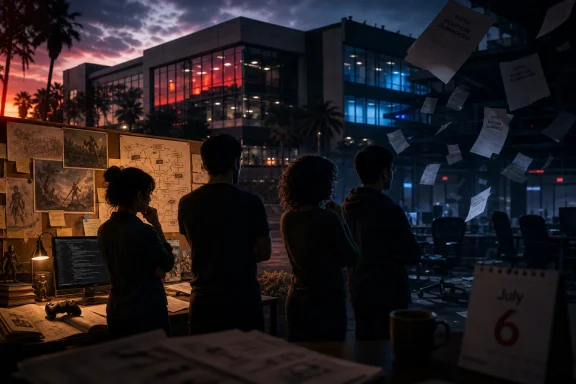 Obsidian Was Supposed to Be the Game Pass Success Story
Obsidian has long occupied a strange, beloved place in PC gaming: too scrappy to be blockbuster-safe, too talented to be dismissed as niche, and too historically important to be treated like just another content mill. It is the studio of Fallout: New Vegas, Pillars of Eternity, Pentiment, Grounded, The Outer Worlds, and Avowed — games that do not all aim at the same audience, but all carry the marks of a developer that knows systems, writing, consequence, and tone.That made Obsidian an unusually good fit for Microsoft’s subscription pitch. Game Pass did not need every first-party studio to ship a 50-million-unit monolith. It needed a cadence of high-quality reasons to stay subscribed: smaller experiments, durable RPGs, co-op survival hits, narrative oddities, and the occasional big-budget first-person adventure.
By that standard, Obsidian did what it was seemingly asked to do. PC Gamer framed the studio’s recent output as five games in five years, an almost absurd pace in a modern industry where AAA development cycles routinely stretch toward half a decade. Grounded grew from survival curiosity into a real franchise. Pentiment became the sort of prestige object platform holders like to point to when they want to prove they still care about art. Avowed and The Outer Worlds 2 pushed the studio back toward larger RPG territory.
The cruel irony is that this is precisely the type of output Microsoft spent years telling players, regulators, and developers it wanted. The company acquired studios to create a broad first-party library, put those games into Game Pass, and make Xbox less dependent on the old cycle of console exclusives and boxed-unit launches. Obsidian did not miss that assignment. The reported layoffs suggest the assignment itself has changed.
The Xbox Reset Has Become a Test of Microsoft’s Own Story
Associated Press reported that Microsoft cut 4,800 jobs on July 6, with about 1,600 of those at Xbox and another 1,600 expected in the gaming division during the fiscal year that began July 1. GeekWire, citing an internal memo from Xbox chief Asha Sharma, described the move as the biggest restructuring in Xbox history and said the division had been operating at margins far below comparable platform and publishing businesses.That is the corporate frame: Xbox is being reset because the economics do not work. The problem is not that explanation is implausible. It is that it collides head-on with the last several years of Microsoft’s gaming strategy.
Microsoft spent the late 2010s and early 2020s telling a scale story. It bought studios, bought Bethesda parent ZeniMax, and then closed the $68.7 billion Activision Blizzard acquisition in 2023. The pitch was that Microsoft’s cloud, subscription infrastructure, PC footprint, console base, and balance sheet could create a gaming business with unusual resilience.
Now the message is narrower and harsher. Studios are being judged less like creative engines in a long-term ecosystem and more like cost centers inside a margin-repair program. That may be financially legible from Redmond. It is culturally combustible inside a developer like Obsidian.
A studio’s value is not stored only in its IP catalog or current headcount. It lives in the people who know why certain tools are brittle, which design instincts repeatedly save a project, how a team communicates under deadline, and where the skeletons are buried in a codebase. When Microsoft cuts deeply enough to hit senior artists, writers with BioWare-era experience, area designers, QA testers, and fresh engineering hires, it is not merely reducing expense. It is reducing organizational memory.
The WARN Math Makes the Story Murkier, Not Cleaner
PC Gamer noted that Obsidian, as a California employer with more than 100 employees, would generally face WARN Act notice obligations for layoffs over certain thresholds. The outlet also observed that California’s WARN tracker did not show an Obsidian filing at the time of publication. That initially suggested a count somewhere below the threshold PC Gamer described.Kotaku’s later report complicated that picture by putting the number at roughly 60 to 70 employees, about a quarter of the studio’s previously reported 285-person headcount. Game Developer subsequently summarized Kotaku’s reporting in similar terms, saying the cuts spanned departments across the company.
The discrepancy does not prove wrongdoing. WARN rules are technical, timing-sensitive, and full of distinctions that can turn on worksite, notice date, severance structure, transfer offers, and other legal details invisible to outside observers. But it does show why layoff coverage often begins with scattered LinkedIn posts and only later hardens into a fuller picture.
For workers, that fog is part of the damage. When a restructuring rolls through a studio, the people affected learn quickly whether they are inside or outside the circle. Everyone else is left to triangulate from Slack silences, calendar deletions, LinkedIn updates, and recruiter messages. Public reporting becomes the only rough map of a private earthquake.
For fans, the WARN detail should also temper premature certainty. It is easy to leap from “nine known names” to “small cut” or from “60 to 70” to “studio doomed.” Neither is necessarily right. What is clear is that Obsidian’s cuts are no longer a rumor on the edge of a larger Xbox story. They are part of the story’s center.
Microsoft Bought Creative Diversity, Then Started Demanding Platform Math
The old defense of Xbox’s acquisition spree was portfolio logic. Not every studio needed to be Bethesda Game Studios, Activision, or Mojang. A platform holder could afford teams that made distinctive, medium-scale work because those teams made the service richer, the brand broader, and the ecosystem stickier.Obsidian embodied that logic. Pentiment was not a traditional system-seller, but it gave Game Pass a kind of cultural credibility that cannot be manufactured with marketing copy. Grounded was not a prestige RPG, but it found a multiplayer survival audience and showed that Obsidian could build beyond its expected lane. Avowed and The Outer Worlds 2 served players who wanted exactly the kind of first-person RPG Microsoft’s portfolio should have been able to sustain.
The post-acquisition danger was always that Microsoft would eventually stop valuing that mix on its own terms. Subscription services often begin by funding variety because variety sells the subscription. Then, when growth slows or margins tighten, variety starts looking like inefficiency.
That appears to be the moment Xbox is entering. The question is no longer whether a game meaningfully strengthens the library, satisfies a loyal audience, or creates long-tail value. The question becomes whether its budget, timeline, staffing, and forecast survive comparison with a more ruthless corporate benchmark.
There is a place for discipline in any studio system. The games industry has indulged plenty of magical thinking about infinite budgets, endless development cycles, and vague “engagement” metrics. But discipline imposed after a decade of acquisition-driven expansion has a different moral texture. Microsoft created a larger house, invited studios in, promised them scale, and is now discovering that the mortgage is uncomfortable.
The Human Cost Is Also a Product Cost
Layoffs in games are often discussed as if they happen between projects, neatly separated from the work. In reality, the damage leaks everywhere. People leaving a studio take with them design context, engine knowledge, production relationships, and the informal trust that lets teams move quickly without turning every decision into a meeting.That matters especially at Obsidian. RPG studios rely on accumulated judgment. A good quest designer is not just someone who can write objectives. A veteran area designer knows how to stage discovery, manage combat density, hide seams, and make choices feel authored rather than assembled. A senior artist knows not only the visual target, but the production compromises that keep that target achievable.
The reported loss of someone like Daniel Alpert is therefore not symbolic only because he had been at Obsidian for 21 years. It is operationally meaningful. Two decades at a studio means having lived through tools, pipelines, canceled ideas, near misses, and institutional habits that never make it into documentation.
The same is true at the other end of the tenure spectrum. Cutting a newly hired engineer after two months tells remaining employees something about planning confidence. If the company was hiring in May and cutting in July, either conditions changed abruptly, or headcount planning was disconnected from the restructuring already forming above the studio.
Neither interpretation reassures the people left behind. Survivors of layoffs inherit the work of colleagues, the anxiety of being next, and the pressure to project loyalty to a strategy that just proved unstable. The burn rate goes down; the psychic tax goes up.
The Industry’s Layoff Cycle Has Become a Management Habit
The broader games industry has spent years normalizing mass layoffs as if they were weather. Pandemic-era growth gave way to post-pandemic contraction. Cheap money disappeared. Hardware cycles softened. Subscription economics became harder to defend. Generative AI became the newest executive obsession, especially at companies already looking for a story about future efficiency.Microsoft is not alone in cutting. But Microsoft is not an ordinary participant in this market. It is one of the richest companies in the world, a cloud giant, an enterprise software default, and now the owner of one of the largest gaming portfolios ever assembled. Its choices set expectations.
That is why the Obsidian cuts land differently from a single independent studio running out of runway. If a Microsoft-owned Obsidian can ship repeatedly, sustain a recognizable identity, contribute to Game Pass, and still lose a reported quarter of its staff during a corporate reset, developers across the industry will draw the obvious conclusion: success is no longer a shield.
This is the most corrosive part of the layoff cycle. It breaks the implicit contract between workers and companies. Developers are often told to accept crunch, volatility, lower pay than adjacent tech sectors, and relocation risk because the work is meaningful and the studio mission matters. But if the mission changes at the spreadsheet level, the sacrifice starts to look like a sucker’s bargain.
It also changes how players interpret platform promises. Every showcase trailer now carries a silent asterisk. Is the studio intact? Will the sequel team survive? Is this roadmap a creative plan or a hostage note to a future earnings call?
Obsidian’s Future Is Not Doomed, But It Is Smaller Than It Looked Last Week
It would be premature to write Obsidian’s obituary. Reports from Windows Central and others pushed back last week on rumors that the studio was in talks to avoid closure, and the current reporting points to layoffs, not a shutdown. Obsidian has survived ugly moments before, including near-death financial stretches long before Microsoft arrived.But survival is not the same as health. A studio can remain open while losing the capacity that made it special. It can keep its name, keep its logo, keep some franchises, and still become less adventurous, less weird, less able to absorb risk.
That is the fear here. Obsidian’s best work has often come from constraint, but not from instability imposed at random. Pentiment worked because it was a focused bet by people with enough trust to make something commercially odd. Fallout: New Vegas became legendary despite brutal constraints because the team had deep RPG instincts and a clear design identity. Those conditions cannot be infinitely squeezed.
The Microsoft-era version of Obsidian seemed to promise something rare: creative eccentricity with a safety net. The studio could make a medieval manuscript murder mystery, a backyard survival game, and first-person RPGs under the same corporate roof. Now the safety net looks thinner, and the eccentricity may be harder to defend.
The next few years will show whether Obsidian remains a studio with latitude or becomes a brand name attached to safer bets. That distinction will matter far more than whether Microsoft says the right supportive things in internal memos.
Game Pass Cannot Be Both the Excuse and the Escape Hatch
The uncomfortable question behind these cuts is what Game Pass is now for. In its most optimistic form, Game Pass was supposed to change the economics of game discovery. It could support games that were not obvious $70 blockbusters because success could be measured across retention, engagement, library value, and ecosystem loyalty.But if those internal metrics now produce layoffs at one of the studios best suited to the model, the pitch needs revision. Either the model did not generate enough value, or the value it generated is being discounted in favor of more conventional margin targets.
Microsoft has never fully exposed the economics of Game Pass, and it probably never will. That leaves outside observers piecing together strategy from pricing changes, release cadence, subscriber commentary, executive statements, and layoffs. The picture emerging in 2026 is not of a company abandoning Game Pass, but of one narrowing the tolerance band around what Game Pass-funded development can look like.
That may produce fewer oddities and more obvious franchise plays. It may push studios toward projects that can justify themselves across multiple revenue streams: premium sales, DLC, cross-platform launches, live-service hooks, merchandising, and subscription engagement. That might be rational. It also risks making Xbox’s first-party slate less distinctive at exactly the moment it needs identity.
If Game Pass becomes merely a distribution wrapper around the same risk-averse content strategy everyone else is pursuing, then Microsoft will have spent years and billions building a less profitable version of the old model.
The New Xbox Bargain Is Written in Red Ink
The clearest lesson from Obsidian’s reported layoffs is not that one beloved RPG studio is finished. It is that the bargain around Xbox first-party development has changed, and everyone inside the system can see it.- Microsoft’s July 6 restructuring reportedly cut 4,800 jobs company-wide, with 1,600 immediate Xbox layoffs and another 1,600 expected during the current fiscal year.
- PC Gamer and Kotaku report that Obsidian lost roughly 60 to 70 employees, or about a quarter of its previously reported 285-person staff.
- The affected workers reportedly include long-tenured veterans, recent hires, artists, designers, writers, producers, engineers, and QA staff.
- Obsidian’s recent output made it one of the strongest examples of the Game Pass content strategy, which makes the cuts more strategically revealing than a simple underperformance story.
- The studio is not reported to be closing, but a deep reduction in headcount can still weaken the institutional knowledge and creative range that made it valuable.
- Xbox’s reset suggests Microsoft is now prioritizing margin repair and portfolio discipline over the expansive creative logic that justified many of its studio acquisitions.
References
- Primary source: PC Gamer
Published: Mon, 06 Jul 2026 23:01:25 GMT
Loading…
www.pcgamer.com - Related coverage: gamesradar.com
Obsidian reportedly safe from Xbox studio closures despite fears the RPG powerhouse was in negotiations to avoid shutdown | GamesRadar+
The iconic dev behind Fallout: New Vegas, Grounded, Star Wars: KOTOR 2, and morewww.gamesradar.com - Related coverage: windowscentral.com
Loading…
www.windowscentral.com - Related coverage: gamedeveloper.com
Loading…
www.gamedeveloper.com - Related coverage: gamespot.com
Loading…
www.gamespot.com - Related coverage: ultimaficha.com.br
Loading…
ultimaficha.com.br
- Related coverage: destructoid.com
Loading…
www.destructoid.com - Related coverage: omelete.com.br
Loading…
www.omelete.com.br - Related coverage: techcrunch.com
Microsoft lays off nearly 5,000 employees across Xbox, commercial sales | TechCrunch
Microsoft cut around 4,800 roles, or 2.1% of its global workforce, on Monday — the latest in a series of layoffs that’s stoking fears of AI replacing jobs. The layoffs will hit Xbox and commercial sales the hardest.techcrunch.com - Related coverage: geekwire.com
Microsoft cuts 4,800 jobs, about 2% globally, revamps salesforce and launches massive Xbox overhaul – GeekWire
Microsoft is cutting 4,800 jobs and overhauling its Xbox gaming business in what its new gaming CEO calls the biggest restructuring in Xbox history, while reshaping its sales and consulting division amid record AI spending and a 30% stock slide.www.geekwire.com - Related coverage: as.com
Loading…
as.com
