

Microsoft is reportedly considering canceling Marvel’s Blade, the Arkane Lyon-developed action game announced in December 2023, as part of a planned Xbox restructuring expected in early July 2026 that could include layoffs, studio closures, spin-offs, mergers, and broader cost-cutting across Microsoft’s gaming division. The story is still in the dangerous middle ground between rumor and policy: serious enough to rattle fans, not yet formal enough to treat as a final obituary. But the larger point is already visible. Xbox’s problem is no longer simply that some games are late, expensive, or commercially uncertain; it is that Microsoft’s gaming strategy now appears to be judging even its most distinctive creative bets against a colder, more corporate definition of survival.
There was a time when Marvel’s Blade looked like exactly the sort of project Microsoft wanted to show off after buying Bethesda: a recognizable comic-book license, a respected European studio, and a genre lane that was neither another service shooter nor another safe sequel. Arkane Lyon had credibility with players who still care about systems-driven design, authored worlds, and games that reward curiosity rather than funneling everyone toward the same monetized treadmill.
That is why the latest reporting lands with more force than a normal cancellation rumor. If Microsoft were merely trimming obscure experiments or quietly shelving prototypes, the story would be unpleasant but familiar. Considering the cancellation of Blade, if accurate, suggests something sharper: even a Marvel-licensed game from a prestige studio may not be protected if the spreadsheet says the schedule slipped, the budget ballooned, or the strategic value no longer pencils out.
The reported restructuring also arrives after years of Xbox arguing that its acquisition spree was about expanding creative output. Microsoft did not spend tens of billions of dollars on gaming assets merely to own more logos on a corporate slide. It sold a vision of Xbox as an ecosystem where studios could breathe, Game Pass could reduce the tyranny of boxed-sales pressure, and niche excellence could coexist with mass-market blockbusters.
That vision now looks harder to defend. It is one thing to tell investors that discipline is coming after a period of expansion. It is another to convince players, developers, and license partners that the same discipline will not hollow out the very studios that made Xbox’s portfolio interesting in the first place.
That makes Arkane a poor fit for a business culture obsessed with predictable returns, but a very good fit for a platform holder trying to prove it has taste. Microsoft has often struggled with the perception that Xbox owns plenty of studios but lacks a coherent identity beyond distribution, subscriptions, and acquisition scale. Arkane, at its best, offered identity in concentrated form.
Marvel’s Blade seemed like a clever bridge between those worlds. Blade is a recognizable Marvel character, but not one so overexposed that every creative choice would arrive pre-chewed by the wider cinematic machine. Arkane Lyon, meanwhile, had the design vocabulary to make a vampire-hunting game feel strange, stylish, and mechanical rather than just another licensed brawler with quips and upgrade trees.
The risk, of course, was always that such a combination would be expensive and difficult. A licensed superhero game carries external expectations, approval pipelines, and marketing pressures. A studio known for bespoke systems is not naturally built for low-cost velocity. If the reported internal release target slipped from 2026 to late 2027, that would not be shocking in modern AAA development — but it would be exactly the sort of delay that invites corporate scrutiny during a restructuring.
This is the phase where big publishers often lose their nerve. Early cancellation looks prudent. Late cancellation looks catastrophic. Midstream cancellation can be framed as discipline, especially when a company is under pressure to show that it can control costs after a buying binge.
For Microsoft, that pressure is not imaginary. Xbox has absorbed Bethesda, Activision Blizzard, and a long list of studios whose cultures, pipelines, and expectations were never designed to operate as one clean machine. Investors want margin. Executives want accountability. Workers get the memo in the form of layoffs, reorganizations, and project reviews.
But games are not cloud workloads. A delayed game is not automatically a failed game, and an expensive one is not automatically a bad investment. The hard part for Xbox is distinguishing between projects that are genuinely off the rails and projects that merely look inconvenient because they do not fit the current quarterly mood.
But the Marvel name is not magic. It can make a project easier to market, but it can also raise the financial bar. License fees, brand approvals, cinematic expectations, and the general assumption that a superhero game must be big all complicate the budget story.
Blade himself occupies an odd commercial position. He is famous enough to matter, beloved by comic and film fans, and visually distinct in a way that should translate well to games. Yet he is not Spider-Man, Batman, or Wolverine. He does not guarantee the kind of mass audience that can easily justify a spiraling AAA budget.
That ambiguity is exactly why Arkane felt like the right studio and why Microsoft may now be hesitating. The best version of Blade is probably not a generic blockbuster. It is probably a mood piece with combat bite, urban texture, supernatural rules, and enough systemic play to justify Arkane’s involvement. That version could be brilliant. It could also be harder to forecast than another military shooter, racing game, or evergreen live-service franchise.
The flaw was never the acquisition impulse by itself. The flaw was assuming that ownership automatically produces output at platform scale. Studios are not factories that can be purchased, plugged into a dashboard, and optimized until the hits roll off an assembly line.
Every acquired studio arrives with its own creative habits, technical debt, unfinished projects, leadership tensions, and culture. Some need more time. Some need sharper direction. Some need protection from the very corporate mechanisms that claim to unlock their potential.
When Microsoft shuts, sells, merges, or reorganizes studios, it is not merely trimming a portfolio. It is admitting that its earlier theory of scale was incomplete. The company wanted more games, but now appears to be deciding which kinds of games it can afford to wait for.
For developers, these reports turn ordinary work into suspended animation. Teams keep building while wondering whether their project will survive the next executive meeting. Morale becomes a resource that no production schedule can fully measure, and once it is spent, studios rarely recover quickly.
The games industry has normalized this whiplash to a grotesque degree. A project can be praised internally one month, absent from a showcase the next, and reportedly under threat shortly thereafter. Employees are expected to remain passionate while the ground underneath them is treated as negotiable.
This is where Microsoft’s public language matters less than its operational behavior. If the company wants Xbox to be seen as a stable home for creative teams, it cannot keep allowing those teams to experience stability as a rumor that expires with the next reorg.
Inside today’s Xbox climate, silence reads differently. It becomes a vacuum for fear. Every missed showcase becomes evidence. Every vague comment from an executive or developer gets parsed like a central-bank statement.
Recent reassurances from people around the project briefly gave fans reason to believe the game was simply not ready to show. That may still be true. But the new reporting reframes those reassurances as part of a more precarious picture: a team may be doing good work and still find itself exposed if leadership decides the business case has changed.
That is the brutal lesson of modern publishing. A game can be real, playable, promising, and doomed all at once. The old binary — alive or canceled — no longer captures the limbo many projects inhabit.
That argument still has merit, but it has limits. A subscription service does not repeal cost. It redistributes the way value is measured, often making that value harder for outsiders — and sometimes insiders — to see.
A game like Blade would have obvious marketing value for Game Pass if it launched strongly. It would give Xbox a premium single-player release with a known character and a distinct studio identity. But if its budget grew too large and its release moved too far out, executives may have started asking whether that marketing value could justify the spend.
This is the unresolved tension at the heart of Xbox’s model. Game Pass needs big, appealing games to feel essential, but big, appealing games are expensive. If Microsoft responds by cutting the risky ones, the service risks becoming broader but less exciting — a catalog with plenty to play and fewer reasons to care.
That creative middle class is where much of gaming’s long-term health lives. These are the studios that produce new mechanics, durable cult followings, and design ideas that larger franchises later absorb. They may not always produce the biggest sales spikes, but they keep the medium from collapsing into sequels, remakes, annualized brands, and algorithmic comfort food.
Microsoft once seemed unusually well positioned to protect that tier. With Windows, Azure, Xbox hardware, Game Pass, and enormous corporate resources behind it, the company could theoretically afford a portfolio where not every release had to be the same kind of hit. That was the strategic promise of being Microsoft rather than a thinner traditional publisher.
If the company now decides it cannot tolerate the economics of studios like Arkane, then the promise changes. Xbox becomes less a haven for variety and more a conventional publisher with a subscription wrapper and a very large acquisition hangover.
But even that outcome would carry a sting. Microsoft bought Bethesda in part to strengthen Xbox’s first-party identity. Selling off a studio like Arkane would be a tacit admission that the company either cannot integrate certain kinds of talent or no longer wants to bear the risks attached to them.
There is also no guarantee that a buyer would be better. New ownership can mean new mandates, new cuts, and new pressures. The romantic version imagines Arkane freed from Xbox’s corporate churn; the realistic version acknowledges that any buyer willing to take on the studio would have its own expectations.
Still, closure is final in a way sale is not. If Microsoft truly views Arkane as nonessential, the least destructive path would be one that lets the studio’s people and design culture continue. For players, the difference between “Arkane survives elsewhere” and “Arkane disappears” is the difference between disappointment and permanent loss.
A canceled Blade would not simply remove one potential console exclusive from the calendar. It would remove a likely PC release from one of the few major publishers still willing, at least in theory, to fund unusual single-player projects at scale. For Windows gamers, that matters more than whether a box under the TV gets bragging rights.
It also affects developers building around Microsoft’s ecosystem. If Xbox’s first-party pipeline becomes more conservative, Game Pass for PC may lean harder on third-party deals, back catalog depth, and safer internal bets. That can still be useful, but it is not the same as a steady stream of ambitious new games from distinctive studios.
The Windows audience has always been more tolerant of oddity than the console market is often assumed to be. Immersive sims, mod-heavy RPGs, strategy games, and experimental hybrids have long found homes on PC. Losing Arkane’s kind of work would be a loss for that tradition, not just for Xbox branding.
That patience has not been irrational. Game development is slow, and Microsoft’s portfolio is large enough that coordination was always going to take time. But patience becomes harder when the reward for waiting appears to be another round of layoffs, cancellations, and internal resets.
The industry has also trained fans to read smoke signals. A missing trailer no longer feels like a harmless absence. A developer’s reassuring social-media post no longer closes the book. Everyone has seen too many games disappear quietly, too many studios praised until the day they are cut.
This is why the Blade rumor hit a nerve. It compresses a decade of Xbox anxiety into one image: a stylish, long-awaited game from a beloved studio, caught between creative promise and corporate subtraction.
The company has a legitimate need to run Xbox as a sustainable business. No serious analysis should pretend budgets do not matter or that every troubled project deserves indefinite funding. The industry has seen plenty of games consume years and fortunes without finding a viable shape.
But Microsoft’s burden is heavier because of its own rhetoric. It told regulators, players, and developers that consolidation would not reduce opportunity. It argued that its ecosystem would expand access and support more content. Now every cancellation and closure will be judged against that promise.
If Blade survives, Microsoft can still frame the review as part of normal portfolio management. If it dies, especially alongside cuts to Arkane, the company will have a harder time convincing anyone that Xbox’s future is about creative abundance rather than defensive consolidation.
This is a structural problem across AAA development. The longer a project takes, the more likely it is to collide with changing budgets, changing platform strategies, changing corporate leadership, and changing audience expectations. By the time the game is ready, the business case that greenlit it may no longer exist.
For Microsoft, the calendar pressure is especially acute. Xbox needs visible wins now, not theoretical wins in eighteen months. It needs to prove that its enormous spending has produced a pipeline, not just a collection of logos. A delayed Blade may look less like a future jewel and more like another expensive promise being carried across fiscal years.
Yet that impatience can become self-defeating. Cancel too many long-gestating projects, and the pipeline gets thinner. Cut too many distinctive studios, and the platform identity gets blurrier. Demand shorter paths to success, and you may end up funding only the safest work.
Xbox has often tried to be all of those things at once. That ambition made sense when Microsoft was building Game Pass and trying to repair the damage of the previous generation. But an all-things strategy becomes fragile when cuts arrive, because every decision suddenly exposes which priority outranks the others.
If Blade is canceled, Microsoft will be signaling that even a major licensed single-player game from Arkane does not clear the bar under the new regime. If Arkane is sold or shuttered, the signal becomes louder: certain kinds of design excellence are expendable if they do not fit the restructuring map.
That would not mean Xbox has no future. Microsoft still owns some of the biggest franchises in gaming, enormous distribution power, and a subscription service with real reach. But it would mean the future is narrower than the pitch that sold many players on the ecosystem.
That in-between quality is exactly what modern Xbox seems to be struggling to value. The company can justify global blockbusters. It can justify service franchises. It can justify small prestige projects if they are cheap enough. What is harder is defending a costly, distinctive game whose upside is real but not guaranteed.
Yet those are often the games that define a platform’s soul. Nobody remembers a generation purely by its portfolio optimization. They remember the games that felt like someone, somewhere, fought to make them exist.
If Microsoft still wants Xbox to be more than a distribution layer, it needs to fight for some of those games. Not all of them. Not blindly. But enough to prove that the creative promise of its acquisitions was not just a pre-restructuring slogan.
But uncertainty should not soften the analysis. The fact that such a decision is reportedly under consideration is itself revealing. It tells us where pressure is landing and which projects may be vulnerable when Xbox leadership looks for savings.
The most concrete read is this:
If Marvel’s Blade survives, it will do so as more than a game that avoided cancellation; it will become a test case for whether Xbox can still protect ambitious, stylish, single-player work inside a company increasingly governed by restructuring logic. If it falls, the loss will be larger than one project, because it will confirm that Microsoft’s gaming empire can buy creative credibility faster than it can preserve it.
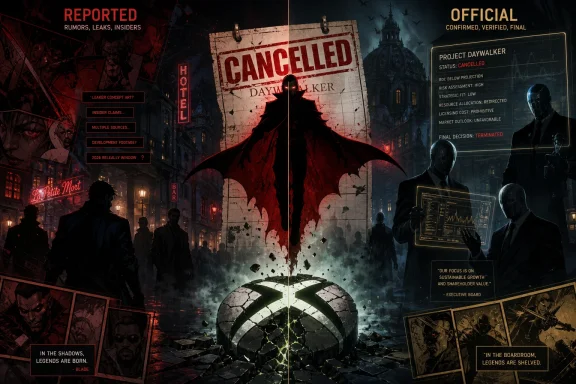 Xbox’s Reset Has Reached the Games People Thought Were Safe
There was a time when Marvel’s Blade looked like exactly the sort of project Microsoft wanted to show off after buying Bethesda: a recognizable comic-book license, a respected European studio, and a genre lane that was neither another service shooter nor another safe sequel. Arkane Lyon had credibility with players who still care about systems-driven design, authored worlds, and games that reward curiosity rather than funneling everyone toward the same monetized treadmill.That is why the latest reporting lands with more force than a normal cancellation rumor. If Microsoft were merely trimming obscure experiments or quietly shelving prototypes, the story would be unpleasant but familiar. Considering the cancellation of Blade, if accurate, suggests something sharper: even a Marvel-licensed game from a prestige studio may not be protected if the spreadsheet says the schedule slipped, the budget ballooned, or the strategic value no longer pencils out.
The reported restructuring also arrives after years of Xbox arguing that its acquisition spree was about expanding creative output. Microsoft did not spend tens of billions of dollars on gaming assets merely to own more logos on a corporate slide. It sold a vision of Xbox as an ecosystem where studios could breathe, Game Pass could reduce the tyranny of boxed-sales pressure, and niche excellence could coexist with mass-market blockbusters.
That vision now looks harder to defend. It is one thing to tell investors that discipline is coming after a period of expansion. It is another to convince players, developers, and license partners that the same discipline will not hollow out the very studios that made Xbox’s portfolio interesting in the first place.
Arkane Was Supposed to Be the Antidote to Bland Scale
Arkane’s value has never been easy to express in the language of platform strategy. The studio’s best work has historically mattered because it felt hand-built, mischievous, and slightly out of step with the safest instincts of big-budget publishing. Dishonored and Deathloop were not important because they promised endless engagement loops; they were important because they trusted players to improvise inside dense, reactive worlds.That makes Arkane a poor fit for a business culture obsessed with predictable returns, but a very good fit for a platform holder trying to prove it has taste. Microsoft has often struggled with the perception that Xbox owns plenty of studios but lacks a coherent identity beyond distribution, subscriptions, and acquisition scale. Arkane, at its best, offered identity in concentrated form.
Marvel’s Blade seemed like a clever bridge between those worlds. Blade is a recognizable Marvel character, but not one so overexposed that every creative choice would arrive pre-chewed by the wider cinematic machine. Arkane Lyon, meanwhile, had the design vocabulary to make a vampire-hunting game feel strange, stylish, and mechanical rather than just another licensed brawler with quips and upgrade trees.
The risk, of course, was always that such a combination would be expensive and difficult. A licensed superhero game carries external expectations, approval pipelines, and marketing pressures. A studio known for bespoke systems is not naturally built for low-cost velocity. If the reported internal release target slipped from 2026 to late 2027, that would not be shocking in modern AAA development — but it would be exactly the sort of delay that invites corporate scrutiny during a restructuring.
The Blade Report Is Really a Story About Microsoft’s Patience
The most telling detail is not simply that Blade may be under review. It is that the game reportedly had enough internal shape to have once been aimed at a much earlier window. That implies this is not merely an idea on a whiteboard being cut before serious money is spent. It suggests a project that had crossed into the expensive, painful middle of development, where cancellation becomes both more brutal and more tempting.This is the phase where big publishers often lose their nerve. Early cancellation looks prudent. Late cancellation looks catastrophic. Midstream cancellation can be framed as discipline, especially when a company is under pressure to show that it can control costs after a buying binge.
For Microsoft, that pressure is not imaginary. Xbox has absorbed Bethesda, Activision Blizzard, and a long list of studios whose cultures, pipelines, and expectations were never designed to operate as one clean machine. Investors want margin. Executives want accountability. Workers get the memo in the form of layoffs, reorganizations, and project reviews.
But games are not cloud workloads. A delayed game is not automatically a failed game, and an expensive one is not automatically a bad investment. The hard part for Xbox is distinguishing between projects that are genuinely off the rails and projects that merely look inconvenient because they do not fit the current quarterly mood.
The Marvel License No Longer Guarantees Immunity
A decade ago, the phrase “Marvel game from a beloved studio” might have sounded almost cancellation-proof. After Marvel’s Spider-Man helped demonstrate how powerful a prestige superhero game could be when paired with the right developer, publishers had every reason to chase their own version of that lightning. A Blade game from Arkane appeared to be Microsoft’s most stylish answer.But the Marvel name is not magic. It can make a project easier to market, but it can also raise the financial bar. License fees, brand approvals, cinematic expectations, and the general assumption that a superhero game must be big all complicate the budget story.
Blade himself occupies an odd commercial position. He is famous enough to matter, beloved by comic and film fans, and visually distinct in a way that should translate well to games. Yet he is not Spider-Man, Batman, or Wolverine. He does not guarantee the kind of mass audience that can easily justify a spiraling AAA budget.
That ambiguity is exactly why Arkane felt like the right studio and why Microsoft may now be hesitating. The best version of Blade is probably not a generic blockbuster. It is probably a mood piece with combat bite, urban texture, supernatural rules, and enough systemic play to justify Arkane’s involvement. That version could be brilliant. It could also be harder to forecast than another military shooter, racing game, or evergreen live-service franchise.
Xbox Keeps Discovering That Buying Studios Is Easier Than Protecting Them
Microsoft’s acquisition strategy was built on a simple premise: Xbox needed more content, and the fastest way to get it was to buy the people already making it. That logic was defensible. Xbox had spent much of the Xbox One era losing the first-party narrative to Sony and Nintendo, and Game Pass needed a steady stream of reasons to stay subscribed.The flaw was never the acquisition impulse by itself. The flaw was assuming that ownership automatically produces output at platform scale. Studios are not factories that can be purchased, plugged into a dashboard, and optimized until the hits roll off an assembly line.
Every acquired studio arrives with its own creative habits, technical debt, unfinished projects, leadership tensions, and culture. Some need more time. Some need sharper direction. Some need protection from the very corporate mechanisms that claim to unlock their potential.
When Microsoft shuts, sells, merges, or reorganizes studios, it is not merely trimming a portfolio. It is admitting that its earlier theory of scale was incomplete. The company wanted more games, but now appears to be deciding which kinds of games it can afford to wait for.
The Human Cost Is Not a Side Plot
It is tempting to talk about Blade as a fan disappointment first. That reaction is understandable; people saw the announcement trailer, imagined Arkane’s take on the Daywalker, and waited through years of silence for proof that the project was still alive. But a cancellation rumor attached to layoffs and possible studio closures is not just content drama.For developers, these reports turn ordinary work into suspended animation. Teams keep building while wondering whether their project will survive the next executive meeting. Morale becomes a resource that no production schedule can fully measure, and once it is spent, studios rarely recover quickly.
The games industry has normalized this whiplash to a grotesque degree. A project can be praised internally one month, absent from a showcase the next, and reportedly under threat shortly thereafter. Employees are expected to remain passionate while the ground underneath them is treated as negotiable.
This is where Microsoft’s public language matters less than its operational behavior. If the company wants Xbox to be seen as a stable home for creative teams, it cannot keep allowing those teams to experience stability as a rumor that expires with the next reorg.
Silence Made Blade Feel More Fragile Than Mysterious
The long quiet around Marvel’s Blade did the project no favors. Announced at The Game Awards in December 2023, the game went largely dark afterward, with no major gameplay reveal, no release window for the public, and little beyond occasional reassurance that development continued. In a healthier environment, that silence might have read as normal AAA incubation.Inside today’s Xbox climate, silence reads differently. It becomes a vacuum for fear. Every missed showcase becomes evidence. Every vague comment from an executive or developer gets parsed like a central-bank statement.
Recent reassurances from people around the project briefly gave fans reason to believe the game was simply not ready to show. That may still be true. But the new reporting reframes those reassurances as part of a more precarious picture: a team may be doing good work and still find itself exposed if leadership decides the business case has changed.
That is the brutal lesson of modern publishing. A game can be real, playable, promising, and doomed all at once. The old binary — alive or canceled — no longer captures the limbo many projects inhabit.
Game Pass Cannot Solve the Budget Problem by Itself
For years, Game Pass was presented as Xbox’s answer to the volatility of traditional game sales. Instead of every title needing to justify itself at $70 on launch day, the subscription could support a wider mix of releases. Smaller games, weirder games, and slower-burn games would all contribute to the perceived value of the catalog.That argument still has merit, but it has limits. A subscription service does not repeal cost. It redistributes the way value is measured, often making that value harder for outsiders — and sometimes insiders — to see.
A game like Blade would have obvious marketing value for Game Pass if it launched strongly. It would give Xbox a premium single-player release with a known character and a distinct studio identity. But if its budget grew too large and its release moved too far out, executives may have started asking whether that marketing value could justify the spend.
This is the unresolved tension at the heart of Xbox’s model. Game Pass needs big, appealing games to feel essential, but big, appealing games are expensive. If Microsoft responds by cutting the risky ones, the service risks becoming broader but less exciting — a catalog with plenty to play and fewer reasons to care.
The Restructuring Threatens Xbox’s Creative Middle Class
The industry often talks as if there are only two types of games: gigantic blockbusters and tiny indies. Arkane represents something more endangered: the high-craft, mid-to-large-budget studio whose games are expensive enough to worry accountants but idiosyncratic enough to resist mass-market certainty.That creative middle class is where much of gaming’s long-term health lives. These are the studios that produce new mechanics, durable cult followings, and design ideas that larger franchises later absorb. They may not always produce the biggest sales spikes, but they keep the medium from collapsing into sequels, remakes, annualized brands, and algorithmic comfort food.
Microsoft once seemed unusually well positioned to protect that tier. With Windows, Azure, Xbox hardware, Game Pass, and enormous corporate resources behind it, the company could theoretically afford a portfolio where not every release had to be the same kind of hit. That was the strategic promise of being Microsoft rather than a thinner traditional publisher.
If the company now decides it cannot tolerate the economics of studios like Arkane, then the promise changes. Xbox becomes less a haven for variety and more a conventional publisher with a subscription wrapper and a very large acquisition hangover.
Selling Arkane Would Be Cleaner Than Closing It, But Still an Indictment
The report that Microsoft may explore selling Arkane is grimly preferable to closure. A sale could preserve jobs, institutional knowledge, and the possibility that the studio continues making games somewhere else. In an industry that too often treats teams as disposable, survival under different ownership would matter.But even that outcome would carry a sting. Microsoft bought Bethesda in part to strengthen Xbox’s first-party identity. Selling off a studio like Arkane would be a tacit admission that the company either cannot integrate certain kinds of talent or no longer wants to bear the risks attached to them.
There is also no guarantee that a buyer would be better. New ownership can mean new mandates, new cuts, and new pressures. The romantic version imagines Arkane freed from Xbox’s corporate churn; the realistic version acknowledges that any buyer willing to take on the studio would have its own expectations.
Still, closure is final in a way sale is not. If Microsoft truly views Arkane as nonessential, the least destructive path would be one that lets the studio’s people and design culture continue. For players, the difference between “Arkane survives elsewhere” and “Arkane disappears” is the difference between disappointment and permanent loss.
Windows Players Should Care Even If They Never Buy an Xbox
This story is not only for console loyalists. Xbox is now deeply entangled with the Windows gaming ecosystem, from the Microsoft Store and Game Pass for PC to cross-platform releases and account infrastructure. When Xbox changes direction, PC players feel it too.A canceled Blade would not simply remove one potential console exclusive from the calendar. It would remove a likely PC release from one of the few major publishers still willing, at least in theory, to fund unusual single-player projects at scale. For Windows gamers, that matters more than whether a box under the TV gets bragging rights.
It also affects developers building around Microsoft’s ecosystem. If Xbox’s first-party pipeline becomes more conservative, Game Pass for PC may lean harder on third-party deals, back catalog depth, and safer internal bets. That can still be useful, but it is not the same as a steady stream of ambitious new games from distinctive studios.
The Windows audience has always been more tolerant of oddity than the console market is often assumed to be. Immersive sims, mod-heavy RPGs, strategy games, and experimental hybrids have long found homes on PC. Losing Arkane’s kind of work would be a loss for that tradition, not just for Xbox branding.
The Fan Reaction Is Emotional Because the Pattern Is Familiar
The collective sigh around this report is not just about Blade. It is about repetition. Xbox fans have spent years being asked to wait: wait for the acquisitions to pay off, wait for the studios to cook, wait for Game Pass to change the economics, wait for the next showcase, wait for the next fiscal year.That patience has not been irrational. Game development is slow, and Microsoft’s portfolio is large enough that coordination was always going to take time. But patience becomes harder when the reward for waiting appears to be another round of layoffs, cancellations, and internal resets.
The industry has also trained fans to read smoke signals. A missing trailer no longer feels like a harmless absence. A developer’s reassuring social-media post no longer closes the book. Everyone has seen too many games disappear quietly, too many studios praised until the day they are cut.
This is why the Blade rumor hit a nerve. It compresses a decade of Xbox anxiety into one image: a stylish, long-awaited game from a beloved studio, caught between creative promise and corporate subtraction.
Microsoft’s Explanation Will Need More Than “Focus”
If Microsoft proceeds with a major Xbox restructuring, the public explanation will likely lean on focus, efficiency, alignment, and long-term growth. Those words are not meaningless, but they have become worn thin by overuse. In games, “focus” often means fewer bets, “efficiency” often means fewer people, and “alignment” often means creative teams bending around financial targets they did not set.The company has a legitimate need to run Xbox as a sustainable business. No serious analysis should pretend budgets do not matter or that every troubled project deserves indefinite funding. The industry has seen plenty of games consume years and fortunes without finding a viable shape.
But Microsoft’s burden is heavier because of its own rhetoric. It told regulators, players, and developers that consolidation would not reduce opportunity. It argued that its ecosystem would expand access and support more content. Now every cancellation and closure will be judged against that promise.
If Blade survives, Microsoft can still frame the review as part of normal portfolio management. If it dies, especially alongside cuts to Arkane, the company will have a harder time convincing anyone that Xbox’s future is about creative abundance rather than defensive consolidation.
The Calendar Has Become Xbox’s Enemy
A late-2027 target would place Blade in a very different market than the one it entered when announced in 2023. Development cycles that long are now common, but they are strategically dangerous. A game can begin under one executive mood and end under another.This is a structural problem across AAA development. The longer a project takes, the more likely it is to collide with changing budgets, changing platform strategies, changing corporate leadership, and changing audience expectations. By the time the game is ready, the business case that greenlit it may no longer exist.
For Microsoft, the calendar pressure is especially acute. Xbox needs visible wins now, not theoretical wins in eighteen months. It needs to prove that its enormous spending has produced a pipeline, not just a collection of logos. A delayed Blade may look less like a future jewel and more like another expensive promise being carried across fiscal years.
Yet that impatience can become self-defeating. Cancel too many long-gestating projects, and the pipeline gets thinner. Cut too many distinctive studios, and the platform identity gets blurrier. Demand shorter paths to success, and you may end up funding only the safest work.
The Real Test Is Whether Xbox Still Believes in Its Own Library
Every platform holder eventually reveals what it believes a library is for. Is it a set of monetizable assets? A retention engine? A cultural statement? A recruitment tool? A promise to players that buying into the ecosystem will lead somewhere interesting?Xbox has often tried to be all of those things at once. That ambition made sense when Microsoft was building Game Pass and trying to repair the damage of the previous generation. But an all-things strategy becomes fragile when cuts arrive, because every decision suddenly exposes which priority outranks the others.
If Blade is canceled, Microsoft will be signaling that even a major licensed single-player game from Arkane does not clear the bar under the new regime. If Arkane is sold or shuttered, the signal becomes louder: certain kinds of design excellence are expendable if they do not fit the restructuring map.
That would not mean Xbox has no future. Microsoft still owns some of the biggest franchises in gaming, enormous distribution power, and a subscription service with real reach. But it would mean the future is narrower than the pitch that sold many players on the ecosystem.
The Daywalker Now Stands for Xbox’s Bigger Dilemma
For all the corporate abstraction around this story, Blade is a fitting symbol. The character exists between worlds: human and vampire, street-level and supernatural, cult favorite and mainstream IP. Arkane’s version of him seemed poised to sit between worlds too — licensed but strange, premium but potentially niche, familiar but not safe.That in-between quality is exactly what modern Xbox seems to be struggling to value. The company can justify global blockbusters. It can justify service franchises. It can justify small prestige projects if they are cheap enough. What is harder is defending a costly, distinctive game whose upside is real but not guaranteed.
Yet those are often the games that define a platform’s soul. Nobody remembers a generation purely by its portfolio optimization. They remember the games that felt like someone, somewhere, fought to make them exist.
If Microsoft still wants Xbox to be more than a distribution layer, it needs to fight for some of those games. Not all of them. Not blindly. But enough to prove that the creative promise of its acquisitions was not just a pre-restructuring slogan.
The Cut That Would Tell Us What Xbox Is Becoming
The immediate facts are still unsettled, and that matters. Microsoft has not publicly announced the reported restructuring. Marvel’s Blade has not been officially canceled. Arkane has not been officially closed or sold. Until those things happen, the responsible position is to treat this as a serious report, not a confirmed outcome.But uncertainty should not soften the analysis. The fact that such a decision is reportedly under consideration is itself revealing. It tells us where pressure is landing and which projects may be vulnerable when Xbox leadership looks for savings.
The most concrete read is this:
- Microsoft is reportedly preparing an Xbox restructuring in early July 2026 that could include layoffs, closures, mergers, spin-offs, and canceled games.
- Marvel’s Blade is reportedly among the projects being weighed for cancellation after an internal target allegedly slipped from 2026 to late 2027.
- Arkane Lyon’s future is reportedly uncertain, with closure or sale both discussed in coverage of Microsoft’s possible plans.
- The game remains un-canceled publicly, and recent comments from people close to the project suggested development was still active.
- The decision, if made, would say as much about Xbox’s tolerance for expensive creative risk as it would about one licensed Marvel game.
If Marvel’s Blade survives, it will do so as more than a game that avoided cancellation; it will become a test case for whether Xbox can still protect ambitious, stylish, single-player work inside a company increasingly governed by restructuring logic. If it falls, the loss will be larger than one project, because it will confirm that Microsoft’s gaming empire can buy creative credibility faster than it can preserve it.
References
- Primary source: Windows Central
Published: 2026-06-30T19:20:22.969727
Xbox is reportedly weighing up Marvel's Blade for cancellation amid planned restructuring | Windows Central
A new report claims Xbox is considering canceling Marvel's Blade as part of a wider restructuring that could include studio closures, mergers, and layoffs.www.windowscentral.com - Related coverage: gematsu.com
The Verge: Microsoft weighing Arkane Studios closure, Marvel’s Blade cancelation - Gematsu
Xbox plans to announce a wave of layoffs leading to studio closures, spinoffs, potential mergers, and canceled games next week, according to a The Verge report…www.gematsu.com - Related coverage: gamespot.com
Microsoft Could Cancel Marvel's Blade And Close Its Developer - GameSpot
At least five Xbox studios could be shuttered.www.gamespot.com - Related coverage: purexbox.com
- Related coverage: engadget.com
Xbox Layoff Plans Reportedly Include Closing Arkane, Canceling Blade
The cuts will apparently start next week.www.engadget.com - Related coverage: shacknews.com
Marvel's Blade from Deathloop studio announced at The Game Awards | Shacknews
The next game from the makers of Deathloop stars Marvel's Daywalker.www.shacknews.com
- Related coverage: mobilesyrup.com
Xbox may cancel Marvel's Blade, close developer Arkane as part of mass layoffs: report
This comes after reports of at least four other potential closures, including Montreal's Compulsion (South of Midnight).mobilesyrup.com - Related coverage: gameinformer.com
Report: Microsoft Is Considering Shutting Down Arkane Studios And Canceling Marvel’s Blade
The studio behind the Dishonored series and Deathloop may be at risk of closure.gameinformer.com - Related coverage: comicbook.com
Marvel's Blade Reportedly in Danger of Cancellation at Xbox
Xbox is said to be considering the shutdown of Arkane Studios, which would lead to the upcoming Blade game being scrapped.comicbook.com - Related coverage: gadgets360.com
- Related coverage: games.gg
Arkane Studios Reportedly Facing Closure in Microsoft Xbox Reset | GAMES.GG
Arkane Studios, maker of Dishonored and the upcoming Marvel's Blade, is reportedly one of five Xbox studios Microsoft is targeting for closure in a majo...games.gg - Related coverage: gamesradar.com
Marvel's Blade is not canceled, Arkane dev confirms after Summer Game Fest no-show and over 2 years of silence | GamesRadar+
The daywalker is still prowlingwww.gamesradar.com - Related coverage: pcgamer.com
Amidst mounting fears of Xbox closures, Todd Howard says Arkane is 'doing a really, really good job' on Blade | PC Gamer
Bethesda's boss confirmed Marvel's Blade is still in the works.www.pcgamer.com - Related coverage: as.com
Es uno de los juegos más esperados de Marvel y tras años de silencio su director pide “paciencia” - Meristation
Un juego que se temió pudiese ser cancelado, pero ahora se confirma que su desarrollo continúa avanzando.as.com
