

On July 7, 2026, Microsoft published a customer story describing how Sirva, a U.S.-based global mobility services company, moved its post-merger relocation operations onto Dynamics 365 Contact Center, Copilot Studio, Power Apps, Power Automate, Azure Communication Services, and Power BI. The headline is not simply that another enterprise standardized on Microsoft software. It is that Microsoft’s AI-first business-apps pitch is starting to look less like a Copilot demo reel and more like the operating model for complex service work.
Sirva is a useful test case because relocation is messy in exactly the way enterprise software hates. A single move can involve shipping, immigration, payroll-adjacent data, destination services, policy interpretation, client-specific exceptions, supplier coordination, and anxious employees whose lives are in transit. If Microsoft can help make that work measurable without pretending it can be fully automated, it tells us something important about where Dynamics, Copilot Studio, and the broader Power Platform stack are headed.
The easy version of this story would be to say that Sirva adopted AI agents. That is true, but it undersells the more interesting change. According to Microsoft’s customer story, Sirva was coming out of a merger with BGRS, with one side of the house used to Zendesk and another relying heavily on Outlook and assorted CRM systems.
That is the kind of operational fragmentation that does not show up well in vendor keynotes. It produces duplicate work, weak reporting, inconsistent service visibility, and the familiar executive complaint that everyone is busy but nobody can prove where the work is going. In Sirva’s case, Microsoft says the company wanted a global view of response times, SLA performance, workload, call volume, answer rates, and client service quality.
That context matters because AI tends to get sold as magic applied at the interface: a bot answers a question, summarizes a call, or drafts an email. Sirva’s deployment is more revealing because the AI sits on top of a larger consolidation effort. The platform decision came first; the agentic layer became useful because the underlying work moved into a common system.
Microsoft’s own framing is careful on this point. Ricardo Baez, Sirva’s vice president of operations, told Microsoft the company was not necessarily dissatisfied with its previous CRM but needed a platform that could unify operations, deliver AI-powered insights, and scale across global service lines. That is enterprise-speak, but the underlying point is plain: a bot cannot fix an organization whose records, channels, workflows, and metrics are scattered across disconnected tools.
Those numbers are impressive, but they also explain why the systems problem became urgent. In a smaller business, a service team can sometimes survive on institutional memory, heroic coordinators, and inbox archaeology. At Sirva’s scale, the cost of fragmented tooling becomes structural.
Legacy BGRS had spent seven years on Zendesk, giving it structured case tracking and SLA visibility. Legacy Sirva consultants, by contrast, often used Outlook as the primary customer communication tool, with other CRMs present elsewhere in the organization. Neither model is inherently absurd. Zendesk is a mature service platform, and Outlook remains the place where a huge amount of enterprise work actually happens. The problem was that the merged company needed a single operating picture.
That is where Microsoft’s stack had an obvious advantage. Dynamics 365 Contact Center is not being positioned here as just another ticketing system. Microsoft describes it as a Copilot-first, cloud-based contact center product designed to bring automation, omnichannel engagement, routing, summaries, AI agents, sentiment analysis, transcription, translation, dashboards, and self-service into the CRM environment of an organization’s choice.
For a company already leaning into Microsoft 365, Power BI, Power Automate, Azure Communication Services, and Copilot Studio, the pitch is not just feature parity. It is gravitational pull. Microsoft is offering a way to make service operations, productivity software, analytics, automation, and AI development feel like parts of the same administrative universe.
That timeline is likely to raise eyebrows among IT pros. Enterprise CRM and contact center migrations are not famous for being quick, painless, or politically simple. Microsoft’s customer story naturally emphasizes success, not the late-night implementation debris, but the timeframe still matters because it points to where SaaS platforms are competing now.
The old enterprise software contest was about who had the deepest feature checklist. The new one is about who can become the fastest way to reorganize work after a business change. Mergers, acquisitions, outsourcing shifts, regional reorganizations, compliance demands, and AI mandates all require companies to rewire process without spending years rebuilding internal systems.
Sirva’s rollout also avoided one of the more dangerous AI traps: telling employees that software is coming to replace their judgment. Baez told Microsoft that nothing implemented was intended to take relocation consultants out of the loop, and that agents were acting as assistants to consultants. In a field like relocation, that distinction is not cosmetic.
A relocation consultant is not simply answering “where is my package?” queries. They are often interpreting client-specific policies, managing exceptions, dealing with time zones and paperwork, and reassuring people who may be moving their families across borders. The workflow is the product. If AI disrupts that relationship rather than supporting it, the software becomes a liability.
Dynamics 365 Contact Center gives Microsoft a way to enter high-volume service operations without requiring every organization to rip out every existing system at once. Microsoft’s documentation describes the product as working across engagement channels and CRM environments, with features such as IVR, unified routing, conversation summaries, AI agents, live transcription, translation, and analytics. In plain terms, it is trying to be the layer where service work becomes visible and steerable.
That is why Sirva’s use of Power BI is not a side detail. If leadership cannot see workload, escalation patterns, SLA performance, quality issues, and client-specific demand, then service management becomes anecdotal. Whoever complains most loudly appears to have the biggest problem. A unified platform turns those complaints into trends that can be investigated, staffed, automated, or escalated.
There is a WindowsForum angle here even though this is not a Windows desktop story. Many IT pros experience Microsoft’s AI push through Windows 11, Microsoft 365 Copilot, Edge, or security tooling. But the enterprise power of Copilot may ultimately be determined less by consumer-facing assistants and more by line-of-business systems like Dynamics, where work already has structure, identity, permissions, and measurable outcomes.
That makes the contact center a natural proving ground. It has enough repetition for AI to help, enough documentation for retrieval to matter, enough human interaction to require caution, and enough managerial pressure to justify analytics. It is also full of legacy systems that executives would love to consolidate if the migration risk can be contained.
That is where the promise and the risk both sharpen. Generic AI can summarize a conversation. Domain-specific AI can draft a relocation response that accounts for policy eligibility, prior actions, and a client’s preferred tone. The latter is more valuable, but it is also harder to govern.
Sirva is also building a custom agent that reviews relocation consultant responses against client policies, measures accuracy, and surfaces quality metrics through automated dashboards. That is a very different use case from a chatbot. It turns AI into a control layer for service quality.
For managers, this is attractive because it makes quality assurance less dependent on random sampling and manual review. For employees, it may feel more ambiguous. An assistant that drafts a response is one thing; an agent that evaluates whether your response complied with policy is another. The same system that reduces drudgery can also increase surveillance if governance and culture are mishandled.
Microsoft’s first-party agent roadmap reinforces this shift. Microsoft Learn describes agents for customer intent, case management, customer knowledge management, and quality evaluation across Dynamics 365 Customer Service and Dynamics 365 Contact Center. These agents are designed to discover customer intent, automate case lifecycle tasks, extract knowledge from cases, and assess customer interactions against evaluation frameworks.
The pattern is clear: Microsoft is not just putting Copilot into business apps. It is decomposing service operations into agent-addressable tasks.
That one sentence carries more weight than most AI announcements. Client opt-in is not just a legal courtesy. It is recognition that AI access to operational data changes the trust boundary.
A relocation program is not like a public product support forum. It contains private employee circumstances, corporate mobility policies, immigration timelines, personal travel details, and sometimes compensation-linked information. An AI system that answers questions about that population has to be correct, permission-aware, auditable, and constrained.
That is why the consultant remains central. The most mature enterprise AI deployments are likely to be those that automate retrieval, summarization, drafting, classification, and measurement while leaving judgment, exception handling, and sensitive communication under human control. In Sirva’s case, Baez told Microsoft the transformation is about giving consultants more time for the personal and complex aspects of relocation where human expertise matters most.
Skeptics will hear that and roll their eyes, because every automation wave arrives wrapped in promises that humans will be elevated rather than squeezed. The skepticism is healthy. But in heavily regulated, emotionally charged, or exception-rich workflows, keeping humans in the loop is not charity. It is a way to prevent the software from confidently doing the wrong thing at scale.
The stack includes Dynamics 365 Contact Center, Copilot Studio, Power Apps, Power Automate, Azure Communication Services, Power BI, and Microsoft 365 Copilot for senior leadership. Sirva also built what Microsoft describes as an internal AI Hive, an intranet hub with best practices, knowledge articles, and curated prompts to support structured AI adoption.
That combination illustrates Microsoft’s favorite enterprise motion. First, consolidate work into a Microsoft business application. Then use Power Platform to adapt process around it. Then use Power BI to make the work visible. Then use Copilot and agents to speed up drafting, summarization, classification, and insight generation. Then use Microsoft 365 Copilot to pull leadership and knowledge work into the same orbit.
For customers, the upside is integration. Identity, security, reporting, automation, collaboration, and AI development can be managed with fewer seams than a patchwork of point solutions. For competitors, this is the nightmare scenario: Microsoft does not need to win every individual feature comparison if it can win the architecture decision.
The risk for customers is lock-in with a friendlier face. Once workflows, dashboards, AI agents, policy checks, portal features, and executive reporting all depend on one vendor ecosystem, leaving becomes harder. That does not mean the decision is wrong. It means the architecture needs to be treated as a strategic commitment, not merely a procurement refresh.
That will sound familiar to sysadmins who lived through SharePoint sprawl, Teams governance, Power Platform shadow IT, and every “citizen developer” wave of the past decade. The technology is powerful precisely because it lets business units move quickly. It is dangerous for the same reason.
Copilot Studio raises the stakes because business logic can now be embedded in conversational and agentic systems. A poorly governed workflow is no longer just a confusing form or an ugly dashboard. It can become an automated recommendation, a drafted response, a policy judgment, or a quality score.
The companies that succeed here will not be the ones that simply license Copilot broadly. They will be the ones that treat agents as products: versioned, tested, monitored, measured, retired when necessary, and owned by accountable teams. They will need subject-matter experts, IT governance, security review, data stewardship, and change management in the same room.
Sirva’s case suggests that Microsoft understands this pitch. The story emphasizes not only agents but adoption patterns, familiar workflows for Zendesk users, CRM structure for Outlook-heavy teams, and leadership use of Copilot for forecasting, account insight, voice-of-customer analysis, and escalation root cause analysis. The message is that AI lands best when it is wrapped in operational discipline.
Service organizations are full of hidden labor. Employees spend time searching inboxes, reconciling policy details, writing repetitive responses, updating cases, briefing colleagues, and explaining escalations. None of that disappears just because a company has a CRM. It disappears only when process, data, and communication channels are aligned tightly enough for automation to help.
Sirva’s use of AI to identify policy eligibility inside a customer-facing portal is a good example. If a relocating employee asks a question and the system can identify the policy that applies, the value is not merely faster response time. The value is reducing the cognitive burden on the consultant and the uncertainty for the employee.
The same applies to quality review. A custom agent that checks consultant responses against client policies could expose training gaps, policy ambiguity, or process bottlenecks. Used well, it improves the system. Used poorly, it becomes a productivity cudgel. The difference will depend less on the model and more on management.
For IT leaders, that is the useful lesson. AI does not eliminate the need to understand the business process. It punishes organizations that do not.
Sirva is a useful test case because relocation is messy in exactly the way enterprise software hates. A single move can involve shipping, immigration, payroll-adjacent data, destination services, policy interpretation, client-specific exceptions, supplier coordination, and anxious employees whose lives are in transit. If Microsoft can help make that work measurable without pretending it can be fully automated, it tells us something important about where Dynamics, Copilot Studio, and the broader Power Platform stack are headed.
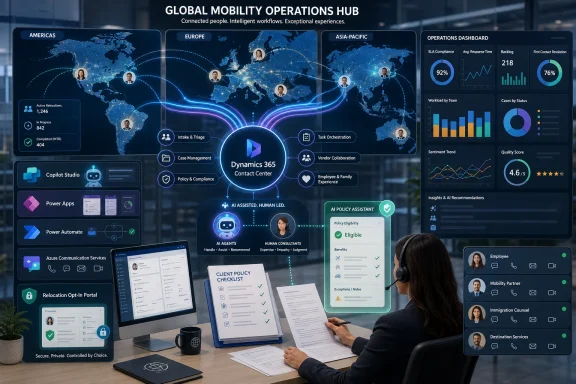 Microsoft’s Best AI Story Is Not a Chatbot Story
The easy version of this story would be to say that Sirva adopted AI agents. That is true, but it undersells the more interesting change. According to Microsoft’s customer story, Sirva was coming out of a merger with BGRS, with one side of the house used to Zendesk and another relying heavily on Outlook and assorted CRM systems.That is the kind of operational fragmentation that does not show up well in vendor keynotes. It produces duplicate work, weak reporting, inconsistent service visibility, and the familiar executive complaint that everyone is busy but nobody can prove where the work is going. In Sirva’s case, Microsoft says the company wanted a global view of response times, SLA performance, workload, call volume, answer rates, and client service quality.
That context matters because AI tends to get sold as magic applied at the interface: a bot answers a question, summarizes a call, or drafts an email. Sirva’s deployment is more revealing because the AI sits on top of a larger consolidation effort. The platform decision came first; the agentic layer became useful because the underlying work moved into a common system.
Microsoft’s own framing is careful on this point. Ricardo Baez, Sirva’s vice president of operations, told Microsoft the company was not necessarily dissatisfied with its previous CRM but needed a platform that could unify operations, deliver AI-powered insights, and scale across global service lines. That is enterprise-speak, but the underlying point is plain: a bot cannot fix an organization whose records, channels, workflows, and metrics are scattered across disconnected tools.
The Merger Created Scale, Then Exposed the Data Problem
Sirva’s current form came from the merger of Sirva and BGRS, two established mobility providers. Microsoft says the combined company operates across the Americas, Europe, and Asia-Pacific, employs about 3,300 people, helps move employees in more than 190 countries, manages more than 100,000 employee relocations annually, and handles more than 175,000 household goods moves each year.Those numbers are impressive, but they also explain why the systems problem became urgent. In a smaller business, a service team can sometimes survive on institutional memory, heroic coordinators, and inbox archaeology. At Sirva’s scale, the cost of fragmented tooling becomes structural.
Legacy BGRS had spent seven years on Zendesk, giving it structured case tracking and SLA visibility. Legacy Sirva consultants, by contrast, often used Outlook as the primary customer communication tool, with other CRMs present elsewhere in the organization. Neither model is inherently absurd. Zendesk is a mature service platform, and Outlook remains the place where a huge amount of enterprise work actually happens. The problem was that the merged company needed a single operating picture.
That is where Microsoft’s stack had an obvious advantage. Dynamics 365 Contact Center is not being positioned here as just another ticketing system. Microsoft describes it as a Copilot-first, cloud-based contact center product designed to bring automation, omnichannel engagement, routing, summaries, AI agents, sentiment analysis, transcription, translation, dashboards, and self-service into the CRM environment of an organization’s choice.
For a company already leaning into Microsoft 365, Power BI, Power Automate, Azure Communication Services, and Copilot Studio, the pitch is not just feature parity. It is gravitational pull. Microsoft is offering a way to make service operations, productivity software, analytics, automation, and AI development feel like parts of the same administrative universe.
Dynamics Wins When the Workflow Is the Product
Sirva’s deployment began with the Microsoft relocation services team, a group of roughly 40 to 50 consultants managing relocations for Microsoft employees globally. Microsoft says that first team went live on Dynamics 365 Contact Center roughly 90 days after the migration decision, and the broader deployment reached the entire organization in under four months.That timeline is likely to raise eyebrows among IT pros. Enterprise CRM and contact center migrations are not famous for being quick, painless, or politically simple. Microsoft’s customer story naturally emphasizes success, not the late-night implementation debris, but the timeframe still matters because it points to where SaaS platforms are competing now.
The old enterprise software contest was about who had the deepest feature checklist. The new one is about who can become the fastest way to reorganize work after a business change. Mergers, acquisitions, outsourcing shifts, regional reorganizations, compliance demands, and AI mandates all require companies to rewire process without spending years rebuilding internal systems.
Sirva’s rollout also avoided one of the more dangerous AI traps: telling employees that software is coming to replace their judgment. Baez told Microsoft that nothing implemented was intended to take relocation consultants out of the loop, and that agents were acting as assistants to consultants. In a field like relocation, that distinction is not cosmetic.
A relocation consultant is not simply answering “where is my package?” queries. They are often interpreting client-specific policies, managing exceptions, dealing with time zones and paperwork, and reassuring people who may be moving their families across borders. The workflow is the product. If AI disrupts that relationship rather than supporting it, the software becomes a liability.
The Contact Center Is Becoming Microsoft’s New Enterprise Beachhead
For years, Microsoft’s enterprise advantage was the desktop: Windows, Office, Exchange, Active Directory, and eventually Teams. In the cloud era, Azure expanded that footprint into infrastructure and platform services. The Sirva story shows a different beachhead taking shape: the contact center as the place where operational data, customer experience, and AI governance meet.Dynamics 365 Contact Center gives Microsoft a way to enter high-volume service operations without requiring every organization to rip out every existing system at once. Microsoft’s documentation describes the product as working across engagement channels and CRM environments, with features such as IVR, unified routing, conversation summaries, AI agents, live transcription, translation, and analytics. In plain terms, it is trying to be the layer where service work becomes visible and steerable.
That is why Sirva’s use of Power BI is not a side detail. If leadership cannot see workload, escalation patterns, SLA performance, quality issues, and client-specific demand, then service management becomes anecdotal. Whoever complains most loudly appears to have the biggest problem. A unified platform turns those complaints into trends that can be investigated, staffed, automated, or escalated.
There is a WindowsForum angle here even though this is not a Windows desktop story. Many IT pros experience Microsoft’s AI push through Windows 11, Microsoft 365 Copilot, Edge, or security tooling. But the enterprise power of Copilot may ultimately be determined less by consumer-facing assistants and more by line-of-business systems like Dynamics, where work already has structure, identity, permissions, and measurable outcomes.
That makes the contact center a natural proving ground. It has enough repetition for AI to help, enough documentation for retrieval to matter, enough human interaction to require caution, and enough managerial pressure to justify analytics. It is also full of legacy systems that executives would love to consolidate if the migration risk can be contained.
Copilot Studio Turns Custom Process Into an AI Surface
The most interesting part of Sirva’s deployment is not the out-of-the-box agent list. It is the custom work being built in Copilot Studio. Microsoft says Sirva is developing agents tailored to relocation workflows, including a proof of concept that drafts customer responses based on historical actions, individual policies, and client communication style.That is where the promise and the risk both sharpen. Generic AI can summarize a conversation. Domain-specific AI can draft a relocation response that accounts for policy eligibility, prior actions, and a client’s preferred tone. The latter is more valuable, but it is also harder to govern.
Sirva is also building a custom agent that reviews relocation consultant responses against client policies, measures accuracy, and surfaces quality metrics through automated dashboards. That is a very different use case from a chatbot. It turns AI into a control layer for service quality.
For managers, this is attractive because it makes quality assurance less dependent on random sampling and manual review. For employees, it may feel more ambiguous. An assistant that drafts a response is one thing; an agent that evaluates whether your response complied with policy is another. The same system that reduces drudgery can also increase surveillance if governance and culture are mishandled.
Microsoft’s first-party agent roadmap reinforces this shift. Microsoft Learn describes agents for customer intent, case management, customer knowledge management, and quality evaluation across Dynamics 365 Customer Service and Dynamics 365 Contact Center. These agents are designed to discover customer intent, automate case lifecycle tasks, extract knowledge from cases, and assess customer interactions against evaluation frameworks.
The pattern is clear: Microsoft is not just putting Copilot into business apps. It is decomposing service operations into agent-addressable tasks.
Human-in-the-Loop Is Not Sentimentality; It Is Risk Management
It is fashionable to talk about AI in terms of replacement, but Sirva’s use case shows why replacement is often the wrong enterprise frame. Relocation data can include salary, passport, immigration, family, and employment information. Microsoft says Sirva’s client-facing Explorer feature in its portal uses AI to answer questions about active relocating employee populations, but adoption requires client opt-in because of the sensitivity of the data.That one sentence carries more weight than most AI announcements. Client opt-in is not just a legal courtesy. It is recognition that AI access to operational data changes the trust boundary.
A relocation program is not like a public product support forum. It contains private employee circumstances, corporate mobility policies, immigration timelines, personal travel details, and sometimes compensation-linked information. An AI system that answers questions about that population has to be correct, permission-aware, auditable, and constrained.
That is why the consultant remains central. The most mature enterprise AI deployments are likely to be those that automate retrieval, summarization, drafting, classification, and measurement while leaving judgment, exception handling, and sensitive communication under human control. In Sirva’s case, Baez told Microsoft the transformation is about giving consultants more time for the personal and complex aspects of relocation where human expertise matters most.
Skeptics will hear that and roll their eyes, because every automation wave arrives wrapped in promises that humans will be elevated rather than squeezed. The skepticism is healthy. But in heavily regulated, emotionally charged, or exception-rich workflows, keeping humans in the loop is not charity. It is a way to prevent the software from confidently doing the wrong thing at scale.
The Zendesk-to-Dynamics Angle Is Really a Microsoft Ecosystem Angle
The customer story inevitably invites a competitive reading: Sirva moved legacy BGRS users from Zendesk and brought other CRM users into Dynamics. That is a win for Microsoft. But the more strategic angle is that Dynamics did not arrive alone.The stack includes Dynamics 365 Contact Center, Copilot Studio, Power Apps, Power Automate, Azure Communication Services, Power BI, and Microsoft 365 Copilot for senior leadership. Sirva also built what Microsoft describes as an internal AI Hive, an intranet hub with best practices, knowledge articles, and curated prompts to support structured AI adoption.
That combination illustrates Microsoft’s favorite enterprise motion. First, consolidate work into a Microsoft business application. Then use Power Platform to adapt process around it. Then use Power BI to make the work visible. Then use Copilot and agents to speed up drafting, summarization, classification, and insight generation. Then use Microsoft 365 Copilot to pull leadership and knowledge work into the same orbit.
For customers, the upside is integration. Identity, security, reporting, automation, collaboration, and AI development can be managed with fewer seams than a patchwork of point solutions. For competitors, this is the nightmare scenario: Microsoft does not need to win every individual feature comparison if it can win the architecture decision.
The risk for customers is lock-in with a friendlier face. Once workflows, dashboards, AI agents, policy checks, portal features, and executive reporting all depend on one vendor ecosystem, leaving becomes harder. That does not mean the decision is wrong. It means the architecture needs to be treated as a strategic commitment, not merely a procurement refresh.
AI Adoption Now Requires Internal Product Management
One understated lesson from Sirva’s story is that enterprise AI adoption is becoming a product-management discipline. The internal AI Hive is the clue. A hub for best practices, knowledge articles, and curated prompts suggests Sirva understood that giving employees tools is not the same as changing how they work.That will sound familiar to sysadmins who lived through SharePoint sprawl, Teams governance, Power Platform shadow IT, and every “citizen developer” wave of the past decade. The technology is powerful precisely because it lets business units move quickly. It is dangerous for the same reason.
Copilot Studio raises the stakes because business logic can now be embedded in conversational and agentic systems. A poorly governed workflow is no longer just a confusing form or an ugly dashboard. It can become an automated recommendation, a drafted response, a policy judgment, or a quality score.
The companies that succeed here will not be the ones that simply license Copilot broadly. They will be the ones that treat agents as products: versioned, tested, monitored, measured, retired when necessary, and owned by accountable teams. They will need subject-matter experts, IT governance, security review, data stewardship, and change management in the same room.
Sirva’s case suggests that Microsoft understands this pitch. The story emphasizes not only agents but adoption patterns, familiar workflows for Zendesk users, CRM structure for Outlook-heavy teams, and leadership use of Copilot for forecasting, account insight, voice-of-customer analysis, and escalation root cause analysis. The message is that AI lands best when it is wrapped in operational discipline.
The Real Prize Is Measurable Service Work
The most concrete business value in the Sirva story is visibility. Microsoft says the company now has a single service platform, case summaries, interaction highlights, structured workflows, and better insight into SLAs, workload, and client service. That is less glamorous than autonomous AI, but it is probably the thing executives will pay for first.Service organizations are full of hidden labor. Employees spend time searching inboxes, reconciling policy details, writing repetitive responses, updating cases, briefing colleagues, and explaining escalations. None of that disappears just because a company has a CRM. It disappears only when process, data, and communication channels are aligned tightly enough for automation to help.
Sirva’s use of AI to identify policy eligibility inside a customer-facing portal is a good example. If a relocating employee asks a question and the system can identify the policy that applies, the value is not merely faster response time. The value is reducing the cognitive burden on the consultant and the uncertainty for the employee.
The same applies to quality review. A custom agent that checks consultant responses against client policies could expose training gaps, policy ambiguity, or process bottlenecks. Used well, it improves the system. Used poorly, it becomes a productivity cudgel. The difference will depend less on the model and more on management.
For IT leaders, that is the useful lesson. AI does not eliminate the need to understand the business process. It punishes organizations that do not.
The Sirva Deployment Shows Where Microsoft Wants the Market to Go
Sirva’s move onto Dynamics 365 Contact Center is best read as a marker of Microsoft’s broader strategy: turn AI from an add-on into the connective tissue of business operations. The customer story gives enough detail to see what is real, and enough vendor gloss to remind us to keep our skepticism close.- Sirva consolidated post-merger service operations from Zendesk, Outlook-centric workflows, and other CRMs onto a Microsoft platform spanning Dynamics 365 Contact Center, Copilot Studio, Power Platform, Azure Communication Services, and Power BI.
- Microsoft says the first relocation services team went live roughly 90 days after the migration decision, and the full organization moved to a single platform in under four months.
- The most practical benefits are not futuristic; they are unified SLA visibility, workload measurement, structured workflows, call and service insight, and better reporting across global operations.
- Sirva is using AI agents as assistants rather than replacements, with custom Copilot Studio work focused on response drafting, policy accuracy, customer intent, and quality metrics.
- The client-facing Explorer feature highlights the central governance challenge, because relocation data can include sensitive employee, salary, passport, and immigration information.
- The deployment strengthens Microsoft’s argument that the real value of Copilot is unlocked when it is connected to business applications, identity, data, analytics, and workflow automation.
References
- Primary source: Microsoft
Published: 2026-07-07T14:16:07.620988
Sirva unifies global mobility operations on a single intelligent platform with Dynamics 365 Contact Center and Copilot Studio | Microsoft Customer Stories
Sirva consolidates fragmented relocation systems onto Dynamics 365 Contact Center, deploying AI agents to empower consultants worldwide.www.microsoft.com