

Microsoft has spent nearly three years building IntelLicense, an enterprise-wide platform that pulls contracts, costs, supplier records, product data, employee usage telemetry, and licensing information from 19 systems into a Software Asset Management portal, then uses agentic AI to answer questions that once took up to six months. The striking part is not that Microsoft attached a Copilot-style interface to procurement data. It is that the company first had to reconstruct an enterprise-wide view of software ownership before AI could offer anything more valuable than faster confusion.
IntelLicense is therefore best understood as a software-governance project with an AI layer, not an AI project that happens to manage software. Microsoft’s account shows how licensing waste accumulates when contracts, purchasing authority, usage records, and supplier negotiations belong to different teams—and why the hard part of fixing that waste is less glamorous than the chatbot placed on top.
Software licensing sprawl is an almost inevitable consequence of enterprise scale. One team buys a specialist application for a project, another negotiates a separate agreement with the same supplier, and a third pays for a competing product because nobody can see what the first two groups already own.
At Microsoft, that pattern plays out across more than 200,000 employees working in over 100 countries. Thousands of third-party tools support those employees, while the associated contracts, entitlements, costs, usage records, supplier relationships, and provisioning details cross organizational boundaries.
Ahmed Musa, a senior software engineer in Microsoft Digital and principal architect for IntelLicense, described licensing information as fragmented among repositories with different owners. Microsoft lacked visibility into which contracts existed and how the purchased software was being used.
That is not merely an inventory failure. It is a breakdown in the connection between procurement, finance, IT operations, employees, software asset managers, and the teams responsible for negotiating with suppliers.
Microsoft Digital initially encountered the problem through employee feedback. Workers reportedly struggled to identify and license the third-party software they needed, but that employee-facing inconvenience exposed a much larger operational weakness.
“As we looked beyond just employees finding software and deeper into the process, we began to see the challenge was also about purchasing, how we dealt with suppliers, and how we managed the licenses at a higher level,” said Revanth Chandra Pydimarri, a senior product manager in Microsoft Digital. “That’s where we saw the big opportunity.”
That distinction matters. A conventional software catalog might help employees find approved applications, but it would not necessarily tell procurement whether two departments had negotiated overlapping contracts, whether paid entitlements were sitting unused, or whether a supplier’s overuse claim matched the company’s provisioning and telemetry records.
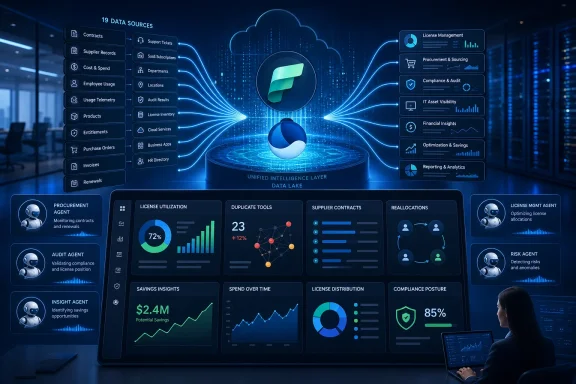
IntelLicense attempts to join those decisions into one system. It collects product information, contracts, costs, employee usage telemetry, and supplier details, then exposes them through Microsoft’s Software Asset Management portal.
The result is meant to be more than a searchable repository. Microsoft is trying to create a common operating model for software acquisition, allocation, auditing, renewal, and retirement—processes that had previously been distributed among teams with incomplete and sometimes incompatible information.
That made IntelLicense a data problem before it became an application problem. Microsoft could not reliably automate licensing decisions until it established relationships among contracts, suppliers, products, users, devices, entitlements, costs, and observed usage.
A contract may describe a purchased right in one language, a provisioning system may represent it as an account or device assignment, and telemetry may measure activity through an entirely different identifier. Even when the records refer to the same product, they do not automatically constitute a trustworthy answer.
Microsoft’s first work was therefore investigative. Selveraj and Chandra Pydimarri mapped the existing software asset-management journey, including its steps, dependencies, stakeholders, and bottlenecks.
The exercise convinced the team that incremental repairs would not be enough. “We identified so many different bottlenecks,” Selveraj said. “And that’s when we decided we can’t just troubleshoot the existing process—we needed to build a new platform that would span the enterprise.”
That conclusion is more important than the eventual choice of AI model or user interface. Many enterprise automation programs fail because they preserve the fragmented process underneath and merely add a new front end.
A conversational assistant cannot infer a dependable license position from records that disagree about what was purchased, who received it, which supplier provided it, and whether it remains in use. It may produce a fluent response quickly, but speed is not the same as authority.
Microsoft says an answer that once took up to six months to track down can now be generated immediately. That is a dramatic improvement, but the more revealing measurement is the original six months: it shows how much labor had been consumed by locating, reconciling, validating, and interpreting information rather than acting on it.
The old process was not slow because employees were incapable of analysis. It was slow because every important question could become a cross-organizational research project.
IntelLicense compresses that research by turning scattered records into a shared data foundation. The AI experience comes later, after the company has done the tedious work of connecting the evidence.
The choice fit the architectural problem. Microsoft needed to ingest and transform information from numerous systems without creating yet another isolated copy of the licensing estate.
Misrak Ararso, a senior software engineer in Microsoft Digital, said Fabric’s unified design made it suitable for the project. The team used Data Wrangler to inspect and clean data, while Microsoft OneLake allowed it to work with information without first duplicating every source.
Microsoft’s current description of Fabric continues to emphasize an integrated data environment operating over OneLake, while its documentation characterizes OneLake as a unified data lake through which Fabric workloads can access shared information. That architecture aligns closely with IntelLicense’s central requirement: establish one governed foundation without pretending every source system will disappear.
The distinction between centralization and replacement is crucial. A large organization rarely gets permission, funding, and cooperation to retire every source system before producing value.
A practical enterprise data platform instead creates a common layer across those systems. It normalizes enough of their meaning to support shared analysis while allowing the originating teams and applications to continue operating.
Microsoft’s account does not portray early Fabric adoption as effortless. Ararso said the team encountered challenges, supplied feedback, and benefited as the platform matured alongside the implementation.
That acknowledgment gives the story more credibility than a frictionless product demonstration would. IntelLicense was not assembled from a polished set of components after all architectural questions had been settled; it evolved with a data platform that was itself changing.
The risk of that approach is obvious. Early adopters may need to absorb shifting capabilities, incomplete tooling, and additional engineering work.
The advantage is equally clear. Microsoft Digital could influence the product while testing it against a difficult internal workload, and the Fabric teams could receive feedback grounded in a real enterprise deployment rather than a synthetic demonstration.
For other organizations, the lesson is not necessarily to adopt preview technology for a financially sensitive system. It is to recognize that software asset management depends on data engineering, ownership, quality controls, and semantic consistency long before it depends on generative AI.
Microsoft offers a simple illustration. One group purchases 20 licenses but uses only 15; another group needs five licenses and buys them independently because it cannot see the unused capacity.
The company has not exceeded its collective entitlement in that example. It has exceeded the necessary expenditure because its organizational boundaries have hidden available inventory.
Employee movement makes the problem worse. When someone changes teams or leaves the company, a license may remain assigned unless identity, provisioning, usage, and ownership information can be reconciled.
Rasa Amiri, senior sourcing manager in Financial Operations, said it had previously been difficult to gauge usage, consolidate agreements, optimize costs, audit contracts, or move licenses. Those processes required manual work and considerable effort.
IntelLicense gives asset managers the ability to identify apparently unused licenses and contact the employee or owner about reallocation. That creates a bridge between telemetry and action: the system does not merely report low usage but helps initiate the process of recovering the entitlement.
The SAM portal focuses on Microsoft’s top 200 suppliers. According to Amiri, newly negotiated deals are uploaded with their costs, contract details, and license quantities, enabling the company to support reallocations and respond more quickly when suppliers claim overuse.
That second function is easy to underestimate. Software asset management is often described as a cost-cutting exercise, but a trustworthy license position also strengthens the customer’s negotiating and audit posture.
A supplier may see one set of activations, accounts, devices, or consumption records. The customer may have different contractual rights, exceptions, allocation rules, or internal ownership records.
Resolving the dispute quickly requires more than a dashboard showing a usage total. It requires traceability from the observed activity back to the relevant agreement, entitlement, provisioning record, and accountable business unit.
IntelLicense is also intended to expose functional duplication. Musa said the platform can identify overlapping tools and surface relevant alternatives, allowing employees and decision-makers to consider products the company already uses before buying another.
This moves the system upstream. Instead of finding waste only after a contract has been signed, IntelLicense can potentially influence product selection and purchasing before another obligation is created.
That is where software asset management becomes strategically useful. Recovering an unused license saves money once; changing the organization’s purchasing behavior can prevent repeated waste across suppliers and renewal cycles.
Chandra Pydimarri cited industry studies estimating that up to 20% of third-party software spending is unnecessary. Microsoft says IntelLicense produced substantial licensing savings over the last fiscal year, although its Inside Track account does not disclose an amount or explain how those savings were calculated.
The missing figure limits independent evaluation. “Substantial” could include avoided purchases, reassigned licenses, negotiated reductions, cancelled renewals, audit savings, or several categories combined.
Even without the number, however, Microsoft’s 20-license example captures the underlying economics. Software waste is often not a spectacular purchasing error; it is the accumulation of ordinary decisions made without enterprise visibility.
Urvi Sengar, a senior software engineer in Microsoft Digital, described the required next step as decision intelligence. Users did not need another passive dashboard, she argued, but a system capable of connecting signals, presenting actionable insights, and guiding decisions in real time.
That observation reflects a weakness common to enterprise analytics. Dashboards can consolidate information while transferring the interpretive burden to the person looking at them.
A sourcing manager negotiating with a supplier does not necessarily want to navigate several reports, reconcile filters, and manually compare product usage with contract terms. The manager wants an answer tied to the current negotiation: what the company owns, what it uses, where capacity remains, which alternatives exist, and which records support that conclusion.
Microsoft used Microsoft Foundry to build a multi-agent layer for IntelLicense. The architecture includes a workflow manager that delegates requests to specialized agents handling areas such as license management, supplier management, and audit scenarios.
Each agent interprets the user’s intent and can call deterministic workflows when necessary. That combination is important because software governance requires both flexible language understanding and predictable execution.
Natural language is useful for expressing an ambiguous business question. It is less appropriate as the sole mechanism for changing an entitlement, contacting a user, approving a purchase, or asserting compliance.
Deterministic workflows can constrain those actions to defined procedures. The agent may help determine which workflow is relevant and gather the context, but the underlying business operation can remain structured, testable, and auditable.
Microsoft’s Foundry documentation similarly presents multi-agent workflows as a way to coordinate specialized roles and business logic, including repeatable sequences and human involvement. IntelLicense applies that pattern to a domain where a single general-purpose assistant would face too many distinct responsibilities.
A license-management query and a supplier-audit query may touch some of the same data, but they have different objectives and risk profiles. Separating them into specialized agents can make routing, evaluation, permissions, and troubleshooting more manageable.
It also creates a new governance burden. Every agent with access to contractual, financial, supplier, employee, or device information becomes another participant in the authorization model.
The quality of IntelLicense will therefore depend on more than whether its answers sound plausible. Microsoft must ensure that agents retrieve only the information appropriate to the user’s role, preserve the context needed to explain recommendations, and do not silently turn an uncertain inference into an operational fact.
This separation is architecturally sensible because each layer changes at a different pace. The portal experience can evolve without redefining every source record, while new specialized agents can be introduced without forcing all users to understand the underlying data model.
More importantly, the architecture gives Microsoft places to enforce control. The UX layer can limit what actions a role may request, the AI layer can restrict which tools and workflows an agent may call, and the data layer can govern access to sensitive records.
The embedded Copilot is the visible part, but the data layer carries most of the authority. If a user asks whether a product is overlicensed, IntelLicense must connect contractual entitlement with provisioning and actual usage rather than answer from a generic description of the agreement.
The multi-agent layer then determines what kind of question has been asked. A request to identify unused licenses may go to a license-management specialist, while a dispute over supplier-reported overuse may require an audit-oriented path.
Sengar said the platform’s workflow manager delegates queries to agents that understand intent and can invoke deterministic processes. The architecture is closer to a controlled service desk staffed by specialists than a single chatbot granted broad access to every licensing operation.
That modularity should also make individual capabilities easier to test. An organization can evaluate whether its audit agent consistently retrieves the correct evidence without conflating that result with the performance of a procurement-recommendation agent.
The unresolved question is how confidently the system distinguishes a recommendation from a verified license position. Enterprise users need visible boundaries between what the data proves, what the AI infers, and what still requires review by procurement, legal, finance, or an asset manager.
Licensing decisions can carry financial, contractual, operational, and compliance consequences. Reclaiming the wrong entitlement may interrupt an employee’s work, while misreading an agreement may weaken the company’s position in a supplier dispute.
Usage telemetry is particularly easy to oversimplify. A product that has not been opened recently may still be essential for an infrequent reporting period, incident response procedure, regulatory task, or specialized project.
Low activity is therefore a signal, not necessarily proof of waste. IntelLicense can identify the candidate and start the conversation, but a responsible recovery process still needs business context.
The same caution applies to overlapping products. Two applications may look functionally similar in a catalog while differing in compatibility, data handling, workflow integration, contractual terms, accessibility, regional availability, or specialized capabilities.
An alternative surfaced by IntelLicense should support a purchasing decision, not pre-empt it. The employee or product owner still needs a way to explain why the apparently redundant tool serves a distinct requirement.
Data freshness is another critical issue. A real-time portal does not guarantee that every contributing system has delivered current or complete information.
If a recently negotiated contract has not been loaded, a new employee assignment has not reached the provisioning record, or telemetry is delayed, the platform’s unified view may be internally consistent but temporally wrong. Every actionable answer should therefore carry enough lineage and timing information for a specialist to judge its reliability.
Microsoft’s own architecture points toward that kind of controlled model. Role-based access, specialized agents, APIs, plug-ins, and deterministic workflows provide boundaries that a general conversational interface alone would not.
The challenge is maintaining those boundaries as the system expands. Adding an agent is technically easier than establishing who owns it, which data it may use, how its quality is evaluated, what actions it may initiate, and how failures are investigated.
IntelLicense may reduce software sprawl while creating a smaller form of agent sprawl inside the management platform. Microsoft will need the same discipline for its AI capabilities that it is applying to third-party licenses: ownership, inventory, usage visibility, overlap detection, and retirement when a component no longer provides value.
That makes the story useful but necessarily selective. Microsoft describes substantial savings and immediate answers without publishing the financial result, accuracy measurements, adoption levels, error rates, supplier-dispute outcomes, or the amount of manual validation still required.
Those omissions do not invalidate the architecture. They do mean readers should distinguish between a persuasive implementation narrative and a complete business case.
Microsoft is serving several audiences at once. Employees are shown a simpler route to software, procurement teams gain negotiating intelligence, IT leaders see a software asset-management pattern, and prospective Microsoft customers see a demonstration of the company’s broader data and AI stack.
IntelLicense is especially effective as a showcase because licensing sprawl is a problem that Microsoft’s enterprise customers will immediately recognize. It is costly, politically distributed, rich in unstructured contractual context, and difficult to solve through a single system replacement.
The project also advances Microsoft’s “Frontier Firm” argument: AI should not remain a standalone productivity feature but become part of how an organization operates. IntelLicense places AI inside an existing business process where recommendations can affect budgets and supplier relationships.
Yet the implementation quietly contradicts the easiest version of that message. Microsoft did not leap from scattered spreadsheets and systems directly to autonomous agents.
It spent nearly three years mapping processes, negotiating access, cleaning records, unifying data, building a portal, and then adding agentic orchestration. The AI transformation depended on conventional enterprise engineering being done first.
That is the more valuable customer-zero lesson. AI can shorten the distance between evidence and action, but it cannot remove the need to define the evidence.
A proper financial assessment would need to separate realized savings from avoided costs. Reassigning an already purchased license may prevent a new purchase, but the value depends on whether the second team would otherwise have bought the same product and whether the agreement permits the transfer.
Contract consolidation may create a better volume discount, but it can also increase commitment or reduce flexibility. Eliminating an overlapping product saves money only if migration, training, integration changes, and lost functionality do not outweigh the license reduction.
Even unused licenses can be economically rational in some agreements. An annual commitment with spare capacity may cost less than a more flexible arrangement that charges a higher unit price.
IntelLicense’s contribution is not that every low-use entitlement automatically becomes savings. It is that Microsoft can evaluate those trade-offs with a more complete view of contracts, allocations, telemetry, costs, and supplier relationships.
The platform can also shorten the feedback loop. Instead of discovering excess capacity during an annual audit, asset managers can reportedly monitor it through the SAM portal and address it while the information remains operationally useful.
That faster cycle may ultimately be more valuable than any one-time cleanup. Software estates drift continuously as employees move, projects end, suppliers change terms, and teams adopt new tools.
A platform that only produces a periodic inventory will begin becoming obsolete as soon as the report is generated. IntelLicense is intended to maintain an active relationship among what Microsoft bought, what it assigned, and what employees actually use.
The agentic layer adds value when it makes that changing state accessible at the moment of decision. A sourcing manager should not need to commission a lengthy research exercise while negotiating a renewal, and an employee should not buy a new tool without being shown relevant alternatives already available.
The mechanism, then, is repeated intervention: reclaim here, consolidate there, challenge an overuse claim, avoid a duplicate purchase, and steer a user toward an existing product. At Microsoft’s scale, many modest corrections can matter more than a single dramatic cut.
Starting with a chatbot reverses that sequence. It encourages teams to optimize the interaction before they know whether the underlying answer is complete, current, or contractually correct.
The first useful scope may also be narrower than Microsoft’s enterprise-wide platform. IntelLicense focuses its real-time SAM portal on the top 200 suppliers, suggesting that prioritization remains necessary even inside one of the world’s largest technology companies.
A smaller organization could begin with its highest-cost suppliers, largest renewal risks, or most duplicated product categories. Proving the quality of a focused dataset is more useful than creating an impressive interface over an unreliable inventory.
Ownership must be explicit. Procurement may own contracts, IT may own provisioning, security may own application approval, finance may own costs, and business teams may control the actual license assignments.
The platform needs a process for resolving disagreements among those sources. Otherwise, “single source of truth” becomes a slogan masking several competing versions of truth.
Telemetry collection also requires restraint. A company needs enough usage information to support allocation and negotiation without turning software asset management into unnecessary employee surveillance.
Role-based access and purpose limitation should be designed into the platform. A procurement specialist may need aggregate utilization and contract evidence, while a license owner may need named assignments for a specific application.
Conversely, a small number of well-supported interventions may justify the system if they improve a major negotiation, prevent a duplicate enterprise agreement, or resolve an expensive supplier dispute.
A department may prefer to keep spare licenses because availability is more important to it than company-wide utilization. A project leader may resist an approved alternative because migration introduces local risk, even when procurement sees obvious duplication.
Central management can expose those trade-offs but cannot eliminate them. Microsoft will need policies that distinguish legitimate reserve capacity and specialist requirements from passive waste.
It will also need incentives. If savings accrue centrally while migration work and operational risk remain with the individual team, local managers have little reason to volunteer their licenses or replace a familiar product.
The best version of IntelLicense would therefore make cooperation easier rather than merely making waste visible. It could shorten requests, simplify reassignment, preserve exceptions, and provide enough context for teams to trust the proposed action.
The multi-agent architecture may help by tailoring the experience. Employees, asset managers, and procurement specialists do not need the same explanation or level of detail, even when they are acting on the same underlying license.
But role-based interfaces cannot substitute for governance. Someone must decide when an agent’s recommendation is sufficient, when a human approval is mandatory, and who is accountable if the resulting action is wrong.
Senthil Selveraj, principal group product manager in Microsoft Digital, said the ultimate goal is to produce cost savings while applying intelligence across as much of the process as possible. That ambition points toward a system that does not merely answer licensing questions but participates throughout procurement and asset management.
The danger is allowing “as much intelligence as possible” to become “as much automation as possible.” The most impactful system will not be the one that takes the most actions; it will be the one that takes or recommends the right actions with evidence users can inspect.
IntelLicense is therefore best understood as a software-governance project with an AI layer, not an AI project that happens to manage software. Microsoft’s account shows how licensing waste accumulates when contracts, purchasing authority, usage records, and supplier negotiations belong to different teams—and why the hard part of fixing that waste is less glamorous than the chatbot placed on top.
 Microsoft’s Licensing Problem Was Organizational Before It Was Technical
Software licensing sprawl is an almost inevitable consequence of enterprise scale. One team buys a specialist application for a project, another negotiates a separate agreement with the same supplier, and a third pays for a competing product because nobody can see what the first two groups already own.At Microsoft, that pattern plays out across more than 200,000 employees working in over 100 countries. Thousands of third-party tools support those employees, while the associated contracts, entitlements, costs, usage records, supplier relationships, and provisioning details cross organizational boundaries.
Ahmed Musa, a senior software engineer in Microsoft Digital and principal architect for IntelLicense, described licensing information as fragmented among repositories with different owners. Microsoft lacked visibility into which contracts existed and how the purchased software was being used.
That is not merely an inventory failure. It is a breakdown in the connection between procurement, finance, IT operations, employees, software asset managers, and the teams responsible for negotiating with suppliers.
Microsoft Digital initially encountered the problem through employee feedback. Workers reportedly struggled to identify and license the third-party software they needed, but that employee-facing inconvenience exposed a much larger operational weakness.
“As we looked beyond just employees finding software and deeper into the process, we began to see the challenge was also about purchasing, how we dealt with suppliers, and how we managed the licenses at a higher level,” said Revanth Chandra Pydimarri, a senior product manager in Microsoft Digital. “That’s where we saw the big opportunity.”
That distinction matters. A conventional software catalog might help employees find approved applications, but it would not necessarily tell procurement whether two departments had negotiated overlapping contracts, whether paid entitlements were sitting unused, or whether a supplier’s overuse claim matched the company’s provisioning and telemetry records.
IntelLicense attempts to join those decisions into one system. It collects product information, contracts, costs, employee usage telemetry, and supplier details, then exposes them through Microsoft’s Software Asset Management portal.
The result is meant to be more than a searchable repository. Microsoft is trying to create a common operating model for software acquisition, allocation, auditing, renewal, and retirement—processes that had previously been distributed among teams with incomplete and sometimes incompatible information.
Nineteen Systems Turned Basic Questions Into Six-Month Investigations
Jay Selveraj, principal software engineering manager in Microsoft Digital, said the project identified 19 different systems containing relevant licensing data. The information was highly distributed, non-standard, and controlled by different teams.That made IntelLicense a data problem before it became an application problem. Microsoft could not reliably automate licensing decisions until it established relationships among contracts, suppliers, products, users, devices, entitlements, costs, and observed usage.
A contract may describe a purchased right in one language, a provisioning system may represent it as an account or device assignment, and telemetry may measure activity through an entirely different identifier. Even when the records refer to the same product, they do not automatically constitute a trustworthy answer.
Microsoft’s first work was therefore investigative. Selveraj and Chandra Pydimarri mapped the existing software asset-management journey, including its steps, dependencies, stakeholders, and bottlenecks.
The exercise convinced the team that incremental repairs would not be enough. “We identified so many different bottlenecks,” Selveraj said. “And that’s when we decided we can’t just troubleshoot the existing process—we needed to build a new platform that would span the enterprise.”
That conclusion is more important than the eventual choice of AI model or user interface. Many enterprise automation programs fail because they preserve the fragmented process underneath and merely add a new front end.
A conversational assistant cannot infer a dependable license position from records that disagree about what was purchased, who received it, which supplier provided it, and whether it remains in use. It may produce a fluent response quickly, but speed is not the same as authority.
Microsoft says an answer that once took up to six months to track down can now be generated immediately. That is a dramatic improvement, but the more revealing measurement is the original six months: it shows how much labor had been consumed by locating, reconciling, validating, and interpreting information rather than acting on it.
The old process was not slow because employees were incapable of analysis. It was slow because every important question could become a cross-organizational research project.
IntelLicense compresses that research by turning scattered records into a shared data foundation. The AI experience comes later, after the company has done the tedious work of connecting the evidence.
Fabric Became the Foundation While It Was Still Maturing
Microsoft chose Microsoft Fabric as IntelLicense’s underlying data platform when Fabric had just entered public preview. That made the project a conspicuous example of Microsoft acting as its own early enterprise customer.The choice fit the architectural problem. Microsoft needed to ingest and transform information from numerous systems without creating yet another isolated copy of the licensing estate.
Misrak Ararso, a senior software engineer in Microsoft Digital, said Fabric’s unified design made it suitable for the project. The team used Data Wrangler to inspect and clean data, while Microsoft OneLake allowed it to work with information without first duplicating every source.
Microsoft’s current description of Fabric continues to emphasize an integrated data environment operating over OneLake, while its documentation characterizes OneLake as a unified data lake through which Fabric workloads can access shared information. That architecture aligns closely with IntelLicense’s central requirement: establish one governed foundation without pretending every source system will disappear.
The distinction between centralization and replacement is crucial. A large organization rarely gets permission, funding, and cooperation to retire every source system before producing value.
A practical enterprise data platform instead creates a common layer across those systems. It normalizes enough of their meaning to support shared analysis while allowing the originating teams and applications to continue operating.
Microsoft’s account does not portray early Fabric adoption as effortless. Ararso said the team encountered challenges, supplied feedback, and benefited as the platform matured alongside the implementation.
That acknowledgment gives the story more credibility than a frictionless product demonstration would. IntelLicense was not assembled from a polished set of components after all architectural questions had been settled; it evolved with a data platform that was itself changing.
The risk of that approach is obvious. Early adopters may need to absorb shifting capabilities, incomplete tooling, and additional engineering work.
The advantage is equally clear. Microsoft Digital could influence the product while testing it against a difficult internal workload, and the Fabric teams could receive feedback grounded in a real enterprise deployment rather than a synthetic demonstration.
For other organizations, the lesson is not necessarily to adopt preview technology for a financially sensitive system. It is to recognize that software asset management depends on data engineering, ownership, quality controls, and semantic consistency long before it depends on generative AI.
Procurement Is Where Visibility Turns Into Financial Leverage
IntelLicense’s most tangible value appears in procurement, where incomplete information produces direct costs. Without an enterprise view, a company can buy licenses it already owns, retain entitlements nobody uses, negotiate separate agreements that should have been consolidated, or struggle to challenge a supplier’s accounting.Microsoft offers a simple illustration. One group purchases 20 licenses but uses only 15; another group needs five licenses and buys them independently because it cannot see the unused capacity.
The company has not exceeded its collective entitlement in that example. It has exceeded the necessary expenditure because its organizational boundaries have hidden available inventory.
Employee movement makes the problem worse. When someone changes teams or leaves the company, a license may remain assigned unless identity, provisioning, usage, and ownership information can be reconciled.
Rasa Amiri, senior sourcing manager in Financial Operations, said it had previously been difficult to gauge usage, consolidate agreements, optimize costs, audit contracts, or move licenses. Those processes required manual work and considerable effort.
IntelLicense gives asset managers the ability to identify apparently unused licenses and contact the employee or owner about reallocation. That creates a bridge between telemetry and action: the system does not merely report low usage but helps initiate the process of recovering the entitlement.
The SAM portal focuses on Microsoft’s top 200 suppliers. According to Amiri, newly negotiated deals are uploaded with their costs, contract details, and license quantities, enabling the company to support reallocations and respond more quickly when suppliers claim overuse.
That second function is easy to underestimate. Software asset management is often described as a cost-cutting exercise, but a trustworthy license position also strengthens the customer’s negotiating and audit posture.
A supplier may see one set of activations, accounts, devices, or consumption records. The customer may have different contractual rights, exceptions, allocation rules, or internal ownership records.
Resolving the dispute quickly requires more than a dashboard showing a usage total. It requires traceability from the observed activity back to the relevant agreement, entitlement, provisioning record, and accountable business unit.
IntelLicense is also intended to expose functional duplication. Musa said the platform can identify overlapping tools and surface relevant alternatives, allowing employees and decision-makers to consider products the company already uses before buying another.
This moves the system upstream. Instead of finding waste only after a contract has been signed, IntelLicense can potentially influence product selection and purchasing before another obligation is created.
That is where software asset management becomes strategically useful. Recovering an unused license saves money once; changing the organization’s purchasing behavior can prevent repeated waste across suppliers and renewal cycles.
Chandra Pydimarri cited industry studies estimating that up to 20% of third-party software spending is unnecessary. Microsoft says IntelLicense produced substantial licensing savings over the last fiscal year, although its Inside Track account does not disclose an amount or explain how those savings were calculated.
The missing figure limits independent evaluation. “Substantial” could include avoided purchases, reassigned licenses, negotiated reductions, cancelled renewals, audit savings, or several categories combined.
Even without the number, however, Microsoft’s 20-license example captures the underlying economics. Software waste is often not a spectacular purchasing error; it is the accumulation of ordinary decisions made without enterprise visibility.
A Dashboard Was Never Going to Be Enough
Centralizing the records solved only the first half of Microsoft’s problem. The SAM portal could display richer information, but users still had to interpret what the data meant and decide what to do.Urvi Sengar, a senior software engineer in Microsoft Digital, described the required next step as decision intelligence. Users did not need another passive dashboard, she argued, but a system capable of connecting signals, presenting actionable insights, and guiding decisions in real time.
That observation reflects a weakness common to enterprise analytics. Dashboards can consolidate information while transferring the interpretive burden to the person looking at them.
A sourcing manager negotiating with a supplier does not necessarily want to navigate several reports, reconcile filters, and manually compare product usage with contract terms. The manager wants an answer tied to the current negotiation: what the company owns, what it uses, where capacity remains, which alternatives exist, and which records support that conclusion.
Microsoft used Microsoft Foundry to build a multi-agent layer for IntelLicense. The architecture includes a workflow manager that delegates requests to specialized agents handling areas such as license management, supplier management, and audit scenarios.
Each agent interprets the user’s intent and can call deterministic workflows when necessary. That combination is important because software governance requires both flexible language understanding and predictable execution.
Natural language is useful for expressing an ambiguous business question. It is less appropriate as the sole mechanism for changing an entitlement, contacting a user, approving a purchase, or asserting compliance.
Deterministic workflows can constrain those actions to defined procedures. The agent may help determine which workflow is relevant and gather the context, but the underlying business operation can remain structured, testable, and auditable.
Microsoft’s Foundry documentation similarly presents multi-agent workflows as a way to coordinate specialized roles and business logic, including repeatable sequences and human involvement. IntelLicense applies that pattern to a domain where a single general-purpose assistant would face too many distinct responsibilities.
A license-management query and a supplier-audit query may touch some of the same data, but they have different objectives and risk profiles. Separating them into specialized agents can make routing, evaluation, permissions, and troubleshooting more manageable.
It also creates a new governance burden. Every agent with access to contractual, financial, supplier, employee, or device information becomes another participant in the authorization model.
The quality of IntelLicense will therefore depend on more than whether its answers sound plausible. Microsoft must ensure that agents retrieve only the information appropriate to the user’s role, preserve the context needed to explain recommendations, and do not silently turn an uncertain inference into an operational fact.
Three Layers Separate Conversation From Control
Microsoft describes IntelLicense as a three-layer system. The design separates the interface used by employees and specialists from the agent orchestration that interprets requests and the governed data needed to answer them.| Layer | Core role | Principal users or components | Practical output |
|---|---|---|---|
| UX layer | Presents role-based information and actions | Employees, software asset managers, procurement specialists, embedded Copilot | Insights, recommendations, queries, and available actions |
| Agentic AI layer | Interprets intent and coordinates work | Workflow manager, specialized agents, plug-ins, APIs, deterministic workflows | Contextual answers and executed or proposed workflows |
| Data layer | Unifies licensing evidence | Fabric, OneLake, entitlement, provisioning, and usage data | Governed contract, user, device, and consumption context |
More importantly, the architecture gives Microsoft places to enforce control. The UX layer can limit what actions a role may request, the AI layer can restrict which tools and workflows an agent may call, and the data layer can govern access to sensitive records.
The embedded Copilot is the visible part, but the data layer carries most of the authority. If a user asks whether a product is overlicensed, IntelLicense must connect contractual entitlement with provisioning and actual usage rather than answer from a generic description of the agreement.
The multi-agent layer then determines what kind of question has been asked. A request to identify unused licenses may go to a license-management specialist, while a dispute over supplier-reported overuse may require an audit-oriented path.
Sengar said the platform’s workflow manager delegates queries to agents that understand intent and can invoke deterministic processes. The architecture is closer to a controlled service desk staffed by specialists than a single chatbot granted broad access to every licensing operation.
That modularity should also make individual capabilities easier to test. An organization can evaluate whether its audit agent consistently retrieves the correct evidence without conflating that result with the performance of a procurement-recommendation agent.
The unresolved question is how confidently the system distinguishes a recommendation from a verified license position. Enterprise users need visible boundaries between what the data proves, what the AI infers, and what still requires review by procurement, legal, finance, or an asset manager.
Agentic AI Is Useful Only When the Boring Workflows Are Trustworthy
The phrase agentic AI can imply broad autonomy, but IntelLicense’s strongest design choice may be its reliance on specialized agents and deterministic workflows rather than unrestricted automated action.Licensing decisions can carry financial, contractual, operational, and compliance consequences. Reclaiming the wrong entitlement may interrupt an employee’s work, while misreading an agreement may weaken the company’s position in a supplier dispute.
Usage telemetry is particularly easy to oversimplify. A product that has not been opened recently may still be essential for an infrequent reporting period, incident response procedure, regulatory task, or specialized project.
Low activity is therefore a signal, not necessarily proof of waste. IntelLicense can identify the candidate and start the conversation, but a responsible recovery process still needs business context.
The same caution applies to overlapping products. Two applications may look functionally similar in a catalog while differing in compatibility, data handling, workflow integration, contractual terms, accessibility, regional availability, or specialized capabilities.
An alternative surfaced by IntelLicense should support a purchasing decision, not pre-empt it. The employee or product owner still needs a way to explain why the apparently redundant tool serves a distinct requirement.
Data freshness is another critical issue. A real-time portal does not guarantee that every contributing system has delivered current or complete information.
If a recently negotiated contract has not been loaded, a new employee assignment has not reached the provisioning record, or telemetry is delayed, the platform’s unified view may be internally consistent but temporally wrong. Every actionable answer should therefore carry enough lineage and timing information for a specialist to judge its reliability.
Microsoft’s own architecture points toward that kind of controlled model. Role-based access, specialized agents, APIs, plug-ins, and deterministic workflows provide boundaries that a general conversational interface alone would not.
The challenge is maintaining those boundaries as the system expands. Adding an agent is technically easier than establishing who owns it, which data it may use, how its quality is evaluated, what actions it may initiate, and how failures are investigated.
IntelLicense may reduce software sprawl while creating a smaller form of agent sprawl inside the management platform. Microsoft will need the same discipline for its AI capabilities that it is applying to third-party licenses: ownership, inventory, usage visibility, overlap detection, and retirement when a component no longer provides value.
Microsoft’s Customer-Zero Story Is Also a Product Argument
The Inside Track account is an internal case study, not an independent audit. It presents IntelLicense as evidence that Microsoft can combine Fabric, OneLake, Foundry, Copilot-style interaction, and its own engineering practices to solve an enterprise-scale problem.That makes the story useful but necessarily selective. Microsoft describes substantial savings and immediate answers without publishing the financial result, accuracy measurements, adoption levels, error rates, supplier-dispute outcomes, or the amount of manual validation still required.
Those omissions do not invalidate the architecture. They do mean readers should distinguish between a persuasive implementation narrative and a complete business case.
Microsoft is serving several audiences at once. Employees are shown a simpler route to software, procurement teams gain negotiating intelligence, IT leaders see a software asset-management pattern, and prospective Microsoft customers see a demonstration of the company’s broader data and AI stack.
IntelLicense is especially effective as a showcase because licensing sprawl is a problem that Microsoft’s enterprise customers will immediately recognize. It is costly, politically distributed, rich in unstructured contractual context, and difficult to solve through a single system replacement.
The project also advances Microsoft’s “Frontier Firm” argument: AI should not remain a standalone productivity feature but become part of how an organization operates. IntelLicense places AI inside an existing business process where recommendations can affect budgets and supplier relationships.
Yet the implementation quietly contradicts the easiest version of that message. Microsoft did not leap from scattered spreadsheets and systems directly to autonomous agents.
It spent nearly three years mapping processes, negotiating access, cleaning records, unifying data, building a portal, and then adding agentic orchestration. The AI transformation depended on conventional enterprise engineering being done first.
That is the more valuable customer-zero lesson. AI can shorten the distance between evidence and action, but it cannot remove the need to define the evidence.
The Savings Claim Matters Less Than the Mechanism Behind It
Microsoft’s refusal to disclose a savings figure leaves the headline business result unquantified. For a project explicitly intended to cut software spending, that is a significant gap.A proper financial assessment would need to separate realized savings from avoided costs. Reassigning an already purchased license may prevent a new purchase, but the value depends on whether the second team would otherwise have bought the same product and whether the agreement permits the transfer.
Contract consolidation may create a better volume discount, but it can also increase commitment or reduce flexibility. Eliminating an overlapping product saves money only if migration, training, integration changes, and lost functionality do not outweigh the license reduction.
Even unused licenses can be economically rational in some agreements. An annual commitment with spare capacity may cost less than a more flexible arrangement that charges a higher unit price.
IntelLicense’s contribution is not that every low-use entitlement automatically becomes savings. It is that Microsoft can evaluate those trade-offs with a more complete view of contracts, allocations, telemetry, costs, and supplier relationships.
The platform can also shorten the feedback loop. Instead of discovering excess capacity during an annual audit, asset managers can reportedly monitor it through the SAM portal and address it while the information remains operationally useful.
That faster cycle may ultimately be more valuable than any one-time cleanup. Software estates drift continuously as employees move, projects end, suppliers change terms, and teams adopt new tools.
A platform that only produces a periodic inventory will begin becoming obsolete as soon as the report is generated. IntelLicense is intended to maintain an active relationship among what Microsoft bought, what it assigned, and what employees actually use.
The agentic layer adds value when it makes that changing state accessible at the moment of decision. A sourcing manager should not need to commission a lengthy research exercise while negotiating a renewal, and an employee should not buy a new tool without being shown relevant alternatives already available.
The mechanism, then, is repeated intervention: reclaim here, consolidate there, challenge an overuse claim, avoid a duplicate purchase, and steer a user toward an existing product. At Microsoft’s scale, many modest corrections can matter more than a single dramatic cut.
Enterprise IT Should Copy the Sequence, Not Merely the Product Stack
Other organizations can learn from IntelLicense without reproducing Microsoft’s exact architecture. The transferable pattern is a sequence: define the decisions, map the process, identify authoritative data, normalize the records, expose the information by role, and only then add AI-assisted interpretation and action.Starting with a chatbot reverses that sequence. It encourages teams to optimize the interaction before they know whether the underlying answer is complete, current, or contractually correct.
The first useful scope may also be narrower than Microsoft’s enterprise-wide platform. IntelLicense focuses its real-time SAM portal on the top 200 suppliers, suggesting that prioritization remains necessary even inside one of the world’s largest technology companies.
A smaller organization could begin with its highest-cost suppliers, largest renewal risks, or most duplicated product categories. Proving the quality of a focused dataset is more useful than creating an impressive interface over an unreliable inventory.
Ownership must be explicit. Procurement may own contracts, IT may own provisioning, security may own application approval, finance may own costs, and business teams may control the actual license assignments.
The platform needs a process for resolving disagreements among those sources. Otherwise, “single source of truth” becomes a slogan masking several competing versions of truth.
Telemetry collection also requires restraint. A company needs enough usage information to support allocation and negotiation without turning software asset management into unnecessary employee surveillance.
Role-based access and purpose limitation should be designed into the platform. A procurement specialist may need aggregate utilization and contract evidence, while a license owner may need named assignments for a specific application.
Action checklist for admins
- Inventory the systems holding contracts, costs, entitlements, provisioning records, supplier data, and usage telemetry.
- Assign an accountable owner and freshness expectation to each source before combining the data.
- Start with the highest-cost or highest-risk suppliers rather than attempting universal coverage immediately.
- Define how product, supplier, user, device, contract, and entitlement identities will be reconciled.
- Treat low usage and product overlap as review signals, not automatic grounds for removal.
- Require approval and auditable workflows for license recovery, purchasing, supplier disputes, and contract changes.
- Separate AI-generated recommendations from verified entitlement and compliance conclusions.
- Measure realized savings, avoided purchases, reclaimed licenses, response time, and decision accuracy independently.
Conversely, a small number of well-supported interventions may justify the system if they improve a major negotiation, prevent a duplicate enterprise agreement, or resolve an expensive supplier dispute.
The Operating Model Will Decide Whether IntelLicense Endures
IntelLicense’s technical architecture is only half of its long-term challenge. The other half is persuading independent teams to treat enterprise optimization as part of their responsibility.A department may prefer to keep spare licenses because availability is more important to it than company-wide utilization. A project leader may resist an approved alternative because migration introduces local risk, even when procurement sees obvious duplication.
Central management can expose those trade-offs but cannot eliminate them. Microsoft will need policies that distinguish legitimate reserve capacity and specialist requirements from passive waste.
It will also need incentives. If savings accrue centrally while migration work and operational risk remain with the individual team, local managers have little reason to volunteer their licenses or replace a familiar product.
The best version of IntelLicense would therefore make cooperation easier rather than merely making waste visible. It could shorten requests, simplify reassignment, preserve exceptions, and provide enough context for teams to trust the proposed action.
The multi-agent architecture may help by tailoring the experience. Employees, asset managers, and procurement specialists do not need the same explanation or level of detail, even when they are acting on the same underlying license.
But role-based interfaces cannot substitute for governance. Someone must decide when an agent’s recommendation is sufficient, when a human approval is mandatory, and who is accountable if the resulting action is wrong.
Senthil Selveraj, principal group product manager in Microsoft Digital, said the ultimate goal is to produce cost savings while applying intelligence across as much of the process as possible. That ambition points toward a system that does not merely answer licensing questions but participates throughout procurement and asset management.
The danger is allowing “as much intelligence as possible” to become “as much automation as possible.” The most impactful system will not be the one that takes the most actions; it will be the one that takes or recommends the right actions with evidence users can inspect.
What Microsoft’s Licensing Rebuild Proves
IntelLicense offers a more useful model for enterprise AI than another general-purpose assistant because its value is tied to a defined operational problem. Its strongest lessons are concrete:- Microsoft connected relevant licensing information distributed across 19 systems.
- Fabric and OneLake provide the data foundation behind the SAM portal.
- The portal focuses on Microsoft’s top 200 suppliers and supports license reallocation and supplier discussions.
- Questions that reportedly took up to six months can now be answered immediately.
- Microsoft Foundry powers specialized agents for licensing, supplier management, and audit scenarios.
- The economic opportunity comes from repeated, governed decisions—not AI-generated text by itself.
References
- Primary source: Microsoft
Published: 2026-07-09T16:42:07.514926
Taming software licensing sprawl at Microsoft with an AI-driven solution - Inside Track Blog
Learn how we built an AI-powered platform to manage our third-party software licensing system and deliver real-time insights and efficiencies.www.microsoft.com - Official source: learn.microsoft.com
Quickstart: Get data into OneLake - Microsoft Fabric | Microsoft Learn
Learn how to bring data into OneLake by uploading a sample CSV file to a lakehouse and by creating a OneLake shortcut to reuse that data from a second lakehouse.learn.microsoft.com - Official source: download.microsoft.com
- Related coverage: deloitte.com
Deloitte Tagline Lockup White-CMYK
How Agentic AI is redefining software entitlement, provisioning and access management Transforming from compliance to revenue-shaping capabilitywww.deloitte.com
- Related coverage: itpro.com
UK firms regret software spending as tool sprawl causes IT headaches | IT Pro
Spur-of-the-moment software purchases are creating fragmented tech stacks, and it’s harming productivitywww.itpro.com - Related coverage: techradar.com
Software budgets are being wasted on over-engineered IT tools | TechRadar
$1 in every $5 is wastedwww.techradar.com