

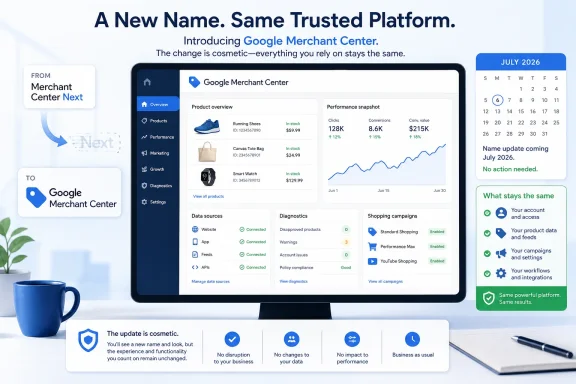
Google is retiring the “Next” label from Merchant Center, reverting the platform’s public name to simply Google Merchant Center. The change is rolling out across Help Center articles, email communications and the web interface during July 2026 and the following weeks.
According to Google’s Merchant Center announcement log, the rebrand is strictly cosmetic. Existing accounts, product data and campaigns are unaffected; features should operate as before, and users will not need to change login procedures or saved bookmarks.
Merchant Center Next was Google’s replacement for the older classic Merchant Center experience. Google completed the migration of all merchants in late 2024, bringing a redesigned interface and updated terminology such as “Data sources” in place of feeds and “Needs attention” in place of diagnostics. It also introduced tools including Product Studio and consolidated analytics views.
With the old platform long retired, “Next” had become more of a legacy migration marker than a useful product distinction. Google’s current announcement does not include new features, policy changes, pricing revisions or an interface migration.
The company’s Help Center wording is unusually direct: no action is required, and the name change does not affect an account. That should limit the practical impact for retailers and agencies, although mixed terminology will likely persist while Google updates its documentation and interface labels in stages.
Teams that maintain internal guides, onboarding materials, screenshots, support templates or client documentation should begin replacing references to “Merchant Center Next” with “Google Merchant Center.” There is no need to revise account links or technical integrations solely because of the branding update.
The rename is also separate from Google’s ongoing developer-platform work. Any organization still using the older Content API for Shopping should continue its planned transition to the Merchant API under Google’s existing migration schedule; the removal of “Next” does not change API behavior or deadlines.
For Windows users, this is a browser-facing terminology update rather than a software, endpoint-management or compatibility change. Expect Google’s labels to change gradually, while the Merchant Center account and workflow underneath remain the same.
According to Google’s Merchant Center announcement log, the rebrand is strictly cosmetic. Existing accounts, product data and campaigns are unaffected; features should operate as before, and users will not need to change login procedures or saved bookmarks.
 A cleanup after the migration
Merchant Center Next was Google’s replacement for the older classic Merchant Center experience. Google completed the migration of all merchants in late 2024, bringing a redesigned interface and updated terminology such as “Data sources” in place of feeds and “Needs attention” in place of diagnostics. It also introduced tools including Product Studio and consolidated analytics views.With the old platform long retired, “Next” had become more of a legacy migration marker than a useful product distinction. Google’s current announcement does not include new features, policy changes, pricing revisions or an interface migration.
The company’s Help Center wording is unusually direct: no action is required, and the name change does not affect an account. That should limit the practical impact for retailers and agencies, although mixed terminology will likely persist while Google updates its documentation and interface labels in stages.
What merchants and administrators should do
For most users, nothing. Merchants should continue managing product data, diagnostics and campaigns normally.Teams that maintain internal guides, onboarding materials, screenshots, support templates or client documentation should begin replacing references to “Merchant Center Next” with “Google Merchant Center.” There is no need to revise account links or technical integrations solely because of the branding update.
The rename is also separate from Google’s ongoing developer-platform work. Any organization still using the older Content API for Shopping should continue its planned transition to the Merchant API under Google’s existing migration schedule; the removal of “Next” does not change API behavior or deadlines.
For Windows users, this is a browser-facing terminology update rather than a software, endpoint-management or compatibility change. Expect Google’s labels to change gradually, while the Merchant Center account and workflow underneath remain the same.