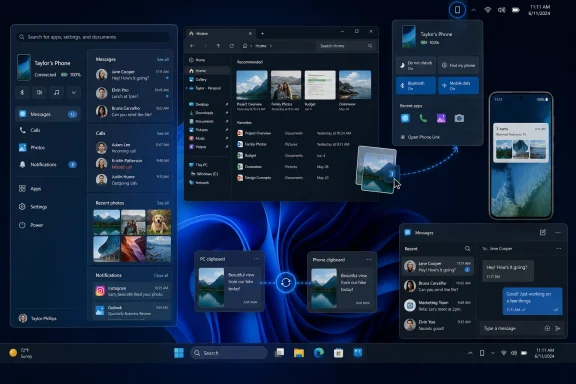
Microsoft is reportedly prototyping a deeper Android layer for Windows 11 that may surface phone activity in Start, add a taskbar phone flyout and drag-to-send transfers, synchronize full clipboard history, and split messaging into a standalone app, according to Android Authority’s account of Windows Central’s reporting. Together, the concepts suggest that Microsoft is exploring ways to make selected phone functions available from familiar Windows surfaces instead of requiring every interaction to begin inside Phone Link.
The important word is prototyping. These features are reportedly being developed internally. Microsoft has not announced them, provided a release plan, or guaranteed that any particular concept will ship.
The concepts described in the reporting would distribute selected interactions across Windows. According to Android Authority’s account of Windows Central, recent phone activity may become more visible in Start, while a connected handset may receive a taskbar icon and compact status flyout. Files would reportedly be transferable by dropping them onto that icon, clipboard history may synchronize across devices, and messaging may move into a separate application.
That does not mean Microsoft has decided to replace Phone Link or turn every phone feature into part of the Windows shell. The reporting describes prototypes, not a finalized architecture. Phone Link could remain the primary place for pairing, management, troubleshooting, or functions that do not fit naturally elsewhere.
The more measured interpretation is that Microsoft may be testing whether frequently used interactions become easier when placed near the Windows surfaces where users already work. Start could handle quick inspection, the taskbar could expose status and controls, and a dedicated application could provide a more focused messaging workspace.

According to Android Authority’s account of Windows Central, Microsoft is reportedly testing Start-menu changes that would show additional recent phone activities without first requiring users to enter the main Phone Link interface.
Users would reportedly be able to hover over an activity to reveal more information, potentially including the full contents of a message. If implemented, that would make Start more than a launcher for the application containing phone information. It would become a surface where some information could be inspected directly.
The immediate benefit would be reduced navigation. A user who sees an abbreviated activity would not necessarily have to open another window and locate the same item again. That is a straightforward convenience rather than a fundamentally new phone capability.
The more important design question is exposure. Start is frequently opened while screen sharing, presenting, receiving remote support, or working near other people. A fuller message preview could make phone activity easier to inspect while also increasing the chance that private material appears unexpectedly.
Microsoft would therefore need to decide what is visible by default, what requires deliberate interaction, and whether users can suppress or limit phone-derived previews. The reporting does not establish those rules, so they should be treated as unresolved design considerations rather than expected product behavior.
Consistency with users’ privacy choices would also matter. If message details are restricted on the phone, users may reasonably expect comparable discretion on the PC. Whether and how Microsoft would carry those preferences between devices is not specified in the supplied reporting.

The taskbar prototype is one of the clearest departures from an application-centered interaction model. According to Android Authority’s account of Windows Central, a connected phone would reportedly receive its own taskbar icon.
Selecting that icon would reportedly open a smartphone flyout with an overview of the handset and controls for certain phone functions. The reported controls include do not disturb, vibrate mode, and find phone.
These controls would differ from simply opening phone content on the PC. They may allow a Windows user to change selected states on the connected handset without picking it up. Someone beginning a presentation, meeting, gaming session, or focused work period could potentially adjust the phone from the desktop.
A flyout is a plausible interface for brief status checks and toggles because it does not require a full application window. However, the reporting does not define the complete layout, supported handset states, error handling, or behavior when a connection is interrupted.
Those gaps matter because a taskbar icon occupies persistent and highly visible space. To justify that position, it would need to communicate useful information without becoming clutter. Microsoft would also need to make connection state understandable, but the supplied reporting does not confirm a detailed status model.
Questions such as whether users could hide the icon, how multiple linked phones would be represented, or which controls would work with which devices remain open. They are appropriate issues for prototype testing, not confirmed elements of Microsoft’s plans.
The appeal is immediate: the user would move an object toward a visible representation of the intended destination. That could reduce the need to remember which application or command initiates a transfer.
The supplied reporting does not establish the underlying transfer method, supported file types, destination folder, size limits, network requirements, or confirmation process. It also does not support treating the reported taskbar transfer as something already available through Start. The meaningful claim is narrower: Microsoft is reportedly prototyping a taskbar drop target for sending files to a connected phone.
If Microsoft develops the concept further, the interface would need to show whether the phone is reachable, whether the transfer has started, and whether it succeeded. It would also need to identify the destination clearly when more than one phone is linked. These are design requirements for a trustworthy implementation, not descriptions of confirmed behavior.
For organizations, the principal issue would be the lowered friction of moving a file from a managed PC to a phone. The same interaction could be useful for legitimate mobile workflows while making casual transfer to a personal device easier. Administrators do not need a hypothetical policy framework today, but they should recognize the reported prototype as a reason to review existing rules governing personal devices and business data.
The table does not represent a Microsoft roadmap. It summarizes a set of internal concepts reported secondhand by Android Authority from Windows Central’s account.
If the prototypes advance, Phone Link could remain the central connected-device application while selected tasks become accessible elsewhere. That would be a practical reorganization rather than proof that Microsoft intends to make the phone equivalent to a native Windows component.
The distinction matters. A prototype placed in Start or on the taskbar can be abandoned, substantially redesigned, limited to certain devices, or withheld from release. Its location indicates what Microsoft may be exploring, not what Windows users are guaranteed to receive.

Current cross-device clipboard synchronization is described in the reporting as synchronizing the last copied item. According to Android Authority’s account of Windows Central, Microsoft may expand that behavior to synchronize an entire clipboard history.
That would be a meaningful usability change. A last-item clipboard acts as a relay: copying something new replaces the item waiting to be pasted. A synchronized history could provide access to several recent fragments, making it easier to collect links, addresses, reference numbers, or pieces of text on one device and retrieve them from the other.
It would also increase the amount of historical data moving between the phone and PC. Clipboard records can include passwords, authentication codes, account details, customer information, private messages, internal links, draft text, and extracts from confidential documents. Users often copy such material for immediate use without thinking of the clipboard as a lasting repository.
The central product decisions would therefore involve retention, visibility, clearing, and user control. Microsoft would need to explain what enters the synchronized history and how users remove it. The supplied reporting does not describe those controls.
Administrators would also need to know whether historical synchronization could be managed independently from simpler connected-phone functions. That question becomes relevant only if Microsoft exposes the prototype publicly and publishes corresponding management documentation. There is currently no new policy identified in the supplied reporting.
The important distinction is between synchronizing one transient item and reproducing a collection of recent items across devices. Even if both are labeled clipboard synchronization, their privacy and data-handling implications are materially different.
Splitting the feature into another application could create clutter, but it could also provide a more focused workspace for an activity that is different from checking phone status or changing a quick setting. Messaging can involve sustained conversations, repeated notifications, and frequent switching between Windows work and phone-originated communication.
The supplied reporting confirms only the reported standalone-app concept. It does not establish how the app would behave across virtual desktops, multiple monitors, taskbar configurations, or window sessions. Nor does it explain how read states, dismissals, notifications, or replies would be reconciled across Start, Phone Link, the proposed app, and the phone.
Those are design considerations Microsoft would need to resolve if the concept moves toward release. They should not be interpreted as likely behavior merely because they would be desirable.
Naming and positioning would also require care. “Messages” is broad enough to be confused with other communication products. Users would need to understand that the application represents messages associated with a connected phone rather than a new Microsoft messaging network. The final name and presentation, if any, have not been established.
A successful design would minimize the number of synchronization rules the user must understand. Whether Microsoft’s prototype achieves that goal cannot be judged until the company demonstrates or releases it.
The reported prototypes indicate that Microsoft may be considering additional places for that connection to appear. Their value, however, would depend less on visual prominence than on reliability. A taskbar destination must accurately represent the intended phone. A Start activity must be current enough to trust. A clipboard item must appear predictably, and a file transfer must provide an understandable result.
These are ordinary interactions, not futuristic demonstrations. Their usefulness would come from making routine cross-device work faster without making Windows feel busier or less private.
The prototypes could also create tension between visibility and optionality. Placing phone-related content in Start and on the taskbar may help users discover features they want. The same placement may frustrate people who do not use Phone Link, do not own an Android phone, or prefer to keep their devices separate.
Microsoft would therefore need to make the experience easy to understand and easy to decline. The supplied reporting does not say how the prototypes could be disabled, whether they would appear automatically, or which users would qualify to see them.
Pre-release testing would be an appropriate way to answer those questions, but no Insider availability is identified in the supplied reporting. Readers should not assume that an Insider rollout is imminent merely because the concepts are reportedly under internal development.

For enterprise IT, the most relevant reported concepts are full-message previews, synchronized clipboard history, and drag-to-phone file transfer.
A fuller message preview in Start may expose personal or business communications during presentations, remote-support sessions, or shared-screen work. Historical clipboard synchronization may place several recently copied items on another device rather than transferring only the latest item. A taskbar drop target may make it easier to move a file from a managed PC to a personal phone.
Those risks do not mean the features would be inappropriate for every organization. They mean existing decisions about Phone Link, Link to Windows, clipboard use, personal devices, and business-data transfer should be reviewed before any future public testing.
Administrators should avoid building controls around the reported interface descriptions. Microsoft has not supplied a new policy, Settings path, deployment package, supported-device matrix, or management document for these prototypes. Until that changes, there is no new feature-specific configuration to implement.
The difference will come down to restraint. Start should not reveal more message content than the user expects. Clipboard history should not quietly create a durable cross-device archive. A drag-to-phone target should make the destination and result unmistakable. Phone controls should be useful enough to justify permanent taskbar visibility, while remaining removable for users who want a simpler desktop.
Microsoft must also avoid multiplying entry points without coordinating them. If phone information appears in several Windows surfaces, users should not have to determine which surface is authoritative or why one is more current than another. Integration succeeds when the system feels simpler than the applications beneath it.
For now, however, none of that is available to evaluate publicly from the supplied reporting. There is no new switch to enable, no deployment to prepare, and no release date to place on a calendar. The practical response is to monitor Microsoft’s announcements and review today’s Phone Link, Link to Windows, clipboard, and personal-device policies.
The reported prototypes provide five useful reminders: cross-device convenience increasingly depends on where features appear; persistent Windows surfaces must justify their presence; message previews require discretion; clipboard history is data, not merely a shortcut; and effortless file transfer can change an organization’s risk assumptions.
Whether Microsoft turns those reminders into shipping Windows 11 features remains uncertain. If it does, the measure of success will not be how many phone controls appear across the desktop. It will be whether users can move between PC and phone with less effort, without losing clarity, control, or trust.
The important word is prototyping. These features are reportedly being developed internally. Microsoft has not announced them, provided a release plan, or guaranteed that any particular concept will ship.
Quick walkthroughWhat this means now
- These are reported internal prototypes, not released Windows 11 features.
- There is nothing new for users or administrators to enable today.
- The supplied reporting identifies no Insider build, Settings path, policy, deployment procedure, or public test.
- Readers should not expect a release date unless Microsoft formally announces one.
Phone Link Is Becoming Infrastructure, Not Just an App
Microsoft began its phone-integration effort in 2018 with Your Phone on the PC and Your Phone Companion on Android. Those names eventually gave way to Phone Link and Link to Windows, but the basic arrangement remained familiar: a dedicated Windows application provides the main interface for interacting with a connected phone.The concepts described in the reporting would distribute selected interactions across Windows. According to Android Authority’s account of Windows Central, recent phone activity may become more visible in Start, while a connected handset may receive a taskbar icon and compact status flyout. Files would reportedly be transferable by dropping them onto that icon, clipboard history may synchronize across devices, and messaging may move into a separate application.
That does not mean Microsoft has decided to replace Phone Link or turn every phone feature into part of the Windows shell. The reporting describes prototypes, not a finalized architecture. Phone Link could remain the primary place for pairing, management, troubleshooting, or functions that do not fit naturally elsewhere.
The more measured interpretation is that Microsoft may be testing whether frequently used interactions become easier when placed near the Windows surfaces where users already work. Start could handle quick inspection, the taskbar could expose status and controls, and a dedicated application could provide a more focused messaging workspace.

Start May Become a Cross-Device Activity Feed
According to Android Authority’s account of Windows Central, Microsoft is reportedly testing Start-menu changes that would show additional recent phone activities without first requiring users to enter the main Phone Link interface.
Users would reportedly be able to hover over an activity to reveal more information, potentially including the full contents of a message. If implemented, that would make Start more than a launcher for the application containing phone information. It would become a surface where some information could be inspected directly.
The immediate benefit would be reduced navigation. A user who sees an abbreviated activity would not necessarily have to open another window and locate the same item again. That is a straightforward convenience rather than a fundamentally new phone capability.
The more important design question is exposure. Start is frequently opened while screen sharing, presenting, receiving remote support, or working near other people. A fuller message preview could make phone activity easier to inspect while also increasing the chance that private material appears unexpectedly.
Microsoft would therefore need to decide what is visible by default, what requires deliberate interaction, and whether users can suppress or limit phone-derived previews. The reporting does not establish those rules, so they should be treated as unresolved design considerations rather than expected product behavior.
Consistency with users’ privacy choices would also matter. If message details are restricted on the phone, users may reasonably expect comparable discretion on the PC. Whether and how Microsoft would carry those preferences between devices is not specified in the supplied reporting.
The Taskbar Could Give the Connected Phone a Persistent Windows Surface
The taskbar prototype is one of the clearest departures from an application-centered interaction model. According to Android Authority’s account of Windows Central, a connected phone would reportedly receive its own taskbar icon.
Selecting that icon would reportedly open a smartphone flyout with an overview of the handset and controls for certain phone functions. The reported controls include do not disturb, vibrate mode, and find phone.
These controls would differ from simply opening phone content on the PC. They may allow a Windows user to change selected states on the connected handset without picking it up. Someone beginning a presentation, meeting, gaming session, or focused work period could potentially adjust the phone from the desktop.
A flyout is a plausible interface for brief status checks and toggles because it does not require a full application window. However, the reporting does not define the complete layout, supported handset states, error handling, or behavior when a connection is interrupted.
Those gaps matter because a taskbar icon occupies persistent and highly visible space. To justify that position, it would need to communicate useful information without becoming clutter. Microsoft would also need to make connection state understandable, but the supplied reporting does not confirm a detailed status model.
Questions such as whether users could hide the icon, how multiple linked phones would be represented, or which controls would work with which devices remain open. They are appropriate issues for prototype testing, not confirmed elements of Microsoft’s plans.
Dragging a File to the Phone Could Be the Most Intuitive Prototype
Files could reportedly be transferred to a connected handset by dragging them onto the proposed phone icon in the taskbar, according to Android Authority’s account of Windows Central.The appeal is immediate: the user would move an object toward a visible representation of the intended destination. That could reduce the need to remember which application or command initiates a transfer.
The supplied reporting does not establish the underlying transfer method, supported file types, destination folder, size limits, network requirements, or confirmation process. It also does not support treating the reported taskbar transfer as something already available through Start. The meaningful claim is narrower: Microsoft is reportedly prototyping a taskbar drop target for sending files to a connected phone.
If Microsoft develops the concept further, the interface would need to show whether the phone is reachable, whether the transfer has started, and whether it succeeded. It would also need to identify the destination clearly when more than one phone is linked. These are design requirements for a trustworthy implementation, not descriptions of confirmed behavior.
For organizations, the principal issue would be the lowered friction of moving a file from a managed PC to a phone. The same interaction could be useful for legitimate mobile workflows while making casual transfer to a personal device easier. Administrators do not need a hypothetical policy framework today, but they should recognize the reported prototype as a reason to review existing rules governing personal devices and business data.
Five Prototypes Point Toward a More Distributed Connected-Device Model
The reported changes are best considered as related interface experiments, with each placing a phone interaction on a different Windows surface.| Windows surface or function | Verified current baseline | Reported prototype | Potential practical effect |
|---|---|---|---|
| Start | A connected-phone companion is present in Windows 11 | More recent activities, with hover details that may include a full message | Quicker inspection without opening another window |
| Taskbar | No new prototype-specific control is available to test from the supplied reporting | Connected-phone icon with a dedicated flyout | Persistent access to reported phone status and controls |
| Phone controls | Capabilities vary within the existing connected-phone experience | Do not disturb, vibrate mode, and find phone toggles would reportedly appear in the flyout | Selected handset controls from the desktop |
| File transfer | The supplied reporting does not establish a current Start-companion transfer path | Files could reportedly be dragged onto the taskbar phone icon | A more visible transfer destination |
| Clipboard and messages | Messaging is available through Phone Link, and clipboard synchronization is described as sharing the last copied item | Full clipboard-history synchronization may be added, and messaging may become a standalone app | Broader clipboard continuity and a more focused messaging workspace |
If the prototypes advance, Phone Link could remain the central connected-device application while selected tasks become accessible elsewhere. That would be a practical reorganization rather than proof that Microsoft intends to make the phone equivalent to a native Windows component.
The distinction matters. A prototype placed in Start or on the taskbar can be abandoned, substantially redesigned, limited to certain devices, or withheld from release. Its location indicates what Microsoft may be exploring, not what Windows users are guaranteed to receive.
Full Clipboard History May Be the Most Sensitive Upgrade
Current cross-device clipboard synchronization is described in the reporting as synchronizing the last copied item. According to Android Authority’s account of Windows Central, Microsoft may expand that behavior to synchronize an entire clipboard history.
That would be a meaningful usability change. A last-item clipboard acts as a relay: copying something new replaces the item waiting to be pasted. A synchronized history could provide access to several recent fragments, making it easier to collect links, addresses, reference numbers, or pieces of text on one device and retrieve them from the other.
It would also increase the amount of historical data moving between the phone and PC. Clipboard records can include passwords, authentication codes, account details, customer information, private messages, internal links, draft text, and extracts from confidential documents. Users often copy such material for immediate use without thinking of the clipboard as a lasting repository.
The central product decisions would therefore involve retention, visibility, clearing, and user control. Microsoft would need to explain what enters the synchronized history and how users remove it. The supplied reporting does not describe those controls.
Administrators would also need to know whether historical synchronization could be managed independently from simpler connected-phone functions. That question becomes relevant only if Microsoft exposes the prototype publicly and publishes corresponding management documentation. There is currently no new policy identified in the supplied reporting.
The important distinction is between synchronizing one transient item and reproducing a collection of recent items across devices. Even if both are labeled clipboard synchronization, their privacy and data-handling implications are materially different.
A Standalone Messages App Could Give Messaging Its Own Workspace
Messaging currently resides in Phone Link. According to Android Authority’s account of Windows Central, Microsoft may separate it into a standalone Messages application that users would be able to pin and launch from Start.Splitting the feature into another application could create clutter, but it could also provide a more focused workspace for an activity that is different from checking phone status or changing a quick setting. Messaging can involve sustained conversations, repeated notifications, and frequent switching between Windows work and phone-originated communication.
The supplied reporting confirms only the reported standalone-app concept. It does not establish how the app would behave across virtual desktops, multiple monitors, taskbar configurations, or window sessions. Nor does it explain how read states, dismissals, notifications, or replies would be reconciled across Start, Phone Link, the proposed app, and the phone.
Those are design considerations Microsoft would need to resolve if the concept moves toward release. They should not be interpreted as likely behavior merely because they would be desirable.
Naming and positioning would also require care. “Messages” is broad enough to be confused with other communication products. Users would need to understand that the application represents messages associated with a connected phone rather than a new Microsoft messaging network. The final name and presentation, if any, have not been established.
A successful design would minimize the number of synchronization rules the user must understand. Whether Microsoft’s prototype achieves that goal cannot be judged until the company demonstrates or releases it.
Microsoft Is Still Pursuing a Cross-Device Ecosystem Advantage
Microsoft does not control a mainstream mobile operating system, so its continuity strategy depends on connecting Windows to phones users already own. Android remains the natural focus for that effort because it is widely used and already participates in Microsoft’s Phone Link and Link to Windows ecosystem.The reported prototypes indicate that Microsoft may be considering additional places for that connection to appear. Their value, however, would depend less on visual prominence than on reliability. A taskbar destination must accurately represent the intended phone. A Start activity must be current enough to trust. A clipboard item must appear predictably, and a file transfer must provide an understandable result.
These are ordinary interactions, not futuristic demonstrations. Their usefulness would come from making routine cross-device work faster without making Windows feel busier or less private.
The prototypes could also create tension between visibility and optionality. Placing phone-related content in Start and on the taskbar may help users discover features they want. The same placement may frustrate people who do not use Phone Link, do not own an Android phone, or prefer to keep their devices separate.
Microsoft would therefore need to make the experience easy to understand and easy to decline. The supplied reporting does not say how the prototypes could be disabled, whether they would appear automatically, or which users would qualify to see them.
Pre-release testing would be an appropriate way to answer those questions, but no Insider availability is identified in the supplied reporting. Readers should not assume that an Insider rollout is imminent merely because the concepts are reportedly under internal development.
Enterprise IT Should Review the Existing Data Boundary
For enterprise IT, the most relevant reported concepts are full-message previews, synchronized clipboard history, and drag-to-phone file transfer.
A fuller message preview in Start may expose personal or business communications during presentations, remote-support sessions, or shared-screen work. Historical clipboard synchronization may place several recently copied items on another device rather than transferring only the latest item. A taskbar drop target may make it easier to move a file from a managed PC to a personal phone.
Those risks do not mean the features would be inappropriate for every organization. They mean existing decisions about Phone Link, Link to Windows, clipboard use, personal devices, and business-data transfer should be reviewed before any future public testing.
Administrators should avoid building controls around the reported interface descriptions. Microsoft has not supplied a new policy, Settings path, deployment package, supported-device matrix, or management document for these prototypes. Until that changes, there is no new feature-specific configuration to implement.
Action checklist for admins
- Do not search for a hidden enablement switch. The supplied reporting identifies no released feature, Insider build, Settings path, registry value, policy, or deployment procedure.
- Inventory current Phone Link use. Determine where Phone Link is permitted, blocked, removed, unsupported, or unmanaged.
- Review Link to Windows expectations. Document whether organization-owned and personal Android phones are allowed to connect to managed PCs.
- Check existing clipboard policy. Identify whether current rules address cloud or cross-device clipboard synchronization and whether copied business data may reach personal devices.
- Review personal-device and data-transfer rules. Confirm whether employees may move work files to phones and whether existing data-loss controls cover that activity.
- Evaluate message-preview exposure. Consider whether phone-derived message details appearing in Start would conflict with screen-sharing, shared-workstation, or confidentiality practices.
- Wait for Microsoft documentation before testing prototypes. If Microsoft announces a public preview, verify supported builds, controls, logging, and deployment guidance before starting an evaluation.
- Use non-sensitive data in any eventual pilot. Test clipboard, messaging, and file-transfer behavior without exposing production credentials, customer data, or confidential documents.
The Prototypes Must Earn Their Place in Windows
Microsoft has a history of putting new experiences in prominent Windows locations before it is clear how many users want them there. A Start companion, taskbar icon, flyout, transfer target, clipboard service, and standalone messaging app could feel coherent—or they could feel like repeated reminders to use a connection that some people do not need.The difference will come down to restraint. Start should not reveal more message content than the user expects. Clipboard history should not quietly create a durable cross-device archive. A drag-to-phone target should make the destination and result unmistakable. Phone controls should be useful enough to justify permanent taskbar visibility, while remaining removable for users who want a simpler desktop.
Microsoft must also avoid multiplying entry points without coordinating them. If phone information appears in several Windows surfaces, users should not have to determine which surface is authoritative or why one is more current than another. Integration succeeds when the system feels simpler than the applications beneath it.
For now, however, none of that is available to evaluate publicly from the supplied reporting. There is no new switch to enable, no deployment to prepare, and no release date to place on a calendar. The practical response is to monitor Microsoft’s announcements and review today’s Phone Link, Link to Windows, clipboard, and personal-device policies.
The reported prototypes provide five useful reminders: cross-device convenience increasingly depends on where features appear; persistent Windows surfaces must justify their presence; message previews require discretion; clipboard history is data, not merely a shortcut; and effortless file transfer can change an organization’s risk assumptions.
Whether Microsoft turns those reminders into shipping Windows 11 features remains uncertain. If it does, the measure of success will not be how many phone controls appear across the desktop. It will be whether users can move between PC and phone with less effort, without losing clarity, control, or trust.
References
- Primary source: Android Authority
Published: Sun, 12 Jul 2026 17:45:00 GMT
Microsoft may make big changes to bring Android and Windows 11 closer together
Microsoft is reportedly working on several major changes to improve and expand upon Phone Link, deepening Android integration.www.androidauthority.com - Official source: play.google.com
- Official source: support.microsoft.com
- Official source: microsoft.com
Use Phone Link to Sync Your Android or iPhone to Your Windows Computer | Microsoft
Sync your smartphone and Windows computer wirelessly using Microsoft Phone Link. Text, call, back up photos, and more no matter if you have an Android or an iPhone.www.microsoft.com - Official source: learn.microsoft.com
Phone Link Task Continuity | Microsoft Learn
Phone Link enables synchronization between your Windows PC and mobile device. Learn how to integrate your Windows app with Phone Link for task continuity.learn.microsoft.com - Related coverage: windowscentral.com
Microsoft adds 'Your Phone' recent apps menu to the System Tray on Windows 11 | Windows Central
Microsoft has today announced an update to the Your Phone app that will introduce quick access to your recently used Android apps directly from the System Tray on Windows 11 and ...www.windowscentral.com
- Official source: cdn-dynmedia-1.microsoft.com
- Official source: blogs.windows.com
- Official source: download.microsoft.com
- Related coverage: techradar.com
Smart new features for Android smartphones just arrived in Windows 11 – including remotely locking your PC via the phone | TechRadar
And cross-device clipboard sharingwww.techradar.com