

Microsoft has fixed CVE-2026-47632, a high-severity elevation-of-privilege vulnerability in the Azure Monitor Agent Metrics Extension that affects versions from 1.0.0 through anything earlier than 1.65. Administrators running the extension on Azure virtual machines or Azure Arc-enabled servers should inventory deployments and move them to version 1.65 or later.
Published by the Microsoft Security Response Center on July 14, 2026, the flaw carries a CVSS 3.1 base score of 8.8. Microsoft describes the underlying weakness as improper certificate validation, which could allow an unauthenticated attacker on an adjacent network to compromise the extension’s trust relationship and elevate privileges.
The immediate priority is not Windows Update on administrator workstations. This is an Azure workload and guest-agent issue, so remediation depends on the extension versions deployed across virtual machines, virtual machine scale sets, and hybrid servers managed through Azure Arc.
CVE-2026-47632 is classified as CWE-295, Improper Certificate Validation. That category covers software that does not adequately verify the authenticity, validity, or expected identity of a certificate presented during a protected connection.
Certificate validation is supposed to establish that a component is communicating with the intended endpoint. If those checks are incomplete, an attacker who can position themselves on the relevant network path may be able to impersonate a trusted service or manipulate communication that the agent assumes is legitimate.
Microsoft’s CVSS vector is
That combination explains the 8.8 rating. The adjacent-network requirement makes this different from a vulnerability that can be attacked indiscriminately from anywhere on the internet, but it does not make it low risk. An attacker who has reached a connected virtual network, compromised a neighboring workload, gained access to a hybrid network segment, or obtained a position suitable for traffic interception may already satisfy the most important prerequisite.
The privilege-escalation label should also be read in context. This is not simply a local user exploiting a desktop application after signing in to Windows. Microsoft says the attack can be initiated without authentication from an adjacent network, with the vulnerable monitoring component providing the path to higher privileges.
That reach makes extension management a fleet problem. Organizations may have the agent installed through several paths, including Azure Policy, VM Insights onboarding, automation templates, scale-set configuration, or direct deployment by individual application teams.
The vulnerable product is specifically identified as the Azure Monitor Agent Metrics Extension, with versions starting at 1.0.0 and below 1.65 listed as affected. Administrators should avoid assuming that the top-level Azure Monitor Agent version displayed in one management view necessarily answers the question. Azure monitoring installations contain multiple components, and their internal version schemes do not always match.
Microsoft’s public Azure Monitor Agent release documentation, for example, separately tracks Windows Logs, Linux Logs, and Metrics components. The security record’s affected-version range should therefore be matched against the Metrics Extension itself rather than inferred from an unrelated package or operating-system build number.
This also means traditional endpoint patch reports may miss the exposure. A dashboard showing current Windows Server cumulative updates does not prove that an Azure VM extension has reached its secure release.
For CVE-2026-47632, administrators need positive confirmation that affected resources have moved to version 1.65 or newer. A policy assignment, an enabled auto-upgrade setting, or an expected rollout date is not the same as verified installation.
A focused response should include these checks:
Scale sets present another potential gap. Updating a model or deployment template does not necessarily guarantee that every existing instance has already received and activated the corrected extension. Image pipelines and infrastructure-as-code definitions should also be reviewed so that newly provisioned machines do not reintroduce an affected release.
That distinction matters because vulnerability databases contain several types of certainty. Microsoft’s acknowledgement, affected-version data, weakness classification, and fixed-version boundary establish that the defect is real. They do not, by themselves, prove that attackers are exploiting it in production or that public proof-of-concept code is available.
Administrators should not confuse confidence in the vulnerability’s existence with confidence about current attacker activity. The former is high because Microsoft has acknowledged and remediated the issue. The available public record provides much less detail about observed exploitation, discovery attribution, indicators of compromise, or the exact certificate-validation failure.
Microsoft’s vector nevertheless supplies enough information for prioritization. No authentication and no user interaction are required, while successful exploitation could affect all three core security properties. Network placement is the principal limiting condition, making segmentation and control of east-west traffic relevant defenses—but not substitutes for upgrading.
CVE-2026-47632 is a reminder that telemetry software expands the attack surface even while improving operational visibility. Monitoring components should be included in vulnerability inventories, version baselines, network threat models, and incident-response playbooks rather than treated as invisible Azure plumbing.
The concrete remediation target is clear: Azure Monitor Agent Metrics Extension 1.65 or later. The unresolved issue for many IT teams will be whether their Azure and Arc inventories can reliably prove that every deployed instance has crossed that boundary following Microsoft’s July 14 release.
Published by the Microsoft Security Response Center on July 14, 2026, the flaw carries a CVSS 3.1 base score of 8.8. Microsoft describes the underlying weakness as improper certificate validation, which could allow an unauthenticated attacker on an adjacent network to compromise the extension’s trust relationship and elevate privileges.
The immediate priority is not Windows Update on administrator workstations. This is an Azure workload and guest-agent issue, so remediation depends on the extension versions deployed across virtual machines, virtual machine scale sets, and hybrid servers managed through Azure Arc.
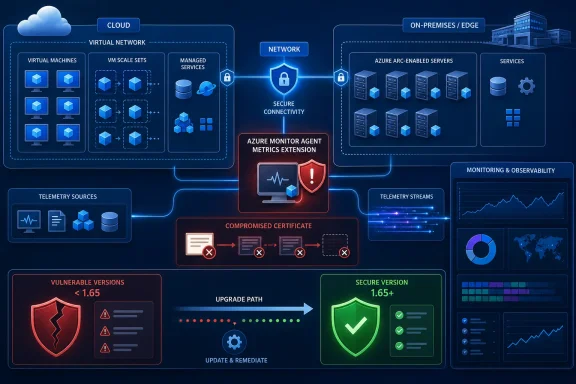 Certificate Validation Turns Monitoring Into an Entry Point
CVE-2026-47632 is classified as CWE-295, Improper Certificate Validation. That category covers software that does not adequately verify the authenticity, validity, or expected identity of a certificate presented during a protected connection.Certificate validation is supposed to establish that a component is communicating with the intended endpoint. If those checks are incomplete, an attacker who can position themselves on the relevant network path may be able to impersonate a trusted service or manipulate communication that the agent assumes is legitimate.
Microsoft’s CVSS vector is
CVSS:3.1/AV:A/AC:L/PR:N/UI:N/S:U/C:H/I:H/A:H. In practical terms, the attacker needs adjacent network access, but exploitation is rated as low complexity and requires neither existing privileges nor user interaction. Microsoft assigns high potential impact to confidentiality, integrity, and availability.That combination explains the 8.8 rating. The adjacent-network requirement makes this different from a vulnerability that can be attacked indiscriminately from anywhere on the internet, but it does not make it low risk. An attacker who has reached a connected virtual network, compromised a neighboring workload, gained access to a hybrid network segment, or obtained a position suitable for traffic interception may already satisfy the most important prerequisite.
The privilege-escalation label should also be read in context. This is not simply a local user exploiting a desktop application after signing in to Windows. Microsoft says the attack can be initiated without authentication from an adjacent network, with the vulnerable monitoring component providing the path to higher privileges.
The Affected Component Sits Across Hybrid Estates
The Azure Monitor Agent collects telemetry from the guest operating systems of Azure and hybrid virtual machines. According to Microsoft Learn, it can be deployed as a virtual machine extension and is used by Azure Monitor features as well as services including Microsoft Sentinel and Microsoft Defender for Cloud.That reach makes extension management a fleet problem. Organizations may have the agent installed through several paths, including Azure Policy, VM Insights onboarding, automation templates, scale-set configuration, or direct deployment by individual application teams.
The vulnerable product is specifically identified as the Azure Monitor Agent Metrics Extension, with versions starting at 1.0.0 and below 1.65 listed as affected. Administrators should avoid assuming that the top-level Azure Monitor Agent version displayed in one management view necessarily answers the question. Azure monitoring installations contain multiple components, and their internal version schemes do not always match.
Microsoft’s public Azure Monitor Agent release documentation, for example, separately tracks Windows Logs, Linux Logs, and Metrics components. The security record’s affected-version range should therefore be matched against the Metrics Extension itself rather than inferred from an unrelated package or operating-system build number.
This also means traditional endpoint patch reports may miss the exposure. A dashboard showing current Windows Server cumulative updates does not prove that an Azure VM extension has reached its secure release.
Automatic Updates Reduce Risk but Do Not Prove Compliance
Microsoft recommends keeping Azure Monitor Agent extensions current and supports an Automatic Extension Update capability. Its release documentation notes that agent releases are staged across regions and deployment batches, so different virtual machines can temporarily run different versions even when automation is enabled.For CVE-2026-47632, administrators need positive confirmation that affected resources have moved to version 1.65 or newer. A policy assignment, an enabled auto-upgrade setting, or an expected rollout date is not the same as verified installation.
A focused response should include these checks:
- Enumerate Azure Monitor Agent and Metrics Extension installations across Azure VMs, scale sets, and Azure Arc-enabled servers.
- Identify instances running Metrics Extension versions earlier than 1.65.
- Confirm whether automatic extension upgrades are enabled and functioning on each resource type.
- Manually remediate systems that are pinned, unhealthy, disconnected, or excluded from normal rollout policies.
- Review extension deployment failures and validate that metric collection resumes after the upgrade.
- Investigate unexpected network or agent activity on exposed systems rather than treating installation of the fixed version as evidence that no compromise occurred.
Scale sets present another potential gap. Updating a model or deployment template does not necessarily guarantee that every existing instance has already received and activated the corrected extension. Image pipelines and infrastructure-as-code definitions should also be reviewed so that newly provisioned machines do not reintroduce an affected release.
The CVSS Score Does Not Establish Active Exploitation
The vulnerability record confirms the flaw and provides meaningful technical characteristics, but it does not amount to a public exploitation walkthrough. At publication time, the National Vulnerability Database listed the record as undergoing enrichment and had not supplied its own independent severity assessment.That distinction matters because vulnerability databases contain several types of certainty. Microsoft’s acknowledgement, affected-version data, weakness classification, and fixed-version boundary establish that the defect is real. They do not, by themselves, prove that attackers are exploiting it in production or that public proof-of-concept code is available.
Administrators should not confuse confidence in the vulnerability’s existence with confidence about current attacker activity. The former is high because Microsoft has acknowledged and remediated the issue. The available public record provides much less detail about observed exploitation, discovery attribution, indicators of compromise, or the exact certificate-validation failure.
Microsoft’s vector nevertheless supplies enough information for prioritization. No authentication and no user interaction are required, while successful exploitation could affect all three core security properties. Network placement is the principal limiting condition, making segmentation and control of east-west traffic relevant defenses—but not substitutes for upgrading.
Monitoring Infrastructure Needs the Same Scrutiny as Workloads
Agents used for logging, metrics, security, backup, and systems management are frequently trusted more than ordinary applications. They often run continuously, communicate with control-plane services, and hold permissions that allow them to inspect or manage the guest environment.CVE-2026-47632 is a reminder that telemetry software expands the attack surface even while improving operational visibility. Monitoring components should be included in vulnerability inventories, version baselines, network threat models, and incident-response playbooks rather than treated as invisible Azure plumbing.
The concrete remediation target is clear: Azure Monitor Agent Metrics Extension 1.65 or later. The unresolved issue for many IT teams will be whether their Azure and Arc inventories can reliably prove that every deployed instance has crossed that boundary following Microsoft’s July 14 release.
References
- Primary source: MSRC
Published: 2026-07-14T07:00:00-07:00
Security Update Guide - Microsoft Security Response Center
 msrc.microsoft.com
- Official source: learn.microsoft.com
Azure Diagnostics extension overview - Azure Monitor | Microsoft Learn
Use Azure Diagnostics for debugging, measuring performance, monitoring, and performing traffic analysis in cloud services, virtual machines, and service fabric.learn.microsoft.com - Official source: azure.microsoft.com
