

CVE-2026-50306 is a high-severity Windows TCP/IP privilege-escalation vulnerability fixed in Microsoft’s July 14, 2026 security updates. The flaw affects supported Windows 10, Windows 11, and Windows Server releases, and could allow an attacker who already has local access to take complete control of a vulnerable machine.
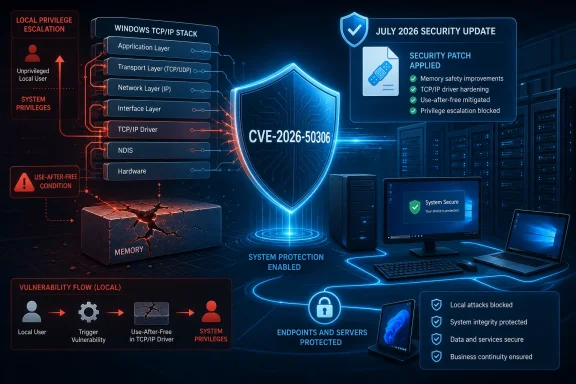
Microsoft describes the underlying defect as a use-after-free memory error in the Windows TCP/IP implementation. The company assigned it a CVSS 3.1 score of 7.8 and an “Important” severity rating, while the National Vulnerability Database published the Microsoft-supplied record shortly after the July Patch Tuesday release.
This is not a drive-by network compromise despite TCP/IP appearing in the name. Exploitation requires an authorized attacker to run code locally with low-level privileges, but successful exploitation could compromise the confidentiality, integrity, and availability of the system without additional user interaction.
Microsoft’s CVSS vector for CVE-2026-50306 is AV:L/AC:L/PR:L/UI:N/S:U/C:H/I:H/A:H. In practical terms, an attacker needs local access and an existing low-privilege account, but the attack is considered low complexity and requires no action from another user.
That makes CVE-2026-50306 most useful as the second stage of an intrusion. A phishing attachment, malicious installer, compromised service account, or exposed remote-management tool might provide the initial foothold; this vulnerability could then provide the privilege jump needed to disable defenses, access protected information, install persistent malware, or interfere with the operating system.
Microsoft and CISA reported no evidence of exploitation when the vulnerability was disclosed on July 14. CISA’s Stakeholder-Specific Vulnerability Categorization data marked exploitation as “none” and the attack as not readily automatable, but assessed the potential technical impact as total.
The absence of known exploitation should not be mistaken for evidence that the flaw is harmless. Privilege-escalation bugs routinely become more useful after patches reveal enough information for researchers and attackers to compare updated and vulnerable binaries. The low-complexity rating also suggests that an attacker who satisfies the local-access requirement does not face unusual conditions or a highly unreliable race.
That defect class is especially concerning in privileged Windows components. The TCP/IP stack operates deep inside the operating system, and corruption there can affect code running with far more authority than an ordinary desktop application.
The public description does not identify the precise packet-processing path, protocol state, or Windows function involved. Microsoft’s record associates CVE-2026-50306 with CWE-416, the standard classification for use-after-free errors, as well as CWE-190, which covers integer overflow or wraparound. Those classifications suggest that an arithmetic or size-handling condition may contribute to the memory-lifetime failure, although Microsoft has not published enough technical detail to establish the complete exploitation chain.
That distinction matters because the vulnerability should not be confused with a remotely reachable TCP/IP flaw. Nothing in Microsoft’s CVSS vector indicates that an unauthenticated attacker can exploit it simply by sending crafted traffic across a network. The documented path is explicitly local and requires low privileges.
The fixed build thresholds published with the CVE record include:
This is particularly important for systems receiving Extended Security Updates. Windows 10 versions such as 1607, 1809, and 21H2 may remain present in specialized, LTSC, embedded, or enterprise environments even though they are absent from most consumer PCs. Windows Server 2012 likewise requires the appropriate extended servicing entitlement and deployment path.
For current Windows 11 systems, the July cumulative update is the normal remediation route. Because Windows cumulative updates supersede earlier servicing content, installing the applicable July 2026 update—or a later cumulative update containing the same fix—should move the machine beyond the vulnerable build threshold.
Confidence in the vulnerability’s existence is therefore high. Confidence in public claims about its precise trigger or exploitation technique should be lower because Microsoft has not released a detailed root-cause analysis, proof of concept, or packet-level description.
Administrators should be cautious about third-party posts that portray CVE-2026-50306 as a remotely exploitable or wormable TCP/IP vulnerability. The available Microsoft and NVD data do not support those descriptions. Its documented characteristics are local attack vector, low attack complexity, low privileges required, and no user interaction.
The CVSS score also captures severity rather than the likelihood of compromise in a particular environment. On a tightly controlled server where interactive logon is prohibited and application execution is restricted, reaching the vulnerable code path may be difficult. On shared workstations, virtual desktop hosts, development machines, jump servers, or systems running numerous third-party agents, a low-privilege local foothold may be much easier to obtain.
Enterprise teams should prioritize systems where untrusted or semi-trusted users can execute code. Multi-user hosts, remote desktop infrastructure, build workers, support workstations, and servers exposed to application-level compromise deserve particular attention because local elevation can turn a contained account breach into a machine-wide incident.
Endpoint controls still provide useful defense in depth while updates move through testing. Application control through Windows Defender Application Control or AppLocker can restrict unauthorized binaries, while Microsoft Defender for Endpoint and comparable EDR platforms can detect suspicious process ancestry, token manipulation, security-tool interference, and post-exploitation persistence. Those controls do not repair the TCP/IP memory defect, however.
The reliable check is the installed Windows build and cumulative-update status. Organizations should confirm that inventory tools report builds at or above Microsoft’s fixed thresholds, investigate devices that have stopped receiving cumulative updates, and treat failed installations or pending reboots as unresolved exposure.
CVE-2026-50306 was not listed as actively exploited at publication, but it offers a high-impact path from an ordinary local account to full system compromise. Installing and verifying the July 2026 Windows security baseline closes that path before public technical analysis makes the flaw easier to reproduce.
Microsoft describes the underlying defect as a use-after-free memory error in the Windows TCP/IP implementation. The company assigned it a CVSS 3.1 score of 7.8 and an “Important” severity rating, while the National Vulnerability Database published the Microsoft-supplied record shortly after the July Patch Tuesday release.
This is not a drive-by network compromise despite TCP/IP appearing in the name. Exploitation requires an authorized attacker to run code locally with low-level privileges, but successful exploitation could compromise the confidentiality, integrity, and availability of the system without additional user interaction.
 Local Access Is the Barrier, Not the Prize
Microsoft’s CVSS vector for CVE-2026-50306 is AV:L/AC:L/PR:L/UI:N/S:U/C:H/I:H/A:H. In practical terms, an attacker needs local access and an existing low-privilege account, but the attack is considered low complexity and requires no action from another user.That makes CVE-2026-50306 most useful as the second stage of an intrusion. A phishing attachment, malicious installer, compromised service account, or exposed remote-management tool might provide the initial foothold; this vulnerability could then provide the privilege jump needed to disable defenses, access protected information, install persistent malware, or interfere with the operating system.
Microsoft and CISA reported no evidence of exploitation when the vulnerability was disclosed on July 14. CISA’s Stakeholder-Specific Vulnerability Categorization data marked exploitation as “none” and the attack as not readily automatable, but assessed the potential technical impact as total.
The absence of known exploitation should not be mistaken for evidence that the flaw is harmless. Privilege-escalation bugs routinely become more useful after patches reveal enough information for researchers and attackers to compare updated and vulnerable binaries. The low-complexity rating also suggests that an attacker who satisfies the local-access requirement does not face unusual conditions or a highly unreliable race.
A Memory-Lifetime Error Inside Windows Networking
A use-after-free vulnerability occurs when software continues using memory after that memory has been released. If an attacker can influence how the freed region is reused, the stale reference may point to attacker-controlled data rather than the object the program expected.That defect class is especially concerning in privileged Windows components. The TCP/IP stack operates deep inside the operating system, and corruption there can affect code running with far more authority than an ordinary desktop application.
The public description does not identify the precise packet-processing path, protocol state, or Windows function involved. Microsoft’s record associates CVE-2026-50306 with CWE-416, the standard classification for use-after-free errors, as well as CWE-190, which covers integer overflow or wraparound. Those classifications suggest that an arithmetic or size-handling condition may contribute to the memory-lifetime failure, although Microsoft has not published enough technical detail to establish the complete exploitation chain.
That distinction matters because the vulnerability should not be confused with a remotely reachable TCP/IP flaw. Nothing in Microsoft’s CVSS vector indicates that an unauthenticated attacker can exploit it simply by sending crafted traffic across a network. The documented path is explicitly local and requires low privileges.
Windows 10, Windows 11, and Server Builds Need the July Baseline
Microsoft’s affected-product record spans client and server editions rather than a single Windows generation. Confirmed affected client releases include Windows 10 versions 1607, 1809, 21H2, and 22H2, along with Windows 11 versions 24H2, 25H2, and 26H1.The fixed build thresholds published with the CVE record include:
- Windows 10 version 1607 must be updated to build 14393.9339 or later.
- Windows 10 version 1809 must be updated to build 17763.9020 or later.
- Windows 10 version 21H2 must be updated to build 19044.7548 or later.
- Windows 10 version 22H2 must be updated to build 19045.7548 or later.
- Windows 11 version 24H2 must be updated to build 26100.8875 or later.
- Windows 11 version 25H2 must be updated to build 26200.8875 or later.
- Windows 11 version 26H1 must be updated to build 28000.2269 or later.
- Windows Server 2012 must be updated to build 9200.26226 or later.
This is particularly important for systems receiving Extended Security Updates. Windows 10 versions such as 1607, 1809, and 21H2 may remain present in specialized, LTSC, embedded, or enterprise environments even though they are absent from most consumer PCs. Windows Server 2012 likewise requires the appropriate extended servicing entitlement and deployment path.
For current Windows 11 systems, the July cumulative update is the normal remediation route. Because Windows cumulative updates supersede earlier servicing content, installing the applicable July 2026 update—or a later cumulative update containing the same fix—should move the machine beyond the vulnerable build threshold.
The CVE Is Confirmed, but Exploit Detail Remains Limited
The vulnerability-confidence language attached to the record describes how strongly the available evidence supports a vulnerability’s existence and how much technical information is publicly known. CVE-2026-50306 is not merely a speculative report: Microsoft has acknowledged the flaw, assigned the CVE, identified affected products, supplied a CVSS vector, and shipped corrected Windows builds.Confidence in the vulnerability’s existence is therefore high. Confidence in public claims about its precise trigger or exploitation technique should be lower because Microsoft has not released a detailed root-cause analysis, proof of concept, or packet-level description.
Administrators should be cautious about third-party posts that portray CVE-2026-50306 as a remotely exploitable or wormable TCP/IP vulnerability. The available Microsoft and NVD data do not support those descriptions. Its documented characteristics are local attack vector, low attack complexity, low privileges required, and no user interaction.
The CVSS score also captures severity rather than the likelihood of compromise in a particular environment. On a tightly controlled server where interactive logon is prohibited and application execution is restricted, reaching the vulnerable code path may be difficult. On shared workstations, virtual desktop hosts, development machines, jump servers, or systems running numerous third-party agents, a low-privilege local foothold may be much easier to obtain.
Patch Verification Matters More Than a Network Workaround
Microsoft has not documented a standalone workaround or registry mitigation for CVE-2026-50306. Disabling ordinary network services based solely on the TCP/IP label would be disruptive and would not provide a clearly supported substitute for installing the security update.Enterprise teams should prioritize systems where untrusted or semi-trusted users can execute code. Multi-user hosts, remote desktop infrastructure, build workers, support workstations, and servers exposed to application-level compromise deserve particular attention because local elevation can turn a contained account breach into a machine-wide incident.
Endpoint controls still provide useful defense in depth while updates move through testing. Application control through Windows Defender Application Control or AppLocker can restrict unauthorized binaries, while Microsoft Defender for Endpoint and comparable EDR platforms can detect suspicious process ancestry, token manipulation, security-tool interference, and post-exploitation persistence. Those controls do not repair the TCP/IP memory defect, however.
The reliable check is the installed Windows build and cumulative-update status. Organizations should confirm that inventory tools report builds at or above Microsoft’s fixed thresholds, investigate devices that have stopped receiving cumulative updates, and treat failed installations or pending reboots as unresolved exposure.
CVE-2026-50306 was not listed as actively exploited at publication, but it offers a high-impact path from an ordinary local account to full system compromise. Installing and verifying the July 2026 Windows security baseline closes that path before public technical analysis makes the flaw easier to reproduce.
References
- Primary source: MSRC
Published: 2026-07-14T07:00:00-07:00
Security Update Guide - Microsoft Security Response Center
 msrc.microsoft.com
- Related coverage: aha.org
