

CVE-2026-50697 is an Important-rated elevation-of-privilege vulnerability in the Windows Common Log File System driver, patched in Microsoft’s July 14, 2026 security updates. The flaw matters because successful exploitation could let an attacker who already has access to a vulnerable Windows machine move beyond their existing permissions and gain higher-level control.
Microsoft disclosed the vulnerability through the Microsoft Security Response Center’s Security Update Guide as part of the July 2026 Patch Tuesday release. The advisory classifies the issue as an elevation-of-privilege vulnerability rather than a remote-code-execution flaw, making it primarily a post-compromise risk: an attacker generally needs an initial foothold before using it to take over more of the system.
For administrators, the response is straightforward. Install the July 14 cumulative security update for every affected Windows release, confirm that endpoints have restarted where required, and verify the resulting OS build rather than treating a successful deployment command as proof that remediation is complete.
The Common Log File System, usually referred to as CLFS, is a Windows logging subsystem used by applications and system components that need reliable, transaction-oriented log handling. Its kernel driver is commonly identified as
That distinction shapes the risk. CVE-2026-50697 is not described as a vulnerability that an unauthenticated attacker can simply trigger across the internet. Instead, it can become useful after another weakness, malicious attachment, stolen credential, exposed remote service, or compromised application has already given the attacker an opportunity to execute code locally.
Elevation-of-privilege vulnerabilities frequently serve as the second stage of an intrusion. A threat actor might initially land inside a restricted user account or sandboxed process, then exploit a kernel-level weakness to obtain broader access, disable security controls, extract credentials, install persistent malware, or interfere with protected system resources.
That makes “local” a description of the attack position, not an assurance that the vulnerability is harmless. On shared workstations, Remote Desktop Session Hosts, developer systems, jump servers, and machines that process untrusted files, a local privilege-escalation path can sharply reduce the value of account separation and application containment.
Microsoft’s Important severity rating also should not be read as permission to defer the update indefinitely. It indicates that CVE-2026-50697 does not occupy the same category as the most direct Critical remote-compromise flaws, but it can still be consequential when combined with another exploit or an existing user-level intrusion.
It does not by itself say that attackers are exploiting CVE-2026-50697 in the wild. Report confidence, exploit-code maturity, public disclosure status, and observed exploitation are separate signals, even though they are sometimes compressed into a single idea of “urgency” in vulnerability dashboards.
This distinction is operationally important. A confirmed vulnerability means defenders should treat the defect as real and the vendor’s remediation as necessary. It does not automatically mean proof-of-concept code is public, exploitation is reliable, or incident responders should assume every unpatched machine has already been attacked.
Conversely, the absence of a public exploit should not become a reason to leave the system exposed. Kernel privilege-escalation vulnerabilities are valuable building blocks, and technical details can emerge after patches are released as researchers and attackers compare updated binaries with their vulnerable predecessors.
Microsoft had not provided a modification date in the submitted advisory information beyond the original July 14, 2026 publication. Administrators should therefore preserve the initial assessment in their vulnerability-management records while continuing to monitor MSRC for revisions covering exploitability, affected products, acknowledgements, or newly documented mitigations.
For example, Microsoft released KB5101649 for Windows 11 version 26H1, bringing that release to OS Build 28000.2525. Windows 11 version 23H2 received KB5099414 and moved to OS Build 22631.7376, while Windows Server 2016 and Windows 10 version 1607 received KB5099535 and moved to OS Build 14393.9339.
Those examples are not a substitute for checking Microsoft’s affected-product table. Environments containing Windows 11 24H2 or 25H2, Windows Server 2019, Windows Server 2022, Windows Server 2025, Azure Edition deployments, LTSC installations, or Extended Security Updates must map each device to its corresponding July package and supported servicing channel.
The practical deployment sequence should remain familiar:
Security teams should still review suspicious events around affected endpoints. Useful leads include unexpected processes obtaining SYSTEM-level execution, new services or scheduled tasks, security-tool tampering, credential-access activity, unexplained driver crashes, and privilege changes that do not align with software deployment or administrative work.
Detection should focus on the broader intrusion chain rather than expecting a perfectly unique CVE signature. A restricted process spawning a privileged child, an unfamiliar executable appearing shortly before a new SYSTEM service, or endpoint protection being disabled immediately after user-level code execution may provide more actionable evidence than a generic
Application control, least-privilege user accounts, attack-surface reduction rules, credential protections, and endpoint detection and response can make initial access or post-exploitation more difficult. None of them corrects the vulnerable CLFS code, however, and none should be recorded as equivalent to installing Microsoft’s update.
The priority for July 2026 is therefore to identify systems still running pre-update builds, deploy the correct cumulative package, complete required restarts, and validate the result. CVE-2026-50697 becomes most dangerous when defenders dismiss it as “only local” and leave an otherwise limited compromise with a path to full Windows control.
Microsoft disclosed the vulnerability through the Microsoft Security Response Center’s Security Update Guide as part of the July 2026 Patch Tuesday release. The advisory classifies the issue as an elevation-of-privilege vulnerability rather than a remote-code-execution flaw, making it primarily a post-compromise risk: an attacker generally needs an initial foothold before using it to take over more of the system.
For administrators, the response is straightforward. Install the July 14 cumulative security update for every affected Windows release, confirm that endpoints have restarted where required, and verify the resulting OS build rather than treating a successful deployment command as proof that remediation is complete.
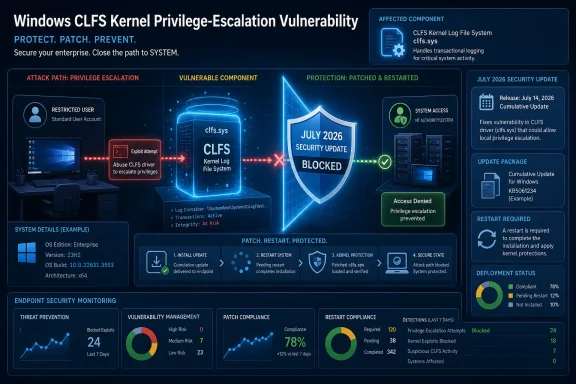 CLFS Bugs Turn Limited Access Into a Larger Problem
The Common Log File System, usually referred to as CLFS, is a Windows logging subsystem used by applications and system components that need reliable, transaction-oriented log handling. Its kernel driver is commonly identified as clfs.sys, placing vulnerabilities in this area close to some of Windows’ most privileged execution paths.That distinction shapes the risk. CVE-2026-50697 is not described as a vulnerability that an unauthenticated attacker can simply trigger across the internet. Instead, it can become useful after another weakness, malicious attachment, stolen credential, exposed remote service, or compromised application has already given the attacker an opportunity to execute code locally.
Elevation-of-privilege vulnerabilities frequently serve as the second stage of an intrusion. A threat actor might initially land inside a restricted user account or sandboxed process, then exploit a kernel-level weakness to obtain broader access, disable security controls, extract credentials, install persistent malware, or interfere with protected system resources.
That makes “local” a description of the attack position, not an assurance that the vulnerability is harmless. On shared workstations, Remote Desktop Session Hosts, developer systems, jump servers, and machines that process untrusted files, a local privilege-escalation path can sharply reduce the value of account separation and application containment.
Microsoft’s Important severity rating also should not be read as permission to defer the update indefinitely. It indicates that CVE-2026-50697 does not occupy the same category as the most direct Critical remote-compromise flaws, but it can still be consequential when combined with another exploit or an existing user-level intrusion.
Microsoft’s Confidence Metric Is Not an Exploitation Warning
The MSRC advisory includes an explanation of the Common Vulnerability Scoring System’s report confidence metric. That metric concerns the credibility and technical certainty of the vulnerability report: whether the issue is merely suspected, reasonably corroborated, or confirmed through detailed evidence, reproducibility, source inspection, or vendor acknowledgment.It does not by itself say that attackers are exploiting CVE-2026-50697 in the wild. Report confidence, exploit-code maturity, public disclosure status, and observed exploitation are separate signals, even though they are sometimes compressed into a single idea of “urgency” in vulnerability dashboards.
This distinction is operationally important. A confirmed vulnerability means defenders should treat the defect as real and the vendor’s remediation as necessary. It does not automatically mean proof-of-concept code is public, exploitation is reliable, or incident responders should assume every unpatched machine has already been attacked.
Conversely, the absence of a public exploit should not become a reason to leave the system exposed. Kernel privilege-escalation vulnerabilities are valuable building blocks, and technical details can emerge after patches are released as researchers and attackers compare updated binaries with their vulnerable predecessors.
Microsoft had not provided a modification date in the submitted advisory information beyond the original July 14, 2026 publication. Administrators should therefore preserve the initial assessment in their vulnerability-management records while continuing to monitor MSRC for revisions covering exploitability, affected products, acknowledgements, or newly documented mitigations.
July’s Cumulative Updates Carry the Fix
Windows security fixes are generally distributed through cumulative updates rather than as isolated packages for each CVE. That means organizations should deploy the July 14, 2026 cumulative update appropriate to each Windows version instead of searching for a standalone CVE-2026-50697 installer.For example, Microsoft released KB5101649 for Windows 11 version 26H1, bringing that release to OS Build 28000.2525. Windows 11 version 23H2 received KB5099414 and moved to OS Build 22631.7376, while Windows Server 2016 and Windows 10 version 1607 received KB5099535 and moved to OS Build 14393.9339.
Those examples are not a substitute for checking Microsoft’s affected-product table. Environments containing Windows 11 24H2 or 25H2, Windows Server 2019, Windows Server 2022, Windows Server 2025, Azure Edition deployments, LTSC installations, or Extended Security Updates must map each device to its corresponding July package and supported servicing channel.
The practical deployment sequence should remain familiar:
- Administrators should inventory Windows editions, versions, architectures, and current OS build numbers before approving the July updates.
- Pilot rings should include systems running endpoint security agents, backup software, storage filters, encryption products, and other kernel-adjacent tools.
- Deployment reporting should distinguish between an update being offered, downloaded, installed, pending restart, and fully applied.
- Security teams should verify final build numbers and investigate endpoints that remain below the July 14 patch level.
- Unsupported Windows installations should be upgraded, isolated, or covered by an applicable Extended Security Updates program rather than treated as patched because Windows Update reports no new package.
Detection Cannot Replace Remediation
CVE-2026-50697 is the kind of vulnerability for which preventive patching is considerably stronger than attempting to identify every exploit attempt. Kernel-level privilege escalation can produce telemetry, but those signals may resemble legitimate driver activity, system instability, or ordinary administrative behavior once the attacker reaches higher privileges.Security teams should still review suspicious events around affected endpoints. Useful leads include unexpected processes obtaining SYSTEM-level execution, new services or scheduled tasks, security-tool tampering, credential-access activity, unexplained driver crashes, and privilege changes that do not align with software deployment or administrative work.
Detection should focus on the broader intrusion chain rather than expecting a perfectly unique CVE signature. A restricted process spawning a privileged child, an unfamiliar executable appearing shortly before a new SYSTEM service, or endpoint protection being disabled immediately after user-level code execution may provide more actionable evidence than a generic
clfs.sys event.Application control, least-privilege user accounts, attack-surface reduction rules, credential protections, and endpoint detection and response can make initial access or post-exploitation more difficult. None of them corrects the vulnerable CLFS code, however, and none should be recorded as equivalent to installing Microsoft’s update.
The priority for July 2026 is therefore to identify systems still running pre-update builds, deploy the correct cumulative package, complete required restarts, and validate the result. CVE-2026-50697 becomes most dangerous when defenders dismiss it as “only local” and leave an otherwise limited compromise with a path to full Windows control.
References
- Primary source: MSRC
Published: 2026-07-14T07:00:00-07:00
Security Update Guide - Microsoft Security Response Center
 msrc.microsoft.com
