

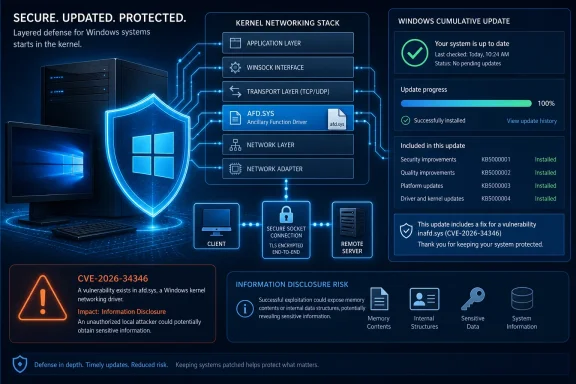
Microsoft published CVE-2026-34346 on July 14, identifying an information disclosure vulnerability in the Windows Ancillary Function Driver for WinSock. The flaw affects a kernel-mode component behind Windows socket communications, making the July security updates the appropriate remediation path for exposed Windows clients and servers.
The entry appeared in the Microsoft Security Response Center’s July 2026 Security Update Guide. Microsoft’s public title confirms the affected component and impact category, but the accompanying metric explanation does not confirm exploitation, technical disclosure, or proof-of-concept availability. It is generic guidance describing how confidence in vulnerability information can be measured, rather than evidence that attackers are already using CVE-2026-34346.
Administrators should deploy the July 14 Windows cumulative update applicable to each supported operating-system version. There is no sound reason to disable Winsock, remove
The Ancillary Function Driver for WinSock is stored as
That location matters because applications routinely rely on Winsock for network communication even when users never interact with the API directly. Browsers, management agents, database clients, backup software, security tools, Windows services, and custom line-of-business applications can all create sockets through the Windows networking interfaces served by AFD.
CVE-2026-34346 is classified as an information disclosure vulnerability. That impact is materially different from remote code execution or elevation of privilege: successful exploitation would expose information that should not be available to the attacker, rather than directly grant SYSTEM access or permit arbitrary code execution.
Information disclosure still warrants attention when the affected component runs in kernel mode. Leaked kernel data can reveal memory contents, addresses, pointers, or other implementation details that help an attacker understand a target and potentially weaken protections such as kernel address-space layout randomization.
Microsoft has not established through the title alone what information can be exposed or whether the disclosure is useful independently. Until the Security Update Guide provides or surfaces more detailed exploitation conditions, defenders should avoid turning a general kernel information leak into a claim that credentials, application data, or cryptographic keys can be stolen.
The same restraint applies in the other direction. A vulnerability does not need to produce code execution by itself to be valuable in a multi-stage attack. Information disclosure bugs are sometimes paired with memory-corruption or privilege-escalation vulnerabilities to make exploitation more reliable, particularly when the second flaw depends on knowledge of kernel memory layout.
That language should not be read as CVE-specific intelligence. It does not say that exploit code for CVE-2026-34346 is public, that security researchers have reproduced the issue, or that Microsoft has observed attacks. Nor does it identify the root cause, vulnerable function, memory operation, or sequence of Winsock calls required to reach the flaw.
This distinction is especially important for vulnerability-management teams consuming Microsoft data through scanners, dashboards, or the MSRC CVRF API. Interface help text can be displayed alongside an entry even though it merely defines a metric. Copying that definition into a ticket as the vulnerability description can create misleading escalation language.
The relevant questions for prioritization are the values Microsoft assigns to this particular CVE:
Enterprise administrators should treat CVE-2026-34346 as part of the normal Windows operating-system servicing track. The appropriate package depends on the deployed release, including Windows 11 23H2, 24H2, 25H2, or 26H1 and the relevant supported Windows Server branches.
Deployment validation should confirm more than the presence of a successful update event. Administrators should check the resulting OS build, verify that endpoints have rebooted where required, and investigate devices that report installation success but remain on an earlier build.
A sensible rollout sequence is to update representative workstations and servers first, exercise network-heavy workloads, and then expand deployment. Test coverage should include VPN clients, endpoint detection agents, web proxies, backup software, database connectivity, failover clusters, and applications that maintain large numbers of concurrent sockets.
There is no indication that
Manually renaming, deleting, or blocking
Organizations that cannot deploy the cumulative update immediately should reduce the opportunity for an attacker to obtain an initial foothold. Application control, least-privilege accounts, Microsoft Defender protections, endpoint detection, restricted administrative access, and rapid containment of compromised hosts remain useful compensating controls, but none should be represented as a vendor-approved substitute for the patch.
Monitoring generic access to Winsock would be ineffective because socket operations are fundamental to normal Windows activity. Similarly, alerts based only on the loading of
Security operations teams should instead watch for the surrounding behavior expected in a chained attack. That includes unusual execution from user-writable directories, unexpected local binaries interacting with kernel interfaces, suspicious privilege changes, endpoint protection tampering, and anomalous processes opening network connections after an initial compromise.
If Microsoft later marks the vulnerability as publicly disclosed or exploited, its priority should be reassessed immediately. The same applies if a researcher releases technical analysis demonstrating that the leak exposes stable kernel addresses or other information that significantly assists exploitation of additional Windows flaws.
For now, the decisive control is straightforward: apply the supported July 14, 2026 Windows cumulative update and verify the resulting build across managed devices. CVE-2026-34346 is a confirmed Windows kernel information disclosure vulnerability, but the generic metric explanation attached to the entry is not proof of active exploitation.
The entry appeared in the Microsoft Security Response Center’s July 2026 Security Update Guide. Microsoft’s public title confirms the affected component and impact category, but the accompanying metric explanation does not confirm exploitation, technical disclosure, or proof-of-concept availability. It is generic guidance describing how confidence in vulnerability information can be measured, rather than evidence that attackers are already using CVE-2026-34346.
Administrators should deploy the July 14 Windows cumulative update applicable to each supported operating-system version. There is no sound reason to disable Winsock, remove
afd.sys, or reset the Winsock catalog as a vulnerability workaround unless Microsoft publishes explicit instructions requiring one.
 A Kernel Networking Flaw With a Narrowly Defined Impact
The Ancillary Function Driver for WinSock is stored as afd.sys. Microsoft’s documentation describes it as a kernel-mode driver that supports Windows socket applications and manages communication between Winsock and the Windows networking stack.That location matters because applications routinely rely on Winsock for network communication even when users never interact with the API directly. Browsers, management agents, database clients, backup software, security tools, Windows services, and custom line-of-business applications can all create sockets through the Windows networking interfaces served by AFD.
CVE-2026-34346 is classified as an information disclosure vulnerability. That impact is materially different from remote code execution or elevation of privilege: successful exploitation would expose information that should not be available to the attacker, rather than directly grant SYSTEM access or permit arbitrary code execution.
Information disclosure still warrants attention when the affected component runs in kernel mode. Leaked kernel data can reveal memory contents, addresses, pointers, or other implementation details that help an attacker understand a target and potentially weaken protections such as kernel address-space layout randomization.
Microsoft has not established through the title alone what information can be exposed or whether the disclosure is useful independently. Until the Security Update Guide provides or surfaces more detailed exploitation conditions, defenders should avoid turning a general kernel information leak into a claim that credentials, application data, or cryptographic keys can be stolen.
The same restraint applies in the other direction. A vulnerability does not need to produce code execution by itself to be valuable in a multi-stage attack. Information disclosure bugs are sometimes paired with memory-corruption or privilege-escalation vulnerabilities to make exploitation more reliable, particularly when the second flaw depends on knowledge of kernel memory layout.
The Metric Text Is Not an Exploitation Alert
The description supplied beneath the advisory discusses confidence in the existence of a vulnerability and the credibility of known technical details. It explains a scoring concept that ranges from uncertain reporting through vendor confirmation and notes that greater technical knowledge may also help prospective attackers.That language should not be read as CVE-specific intelligence. It does not say that exploit code for CVE-2026-34346 is public, that security researchers have reproduced the issue, or that Microsoft has observed attacks. Nor does it identify the root cause, vulnerable function, memory operation, or sequence of Winsock calls required to reach the flaw.
This distinction is especially important for vulnerability-management teams consuming Microsoft data through scanners, dashboards, or the MSRC CVRF API. Interface help text can be displayed alongside an entry even though it merely defines a metric. Copying that definition into a ticket as the vulnerability description can create misleading escalation language.
The relevant questions for prioritization are the values Microsoft assigns to this particular CVE:
- Administrators should verify whether Microsoft marks exploitation as detected, publicly disclosed, or less likely.
- Security teams should record the CVSS vector rather than inferring network reachability from the presence of “WinSock” in the title.
- Deployment owners should use Microsoft’s affected-product table to map the CVE to supported Windows releases and their corresponding cumulative updates.
- Incident responders should distinguish evidence of active exploitation from the broader possibility that technical details could eventually emerge.
Patch the Operating System, Not the Socket Catalog
For home and small-business systems, the practical response is to install the July 2026 cumulative security update through Windows Update and restart when requested. Because Windows cumulative updates include previous security fixes, a fully installed later cumulative update should also supersede the July package unless Microsoft documents an exception.Enterprise administrators should treat CVE-2026-34346 as part of the normal Windows operating-system servicing track. The appropriate package depends on the deployed release, including Windows 11 23H2, 24H2, 25H2, or 26H1 and the relevant supported Windows Server branches.
Deployment validation should confirm more than the presence of a successful update event. Administrators should check the resulting OS build, verify that endpoints have rebooted where required, and investigate devices that report installation success but remain on an earlier build.
A sensible rollout sequence is to update representative workstations and servers first, exercise network-heavy workloads, and then expand deployment. Test coverage should include VPN clients, endpoint detection agents, web proxies, backup software, database connectivity, failover clusters, and applications that maintain large numbers of concurrent sockets.
There is no indication that
netsh winsock reset remediates CVE-2026-34346. That command rebuilds the Winsock catalog and is commonly used to troubleshoot damaged networking configuration; it does not replace a vulnerable kernel driver with a corrected version.Manually renaming, deleting, or blocking
afd.sys is still less appropriate. AFD is a foundational Windows networking component, and disrupting it can prevent applications and services from communicating. Such an action would impose a significant availability cost without evidence that it safely closes the vulnerable code path.Organizations that cannot deploy the cumulative update immediately should reduce the opportunity for an attacker to obtain an initial foothold. Application control, least-privilege accounts, Microsoft Defender protections, endpoint detection, restricted administrative access, and rapid containment of compromised hosts remain useful compensating controls, but none should be represented as a vendor-approved substitute for the patch.
Detection Will Depend on the Missing Technical Detail
CVE identifiers are valuable for inventory and patch compliance, but they do not automatically produce a reliable detection rule. Without a published proof of concept, vulnerable function, crash signature, or documented sequence of requests, defenders have little basis for creating a high-confidence alert specifically for CVE-2026-34346.Monitoring generic access to Winsock would be ineffective because socket operations are fundamental to normal Windows activity. Similarly, alerts based only on the loading of
afd.sys would describe expected operating-system behavior rather than exploitation.Security operations teams should instead watch for the surrounding behavior expected in a chained attack. That includes unusual execution from user-writable directories, unexpected local binaries interacting with kernel interfaces, suspicious privilege changes, endpoint protection tampering, and anomalous processes opening network connections after an initial compromise.
If Microsoft later marks the vulnerability as publicly disclosed or exploited, its priority should be reassessed immediately. The same applies if a researcher releases technical analysis demonstrating that the leak exposes stable kernel addresses or other information that significantly assists exploitation of additional Windows flaws.
For now, the decisive control is straightforward: apply the supported July 14, 2026 Windows cumulative update and verify the resulting build across managed devices. CVE-2026-34346 is a confirmed Windows kernel information disclosure vulnerability, but the generic metric explanation attached to the entry is not proof of active exploitation.
References
- Primary source: MSRC
Published: 2026-07-14T07:00:00-07:00
Security Update Guide - Microsoft Security Response Center
 msrc.microsoft.com
- Official source: learn.microsoft.com
Porting TDI Drivers to Winsock Kernel - Windows drivers | Microsoft Learn
To port your TDI driver to Winsock Kernel (WSK), you'll need to convert TDI tasks to their WSK equivalents as shown in the following table.learn.microsoft.com
