

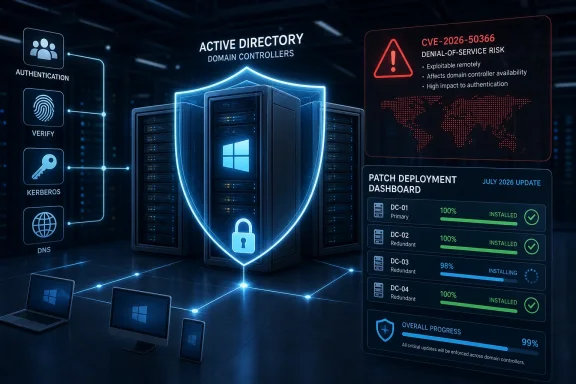
Microsoft’s July 14, 2026 security updates address CVE-2026-50366, a denial-of-service vulnerability in Windows Active Directory Domain Services that can be triggered remotely by an authenticated attacker. Because exploitation could disrupt a domain controller’s availability, administrators should prioritize testing and deploying the July cumulative updates across their DC fleet.
Detailed in Microsoft’s Security Update Guide, the flaw is a null-pointer dereference in Active Directory Domain Services. The National Vulnerability Database describes it as allowing an authorized attacker to cause a denial-of-service condition over a network, without requiring user interaction.
Microsoft assigned CVE-2026-50366 a CVSS 3.1 base score of 6.5, placing it in the Medium severity band. That score should not obscure the operational importance of the affected role: even a temporary Active Directory outage can interfere with authentication, Group Policy processing, Kerberos ticket issuance, and applications that depend on LDAP directory access.
The CVSS vector is
The required privileges provide an important boundary. This is not described as an unauthenticated internet attack, and an attacker would first need valid authorization within the affected environment. That lowers the probability of opportunistic exploitation but still fits a common intrusion pattern in which stolen employee credentials provide an initial foothold.
Once inside a domain, low-privileged accounts are not necessarily trusted. Password spraying, phishing, malware infections, exposed service credentials, and abandoned accounts can all give an intruder the authenticated position needed to probe internal services.
Microsoft’s scoring indicates that successful exploitation affects availability rather than confidentiality or integrity. The disclosed impact is therefore service disruption, not credential theft, arbitrary code execution, or modification of directory objects. There is currently no public technical detail establishing that the flaw can be escalated into those more severe outcomes.
The underlying weakness is classified as CWE-476, or a null-pointer dereference. This generally occurs when software attempts to use a memory reference that does not point to a valid object, potentially terminating the affected process or otherwise making the service unavailable.
Microsoft has not publicly documented the precise request structure, protocol operation, or Active Directory code path needed to reach the faulty condition. That limits immediate defensive options outside patching, access control, monitoring, and reducing unnecessary network exposure to domain controllers.
AD DS sits in the authentication path for most traditional Windows enterprise environments. Depending on the architecture and the behavior of the vulnerable process, disruption may affect interactive logons, service authentication, management tools, directory queries, certificate-related workflows, and applications that use domain identities.
A single affected DC should not normally take down a well-designed domain. Sites with multiple healthy domain controllers, working DNS registration, replicated directory data, and clients able to locate alternative DCs have more resilience. Smaller organizations, remote sites, and environments with applications pinned to a particular LDAP server may experience a sharper impact.
That makes redundancy relevant but not a substitute for the security update. If the same crafted traffic can be sent to every reachable DC, an attacker who has mapped the environment could attempt to disrupt multiple replicas. Administrators should also remember that a server being available on paper does not guarantee that clients, appliances, or older applications will fail over cleanly.
CISA’s initial Stakeholder-Specific Vulnerability Categorization data listed no known exploitation as of July 14. It also assessed exploitation as not readily automatable and the technical impact as partial. Those early judgments reduce the immediate alarm level, but they do not eliminate the possibility of later technical disclosure or proof-of-concept development.
The National Vulnerability Database was still awaiting its own enrichment when the record appeared. Its displayed 6.5 score and vector originated from Microsoft, while additional independent analysis had not yet been added.
The affected records include Windows Server 2012 and later server generations, with Server Core installations represented where applicable. Administrators should use Microsoft’s Security Update Guide and their organization’s update catalog to identify the exact package for each deployed Windows Server release rather than assuming that only the newest domain controllers require attention.
Microsoft’s published fixed-build thresholds include:
July’s rollout deserves the usual staged approach, particularly in large or tightly controlled forests. Administrators can update one redundant DC per site or operating-system cohort, validate directory replication and authentication, and then continue through the remaining controllers without leaving part of the fleet exposed indefinitely.
Post-update checks should include
Internal segmentation is especially relevant because CVE-2026-50366 requires an authorized attacker rather than an anonymous external connection. Blocking unnecessary workstation-to-DC paths is rarely practical for core authentication protocols, but management interfaces and access from server, VPN, guest, development, and vendor networks can often be narrowed.
Security teams should also treat unexplained Active Directory service failures as potentially hostile until logs and network evidence show otherwise. A denial-of-service attempt can serve as a diversion during a broader intrusion, while repeated crashes may erase short-lived evidence or complicate incident response.
There is no public indication that CVE-2026-50366 was exploited before disclosure, and the vulnerability does not carry the urgency of an unauthenticated remote-code-execution flaw. Its combination of network reachability, low attack complexity, ordinary authenticated privileges, and high availability impact nevertheless makes domain controllers the priority deployment target for Microsoft’s July 2026 updates.
Detailed in Microsoft’s Security Update Guide, the flaw is a null-pointer dereference in Active Directory Domain Services. The National Vulnerability Database describes it as allowing an authorized attacker to cause a denial-of-service condition over a network, without requiring user interaction.
Microsoft assigned CVE-2026-50366 a CVSS 3.1 base score of 6.5, placing it in the Medium severity band. That score should not obscure the operational importance of the affected role: even a temporary Active Directory outage can interfere with authentication, Group Policy processing, Kerberos ticket issuance, and applications that depend on LDAP directory access.
 Ordinary Credentials Put Domain Controllers in Reach
The CVSS vector is CVSS:3.1/AV:N/AC:L/PR:L/UI:N/S:U/C:N/I:N/A:H. In practical terms, the attack can be launched across a network, requires low privileges, has low attack complexity, and does not depend on someone opening a file or clicking a link.The required privileges provide an important boundary. This is not described as an unauthenticated internet attack, and an attacker would first need valid authorization within the affected environment. That lowers the probability of opportunistic exploitation but still fits a common intrusion pattern in which stolen employee credentials provide an initial foothold.
Once inside a domain, low-privileged accounts are not necessarily trusted. Password spraying, phishing, malware infections, exposed service credentials, and abandoned accounts can all give an intruder the authenticated position needed to probe internal services.
Microsoft’s scoring indicates that successful exploitation affects availability rather than confidentiality or integrity. The disclosed impact is therefore service disruption, not credential theft, arbitrary code execution, or modification of directory objects. There is currently no public technical detail establishing that the flaw can be escalated into those more severe outcomes.
The underlying weakness is classified as CWE-476, or a null-pointer dereference. This generally occurs when software attempts to use a memory reference that does not point to a valid object, potentially terminating the affected process or otherwise making the service unavailable.
Microsoft has not publicly documented the precise request structure, protocol operation, or Active Directory code path needed to reach the faulty condition. That limits immediate defensive options outside patching, access control, monitoring, and reducing unnecessary network exposure to domain controllers.
A Medium Score Meets a High-Impact Server Role
CVE scores measure technical exploit characteristics, not the business importance of a particular server. A 6.5 vulnerability on an isolated workstation is one problem; a vulnerability capable of interrupting a domain controller is another.AD DS sits in the authentication path for most traditional Windows enterprise environments. Depending on the architecture and the behavior of the vulnerable process, disruption may affect interactive logons, service authentication, management tools, directory queries, certificate-related workflows, and applications that use domain identities.
A single affected DC should not normally take down a well-designed domain. Sites with multiple healthy domain controllers, working DNS registration, replicated directory data, and clients able to locate alternative DCs have more resilience. Smaller organizations, remote sites, and environments with applications pinned to a particular LDAP server may experience a sharper impact.
That makes redundancy relevant but not a substitute for the security update. If the same crafted traffic can be sent to every reachable DC, an attacker who has mapped the environment could attempt to disrupt multiple replicas. Administrators should also remember that a server being available on paper does not guarantee that clients, appliances, or older applications will fail over cleanly.
CISA’s initial Stakeholder-Specific Vulnerability Categorization data listed no known exploitation as of July 14. It also assessed exploitation as not readily automatable and the technical impact as partial. Those early judgments reduce the immediate alarm level, but they do not eliminate the possibility of later technical disclosure or proof-of-concept development.
The National Vulnerability Database was still awaiting its own enrichment when the record appeared. Its displayed 6.5 score and vector originated from Microsoft, while additional independent analysis had not yet been added.
July Updates Establish the Patched Build Line
Microsoft’s CVE record identifies a broad range of Windows releases as affected, including supported and extended-support Windows Server branches. The record also associates the flaw with several Windows client versions because Microsoft vulnerability data is organized around shared Windows components and servicing baselines.The affected records include Windows Server 2012 and later server generations, with Server Core installations represented where applicable. Administrators should use Microsoft’s Security Update Guide and their organization’s update catalog to identify the exact package for each deployed Windows Server release rather than assuming that only the newest domain controllers require attention.
Microsoft’s published fixed-build thresholds include:
- Windows 10 version 1607 systems must reach build 14393.9339 or later.
- Windows 10 version 1809 systems must reach build 17763.9020 or later.
- Windows 10 versions 21H2 and 22H2 must reach builds 19044.7548 and 19045.7548 respectively.
- Windows 11 versions 24H2 and 25H2 must reach build 8875 on their respective 26100 and 26200 branches.
- Windows 11 version 26H1 must reach build 28000.2269 or later.
- Windows Server 2012 must reach build 6.2.9200.26226 or later.
July’s rollout deserves the usual staged approach, particularly in large or tightly controlled forests. Administrators can update one redundant DC per site or operating-system cohort, validate directory replication and authentication, and then continue through the remaining controllers without leaving part of the fleet exposed indefinitely.
Post-update checks should include
repadmin /replsummary, dcdiag, DNS registration, SYSVOL and NETLOGON availability, Kerberos authentication, and application LDAP connectivity. Monitoring should also watch for unexpected LSASS or AD DS failures and repeated service interruptions, both before and after deployment.Segmentation Limits the Blast Radius Before Patching
Where immediate patching is not possible, administrators should restrict access to domain-controller services to the networks and systems that genuinely require them. Domain controllers should not expose LDAP, Kerberos, SMB, RPC, or other management and directory interfaces directly to untrusted networks.Internal segmentation is especially relevant because CVE-2026-50366 requires an authorized attacker rather than an anonymous external connection. Blocking unnecessary workstation-to-DC paths is rarely practical for core authentication protocols, but management interfaces and access from server, VPN, guest, development, and vendor networks can often be narrowed.
Security teams should also treat unexplained Active Directory service failures as potentially hostile until logs and network evidence show otherwise. A denial-of-service attempt can serve as a diversion during a broader intrusion, while repeated crashes may erase short-lived evidence or complicate incident response.
There is no public indication that CVE-2026-50366 was exploited before disclosure, and the vulnerability does not carry the urgency of an unauthenticated remote-code-execution flaw. Its combination of network reachability, low attack complexity, ordinary authenticated privileges, and high availability impact nevertheless makes domain controllers the priority deployment target for Microsoft’s July 2026 updates.
References
- Primary source: MSRC
Published: 2026-07-14T07:00:00-07:00
Security Update Guide - Microsoft Security Response Center
 msrc.microsoft.com
- Related coverage: tomshardware.com
Microsoft's April patch puts Windows domain controllers into reboot loops — third known issue from KB5082063 is affecting Windows Server 2016 through 2025 | Tom's Hardware
Microsoft has confirmed the issuewww.tomshardware.com
