

CVE-2026-50427 exposes supported Windows 10, Windows 11, and Windows Server installations to a local elevation-of-privilege attack through Content Delivery Manager, with Microsoft rating the flaw High severity at CVSS 7.8. Administrators should deploy the July 14, 2026 security updates and verify that devices have reached the fixed OS builds rather than treating successful update synchronization as proof of protection.
Detailed in Microsoft’s Security Update Guide and published through the National Vulnerability Database on July 14, the vulnerability is a use-after-free memory-management error combined with improper synchronization. A logged-in attacker with low-level privileges could exploit it locally without requiring another user to open a file, follow a link, or approve a prompt.
The weakness is not remotely exploitable on its own. Its practical danger lies in what happens after an attacker has already gained a foothold through malware, a compromised account, a malicious application, or another vulnerability: CVE-2026-50427 could reportedly provide the step from limited access to substantially greater control of the Windows system.
Microsoft describes CVE-2026-50427 as an elevation-of-privilege vulnerability in Content Delivery Manager, a Windows component associated with retrieving and presenting system-managed content. The company’s concise description says an authorized local attacker could trigger a use after free, meaning software attempts to access memory after the underlying object has already been released.
The record also maps the defect to CWE-416, Use After Free, and CWE-362, a race condition involving improper synchronization of a shared resource. Together, those classifications suggest that the vulnerable code may mishandle an object’s lifetime when multiple operations occur in an unsafe order.
Microsoft’s CVSS 3.1 vector is
A successful attack could have a high impact on confidentiality, integrity, and availability. Microsoft has not published sufficient technical detail to establish the exact elevated security context obtained, so administrators should not assume the result is necessarily
The “confirmed” report-confidence metric shown in Microsoft’s advisory concerns confidence in the vulnerability’s existence and technical basis. It does not mean exploitation in the wild has been confirmed, nor does it establish that public proof-of-concept code is available. Microsoft’s acknowledgment confirms the defect, while the limited public detail leaves defenders and would-be attackers without a vendor-provided exploitation recipe.
Server Core installations of Windows Server 2019 and Windows Server 2025 are also included. The affected Windows 10 architectures vary by release and include x86, x64, and ARM64, while the listed Windows 11 branches cover x64 and ARM64 systems.
For Windows 11 versions 24H2 and 25H2, the July cumulative update is KB5101650. As reported by BleepingComputer and reflected in Microsoft’s servicing information, installation advances Windows 11 24H2 to build 26100.8875 and Windows 11 25H2 to build 26200.8875.
The version comparison matters because vulnerability scanners, endpoint-management dashboards, and update rings can disagree temporarily about installation state. Administrators can confirm the active build by running
A device running Windows 11 24H2 build 26100.8874 or earlier remains below Microsoft’s stated remediation boundary. A device on 26100.8875 or later has crossed that boundary, assuming it has not been placed in an unsupported or partially serviced state.
The Windows 11 version 26H1 entry is unusual because Microsoft lists builds earlier than 28000.2269 as affected, while build 28000.2269 was delivered with the June 9 update KB5095051. That indicates systems already on that build meet the CVE record’s fixed threshold, but administrators should still install the latest available cumulative update to avoid relying on a single CVE comparison while missing later security fixes.
Local privilege-escalation flaws are frequently useful as the second stage of an intrusion. An attacker may first arrive through credential theft, a browser or document exploit, an untrusted installer, remote-management abuse, or a poorly secured user account. Local elevation then helps the attacker disable controls, reach data unavailable to the original account, establish persistence, or interfere with recovery.
Application-control policies and restricted user accounts can reduce the opportunities available to an attacker, but they do not repair the memory-safety defect. Microsoft Defender for Endpoint and other endpoint detection and response products may identify suspicious behavior around an attempted escalation, though no behavioral rule should be considered equivalent to installing the corrected Windows binaries.
Administrators should avoid improvised attempts to remove or disable Content Delivery Manager files, scheduled tasks, or related Windows components. Such changes are not Microsoft’s documented remediation and can create servicing failures without reliably closing the vulnerable code path.
Server administrators should pay particular attention to Windows Server 2019 and Windows Server 2025 systems where non-administrative interactive access is permitted. A server that accepts sessions from many users gives an attacker more opportunities to reach the local execution prerequisite than a tightly controlled infrastructure server with no routine interactive logons.
Normal staged deployment remains reasonable: test the July cumulative updates against critical applications, validate restart behavior, and then move through production rings. However, organizations should set a short completion window and use OS build reporting to locate machines held back by safeguard blocks, failed installations, long uptime, or stale WSUS approvals.
Security teams should also look beyond the patch percentage. Recent creation of local accounts, unexpected scheduled tasks, service modifications, attempts to tamper with endpoint protection, and unusual execution from user-writable directories can indicate the sort of activity that often surrounds privilege escalation, even though Microsoft has not supplied a CVE-specific detection signature.
The immediate milestone is straightforward: Windows 11 24H2 and 25H2 fleets should report builds 26100.8875 and 26200.8875 or later, while Windows 10 and Windows Server estates should meet their corresponding fixed thresholds. Until those numbers appear in inventory, CVE-2026-50427 remains an available route for a low-privilege local intruder to turn an initial foothold into a much more damaging Windows compromise.
Detailed in Microsoft’s Security Update Guide and published through the National Vulnerability Database on July 14, the vulnerability is a use-after-free memory-management error combined with improper synchronization. A logged-in attacker with low-level privileges could exploit it locally without requiring another user to open a file, follow a link, or approve a prompt.
The weakness is not remotely exploitable on its own. Its practical danger lies in what happens after an attacker has already gained a foothold through malware, a compromised account, a malicious application, or another vulnerability: CVE-2026-50427 could reportedly provide the step from limited access to substantially greater control of the Windows system.
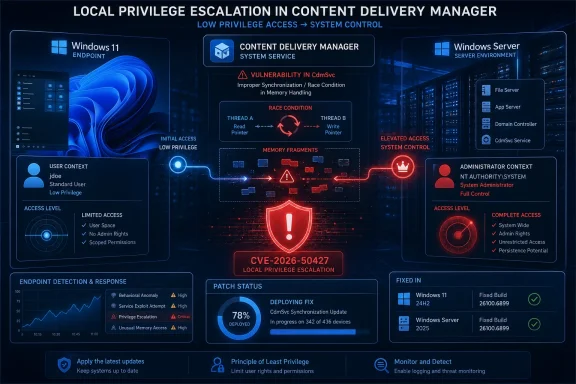 A Local Flaw With System-Level Consequences
Microsoft describes CVE-2026-50427 as an elevation-of-privilege vulnerability in Content Delivery Manager, a Windows component associated with retrieving and presenting system-managed content. The company’s concise description says an authorized local attacker could trigger a use after free, meaning software attempts to access memory after the underlying object has already been released.The record also maps the defect to CWE-416, Use After Free, and CWE-362, a race condition involving improper synchronization of a shared resource. Together, those classifications suggest that the vulnerable code may mishandle an object’s lifetime when multiple operations occur in an unsafe order.
Microsoft’s CVSS 3.1 vector is
AV:L/AC:L/PR:L/UI:N/S:U/C:H/I:H/A:H. In operational terms, exploitation requires local access and an existing low-privilege account, but attack complexity is considered low and no victim interaction is necessary once the attacker can execute the exploit.A successful attack could have a high impact on confidentiality, integrity, and availability. Microsoft has not published sufficient technical detail to establish the exact elevated security context obtained, so administrators should not assume the result is necessarily
NT AUTHORITY\SYSTEM; the confirmed security boundary crossing is serious enough without overstating the outcome.The “confirmed” report-confidence metric shown in Microsoft’s advisory concerns confidence in the vulnerability’s existence and technical basis. It does not mean exploitation in the wild has been confirmed, nor does it establish that public proof-of-concept code is available. Microsoft’s acknowledgment confirms the defect, while the limited public detail leaves defenders and would-be attackers without a vendor-provided exploitation recipe.
The Fixed Build Is the Useful Compliance Test
The affected-product data submitted by Microsoft spans currently serviced Windows client and server branches. The vulnerable build ranges and fixed thresholds are:| Windows release | Builds below this level are affected |
|---|---|
| Windows 10 version 1809 | 17763.9020 |
| Windows 10 version 21H2 | 19044.7548 |
| Windows 10 version 22H2 | 19045.7548 |
| Windows 11 version 24H2 | 26100.8875 |
| Windows 11 version 25H2 | 26200.8875 |
| Windows 11 version 26H1 | 28000.2269 |
| Windows Server 2019 | 17763.9020 |
| Windows Server 2025 | 26100.33158 |
For Windows 11 versions 24H2 and 25H2, the July cumulative update is KB5101650. As reported by BleepingComputer and reflected in Microsoft’s servicing information, installation advances Windows 11 24H2 to build 26100.8875 and Windows 11 25H2 to build 26200.8875.
The version comparison matters because vulnerability scanners, endpoint-management dashboards, and update rings can disagree temporarily about installation state. Administrators can confirm the active build by running
winver, checking the CurrentBuildNumber and UBR registry values, or querying their endpoint-management platform.A device running Windows 11 24H2 build 26100.8874 or earlier remains below Microsoft’s stated remediation boundary. A device on 26100.8875 or later has crossed that boundary, assuming it has not been placed in an unsupported or partially serviced state.
The Windows 11 version 26H1 entry is unusual because Microsoft lists builds earlier than 28000.2269 as affected, while build 28000.2269 was delivered with the June 9 update KB5095051. That indicates systems already on that build meet the CVE record’s fixed threshold, but administrators should still install the latest available cumulative update to avoid relying on a single CVE comparison while missing later security fixes.
Content Delivery Manager Is Not a Reason to Delay Patching
Content Delivery Manager is not a typical internet-facing Windows service, and the vulnerability cannot be attacked directly across a network according to Microsoft’s CVSS assessment. That lowers the immediate risk for a fully uncompromised endpoint but does not make the patch optional.Local privilege-escalation flaws are frequently useful as the second stage of an intrusion. An attacker may first arrive through credential theft, a browser or document exploit, an untrusted installer, remote-management abuse, or a poorly secured user account. Local elevation then helps the attacker disable controls, reach data unavailable to the original account, establish persistence, or interfere with recovery.
Application-control policies and restricted user accounts can reduce the opportunities available to an attacker, but they do not repair the memory-safety defect. Microsoft Defender for Endpoint and other endpoint detection and response products may identify suspicious behavior around an attempted escalation, though no behavioral rule should be considered equivalent to installing the corrected Windows binaries.
Administrators should avoid improvised attempts to remove or disable Content Delivery Manager files, scheduled tasks, or related Windows components. Such changes are not Microsoft’s documented remediation and can create servicing failures without reliably closing the vulnerable code path.
Patch Rings Should Prioritize Shared and Exposed Devices
CVE-2026-50427 does not demand the same emergency perimeter response as an unauthenticated remote-code-execution vulnerability. It does justify prompt deployment wherever untrusted or semi-trusted users can sign in locally, including shared workstations, kiosks that permit application execution, remote desktop hosts, jump boxes, development systems, and administrative workstations.Server administrators should pay particular attention to Windows Server 2019 and Windows Server 2025 systems where non-administrative interactive access is permitted. A server that accepts sessions from many users gives an attacker more opportunities to reach the local execution prerequisite than a tightly controlled infrastructure server with no routine interactive logons.
Normal staged deployment remains reasonable: test the July cumulative updates against critical applications, validate restart behavior, and then move through production rings. However, organizations should set a short completion window and use OS build reporting to locate machines held back by safeguard blocks, failed installations, long uptime, or stale WSUS approvals.
Security teams should also look beyond the patch percentage. Recent creation of local accounts, unexpected scheduled tasks, service modifications, attempts to tamper with endpoint protection, and unusual execution from user-writable directories can indicate the sort of activity that often surrounds privilege escalation, even though Microsoft has not supplied a CVE-specific detection signature.
The immediate milestone is straightforward: Windows 11 24H2 and 25H2 fleets should report builds 26100.8875 and 26200.8875 or later, while Windows 10 and Windows Server estates should meet their corresponding fixed thresholds. Until those numbers appear in inventory, CVE-2026-50427 remains an available route for a low-privilege local intruder to turn an initial foothold into a much more damaging Windows compromise.
References
- Primary source: MSRC
Published: 2026-07-14T07:00:00-07:00
Security Update Guide - Microsoft Security Response Center
 msrc.microsoft.com
