

CVE-2026-50404 is a high-severity Windows Media vulnerability that can let a locally authenticated attacker elevate privileges on Windows 11. Microsoft addressed the flaw in the July 14, 2026 security update for Windows 11 versions 24H2 and 25H2, while Windows 11 version 26H1 systems were protected by an earlier cumulative update.
Detailed in Microsoft’s Security Update Guide and subsequently published by the National Vulnerability Database, CVE-2026-50404 carries a CVSS 3.1 base score of 7.0 out of 10. It affects both x64 and Arm64 installations, making the patch relevant across conventional Windows PCs and Arm-based systems such as newer Copilot+ PCs.
This is not a remote, unauthenticated entry point. An attacker must already have local access under an authorized, low-privilege account, but successful exploitation could provide the elevated permissions needed to take control of the affected machine.
Microsoft describes CVE-2026-50404 as an improper synchronization vulnerability in Windows Media. The weakness is classified under both CWE-362, concurrent execution using a shared resource without adequate synchronization, and CWE-416, use after free.
In practical terms, a race condition occurs when security-sensitive behavior depends on the timing or ordering of two or more operations. If Windows Media releases a memory object while another operation can still access it, an attacker may be able to manipulate the resulting state before Windows finishes processing it.
Exploitation is not considered straightforward. Microsoft’s CVSS vector assigns high attack complexity, meaning an attacker would need to prepare the target environment or win a timing-sensitive race that cannot be triggered reliably on every attempt.
The remaining characteristics are more serious. The attack requires low privileges, needs no user interaction and can produce a high impact across confidentiality, integrity and availability. The CVSS scope remains unchanged, indicating that exploitation does not cross into a separately governed security authority, but the attacker could still gain extensive control within the affected Windows environment.
CISA’s initial Stakeholder-Specific Vulnerability Categorization assessment recorded no observed exploitation and classified automated exploitation as unlikely. It nevertheless marked the potential technical impact as total, reflecting what could happen if an attacker successfully converts the memory flaw into privilege escalation.
Those build numbers are the clearest verification point for administrators. After deployment,
Windows 11 version 26H1 has a different servicing history. Microsoft lists OS Build 28000.2269 as the fixed boundary, corresponding to KB5095051 released on June 9, 2026. The July 14 update, KB5101649, moves 26H1 devices further ahead to Build 28000.2525.
That chronology means a fully updated 26H1 machine was already above the vulnerable build boundary before Microsoft published CVE-2026-50404 on July 14. Organizations that delayed or skipped the June cumulative update should deploy the latest 26H1 package rather than treating the earlier release date as evidence that the vulnerability does not apply.
Windows 11 version 23H2 does not appear in Microsoft’s affected-product data for this CVE. Neither do the currently listed Windows Server releases. Administrators should base deployment decisions on the explicit product and build information rather than assume every Windows installation contains the vulnerable Windows Media code path.
CVE-2026-50404 could reportedly close that gap. Because the CVSS vector requires no additional user interaction after the attacker has low-privilege access, exploitation could be attempted directly from an existing session or process running under the compromised account.
Elevated execution can enable actions that standard users ordinarily cannot perform, including modifying protected files, interfering with services, accessing another user’s information or establishing more durable persistence. Microsoft’s scoring assigns high potential impact in all three traditional security categories, although the company has not published enough technical detail to establish which of those post-exploitation actions has been demonstrated.
The high-complexity rating provides some risk reduction, particularly for indiscriminate attacks. Race-condition exploits often depend on memory layout, system load, thread scheduling or repeated attempts. That is a barrier, not a mitigation: determined attackers can sometimes improve reliability after studying the patch and comparing vulnerable and corrected binaries.
This period after release matters because Microsoft has confirmed the root weakness and identified the fixed builds. Even without public proof-of-concept code, that information gives vulnerability researchers—and potentially attackers—a clear starting point for patch analysis.
Here, the vulnerability is backed by Microsoft as the assigning CVE Numbering Authority. The vendor has identified the affected products, assigned two specific weakness classifications, supplied a CVSS vector and established fixed build boundaries. That gives defenders high confidence that the flaw is real even though Microsoft has released only a concise technical description.
That confidence should not be conflated with exploit maturity. As of July 15, 2026, the NVD record remained marked as awaiting enrichment, and CISA’s assessment showed no known exploitation. No broadly documented public proof of concept was identified in the initial disclosure material.
The distinction is operationally important. CVE-2026-50404 does not currently demand the emergency response normally reserved for an actively exploited zero-day, but it does justify deployment through the normal accelerated Patch Tuesday process. Systems shared by multiple users, developer workstations, virtual desktop infrastructure and endpoints where users routinely run downloaded software deserve particular attention.
For unmanaged PCs, Windows Update should install the applicable cumulative security update automatically. Users can trigger detection from Settings, Windows Update and Check for updates, then restart if requested.
Enterprise administrators should approve and deploy KB5101650 to Windows 11 24H2 and 25H2 rings after their normal validation, while 26H1 devices should receive KB5101649 or another update that leaves them at Build 28000.2269 or later. Microsoft Endpoint Configuration Manager, Windows Autopatch, Windows Update for Business, WSUS and equivalent tools can all use the resulting OS build as the compliance test.
The practical endpoint is unambiguous: Windows 11 24H2 should report Build 26100.8875 or later, 25H2 should report 26200.8875 or later, and 26H1 should report 28000.2269 or later. Any affected machine below those thresholds still exposes the Windows Media privilege boundary that CVE-2026-50404 can potentially break.
Detailed in Microsoft’s Security Update Guide and subsequently published by the National Vulnerability Database, CVE-2026-50404 carries a CVSS 3.1 base score of 7.0 out of 10. It affects both x64 and Arm64 installations, making the patch relevant across conventional Windows PCs and Arm-based systems such as newer Copilot+ PCs.
This is not a remote, unauthenticated entry point. An attacker must already have local access under an authorized, low-privilege account, but successful exploitation could provide the elevated permissions needed to take control of the affected machine.
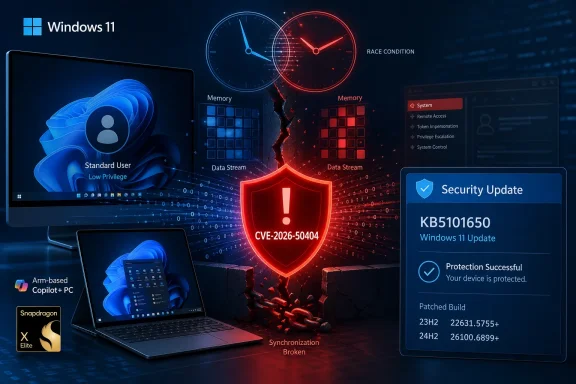 A Race Condition Opens the Privilege Boundary
Microsoft describes CVE-2026-50404 as an improper synchronization vulnerability in Windows Media. The weakness is classified under both CWE-362, concurrent execution using a shared resource without adequate synchronization, and CWE-416, use after free.In practical terms, a race condition occurs when security-sensitive behavior depends on the timing or ordering of two or more operations. If Windows Media releases a memory object while another operation can still access it, an attacker may be able to manipulate the resulting state before Windows finishes processing it.
Exploitation is not considered straightforward. Microsoft’s CVSS vector assigns high attack complexity, meaning an attacker would need to prepare the target environment or win a timing-sensitive race that cannot be triggered reliably on every attempt.
The remaining characteristics are more serious. The attack requires low privileges, needs no user interaction and can produce a high impact across confidentiality, integrity and availability. The CVSS scope remains unchanged, indicating that exploitation does not cross into a separately governed security authority, but the attacker could still gain extensive control within the affected Windows environment.
CISA’s initial Stakeholder-Specific Vulnerability Categorization assessment recorded no observed exploitation and classified automated exploitation as unlikely. It nevertheless marked the potential technical impact as total, reflecting what could happen if an attacker successfully converts the memory flaw into privilege escalation.
Windows 11 24H2 and 25H2 Need KB5101650
The affected-version data supplied by Microsoft identifies three Windows 11 release families:- Windows 11 version 24H2 builds earlier than 26100.8875 are affected on x64 and Arm64 systems.
- Windows 11 version 25H2 builds earlier than 26200.8875 are affected on x64 and Arm64 systems.
- Windows 11 version 26H1 builds earlier than 28000.2269 are affected on x64 and Arm64 systems.
Those build numbers are the clearest verification point for administrators. After deployment,
winver, Settings under System and About, or an endpoint-management inventory query should report the patched revision or a later build.Windows 11 version 26H1 has a different servicing history. Microsoft lists OS Build 28000.2269 as the fixed boundary, corresponding to KB5095051 released on June 9, 2026. The July 14 update, KB5101649, moves 26H1 devices further ahead to Build 28000.2525.
That chronology means a fully updated 26H1 machine was already above the vulnerable build boundary before Microsoft published CVE-2026-50404 on July 14. Organizations that delayed or skipped the June cumulative update should deploy the latest 26H1 package rather than treating the earlier release date as evidence that the vulnerability does not apply.
Windows 11 version 23H2 does not appear in Microsoft’s affected-product data for this CVE. Neither do the currently listed Windows Server releases. Administrators should base deployment decisions on the explicit product and build information rather than assume every Windows installation contains the vulnerable Windows Media code path.
Local Access Does Not Make the Flaw Harmless
Elevation-of-privilege vulnerabilities are frequently used as the second stage of an intrusion. A malicious document, compromised application, stolen standard-user account or separate code-execution flaw may provide an initial foothold without granting the permissions needed to disable security controls or access protected data.CVE-2026-50404 could reportedly close that gap. Because the CVSS vector requires no additional user interaction after the attacker has low-privilege access, exploitation could be attempted directly from an existing session or process running under the compromised account.
Elevated execution can enable actions that standard users ordinarily cannot perform, including modifying protected files, interfering with services, accessing another user’s information or establishing more durable persistence. Microsoft’s scoring assigns high potential impact in all three traditional security categories, although the company has not published enough technical detail to establish which of those post-exploitation actions has been demonstrated.
The high-complexity rating provides some risk reduction, particularly for indiscriminate attacks. Race-condition exploits often depend on memory layout, system load, thread scheduling or repeated attempts. That is a barrier, not a mitigation: determined attackers can sometimes improve reliability after studying the patch and comparing vulnerable and corrected binaries.
This period after release matters because Microsoft has confirmed the root weakness and identified the fixed builds. Even without public proof-of-concept code, that information gives vulnerability researchers—and potentially attackers—a clear starting point for patch analysis.
The Confidence Metric Confirms the Bug, Not Active Exploitation
The report-confidence language attached to the advisory can be easy to misread. It measures confidence that the vulnerability and its technical description are accurate; it does not measure the probability that an organization will be attacked.Here, the vulnerability is backed by Microsoft as the assigning CVE Numbering Authority. The vendor has identified the affected products, assigned two specific weakness classifications, supplied a CVSS vector and established fixed build boundaries. That gives defenders high confidence that the flaw is real even though Microsoft has released only a concise technical description.
That confidence should not be conflated with exploit maturity. As of July 15, 2026, the NVD record remained marked as awaiting enrichment, and CISA’s assessment showed no known exploitation. No broadly documented public proof of concept was identified in the initial disclosure material.
The distinction is operationally important. CVE-2026-50404 does not currently demand the emergency response normally reserved for an actively exploited zero-day, but it does justify deployment through the normal accelerated Patch Tuesday process. Systems shared by multiple users, developer workstations, virtual desktop infrastructure and endpoints where users routinely run downloaded software deserve particular attention.
Patch Verification Is the Useful Control
Microsoft has not documented a standalone workaround or configuration change that neutralizes CVE-2026-50404. Disabling media applications would also be an uncertain substitute because “Windows Media” describes the affected Windows component, not necessarily a single removable player interface.For unmanaged PCs, Windows Update should install the applicable cumulative security update automatically. Users can trigger detection from Settings, Windows Update and Check for updates, then restart if requested.
Enterprise administrators should approve and deploy KB5101650 to Windows 11 24H2 and 25H2 rings after their normal validation, while 26H1 devices should receive KB5101649 or another update that leaves them at Build 28000.2269 or later. Microsoft Endpoint Configuration Manager, Windows Autopatch, Windows Update for Business, WSUS and equivalent tools can all use the resulting OS build as the compliance test.
The practical endpoint is unambiguous: Windows 11 24H2 should report Build 26100.8875 or later, 25H2 should report 26200.8875 or later, and 26H1 should report 28000.2269 or later. Any affected machine below those thresholds still exposes the Windows Media privilege boundary that CVE-2026-50404 can potentially break.
References
- Primary source: MSRC
Published: 2026-07-14T07:00:00-07:00
Security Update Guide - Microsoft Security Response Center
 msrc.microsoft.com
