

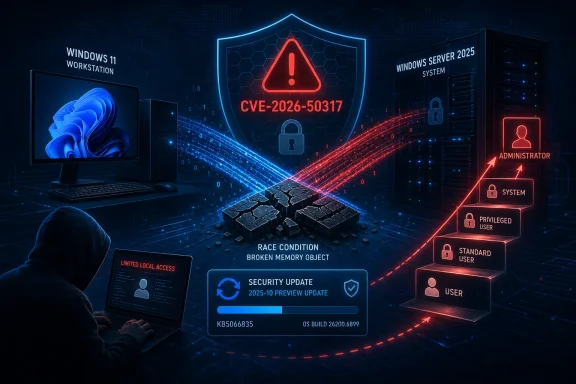
Detailed in Microsoft’s Security Update Guide and newly published by the National Vulnerability Database, the vulnerability carries a CVSS 3.1 base score of 7.8 out of 10. Microsoft rates it Important rather than Critical because exploitation requires local access and existing low-level privileges, but a successful attack could compromise the confidentiality, integrity, and availability of the affected machine.
The immediate action is straightforward: administrators should deploy the July cumulative updates and confirm that endpoints have reached the fixed build levels. CVE-2026-50317 is not identified as one of the publicly disclosed or actively exploited zero-days in Microsoft’s July release, but its low-complexity attack path makes prolonged patch deferral difficult to justify.
A Race Condition Opens the Door to Higher Privileges
Microsoft describes CVE-2026-50317 as improper synchronization during concurrent use of a shared resource. The vulnerability is categorized under CWE-362, covering race conditions, and CWE-416, covering use-after-free memory access.
A race condition occurs when security-relevant behavior depends on the order or timing of two or more operations. An attacker who can repeatedly manipulate that timing may cause Windows to access an object after it has been released, potentially corrupting memory or redirecting execution in a privileged context.
Microsoft’s CVSS vector is AV:L/AC:L/PR:L/UI:N/S:U/C:H/I:H/A:H. In practical terms, the attacker must already be able to run code locally and must possess some valid privileges, but the attack is considered low complexity and requires no interaction from another user.
That combination makes CVE-2026-50317 more useful as a second stage than as an initial entry point. It will not independently compromise an untrusted Windows PC over the internet, but it could help malware, a malicious insider, or an attacker who has stolen a standard user account turn limited access into broader control.
No user needs to open a document, approve a prompt, or visit a malicious website once the attacker is positioned to exercise the flaw. That absence of user interaction matters on shared workstations, development systems, virtual desktop infrastructure, and servers where multiple people or services can execute code.
Newer Windows Builds Carry the Exposure
The initial CVE record identifies a narrower set of affected platforms than the generic “Windows Operating Systems” title suggests. Microsoft lists current Windows 11 releases and Windows Server 2025, including Server Core:
- Windows 11 24H2 is affected on x64 and Arm64 systems before build 26100.8875.
- Windows 11 25H2 is affected on x64 and Arm64 systems before build 26200.8875.
- Windows 11 26H1 is affected on x64 and Arm64 systems before build 28000.2269.
- Windows Server 2025 is affected before build 26100.33158.
- Windows Server 2025 Server Core installations are affected before build 26100.33158.
The associated July packages include KB5101650 for Windows 11 24H2 and 25H2, with separate update paths used for Windows 11 26H1 and Windows Server 2025. Administrators should use the installed OS edition, architecture, and build number rather than relying only on a generic “up to date” status.
That distinction is especially important in managed environments where quality-update deferrals, deployment rings, safeguard holds, or maintenance windows can leave machines several builds behind. An endpoint may have successfully checked Windows Update while still waiting for the security package approved by its organization.
Windows 11 users can inspect the installed build by running winver or checking Settings under System and About. Administrators can collect the same information remotely through PowerShell, Microsoft Intune, Configuration Manager, Windows Update for Business reporting, or their endpoint-management platform.
Server teams should verify both full Windows Server 2025 installations and Server Core machines. Core installations reduce exposed components and interactive surface area, but they are explicitly listed as affected and still require the corrected operating-system build.
Local Does Not Mean Low Risk
Elevation-of-privilege vulnerabilities are frequently underestimated because their CVSS attack vector is local. In real intrusions, however, gaining an initial foothold and gaining full administrative control are separate steps, and local privilege escalation is often the bridge between them.
A phishing attachment, browser exploit, exposed remote-management credential, or compromised application may initially execute with the rights of a standard user or restricted service account. If that code can then exploit CVE-2026-50317, the attacker could potentially escape those restrictions and interfere with protected data, security controls, or system configuration.
The CVSS impact ratings are High for confidentiality, integrity, and availability. Microsoft’s scoring therefore reflects the possibility of a complete security impact on the vulnerable system, even though exploitation does not cross into a different security authority or scope.
The available description does not identify the precise Windows subsystem, service, or kernel object involved. Microsoft has also not published reproduction steps or technical exploit details. That limits defenders’ ability to build a specific behavioral detection around the underlying race condition and reinforces the value of fixing the vulnerable code instead of depending on monitoring alone.
Endpoint detection and response tools may still detect actions taken before or after successful escalation, such as suspicious process trees, credential access, service creation, security-control tampering, or unusual privileged child processes. They should not be treated as a replacement for the July update, particularly because timing-dependent memory bugs can produce behavior that varies between attempts and systems.
Patch Triage Must Look Beyond the July Zero-Days
CVE-2026-50317 arrived inside an unusually large July 2026 Microsoft security release. BleepingComputer counted 570 vulnerabilities fixed on Patch Tuesday, including two flaws known to be exploited and a third that had been publicly disclosed.
That volume creates an obvious triage problem. CVE-2026-50317 is not the headline vulnerability in the release, but its CVSS 7.8 score, low attack complexity, and potential for high impact make it relevant to endpoint and server hardening.
Organizations will reasonably prioritize known exploitation, public proof-of-concept code, internet-facing services, and domain infrastructure first. Once those emergency items are covered, this vulnerability belongs in the normal expedited Windows cumulative-update deployment rather than being deferred simply because Microsoft has not reported active attacks.
A sensible rollout begins with representative Windows 11 and Windows Server 2025 systems, followed by broader deployment after checking application compatibility, boot health, BitLocker recovery behavior, networking, and security-agent operation. The cumulative nature of Windows servicing means administrators are testing the entire July package, not an isolated CVE-2026-50317 hotfix.
One complication affects a limited number of Dell systems using Intel processors. Reporting around KB5101650 indicates that Microsoft withheld the Windows 11 24H2 and 25H2 update from some affected devices because of possible unexpected shutdowns, excess heat, reduced performance, and battery drain. Administrators responsible for those models should track the safeguard status rather than attempting to force-install an update that Microsoft or Dell has blocked.
For systems without a documented compatibility hold, the operational target is clear: reach build 26100.8875 on Windows 11 24H2, build 26200.8875 on Windows 11 25H2, build 28000.2269 on Windows 11 26H1, or build 26100.33158 on Windows Server 2025. Machines below those thresholds remain exposed to a confirmed local path from limited access to elevated Windows privileges.
References
- CVE-2026-50317 Windows Operating Systems Elevation of Privilege Vulnerability MSRC · 2026-07-14T07:00:00-07:00