

CVE-2026-50488 is a high-severity elevation-of-privilege vulnerability in the Windows Clipboard User Service that can let a locally authenticated attacker gain higher privileges through command injection. Microsoft patched the flaw on July 14, 2026, in cumulative updates for Windows 11 24H2, Windows 11 25H2, and Windows Server 2025.
Detailed in Microsoft’s Security Update Guide and recorded by the National Vulnerability Database, the vulnerability carries a CVSS 3.1 base score of 7.8 out of 10. Microsoft rates it Important rather than Critical because an attacker must already have local access and low-level privileges, but successful exploitation could produce a complete loss of confidentiality, integrity, and availability.
Administrators should deploy KB5101650 to Windows 11 endpoints and KB5099536 to Windows Server 2025 systems. Microsoft’s assessment at publication says the vulnerability was not publicly disclosed or known to be exploited, and exploitation is considered less likely.
Microsoft describes CVE-2026-50488 as an improper neutralization of special elements used in a command, categorized as CWE-77. In practical terms, Windows Clipboard User Service does not safely handle some command-related input, creating a path through which an authorized local attacker could inject instructions and elevate privileges.
The CVSS vector is
This is not a remote, pre-authentication entry point. An attacker cannot exploit the Clipboard User Service directly over the internet based on Microsoft’s published assessment. The more realistic scenario is post-compromise privilege escalation: malicious code, a compromised standard user account, or an attacker with an existing foothold uses the flaw to break out of a restricted context.
That distinction lowers the immediate exposure compared with a remotely exploitable Windows service vulnerability, but it does not make CVE-2026-50488 harmless. Local privilege-escalation bugs are frequently valuable components in attack chains because malware initially delivered through phishing, a browser flaw, or stolen credentials may still need elevated rights to disable defenses, access protected information, establish persistence, or interfere with system recovery.
For Windows 11 24H2 and 25H2, the fix arrives through KB5101650. Installing it advances Windows 11 24H2 to build 26100.8875 and Windows 11 25H2 to build 26200.8875. The cumulative package is available through Windows Update, Windows Update for Business, Microsoft Update Catalog, and Windows Server Update Services.
Windows Server 2025 receives the correction through KB5099536, which advances the operating system to build 26100.33158. The Server Core installation is also covered, an important detail for organizations that may otherwise treat clipboard-related vulnerabilities as relevant only to interactive desktop deployments.
The affected service name should not be taken to mean that only users who regularly copy and paste sensitive content are at risk. The security boundary at issue is the vulnerable service and its command handling, not merely the contents currently stored on the clipboard.
In this case, Microsoft is the assigning CVE Numbering Authority and has published the vulnerability, affected products, impact, weakness category, CVSS vector, and fixed-build boundaries. That supports high confidence that CVE-2026-50488 exists and that the July updates address it.
Report confidence is separate from exploit-code maturity and active exploitation. It does not mean a proof of concept is circulating, that attackers possess a working exploit, or that the vulnerability has been observed in malware campaigns. According to Microsoft’s Patch Tuesday data collected by BleepingComputer, CVE-2026-50488 was not publicly disclosed, was not known to be exploited, and was assessed as “Exploitation Less Likely” when released.
That assessment should guide prioritization, not postponement. Microsoft’s Exploitability Index is a forecast based on factors such as the technical conditions required for reliable exploitation; it is not a guarantee that exploit development will fail. The low-complexity CVSS rating also indicates that there are no specialized conditions in the scoring model beyond obtaining local access and limited privileges.
For security teams, the useful reading is that CVE-2026-50488 is a confirmed, consequential privilege-escalation flaw without evidence of active attack as of July 14. It belongs in the normal July deployment cycle, with faster handling on shared systems, developer workstations, privileged administrative endpoints, virtual desktop infrastructure, and servers where untrusted or lower-privileged users can execute code.
Endpoint teams can verify Windows 11 deployment by checking for KB5101650 or confirming that the build is at least 26100.8875 on Windows 11 24H2 and 26200.8875 on Windows 11 25H2. Windows Server 2025 should show KB5099536 and build 26100.33158 or later.
The Windows 11 package includes servicing stack update KB5120102, build 26100.8872. Microsoft says KB5101650 is cumulative and is not currently associated with any known issues, although organizations should still conduct their usual compatibility testing because the July package also contains security hardening and quality changes unrelated to CVE-2026-50488.
Administrators deploying standalone MSU packages should follow Microsoft’s documented prerequisite order rather than extracting only individual security files. WSUS and Windows Update for Business environments can distribute the cumulative update under the normal Security Updates classification.
Detection teams should continue to monitor for unexpected process creation, command interpreters launched from unusual service contexts, new privileged persistence mechanisms, and unexplained changes to security controls. Microsoft has not published enough root-cause or exploitation detail to define a dependable CVE-specific behavioral signature, so defensive monitoring must focus on the likely consequences of successful privilege escalation.
The immediate milestone is straightforward: Windows 11 systems should reach the July 14 builds, and Windows Server 2025 should reach build 26100.33158. Until then, any attacker who already obtains low-privileged local execution may have a confirmed route to turn that foothold into a substantially more damaging Windows compromise.
Detailed in Microsoft’s Security Update Guide and recorded by the National Vulnerability Database, the vulnerability carries a CVSS 3.1 base score of 7.8 out of 10. Microsoft rates it Important rather than Critical because an attacker must already have local access and low-level privileges, but successful exploitation could produce a complete loss of confidentiality, integrity, and availability.
Administrators should deploy KB5101650 to Windows 11 endpoints and KB5099536 to Windows Server 2025 systems. Microsoft’s assessment at publication says the vulnerability was not publicly disclosed or known to be exploited, and exploitation is considered less likely.
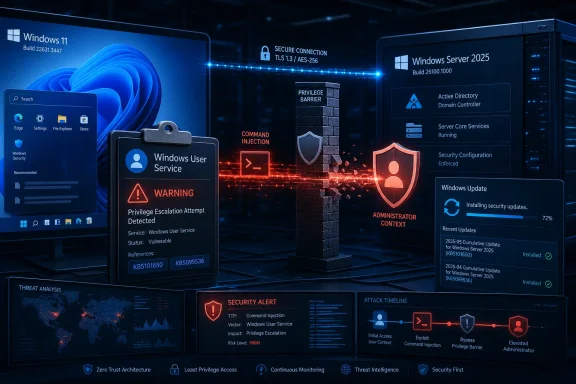 Command Injection Turns Local Access Into a Bigger Problem
Microsoft describes CVE-2026-50488 as an improper neutralization of special elements used in a command, categorized as CWE-77. In practical terms, Windows Clipboard User Service does not safely handle some command-related input, creating a path through which an authorized local attacker could inject instructions and elevate privileges.The CVSS vector is
CVSS:3.1/AV:L/AC:L/PR:L/UI:N/S:U/C:H/I:H/A:H. That combination describes a local attack with low complexity, requiring low privileges but no action from another user. The security scope remains unchanged, meaning the compromise stays within the security authority of the vulnerable Windows system, but Microsoft assigns High impact ratings across confidentiality, integrity, and availability.This is not a remote, pre-authentication entry point. An attacker cannot exploit the Clipboard User Service directly over the internet based on Microsoft’s published assessment. The more realistic scenario is post-compromise privilege escalation: malicious code, a compromised standard user account, or an attacker with an existing foothold uses the flaw to break out of a restricted context.
That distinction lowers the immediate exposure compared with a remotely exploitable Windows service vulnerability, but it does not make CVE-2026-50488 harmless. Local privilege-escalation bugs are frequently valuable components in attack chains because malware initially delivered through phishing, a browser flaw, or stolen credentials may still need elevated rights to disable defenses, access protected information, establish persistence, or interfere with system recovery.
The Affected List Is Short and Specific
The initial CVE record identifies four affected product configurations, all from the current Windows platform generation:- Windows 11 24H2 on x64 and Arm64 is affected before OS build 26100.8875.
- Windows 11 25H2 on x64 and Arm64 is affected before OS build 26200.8875.
- Windows Server 2025 is affected before OS build 26100.33158.
- Windows Server 2025 Server Core installations are affected before OS build 26100.33158.
For Windows 11 24H2 and 25H2, the fix arrives through KB5101650. Installing it advances Windows 11 24H2 to build 26100.8875 and Windows 11 25H2 to build 26200.8875. The cumulative package is available through Windows Update, Windows Update for Business, Microsoft Update Catalog, and Windows Server Update Services.
Windows Server 2025 receives the correction through KB5099536, which advances the operating system to build 26100.33158. The Server Core installation is also covered, an important detail for organizations that may otherwise treat clipboard-related vulnerabilities as relevant only to interactive desktop deployments.
The affected service name should not be taken to mean that only users who regularly copy and paste sensitive content are at risk. The security boundary at issue is the vulnerable service and its command handling, not merely the contents currently stored on the clipboard.
“Confirmed” Does Not Mean Attacks Are Underway
The report-confidence text included in Microsoft’s advisory describes how much confidence exists in the vulnerability and its technical basis. A confirmed rating means the flaw has been substantiated through detailed reporting, reproducible behavior, source-level evidence, or acknowledgment by the affected vendor.In this case, Microsoft is the assigning CVE Numbering Authority and has published the vulnerability, affected products, impact, weakness category, CVSS vector, and fixed-build boundaries. That supports high confidence that CVE-2026-50488 exists and that the July updates address it.
Report confidence is separate from exploit-code maturity and active exploitation. It does not mean a proof of concept is circulating, that attackers possess a working exploit, or that the vulnerability has been observed in malware campaigns. According to Microsoft’s Patch Tuesday data collected by BleepingComputer, CVE-2026-50488 was not publicly disclosed, was not known to be exploited, and was assessed as “Exploitation Less Likely” when released.
That assessment should guide prioritization, not postponement. Microsoft’s Exploitability Index is a forecast based on factors such as the technical conditions required for reliable exploitation; it is not a guarantee that exploit development will fail. The low-complexity CVSS rating also indicates that there are no specialized conditions in the scoring model beyond obtaining local access and limited privileges.
For security teams, the useful reading is that CVE-2026-50488 is a confirmed, consequential privilege-escalation flaw without evidence of active attack as of July 14. It belongs in the normal July deployment cycle, with faster handling on shared systems, developer workstations, privileged administrative endpoints, virtual desktop infrastructure, and servers where untrusted or lower-privileged users can execute code.
Patch Verification Matters More Than Service Workarounds
Microsoft has provided an official fix through the cumulative servicing channel, and no vulnerability-specific workaround is needed for normally managed systems. Disabling clipboard functionality or attempting to stop per-user services is not an equivalent substitute for updating, particularly because Windows user services may be instantiated dynamically and can support functionality beyond the obvious clipboard interface.Endpoint teams can verify Windows 11 deployment by checking for KB5101650 or confirming that the build is at least 26100.8875 on Windows 11 24H2 and 26200.8875 on Windows 11 25H2. Windows Server 2025 should show KB5099536 and build 26100.33158 or later.
The Windows 11 package includes servicing stack update KB5120102, build 26100.8872. Microsoft says KB5101650 is cumulative and is not currently associated with any known issues, although organizations should still conduct their usual compatibility testing because the July package also contains security hardening and quality changes unrelated to CVE-2026-50488.
Administrators deploying standalone MSU packages should follow Microsoft’s documented prerequisite order rather than extracting only individual security files. WSUS and Windows Update for Business environments can distribute the cumulative update under the normal Security Updates classification.
Detection teams should continue to monitor for unexpected process creation, command interpreters launched from unusual service contexts, new privileged persistence mechanisms, and unexplained changes to security controls. Microsoft has not published enough root-cause or exploitation detail to define a dependable CVE-specific behavioral signature, so defensive monitoring must focus on the likely consequences of successful privilege escalation.
The immediate milestone is straightforward: Windows 11 systems should reach the July 14 builds, and Windows Server 2025 should reach build 26100.33158. Until then, any attacker who already obtains low-privileged local execution may have a confirmed route to turn that foothold into a substantially more damaging Windows compromise.
References
- Primary source: MSRC
Published: 2026-07-14T07:00:00-07:00
Security Update Guide - Microsoft Security Response Center
 msrc.microsoft.com
