

CVE-2026-50667, a Windows Common Log File System Driver elevation-of-privilege vulnerability, was fixed in Microsoft’s July 14, 2026 security updates. The flaw affects supported Windows client and server releases and could let an attacker who already has local access raise privileges to SYSTEM, making prompt deployment important on multi-user endpoints, virtual desktop infrastructure, jump hosts, and servers where an initial compromise could become a full machine takeover.
Microsoft’s Security Response Center classifies CVE-2026-50667 as Important, with a CVSS 3.1 base score of 7.8. The vulnerability is a race condition, tracked under CWE-362, involving concurrent access to shared resources in the Windows Common Log File System, better known as CLFS.
The issue requires local access and valid low-level privileges, so it is not a remotely exploitable entry point by itself. Its practical danger lies later in an attack chain: malware, a malicious user, or an intruder who has obtained an ordinary account could reportedly exploit the driver flaw to escape that restricted security context.
CLFS is a Windows kernel component that provides a general-purpose logging subsystem for applications and system services. Because its driver operates in the kernel, a successful privilege-escalation exploit can cross one of Windows’ most important security boundaries.
Microsoft’s CVSS assessment reflects that attack path. CVE-2026-50667 uses a local attack vector, requires low privileges, needs no user interaction, and can result in a complete loss of confidentiality, integrity, and availability on the affected computer. In practical terms, successful exploitation would allow an attacker to execute code with SYSTEM rights.
That distinction matters when triaging the vulnerability. CVE-2026-50667 cannot normally be used to compromise an untouched machine directly over the network, but it can turn a limited foothold into administrative control. Attackers regularly combine local privilege-escalation vulnerabilities with phishing, browser bugs, exposed services, stolen credentials, or malicious documents.
Once operating as SYSTEM, an attacker may be able to disable endpoint protections, access data belonging to other users, extract credentials, install persistent services, manipulate security logs, and use the compromised system as a staging point for lateral movement. Whether those actions succeed will still depend on other controls, including Microsoft Defender protections, Credential Guard, application control, network segmentation, and identity policies.
The vulnerability’s race-condition classification also provides a little more technical context than Microsoft’s short title alone. A race condition occurs when security depends on operations happening in an expected order, but an attacker can manipulate timing or concurrent access so that a shared resource reaches an unsafe state.
Microsoft has not published exploit code or enough implementation detail to reproduce the flaw. That restraint is normal for a newly patched kernel vulnerability and limits immediate guidance for defenders looking for unique file, process, or event-log indicators.
For current Windows 11 production systems, the main update is KB5101650. It moves Windows 11 version 24H2 to build 26100.8875 and Windows 11 version 25H2 to build 26200.8875. Versions below those build numbers remain within Microsoft’s affected ranges for CVE-2026-50667.
Windows 11 version 26H1 receives KB5101649, taking it to build 28000.2525. Microsoft lists earlier 26H1 builds beginning with 28000.0 as affected.
The other relevant patched build thresholds include:
Organizations still running Windows Server 2012 or Windows Server 2012 R2 should note that receiving a patch depends on enrollment in the applicable Extended Security Updates program. The presence of an affected-product entry does not mean an out-of-support installation will automatically receive the update without the required licensing and servicing configuration.
Internet-facing servers should also be reviewed even though exploitation is local. A web application or service account compromised through an unrelated vulnerability may initially have restricted rights; a reliable CLFS exploit could supply the second step needed to take over the operating system.
Administrators can reduce exposure while updates move through testing by applying familiar controls rather than attempting to disable CLFS. Restrict interactive logons, block unnecessary executable content, enforce Windows Defender Application Control or AppLocker where practical, and monitor for unusual child processes or service creation originating from low-privilege applications.
There is no broadly applicable Microsoft workaround that provides the same protection as replacing the vulnerable driver code. Disabling an underlying Windows logging component would also risk destabilizing applications and services, making patch installation the appropriate remediation.
For managed fleets, deployment validation should include a post-restart build inventory and checks for pending reboot states. Security scanners may identify the CVE through installed-package or build-level assessment, but administrators should confirm that supersedence rules and servicing-stack prerequisites did not leave machines on an older cumulative update.
The currently public information supports confidence that the vulnerability exists and that Microsoft has corrected it, but it does not establish active exploitation. Microsoft’s advisory does not identify CVE-2026-50667 as publicly disclosed or exploited in the wild at publication, and no public proof-of-concept was available in the initial reporting.
That status can change after patches ship. Attackers and researchers can compare pre-update and post-update driver binaries—a process known as patch diffing—to locate the modified code and infer the underlying defect. Kernel privilege-escalation bugs often become more actionable once that analysis is complete, even when the original advisory contains few technical details.
Defenders should therefore treat “not known to be exploited” as a snapshot dated July 14, 2026, not a reason to postpone remediation indefinitely. The immediate milestone is installation of the July cumulative update and verification that every affected system has reached its patched build; the unresolved question is how quickly researchers or attackers can turn Microsoft’s race-condition fix into working exploit knowledge.
Microsoft’s Security Response Center classifies CVE-2026-50667 as Important, with a CVSS 3.1 base score of 7.8. The vulnerability is a race condition, tracked under CWE-362, involving concurrent access to shared resources in the Windows Common Log File System, better known as CLFS.
The issue requires local access and valid low-level privileges, so it is not a remotely exploitable entry point by itself. Its practical danger lies later in an attack chain: malware, a malicious user, or an intruder who has obtained an ordinary account could reportedly exploit the driver flaw to escape that restricted security context.
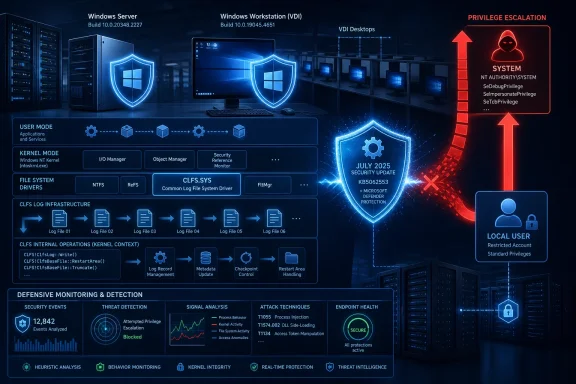 A Local Bug With System-Level Consequences
CLFS is a Windows kernel component that provides a general-purpose logging subsystem for applications and system services. Because its driver operates in the kernel, a successful privilege-escalation exploit can cross one of Windows’ most important security boundaries.Microsoft’s CVSS assessment reflects that attack path. CVE-2026-50667 uses a local attack vector, requires low privileges, needs no user interaction, and can result in a complete loss of confidentiality, integrity, and availability on the affected computer. In practical terms, successful exploitation would allow an attacker to execute code with SYSTEM rights.
That distinction matters when triaging the vulnerability. CVE-2026-50667 cannot normally be used to compromise an untouched machine directly over the network, but it can turn a limited foothold into administrative control. Attackers regularly combine local privilege-escalation vulnerabilities with phishing, browser bugs, exposed services, stolen credentials, or malicious documents.
Once operating as SYSTEM, an attacker may be able to disable endpoint protections, access data belonging to other users, extract credentials, install persistent services, manipulate security logs, and use the compromised system as a staging point for lateral movement. Whether those actions succeed will still depend on other controls, including Microsoft Defender protections, Credential Guard, application control, network segmentation, and identity policies.
The vulnerability’s race-condition classification also provides a little more technical context than Microsoft’s short title alone. A race condition occurs when security depends on operations happening in an expected order, but an attacker can manipulate timing or concurrent access so that a shared resource reaches an unsafe state.
Microsoft has not published exploit code or enough implementation detail to reproduce the flaw. That restraint is normal for a newly patched kernel vulnerability and limits immediate guidance for defenders looking for unique file, process, or event-log indicators.
July Updates Draw the Patched Build Line
The affected-product data covers a broad cross-section of Windows, from older systems receiving specialized servicing to Windows 11 version 26H1. Administrators should verify successful installation by checking both the cumulative update and resulting OS build rather than relying solely on a deployment console’s “installed” status.For current Windows 11 production systems, the main update is KB5101650. It moves Windows 11 version 24H2 to build 26100.8875 and Windows 11 version 25H2 to build 26200.8875. Versions below those build numbers remain within Microsoft’s affected ranges for CVE-2026-50667.
Windows 11 version 26H1 receives KB5101649, taking it to build 28000.2525. Microsoft lists earlier 26H1 builds beginning with 28000.0 as affected.
The other relevant patched build thresholds include:
- Windows 10 version 1607 and Windows Server 2016 are protected at build 14393.9339.
- Windows 10 version 1809 and Windows Server 2019 are protected at build 17763.9020 through KB5099538.
- Windows 10 version 21H2 reaches build 19044.7548.
- Windows 10 version 22H2 reaches build 19045.7548.
- Windows Server 2022 reaches build 20348.5386 through KB5099540.
- Windows Server 2025 reaches build 26100.33158.
- Windows Server 2012 reaches build 9200.26226, while Windows Server 2012 R2 reaches build 9600.23291 through their applicable extended servicing channels.
Organizations still running Windows Server 2012 or Windows Server 2012 R2 should note that receiving a patch depends on enrollment in the applicable Extended Security Updates program. The presence of an affected-product entry does not mean an out-of-support installation will automatically receive the update without the required licensing and servicing configuration.
Patch Priority Depends on Where Users Can Run Code
CVE-2026-50667 warrants accelerated deployment on systems where untrusted or lightly trusted users can execute applications. Remote Desktop Session Hosts, shared engineering workstations, classroom and laboratory PCs, kiosks with imperfect application restrictions, and pooled VDI desktops have greater exposure than locked-down appliances with no interactive users.Internet-facing servers should also be reviewed even though exploitation is local. A web application or service account compromised through an unrelated vulnerability may initially have restricted rights; a reliable CLFS exploit could supply the second step needed to take over the operating system.
Administrators can reduce exposure while updates move through testing by applying familiar controls rather than attempting to disable CLFS. Restrict interactive logons, block unnecessary executable content, enforce Windows Defender Application Control or AppLocker where practical, and monitor for unusual child processes or service creation originating from low-privilege applications.
There is no broadly applicable Microsoft workaround that provides the same protection as replacing the vulnerable driver code. Disabling an underlying Windows logging component would also risk destabilizing applications and services, making patch installation the appropriate remediation.
For managed fleets, deployment validation should include a post-restart build inventory and checks for pending reboot states. Security scanners may identify the CVE through installed-package or build-level assessment, but administrators should confirm that supersedence rules and servicing-stack prerequisites did not leave machines on an older cumulative update.
A Familiar Windows Kernel Target Returns
CLFS has appeared repeatedly in Windows privilege-escalation advisories, including vulnerabilities exploited in real attacks in previous years. That history does not prove CVE-2026-50667 is being weaponized, but it makes the component more interesting to exploit developers who may already understand its objects, file formats, and kernel interfaces.The currently public information supports confidence that the vulnerability exists and that Microsoft has corrected it, but it does not establish active exploitation. Microsoft’s advisory does not identify CVE-2026-50667 as publicly disclosed or exploited in the wild at publication, and no public proof-of-concept was available in the initial reporting.
That status can change after patches ship. Attackers and researchers can compare pre-update and post-update driver binaries—a process known as patch diffing—to locate the modified code and infer the underlying defect. Kernel privilege-escalation bugs often become more actionable once that analysis is complete, even when the original advisory contains few technical details.
Defenders should therefore treat “not known to be exploited” as a snapshot dated July 14, 2026, not a reason to postpone remediation indefinitely. The immediate milestone is installation of the July cumulative update and verification that every affected system has reached its patched build; the unresolved question is how quickly researchers or attackers can turn Microsoft’s race-condition fix into working exploit knowledge.
References
- Primary source: MSRC
Published: 2026-07-14T07:00:00-07:00
Security Update Guide - Microsoft Security Response Center
 msrc.microsoft.com
