

CVE-2026-50668, a heap-based buffer overflow affecting Windows storage code, was patched in Microsoft’s July 14, 2026 security updates across supported Windows 10, Windows 11, and Windows Server releases. The flaw can allow an attacker with physical access to elevate privileges without already holding a Windows account, making timely patching especially important for servers, shared workstations, kiosks, and other systems that may encounter untrusted storage devices.
Microsoft’s Security Update Guide identifies the issue as a Windows Resilient File System elevation-of-privilege vulnerability and assigns it a CVSS 3.1 score of 6.8. However, the CVE description submitted by Microsoft and reproduced by the National Vulnerability Database says the heap-based buffer overflow is in Windows NTFS, not ReFS. That ReFS-versus-NTFS discrepancy is significant enough that administrators should track the CVE number rather than relying solely on product-name filters in vulnerability-management tools.
Microsoft’s CVSS vector classifies CVE-2026-50668 as a physical attack with low complexity, no privileges required, and no user interaction. This is not a remotely exploitable flaw that an attacker can reach over SMB, Remote Desktop, or an exposed Windows service.
The physical attack requirement substantially reduces the number of realistic scenarios, but it does not make the vulnerability harmless. A person who can connect or present attacker-controlled storage to a vulnerable computer could reportedly trigger faulty filesystem processing and exploit the resulting memory corruption.
The flaw is categorized as CWE-122, a heap-based buffer overflow. Such vulnerabilities occur when software writes beyond the memory allocated to an object on the heap, potentially corrupting neighboring data and changing program behavior. In this case, Microsoft says successful exploitation can compromise confidentiality, integrity, and availability at a high level.
The CVSS vector also specifies that scope remains unchanged. In practical terms, the vulnerable Windows component and the compromised security authority remain within the same security boundary, even though exploitation may result in extensive control over the affected machine.
Microsoft’s wording says an “unauthorized attacker” could elevate privileges, while the scoring indicates no existing privileges or user interaction are required. Administrators should therefore avoid interpreting “elevation of privilege” as proof that an attacker must first log on with a low-privilege account; the physical access requirement is the principal gate identified in the public record.
ReFS and NTFS are separate Microsoft filesystems with different deployment profiles. NTFS remains the standard filesystem on most Windows system volumes and ordinary client PCs, while ReFS is more commonly found in Windows Server storage deployments, virtualization environments, and specialized data volumes. Confusing the two can materially alter an organization’s assessment of exposure.
At publication time, the National Vulnerability Database marked the record as awaiting enrichment and repeated Microsoft’s NTFS description. Third-party CVE databases have inherited the same inconsistency: the displayed title references ReFS, while the description names NTFS.
There is not enough public technical information to determine whether the bug resides specifically in ReFS, specifically in NTFS, or in shared storage-processing code that Microsoft has labeled inconsistently. Microsoft may correct the title or description in a later Security Update Guide revision. Until then, the safe assumption is that affected Windows builds should be patched regardless of which filesystem an administrator believes is in use.
This also matters for scanner results. Security products that map exposure by advisory title may place the CVE under ReFS, while tools ingesting the CVE description or CWE data may associate it with NTFS. A missing ReFS volume should not be used as the sole basis for suppressing or accepting the finding.
The boilerplate explanation of Microsoft’s report-confidence metric does not provide additional exploit details. It explains how confidence is evaluated generally, but it should not be read as evidence that a public proof of concept exists or that attacks have been observed.
These build numbers provide a more reliable compliance test than checking whether Windows Update reports that a device is current. Administrators can retrieve the installed build with
The breadth of the affected list also argues against treating CVE-2026-50668 as a niche ReFS-only server problem. Microsoft has assigned affected ranges to mainstream Windows 10 and Windows 11 client releases, including systems where ReFS may not be configured as a user-visible data volume.
Risk rises on devices where physical control is weak or storage media frequently crosses trust boundaries. That includes publicly accessible PCs, classroom and laboratory systems, repair benches, branch-office equipment, shared administrative workstations, and servers housed in locations accessible to contractors or multiple tenants.
Controls that restrict removable storage can reduce exposure while updates are tested. Device-control policies in Microsoft Defender for Endpoint, Group Policy restrictions, firmware protections, locked enclosures, and disciplined handling of removable drives all provide useful layers, but they do not replace the operating-system fix.
Administrators should also review recovery and servicing paths. A machine that is ordinarily locked down may still process external media during imaging, backup restoration, offline maintenance, forensic acquisition, or disaster recovery. Those workflows can create precisely the physical interaction that the CVSS vector assumes.
Microsoft published CVE-2026-50668 on July 14, 2026, as part of the regular Patch Tuesday release. The immediate task is to deploy the appropriate cumulative update and verify that devices meet or exceed the fixed build for their Windows branch; the remaining question is whether Microsoft will revise the advisory to clarify whether the vulnerable filesystem is ReFS, NTFS, or code shared by both.
Microsoft’s Security Update Guide identifies the issue as a Windows Resilient File System elevation-of-privilege vulnerability and assigns it a CVSS 3.1 score of 6.8. However, the CVE description submitted by Microsoft and reproduced by the National Vulnerability Database says the heap-based buffer overflow is in Windows NTFS, not ReFS. That ReFS-versus-NTFS discrepancy is significant enough that administrators should track the CVE number rather than relying solely on product-name filters in vulnerability-management tools.
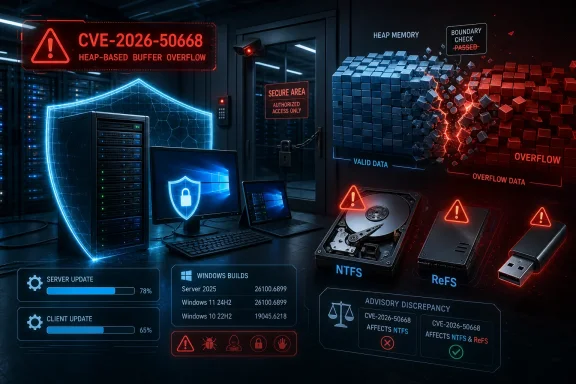 Physical Access Limits Reach but Raises the Stakes
Microsoft’s CVSS vector classifies CVE-2026-50668 as a physical attack with low complexity, no privileges required, and no user interaction. This is not a remotely exploitable flaw that an attacker can reach over SMB, Remote Desktop, or an exposed Windows service.The physical attack requirement substantially reduces the number of realistic scenarios, but it does not make the vulnerability harmless. A person who can connect or present attacker-controlled storage to a vulnerable computer could reportedly trigger faulty filesystem processing and exploit the resulting memory corruption.
The flaw is categorized as CWE-122, a heap-based buffer overflow. Such vulnerabilities occur when software writes beyond the memory allocated to an object on the heap, potentially corrupting neighboring data and changing program behavior. In this case, Microsoft says successful exploitation can compromise confidentiality, integrity, and availability at a high level.
The CVSS vector also specifies that scope remains unchanged. In practical terms, the vulnerable Windows component and the compromised security authority remain within the same security boundary, even though exploitation may result in extensive control over the affected machine.
Microsoft’s wording says an “unauthorized attacker” could elevate privileges, while the scoring indicates no existing privileges or user interaction are required. Administrators should therefore avoid interpreting “elevation of privilege” as proof that an attacker must first log on with a low-privilege account; the physical access requirement is the principal gate identified in the public record.
The Advisory’s Filesystem Identity Is Unclear
The most unusual part of CVE-2026-50668 is the mismatch between its title and its technical description. Microsoft’s advisory title calls it a Windows Resilient File System vulnerability, while the Microsoft-authored CVE record says the heap-based overflow exists in Windows NTFS.ReFS and NTFS are separate Microsoft filesystems with different deployment profiles. NTFS remains the standard filesystem on most Windows system volumes and ordinary client PCs, while ReFS is more commonly found in Windows Server storage deployments, virtualization environments, and specialized data volumes. Confusing the two can materially alter an organization’s assessment of exposure.
At publication time, the National Vulnerability Database marked the record as awaiting enrichment and repeated Microsoft’s NTFS description. Third-party CVE databases have inherited the same inconsistency: the displayed title references ReFS, while the description names NTFS.
There is not enough public technical information to determine whether the bug resides specifically in ReFS, specifically in NTFS, or in shared storage-processing code that Microsoft has labeled inconsistently. Microsoft may correct the title or description in a later Security Update Guide revision. Until then, the safe assumption is that affected Windows builds should be patched regardless of which filesystem an administrator believes is in use.
This also matters for scanner results. Security products that map exposure by advisory title may place the CVE under ReFS, while tools ingesting the CVE description or CWE data may associate it with NTFS. A missing ReFS volume should not be used as the sole basis for suppressing or accepting the finding.
The boilerplate explanation of Microsoft’s report-confidence metric does not provide additional exploit details. It explains how confidence is evaluated generally, but it should not be read as evidence that a public proof of concept exists or that attacks have been observed.
July’s Builds Establish the Patch Boundary
The affected-product record covers a broad range of client and server releases. Systems running builds below Microsoft’s July 2026 thresholds remain affected:- Windows 10 Version 1607 and Windows Server 2016 are affected below build 14393.9339.
- Windows 10 Version 1809 and Windows Server 2019 are affected below build 17763.9020.
- Windows 10 Version 21H2 is affected below build 19044.7548.
- Windows 10 Version 22H2 is affected below build 19045.7548.
- Windows Server 2022 is affected below build 20348.5386.
- Windows 11 Version 24H2 is affected below build 26100.8875.
- Windows 11 Version 25H2 is affected below build 26200.8875.
- Windows 11 version 26H1 is affected below build 28000.2525.
- Windows Server 2025 is affected below build 26100.33158.
These build numbers provide a more reliable compliance test than checking whether Windows Update reports that a device is current. Administrators can retrieve the installed build with
winver, PowerShell, endpoint-management inventory, or vulnerability-management tooling and compare it with the relevant fixed threshold.The breadth of the affected list also argues against treating CVE-2026-50668 as a niche ReFS-only server problem. Microsoft has assigned affected ranges to mainstream Windows 10 and Windows 11 client releases, including systems where ReFS may not be configured as a user-visible data volume.
Patch Priority Depends on Who Can Touch the Machine
Internet-facing systems do not appear to face direct remote exploitation through this vulnerability alone. Organizations can therefore place CVE-2026-50668 below remotely reachable code-execution flaws and vulnerabilities already under active attack when sequencing an emergency rollout.Risk rises on devices where physical control is weak or storage media frequently crosses trust boundaries. That includes publicly accessible PCs, classroom and laboratory systems, repair benches, branch-office equipment, shared administrative workstations, and servers housed in locations accessible to contractors or multiple tenants.
Controls that restrict removable storage can reduce exposure while updates are tested. Device-control policies in Microsoft Defender for Endpoint, Group Policy restrictions, firmware protections, locked enclosures, and disciplined handling of removable drives all provide useful layers, but they do not replace the operating-system fix.
Administrators should also review recovery and servicing paths. A machine that is ordinarily locked down may still process external media during imaging, backup restoration, offline maintenance, forensic acquisition, or disaster recovery. Those workflows can create precisely the physical interaction that the CVSS vector assumes.
Microsoft published CVE-2026-50668 on July 14, 2026, as part of the regular Patch Tuesday release. The immediate task is to deploy the appropriate cumulative update and verify that devices meet or exceed the fixed build for their Windows branch; the remaining question is whether Microsoft will revise the advisory to clarify whether the vulnerable filesystem is ReFS, NTFS, or code shared by both.
References
- Primary source: MSRC
Published: 2026-07-14T07:00:00-07:00
Security Update Guide - Microsoft Security Response Center
 msrc.microsoft.com
