

St. Mary’s County Public Schools has started a phased rollout of a closed enterprise version of Microsoft Copilot, giving administrative staff first access on July 1 and planning teacher access for January 1, 2027. Student access is expected to follow later in 2027.
Southern Maryland News reported that the district trained administrative staff before the rollout and that Superintendent J. Scott Smith discussed the plan during the Board of Education’s June 24 meeting. The district’s 2026–27 school year begins August 26, meaning teachers will receive access roughly midway through the academic calendar.
The district is positioning the deployment as an enterprise-managed Copilot environment rather than unrestricted consumer AI access. Supervisor of Information Technology Will Buckmaster told Southern Maryland News that the selected version offers useful integrations and data-protection controls.
That distinction matters for Windows administrators and school IT teams. Microsoft’s enterprise Copilot offerings are designed to operate under organizational identity, access, and data-governance controls, but the protection is only as good as the tenant configuration, permissions, retention policies, and staff training behind it. A “closed” deployment does not eliminate the need to verify what data connectors are enabled, who can access generated material, or how prompts and outputs are handled.
The policy also bars staff from entering sensitive data into AI systems without explicit authorization. It prohibits using AI to make critical professional or educational decisions, including grading, discipline, and performance evaluations.
Students will be required to disclose AI-generated content and will be prohibited from using the tools for plagiarism, falsifying work, or harmful or discriminatory conduct.
For teachers, the January 2027 launch will likely make Copilot useful for drafting, planning, summarizing, and adapting materials, with disclosure and human review expected. For IT staff, the immediate work is less about the chatbot itself than enforcing data boundaries, role-based access, auditing, and the newly adopted policy.
Administrative users are already in the first deployment phase, while the district’s teacher rollout remains scheduled for January 1, 2027.
Southern Maryland News reported that the district trained administrative staff before the rollout and that Superintendent J. Scott Smith discussed the plan during the Board of Education’s June 24 meeting. The district’s 2026–27 school year begins August 26, meaning teachers will receive access roughly midway through the academic calendar.
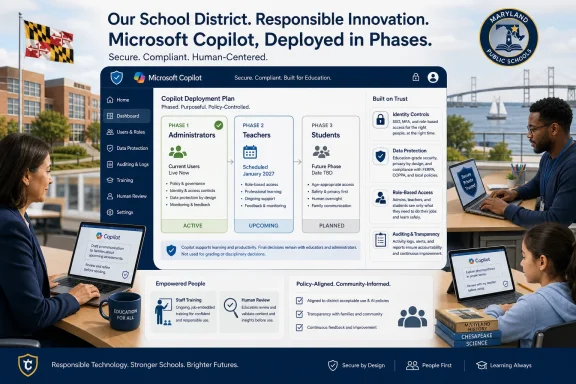 Copilot, but with district controls
The district is positioning the deployment as an enterprise-managed Copilot environment rather than unrestricted consumer AI access. Supervisor of Information Technology Will Buckmaster told Southern Maryland News that the selected version offers useful integrations and data-protection controls.That distinction matters for Windows administrators and school IT teams. Microsoft’s enterprise Copilot offerings are designed to operate under organizational identity, access, and data-governance controls, but the protection is only as good as the tenant configuration, permissions, retention policies, and staff training behind it. A “closed” deployment does not eliminate the need to verify what data connectors are enabled, who can access generated material, or how prompts and outputs are handled.
Policy sets limits on classroom use
The Board adopted an AI-use policy on June 24, according to Southern Maryland News. It requires staff to identify AI-generated instructional materials, teach ethical use, and monitor student use. Staff must complete district-approved training before using AI for classroom or administrative work.The policy also bars staff from entering sensitive data into AI systems without explicit authorization. It prohibits using AI to make critical professional or educational decisions, including grading, discipline, and performance evaluations.
Students will be required to disclose AI-generated content and will be prohibited from using the tools for plagiarism, falsifying work, or harmful or discriminatory conduct.
Practical implications
The staged approach gives St. Mary’s time to test governance and professional-development processes with staff before Copilot reaches classrooms. The district’s rules correctly treat AI output as assistive material rather than a decision-maker: a generated lesson resource can be reviewed, while a generated grade or disciplinary recommendation should not drive an outcome.For teachers, the January 2027 launch will likely make Copilot useful for drafting, planning, summarizing, and adapting materials, with disclosure and human review expected. For IT staff, the immediate work is less about the chatbot itself than enforcing data boundaries, role-based access, auditing, and the newly adopted policy.
Administrative users are already in the first deployment phase, while the district’s teacher rollout remains scheduled for January 1, 2027.
References
- Primary source: somdnews.com
Published: 2026-07-15T14:45:00+00:00
St. Mary’s schools begin rollout of AI platform
Teachers in St. Mary's can begin using their own exclusive AI model in classrooms starting midway through next school year. Student access to the AI will follow.www.somdnews.com
