

Microsoft’s July 14 security release fixes CVE-2026-56197, a high-severity remote code execution vulnerability in Windows Admin Center (WAC) affecting versions from 1809.0 through 2.7.3. Organizations running the browser-based Windows Server management gateway should move to Windows Admin Center 2.7.4 or later as a priority, particularly where the service is reachable by a broad population of administrators or support staff.
Microsoft describes the flaw as command injection: improper neutralization of special command elements can allow an authorized attacker to execute code across the network. The company assigned it a CVSS 3.1 score of 8.8, based on a network attack vector, low attack complexity, low privileges required, no user interaction, and high impact to confidentiality, integrity, and availability. NIST’s National Vulnerability Database reflects the same vendor-supplied assessment and lists CWE-77, the standard classification for command injection.
This is not a Windows cumulative-update issue. The vulnerable surface is the Windows Admin Center gateway application itself, meaning patch programs focused only on monthly operating-system rollups can leave an exposed management plane behind.
The required-privileges portion of the CVSS vector matters, but it should not be mistaken for a safety net. Microsoft says exploitation requires an authorized attacker, so an unauthenticated internet scan is not sufficient to trigger CVE-2026-56197. Yet WAC is designed to centralize access to infrastructure: servers, clusters, Hyper-V hosts, virtual machines, storage, and related Windows management functions.
That makes a valid but lower-tier gateway account an important boundary. Windows Admin Center distinguishes between gateway users and gateway administrators, and its role-based access control model can grant limited management duties instead of full local-administrator rights. A command-injection path that bypasses the intended constraints of that model could turn a management portal user into code execution on a system that has privileged reach into the environment.
Microsoft’s documentation also makes clear that WAC gateway access and access to managed servers are separate permissions. In a properly configured deployment, a gateway user still needs suitable credentials to operate a target server. But security teams should treat that architecture as blast-radius management, not a reason to defer the update: a compromised gateway is often positioned beside the administrative credentials, delegation settings, WinRM paths, and server inventory an attacker wants next.
The current WAC release naming can be confusing because Microsoft’s broader release-history page highlights calendar-style releases such as 2511 and 2606. For CVE-2026-56197, the decisive boundary is not the release-family label but the explicit fixed version in the advisory: 2.7.4. Administrators should verify the actual installed product version rather than assume that a recently deployed package, an older long-lived gateway, or an automatic-update setting has already delivered the fix.
Microsoft supports updating non-preview Windows Admin Center versions through Microsoft Update or by manual installation. Its installation guidance also notes that automatic updates are selected by default in the installer, but that setting is not proof of compliance. Update deferrals, service-account permissions, disconnected networks, proxy restrictions, and older installation practices can all leave gateway systems behind.
A focused validation pass should include:
The immediate question is whether a gateway is exposed beyond the administrators who require it. A WAC service should not be casually internet-accessible, nor should it be available to every internal user simply because the gateway URL is reachable. Microsoft’s access-control documentation notes that, absent configured groups, any user who can access the gateway URL has gateway-user access. That default deserves a fresh review in light of a flaw that requires authorization rather than anonymous access.
Where Microsoft Entra ID is used for gateway authentication, administrators can apply user assignment, multifactor authentication, and Conditional Access. In Active Directory-based deployments, teams should explicitly validate the gateway Users and Administrators groups, remove stale delegations, and make sure temporary support accounts have not accumulated permanent access.
RBAC should be reviewed too. Limited roles remain valuable, but they should be assigned narrowly and paired with ordinary identity hygiene: phishing-resistant MFA where possible, separate administrative accounts, monitored sign-ins, and short-lived access for support operations. The weakness in CVE-2026-56197 is not that RBAC is useless; it is that any security boundary should be assumed vulnerable until the gateway has been patched.
At the same time, CISA rates the potential technical impact as total, matching Microsoft’s high confidentiality, integrity, and availability impact ratings. In practice, this means defenders should not frame the issue as merely a denial-of-service defect or a minor portal bug. If a suitably authorized actor can reach the vulnerable command-processing path, the expected result can be arbitrary code execution with consequences that extend well beyond the WAC interface.
The lack of a public proof of concept also should not be overread. Microsoft’s public description identifies the vulnerability class and confirms the affected version range, but it does not disclose the vulnerable command path, payload requirements, execution context, or a specific WAC feature involved. That limited technical detail lowers immediate copy-and-paste exploitation risk, not the need to remediate.
Upgrade all affected WAC instances to 2.7.4 or later, restrict gateway reachability while remediation is completed, and verify who holds gateway access. The next milestone is not a future Windows cumulative update—it is confirming that no Windows Admin Center gateway below the fixed version remains in the administrative path.
Microsoft describes the flaw as command injection: improper neutralization of special command elements can allow an authorized attacker to execute code across the network. The company assigned it a CVSS 3.1 score of 8.8, based on a network attack vector, low attack complexity, low privileges required, no user interaction, and high impact to confidentiality, integrity, and availability. NIST’s National Vulnerability Database reflects the same vendor-supplied assessment and lists CWE-77, the standard classification for command injection.
This is not a Windows cumulative-update issue. The vulnerable surface is the Windows Admin Center gateway application itself, meaning patch programs focused only on monthly operating-system rollups can leave an exposed management plane behind.
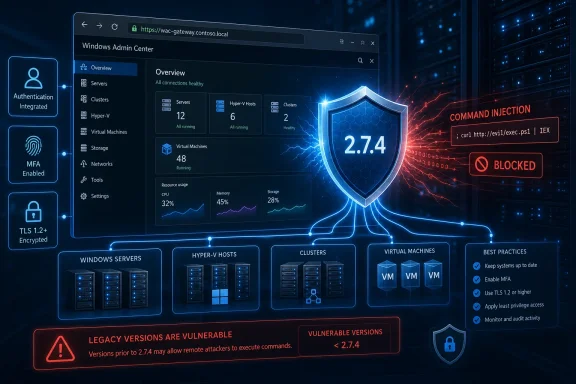 The Login Requirement Does Not Make This a Routine Bug
The required-privileges portion of the CVSS vector matters, but it should not be mistaken for a safety net. Microsoft says exploitation requires an authorized attacker, so an unauthenticated internet scan is not sufficient to trigger CVE-2026-56197. Yet WAC is designed to centralize access to infrastructure: servers, clusters, Hyper-V hosts, virtual machines, storage, and related Windows management functions.That makes a valid but lower-tier gateway account an important boundary. Windows Admin Center distinguishes between gateway users and gateway administrators, and its role-based access control model can grant limited management duties instead of full local-administrator rights. A command-injection path that bypasses the intended constraints of that model could turn a management portal user into code execution on a system that has privileged reach into the environment.
Microsoft’s documentation also makes clear that WAC gateway access and access to managed servers are separate permissions. In a properly configured deployment, a gateway user still needs suitable credentials to operate a target server. But security teams should treat that architecture as blast-radius management, not a reason to defer the update: a compromised gateway is often positioned beside the administrative credentials, delegation settings, WinRM paths, and server inventory an attacker wants next.
Version 2.7.4 Is the Patch Line
According to Microsoft’s vulnerability record, WAC releases earlier than 2.7.4 are affected, beginning with version 1809.0. The practical remediation is therefore straightforward: inventory every Windows Admin Center gateway, verify its installed version, and upgrade any installation below 2.7.4.The current WAC release naming can be confusing because Microsoft’s broader release-history page highlights calendar-style releases such as 2511 and 2606. For CVE-2026-56197, the decisive boundary is not the release-family label but the explicit fixed version in the advisory: 2.7.4. Administrators should verify the actual installed product version rather than assume that a recently deployed package, an older long-lived gateway, or an automatic-update setting has already delivered the fix.
Microsoft supports updating non-preview Windows Admin Center versions through Microsoft Update or by manual installation. Its installation guidance also notes that automatic updates are selected by default in the installer, but that setting is not proof of compliance. Update deferrals, service-account permissions, disconnected networks, proxy restrictions, and older installation practices can all leave gateway systems behind.
A focused validation pass should include:
- Confirm every WAC gateway is running version 2.7.4 or newer.
- Check both dedicated gateway servers and desktop-mode deployments that may have been installed for a small operations team.
- Review management jump hosts, lab environments, branch-office servers, and cluster-management systems that can escape standard software inventory.
- Restart and validate the Windows Admin Center service after the upgrade, then confirm expected browser access and target-server management functions.
- Document the update separately from Windows Server Patch Tuesday compliance, since the remediation is an application upgrade.
Exposure Depends on Gateway Design
CVE-2026-56197 is a particularly good reason to revisit a WAC deployment’s access design. Microsoft recommends trusted TLS certificates in production and supports configuration choices for network access, HTTPS port selection, certificate assignment, endpoint naming, trusted hosts, and WinRM over HTTPS. Those controls do not replace the product update, but they determine who can realistically reach the gateway while patching is underway.The immediate question is whether a gateway is exposed beyond the administrators who require it. A WAC service should not be casually internet-accessible, nor should it be available to every internal user simply because the gateway URL is reachable. Microsoft’s access-control documentation notes that, absent configured groups, any user who can access the gateway URL has gateway-user access. That default deserves a fresh review in light of a flaw that requires authorization rather than anonymous access.
Where Microsoft Entra ID is used for gateway authentication, administrators can apply user assignment, multifactor authentication, and Conditional Access. In Active Directory-based deployments, teams should explicitly validate the gateway Users and Administrators groups, remove stale delegations, and make sure temporary support accounts have not accumulated permanent access.
RBAC should be reviewed too. Limited roles remain valuable, but they should be assigned narrowly and paired with ordinary identity hygiene: phishing-resistant MFA where possible, separate administrative accounts, monitored sign-ins, and short-lived access for support operations. The weakness in CVE-2026-56197 is not that RBAC is useless; it is that any security boundary should be assumed vulnerable until the gateway has been patched.
No Public Exploitation Signal, but Total Impact Is Still Plausible
As of July 15, CISA’s Stakeholder-Specific Vulnerability Categorization data for CVE-2026-56197 lists exploitation as “none” and says the flaw is not automatable. That is useful prioritization context: Microsoft and CISA are not currently describing a wormable, no-credential attack or known in-the-wild exploitation campaign.At the same time, CISA rates the potential technical impact as total, matching Microsoft’s high confidentiality, integrity, and availability impact ratings. In practice, this means defenders should not frame the issue as merely a denial-of-service defect or a minor portal bug. If a suitably authorized actor can reach the vulnerable command-processing path, the expected result can be arbitrary code execution with consequences that extend well beyond the WAC interface.
The lack of a public proof of concept also should not be overread. Microsoft’s public description identifies the vulnerability class and confirms the affected version range, but it does not disclose the vulnerable command path, payload requirements, execution context, or a specific WAC feature involved. That limited technical detail lowers immediate copy-and-paste exploitation risk, not the need to remediate.
Patch the Gateway Before It Becomes the Pivot Point
Windows Admin Center exists to make privileged Windows infrastructure easier to operate from a single browser interface. That convenience is precisely why CVE-2026-56197 deserves attention beyond its “Important” severity label: an authenticated remote code execution flaw in a management gateway can be far more consequential than a similarly scored issue on an isolated workstation.Upgrade all affected WAC instances to 2.7.4 or later, restrict gateway reachability while remediation is completed, and verify who holds gateway access. The next milestone is not a future Windows cumulative update—it is confirming that no Windows Admin Center gateway below the fixed version remains in the administrative path.
References
- Primary source: MSRC
Published: 2026-07-14T07:00:00-07:00
Security Update Guide - Microsoft Security Response Center
 msrc.microsoft.com
- Related coverage: encyb.com
Encyb SOC Advisory Report Windows Admin Center Privilege Escalation Vulnerability
PDF documentencyb.com
- Related coverage: tomshardware.com
Windows Server vulnerability can grant system privileges with just a malformed packet — domain controllers are being exploited in the wild | Tom's Hardware
System administrators, run the May 12 patch immediately if you haven't already.www.tomshardware.com
