

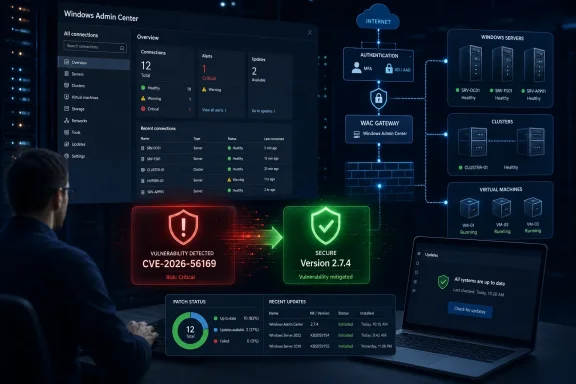
Detailed in Microsoft’s Security Update Guide on July 14, 2026, the flaw carries a CVSS 3.1 base score of 8.1. Microsoft classifies it as an elevation-of-privilege vulnerability caused by improper authentication, tracked under CWE-287.
The vulnerability does not provide an unauthenticated route into Windows Admin Center. An attacker must already possess low-level privileges, but exploitation requires no user interaction and has low attack complexity, according to Microsoft’s CVSS assessment. Because the attack vector is network-based, however, the exposure extends beyond someone with an interactive session on the gateway server.
An Admin Console Is a High-Value Place to Escalate
Windows Admin Center is a browser-based management platform for Windows Server, Windows PCs, failover clusters and hyper-converged infrastructure. Organizations commonly install it as a gateway service, allowing authorized personnel to administer multiple systems through one interface.
That role makes an authentication failure particularly consequential. Windows Admin Center is not merely another application installed on a management server; it is designed to make privileged connections to other machines and expose tools for managing services, certificates, storage, networking, virtual machines, updates and local accounts.
Microsoft’s short description says an authorized attacker can exploit CVE-2026-56169 to elevate privileges over a network. The wording indicates that an attacker needs valid access before attempting exploitation, but that the privileges granted after authentication may not be properly enforced.
Microsoft has not publicly documented the exact authentication flow, request sequence or affected administrative operation. It also has not published proof-of-concept code or exploitation instructions. That restraint limits what defenders can hunt for, but it also withholds a straightforward blueprint from would-be attackers.
The CVSS vector is more revealing about the expected conditions:
- Exploitation can be performed over an adjacent or remote network connection to the vulnerable service.
- Attack complexity is rated low, meaning Microsoft does not expect unusual race conditions or specialized environmental requirements.
- The attacker needs low privileges before exploitation.
- No action by another user is required.
- Successful exploitation can cause high confidentiality and integrity impact.
- Microsoft assigned no direct availability impact.
The absence of an availability rating should not be mistaken for a low operational risk. An attacker who gains greater control over an administrative gateway may be more interested in reading configuration data, changing settings or using legitimate management paths than in crashing the service.
Version 2.7.4 Draws the Security Boundary
The National Vulnerability Database’s initial record, based on information supplied by Microsoft, identifies Windows Admin Center versions from 1809.0 up to but not including 2.7.4 as affected. That makes 2.7.4 the minimum fixed release currently identified for CVE-2026-56169.
Administrators should verify the installed product version rather than assuming ordinary Windows patching has remediated the gateway. Windows Admin Center has its own release and servicing model, even though non-preview installations can receive updates through Microsoft Update in supported configurations.
This distinction matters on servers where operating-system cumulative updates are deployed automatically but application upgrades are separately approved. A fully patched Windows Server host can still be running an outdated Windows Admin Center package.
Microsoft’s support policy also expects customers using the generally available release to remain current. The company describes Windows Admin Center as following the Modern Lifecycle Policy, under which only the latest version is serviced and supported and customers are expected to upgrade within 30 days of a new release becoming available.
For most environments, the immediate response is straightforward:
- Inventory every machine hosting a Windows Admin Center gateway, including standby and high-availability nodes.
- Confirm whether each installation is version 2.7.4 or later.
- Upgrade affected gateways using the organization’s normal tested deployment process.
- Verify that the Windows Admin Center service starts correctly and that administrators can still connect to representative managed nodes.
- Review gateway authentication and administrative activity for unexplained privilege changes or unusual management operations.
High-availability deployments require particular care. Updating only the active node may leave another vulnerable gateway available through failover, a load balancer or an old administrative bookmark. The same concern applies to lab instances that retain credentials or network reachability into production.
Organizations should also check software-distribution inventories for Windows Admin Center installations that were deployed manually. Management gateways can escape routine discovery when they were built for a temporary migration, proof of concept or isolated server team and then quietly became permanent.
Network Reachability Raises the Priority
CVE-2026-56169 is not scored as a local-only privilege escalation. Microsoft’s network attack-vector rating means the attacker does not need console access to the Windows Admin Center host, provided the vulnerable service is reachable and the attacker can authenticate at the required initial privilege level.
That makes exposure architecture central to triage. A gateway reachable only from a hardened management network presents a different immediate risk from one published broadly across an internal network or exposed through an Internet-facing reverse proxy.
Internet exposure does not remove the authentication requirement, but it gives attackers more opportunities to combine the flaw with stolen passwords, session theft, password spraying or access purchased from an initial-access broker. Conditional Access and multifactor authentication can reduce the chance of obtaining the first valid session, but they do not substitute for repairing faulty authorization inside the product.
Until the upgrade is complete, administrators can reduce opportunity by restricting gateway access to approved management subnets, VPN users or privileged access workstations. Unnecessary inbound access should be removed at firewalls and reverse proxies, and dormant Windows Admin Center accounts should be disabled.
These measures are temporary risk controls, not fixes. The flaw concerns what an already authorized attacker can accomplish, so narrowing the pool of users and devices able to reach the gateway helps without correcting the underlying improper authentication.
Defenders should pay attention to accounts that successfully authenticate and then perform operations inconsistent with their assigned Windows Admin Center role. Relevant evidence may span gateway logs, Windows Security event logs, Microsoft Entra sign-in records, reverse-proxy telemetry and logs on managed servers. The advisory does not currently provide a specific event ID or detection signature for attempted exploitation.
“Confirmed” Describes the Evidence, Not Active Attacks
Microsoft marks the vulnerability’s report confidence as confirmed. In CVSS terminology, that means the vulnerability’s existence and technical basis have been validated through detailed reporting, reproducible evidence, source inspection or vendor confirmation.
It does not mean Microsoft has confirmed attacks in the wild. Report confidence measures certainty that the defect is real, while exploitation status measures whether adversaries are known to be using it. Those are separate signals and should not be conflated when setting incident severity.
As of the July 14 disclosure, the public records reviewed for CVE-2026-56169 do not establish active exploitation or public disclosure before Microsoft’s update. They also do not identify a publicly available exploit. Administrators should recheck Microsoft’s advisory during the deployment window because exploitation assessments and acknowledgements can be revised after initial publication.
The lack of known exploitation gives IT teams room to test the update, particularly where Windows Admin Center supports production clusters or remote sites. It does not justify waiting for the next routine application-maintenance cycle: low-complexity privilege escalation in a centralized administrative service is exactly the kind of weakness that becomes more useful once researchers and attackers compare the fixed and vulnerable builds.
Windows Admin Center 2.7.4 is now the practical baseline. The remaining uncertainty is not whether CVE-2026-56169 exists, but how quickly organizations can locate every gateway that still trusts authenticated users more than it should.
References
- CVE-2026-56169 Windows Admin Center Elevation of Privilege Vulnerability MSRC · 2026-07-14T07:00:00-07:00