

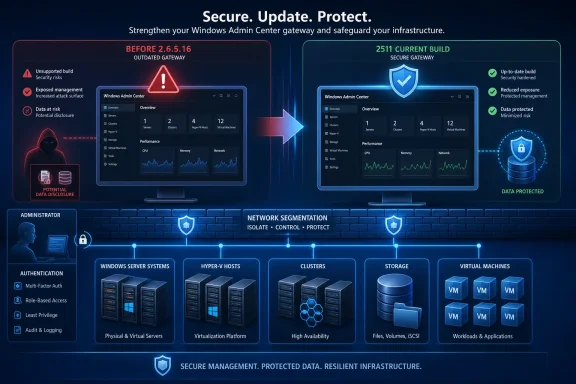
Microsoft has disclosed CVE-2026-56185, an information-disclosure vulnerability in Windows Admin Center that affects builds earlier than 2.6.5.16. Administrators running an older gateway should upgrade to a current Windows Admin Center 2511 build rather than treating the issue as a routine Windows operating system patch.
Detailed in the Microsoft Security Response Center’s July 14, 2026 security advisory, the flaw carries a CVSS 3.1 base score of 6.5, placing it in the Medium severity band. Microsoft describes the underlying problem as improper authentication that could allow an authorized attacker to disclose information over a network.
The distinction matters: this is not presented as an unauthenticated Internet attack, remote code execution flaw, or denial-of-service bug. Exploitation requires an attacker to possess some level of privileges, but it can occur remotely, requires no user interaction, and may expose information with high confidentiality impact.
Windows Admin Center is a browser-based management platform used to administer Windows Server, Windows PCs, Hyper-V hosts, failover clusters, storage, certificates, firewall rules, services, and other infrastructure components. It commonly runs as a gateway through which administrators connect to multiple managed systems.
That makes an authentication-bound disclosure flaw more consequential than its Medium rating may initially suggest. An attacker who already has limited access to the management service could potentially cross an authorization boundary and retrieve information that the account should not be permitted to view.
Microsoft’s CVSS vector is
The score assigns high impact to confidentiality but no impact to integrity or availability. Microsoft is therefore not claiming that CVE-2026-56185 directly permits an attacker to modify managed resources, execute commands, or take the Windows Admin Center gateway offline.
That narrower impact should not be confused with negligible risk. Information available through an administrative portal can help an intruder map servers, users, configurations, certificates, virtual machines, storage, and other components that may be useful in a later stage of an attack.
Microsoft subsequently shipped build 2.6.6.18 on April 9 and build 2.6.7 on May 11. The later 2.6.7 package included additional security improvements and an installer correction, making it the preferable destination for environments that have not yet updated.
The remediation boundary creates an unusual chronology: a non-vulnerable build had already been available for more than three months when Microsoft assigned and published CVE-2026-56185 on July 14. Organizations that routinely update Windows Admin Center may therefore already be protected, while gateways left on older releases require attention.
Administrators should inventory the Windows Admin Center application itself rather than relying solely on the Windows Server build or July cumulative-update status. Windows Admin Center has its own release and servicing path, so installing the latest Windows Server security updates does not by itself prove that the gateway is running a corrected WAC build.
The immediate checks are straightforward:
The attack complexity is rated Low, and user interaction is None. Once an attacker has the necessary access and network reachability, Microsoft does not expect exploitation to depend on a victim clicking a link, opening a document, or approving a prompt.
The scope remains Unchanged, indicating that the security impact stays within the authority represented by the vulnerable component. Integrity and availability are both scored None, so current public information does not support claims that CVE-2026-56185 can directly alter server configurations or disrupt Windows Admin Center.
Microsoft’s concise description does not identify the exact data exposed, the vulnerable endpoint, or the requests needed to trigger the disclosure. It also does not explain how privileges are validated incorrectly. Administrators should consequently avoid assuming that a particular Windows Admin Center role or feature is unaffected unless Microsoft provides further technical detail.
As of the initial publication, the National Vulnerability Database was still awaiting enrichment of the record. Its entry reproduced Microsoft’s CVSS score and affected-version range but did not yet provide an independent NIST severity analysis.
The public record also associates CVE-2026-56185 with both CWE-287, Improper Authentication, and CWE-94, Improper Control of Generation of Code. The latter classification is normally associated with code-injection conditions and does not obviously match Microsoft’s short information-disclosure description. Without further technical documentation, the safest reading is that improper authentication is the confirmed exploitation characteristic and that the additional weakness mapping may require clarification.
Network segmentation cannot correct the software flaw, but it can reduce the population capable of reaching it. Environments should limit access through firewalls, VPNs, privileged access workstations, management VLANs, or comparable controls, while enforcing multifactor authentication where the deployment’s identity configuration supports it.
Teams should also examine whether low-privilege Windows Admin Center access has been granted more broadly than intended. Since Microsoft’s model requires an authorized attacker rather than an anonymous one, dormant accounts, overextended delegation, and compromised administrator credentials are central to the practical risk.
There is no publicly detailed exploit chain in the initial advisory, and the available description does not establish that CVE-2026-56185 is being used in attacks. That is not a reason to postpone remediation: the fixed-build threshold is explicit, and current Windows Admin Center 2511 packages have already moved beyond it.
For most organizations, the decisive action is to locate every Windows Admin Center gateway and verify that its application build is 2.6.5.16 or later. Any older instance remains on the vulnerable side of Microsoft’s published boundary, regardless of how fully patched the underlying Windows Server host may be.
Detailed in the Microsoft Security Response Center’s July 14, 2026 security advisory, the flaw carries a CVSS 3.1 base score of 6.5, placing it in the Medium severity band. Microsoft describes the underlying problem as improper authentication that could allow an authorized attacker to disclose information over a network.
The distinction matters: this is not presented as an unauthenticated Internet attack, remote code execution flaw, or denial-of-service bug. Exploitation requires an attacker to possess some level of privileges, but it can occur remotely, requires no user interaction, and may expose information with high confidentiality impact.
 Windows Admin Center’s Gateway Role Raises the Stakes
Windows Admin Center is a browser-based management platform used to administer Windows Server, Windows PCs, Hyper-V hosts, failover clusters, storage, certificates, firewall rules, services, and other infrastructure components. It commonly runs as a gateway through which administrators connect to multiple managed systems.That makes an authentication-bound disclosure flaw more consequential than its Medium rating may initially suggest. An attacker who already has limited access to the management service could potentially cross an authorization boundary and retrieve information that the account should not be permitted to view.
Microsoft’s CVSS vector is
CVSS:3.1/AV:N/AC:L/PR:L/UI:N/S:U/C:H/I:N/A:N. In practical terms, Microsoft assesses the vulnerability as reachable over a network, straightforward to exploit once the required access exists, and independent of any action by another user.The score assigns high impact to confidentiality but no impact to integrity or availability. Microsoft is therefore not claiming that CVE-2026-56185 directly permits an attacker to modify managed resources, execute commands, or take the Windows Admin Center gateway offline.
That narrower impact should not be confused with negligible risk. Information available through an administrative portal can help an intruder map servers, users, configurations, certificates, virtual machines, storage, and other components that may be useful in a later stage of an attack.
The Fixed-Build Boundary Is 2.6.5.16
The CVE record identifies Windows Admin Center versions from 1809.0 up to, but not including, build 2.6.5.16 as affected. Build 2.6.5.16 was released as an updated Windows Admin Center 2511 installer on April 2, 2026, according to Microsoft’s Windows Admin Center announcement history.Microsoft subsequently shipped build 2.6.6.18 on April 9 and build 2.6.7 on May 11. The later 2.6.7 package included additional security improvements and an installer correction, making it the preferable destination for environments that have not yet updated.
The remediation boundary creates an unusual chronology: a non-vulnerable build had already been available for more than three months when Microsoft assigned and published CVE-2026-56185 on July 14. Organizations that routinely update Windows Admin Center may therefore already be protected, while gateways left on older releases require attention.
Administrators should inventory the Windows Admin Center application itself rather than relying solely on the Windows Server build or July cumulative-update status. Windows Admin Center has its own release and servicing path, so installing the latest Windows Server security updates does not by itself prove that the gateway is running a corrected WAC build.
The immediate checks are straightforward:
- Confirm the installed Windows Admin Center build on every gateway, including secondary, lab, and disaster-recovery instances.
- Treat any build earlier than 2.6.5.16 as affected by CVE-2026-56185.
- Prefer the latest supported Windows Admin Center 2511 installer instead of stopping at the minimum fixed build.
- Review network exposure and authentication logs if an affected gateway was accessible from broad internal networks or the Internet.
- Validate extensions and management workflows after upgrading, particularly in clustered or highly available deployments.
Existing Access Is Required, but No Click Is Needed
Microsoft’s assessment assignsPR:L, meaning an attacker needs low privileges before exploitation. That lowers the likelihood of opportunistic mass exploitation compared with a pre-authentication vulnerability, but it makes compromised help-desk, delegated-administration, or other low-privilege accounts relevant to the threat model.The attack complexity is rated Low, and user interaction is None. Once an attacker has the necessary access and network reachability, Microsoft does not expect exploitation to depend on a victim clicking a link, opening a document, or approving a prompt.
The scope remains Unchanged, indicating that the security impact stays within the authority represented by the vulnerable component. Integrity and availability are both scored None, so current public information does not support claims that CVE-2026-56185 can directly alter server configurations or disrupt Windows Admin Center.
Microsoft’s concise description does not identify the exact data exposed, the vulnerable endpoint, or the requests needed to trigger the disclosure. It also does not explain how privileges are validated incorrectly. Administrators should consequently avoid assuming that a particular Windows Admin Center role or feature is unaffected unless Microsoft provides further technical detail.
As of the initial publication, the National Vulnerability Database was still awaiting enrichment of the record. Its entry reproduced Microsoft’s CVSS score and affected-version range but did not yet provide an independent NIST severity analysis.
The public record also associates CVE-2026-56185 with both CWE-287, Improper Authentication, and CWE-94, Improper Control of Generation of Code. The latter classification is normally associated with code-injection conditions and does not obviously match Microsoft’s short information-disclosure description. Without further technical documentation, the safest reading is that improper authentication is the confirmed exploitation characteristic and that the additional weakness mapping may require clarification.
Restricting the Gateway Remains a Necessary Backstop
Windows Admin Center should generally be reachable only by administrators and trusted management systems. A gateway exposed directly to untrusted networks gives attackers more opportunities to test authentication behavior, reuse stolen credentials, or combine a vulnerability such as CVE-2026-56185 with credential attacks.Network segmentation cannot correct the software flaw, but it can reduce the population capable of reaching it. Environments should limit access through firewalls, VPNs, privileged access workstations, management VLANs, or comparable controls, while enforcing multifactor authentication where the deployment’s identity configuration supports it.
Teams should also examine whether low-privilege Windows Admin Center access has been granted more broadly than intended. Since Microsoft’s model requires an authorized attacker rather than an anonymous one, dormant accounts, overextended delegation, and compromised administrator credentials are central to the practical risk.
There is no publicly detailed exploit chain in the initial advisory, and the available description does not establish that CVE-2026-56185 is being used in attacks. That is not a reason to postpone remediation: the fixed-build threshold is explicit, and current Windows Admin Center 2511 packages have already moved beyond it.
For most organizations, the decisive action is to locate every Windows Admin Center gateway and verify that its application build is 2.6.5.16 or later. Any older instance remains on the vulnerable side of Microsoft’s published boundary, regardless of how fully patched the underlying Windows Server host may be.
References
- Primary source: MSRC
Published: 2026-07-14T07:00:00-07:00
Security Update Guide - Microsoft Security Response Center
 msrc.microsoft.com
- Official source: techcommunity.microsoft.com
- Official source: learn.microsoft.com
Windows Admin Center release history | Microsoft Learn
A summary of the history of Windows Admin Center releases, including links to download them.learn.microsoft.com
