

CVE-2026-53403 fixes a Linux kernel null-pointer dereference in the legacy framebuffer subsystem that can crash a system during console takeover after a userspace mode-list change. The issue is not a vulnerability in Windows itself, but it matters to Windows administrators and developers running Linux through WSL 2, Hyper-V virtual machines, dual-boot installations, embedded devices, or custom Linux kernels.
The newly published CVE record, supplied by kernel.org and indexed by the National Vulnerability Database on July 19, describes a flaw in
The immediate remediation is straightforward: move to a kernel release containing the upstream stable fix. According to the kernel.org affected-version data carried by NVD, fixed releases are Linux 5.10.260, 5.15.211, 6.1.177, 6.6.144, 6.12.95, 6.18.38, and 7.1.3 or later within their respective stable series.
The bug stems from a broken assumption in framebuffer mode management. A framebuffer device maintains a current display mode in
Normally, that invariant is preserved. Kernel paths such as
The weak point is
That sounds like a narrow bookkeeping problem, but the result can be a crash. If userspace supplies a new list without the current mode, the framebuffer state can become internally inconsistent:
A later console takeover can then expose the inconsistent state. The
From there, a later
This is therefore best understood as an availability flaw, not a demonstrated privilege-escalation or information-disclosure bug. NVD had not assigned a CVSS score as of July 20, and the supplied record does not describe public exploitation or a remotely reachable attack path.
The triggering conditions also narrow the immediate exposure. An attacker or local process needs an avenue to replace framebuffer modes, must omit the active mode from that replacement list, and must then reach the relevant console takeover path while
It can also appear as a compatibility layer even where a system otherwise looks modern. A VM’s early boot console, a recovery shell, or a low-level virtual display configuration can rely on pieces of the framebuffer stack that do not receive much attention until a corner case breaks.
The affected file is core framebuffer code rather than a vendor-specific GPU driver. That means the relevant question is not solely whether a machine has AMD, Intel, or NVIDIA graphics. Instead, administrators should identify kernels built with framebuffer and framebuffer-console support, then determine whether their use case permits userspace changes to display modes or automated console transitions.
For Windows-focused environments, the distinction matters. Windows hosts are not affected at the Windows kernel level. A standard Windows 11 or Windows Server deployment does not inherit a Linux
The exposure lies in separately maintained Linux kernels: a WSL 2 installation using a custom kernel, Linux guest VMs under Hyper-V, Linux-based recovery or management appliances, and developer workstations that boot Linux directly. The supplied advisory does not establish that Microsoft’s shipping WSL kernel was affected or remains unpatched; that has to be checked against the exact WSL kernel build in use and Microsoft’s update channel.
Teams maintaining custom kernels can also backport the focused fix. The change preserves the active framebuffer mode when
For most WindowsForum readers, this will be a routine patch rather than an emergency. The priority rises for organizations operating custom WSL kernels, long-lived Linux VMs, framebuffer-based kiosks, embedded products, and recovery environments where a console crash can turn a minor display-state defect into an outage.
The important next step is not to hunt for a Windows patch: it is to verify the Linux kernel actually in use, obtain the vendor’s fixed build, and avoid leaving an active framebuffer mode absent from any userspace-replaced model list until that update is deployed.
The newly published CVE record, supplied by kernel.org and indexed by the National Vulnerability Database on July 19, describes a flaw in
drivers/video/fbdev/core/fbmem.c. The defect exists in the kernel’s fbdev code, a long-standing subsystem used to provide framebuffer display support, particularly in console, virtual-machine, embedded, and legacy graphics scenarios.The immediate remediation is straightforward: move to a kernel release containing the upstream stable fix. According to the kernel.org affected-version data carried by NVD, fixed releases are Linux 5.10.260, 5.15.211, 6.1.177, 6.6.144, 6.12.95, 6.18.38, and 7.1.3 or later within their respective stable series.
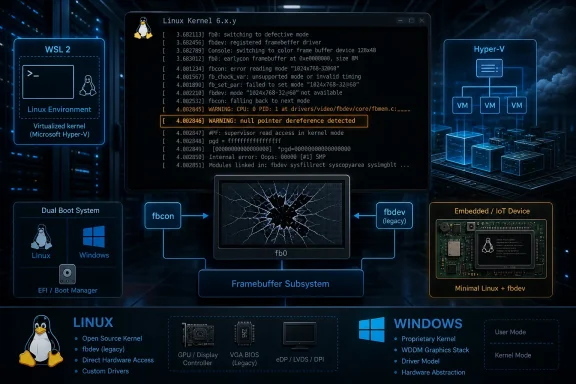 A Mode List Can Lose the Active Display Mode
The bug stems from a broken assumption in framebuffer mode management. A framebuffer device maintains a current display mode in info->var and a list of accepted display modes in info->modelist. The code expects those two structures to remain aligned: the current mode must also be present in the model list.Normally, that invariant is preserved. Kernel paths such as
fb_set_var() add a new mode when the active configuration changes, while do_register_framebuffer() does likewise when the framebuffer is registered. In other words, standard framebuffer setup and mode-setting operations ensure that the active setting is still representable in the device’s advertised modes.The weak point is
store_modes(), which lets userspace replace the framebuffer mode list. Its underlying helper, fb_new_modelist(), validates the incoming modes but, before this fix, did not make sure that the framebuffer’s existing active mode remained in the replacement list.That sounds like a narrow bookkeeping problem, but the result can be a crash. If userspace supplies a new list without the current mode, the framebuffer state can become internally inconsistent:
info->var still describes the old mode, while info->modelist no longer contains a matching entry.The Crash Requires a Particular Console Path
Kernel.org’s description lays out the failure chain. The framebuffer console code, orfbcon, is expected to repoint consoles when the mode list changes. But that work only applies to consoles already mapped to the affected framebuffer. If fbcon is unbound at the time of the userspace update, there are no mapped consoles to repair.A later console takeover can then expose the inconsistent state. The
var_to_display() path searches the new model list for the active mode using fb_match_mode(). With no match available, the display mode pointer remains NULL.From there, a later
fbcon_switch() passes that null mode through display_to_var() and into fb_videomode_to_var(), which dereferences it. The practical result is a kernel null-pointer dereference, usually translating into an oops or panic depending on kernel configuration and the environment.This is therefore best understood as an availability flaw, not a demonstrated privilege-escalation or information-disclosure bug. NVD had not assigned a CVSS score as of July 20, and the supplied record does not describe public exploitation or a remotely reachable attack path.
The triggering conditions also narrow the immediate exposure. An attacker or local process needs an avenue to replace framebuffer modes, must omit the active mode from that replacement list, and must then reach the relevant console takeover path while
fbcon has been unbound or otherwise has not repaired the mapping. That combination will be uncommon on ordinary desktop Linux systems using modern DRM/KMS graphics drivers, but it is plausible in specialized deployments.Why Legacy fbdev Still Deserves Patch Attention
fbdev is often described as legacy technology because modern Linux graphics is centered on Direct Rendering Manager and kernel mode-setting drivers. Yet framebuffer support remains important in places where administrators least want unstable consoles: appliance hardware, serial-and-display recovery environments, small embedded systems, virtual machines, installer and rescue images, and systems using simple framebuffer drivers.It can also appear as a compatibility layer even where a system otherwise looks modern. A VM’s early boot console, a recovery shell, or a low-level virtual display configuration can rely on pieces of the framebuffer stack that do not receive much attention until a corner case breaks.
The affected file is core framebuffer code rather than a vendor-specific GPU driver. That means the relevant question is not solely whether a machine has AMD, Intel, or NVIDIA graphics. Instead, administrators should identify kernels built with framebuffer and framebuffer-console support, then determine whether their use case permits userspace changes to display modes or automated console transitions.
For Windows-focused environments, the distinction matters. Windows hosts are not affected at the Windows kernel level. A standard Windows 11 or Windows Server deployment does not inherit a Linux
fbdev bug merely because it runs Windows.The exposure lies in separately maintained Linux kernels: a WSL 2 installation using a custom kernel, Linux guest VMs under Hyper-V, Linux-based recovery or management appliances, and developer workstations that boot Linux directly. The supplied advisory does not establish that Microsoft’s shipping WSL kernel was affected or remains unpatched; that has to be checked against the exact WSL kernel build in use and Microsoft’s update channel.
Patch by Kernel Line, Not by Distribution Label
The cleanest response is to deploy a vendor kernel update that incorporates the stable patch. The version thresholds in the CVE record are particularly useful for teams maintaining their own kernels or consuming long-term support series:- Linux 5.10 systems need 5.10.260 or newer.
- Linux 5.15 systems need 5.15.211 or newer.
- Linux 6.1 systems need 6.1.177 or newer.
- Linux 6.6 systems need 6.6.144 or newer.
- Linux 6.12 systems need 6.12.95 or newer.
- Linux 6.18 systems need 6.18.38 or newer.
- Linux 7.1 systems need 7.1.3 or newer.
uname -r alone as conclusive evidence.Teams maintaining custom kernels can also backport the focused fix. The change preserves the active framebuffer mode when
fb_new_modelist() accepts a replacement list, matching the behavior already used by fb_set_var(). It is a small correction, but it restores the consistency requirement that downstream console code assumes.Treat It as a Reliability Fix With Security Tracking
There is no indication in the published record that CVE-2026-53403 is being exploited, nor is there a CVSS assessment to support sensational severity claims. But kernel crashes caused by local configuration interfaces still belong in normal vulnerability-management workflows, especially on shared systems where less-trusted users can interact with display configuration or where uptime is critical.For most WindowsForum readers, this will be a routine patch rather than an emergency. The priority rises for organizations operating custom WSL kernels, long-lived Linux VMs, framebuffer-based kiosks, embedded products, and recovery environments where a console crash can turn a minor display-state defect into an outage.
The important next step is not to hunt for a Windows patch: it is to verify the Linux kernel actually in use, obtain the vendor’s fixed build, and avoid leaving an active framebuffer mode absent from any userspace-replaced model list until that update is deployed.
References
- Primary source: NVD / Linux Kernel
Published: 2026-07-20T01:02:51-07:00
NVD - CVE-2026-53403
 nvd.nist.gov
- Security advisory: MSRC
Published: 2026-07-20T01:02:51-07:00
Original feed URL
Security Update Guide - Microsoft Security Response Center
 msrc.microsoft.com
