

CVE-2026-63959 is a newly published Linux kernel vulnerability that turns an apparently narrow USB Type-C protocol parsing flaw into a reminder that modern ports are no longer simple peripheral connectors. The issue, disclosed on July 19, 2026 and updated in the National Vulnerability Database on July 20, affects the Maxim TCPCI USB Type-C controller path in Linux and can allow a malformed but CRC-valid USB Power Delivery message to make the kernel read uninitialized stack memory. The fix is available in updated stable kernel releases, and while the available record does not assign a CVSS score or document active exploitation, affected Linux installations should treat it as a patching priority wherever USB-C ports are exposed to untrusted chargers, docks, cables, displays, test fixtures, or devices.
USB Type-C consolidated charging, data, display output, accessory mode, and high-speed peripheral connectivity into a physically compact reversible connector. That flexibility has made it indispensable across laptops, tablets, phones, handheld gaming systems, monitors, docking stations, embedded equipment, and developer hardware. It has also pushed more security-critical negotiation into the lowest layers of the device stack.
Those decisions occur before ordinary USB data traffic becomes the primary concern. As a result, the operating system and embedded controller firmware must interpret data supplied by the connected partner while the connection itself is being established, reset, renegotiated, or moved between roles.
The vulnerable code resides in
The lesson is not that every USB-C accessory is hostile. It is that protocol validation must assume that external hardware can be malformed, defective, counterfeit, compromised, or deliberately adversarial, even when a lower-layer integrity check says a packet arrived without transmission corruption.
The controller also exposes a received-byte count, represented in the affected code path as
A malicious device can therefore produce a frame that is structurally intact at the transport level while still being logically invalid: the header declares several data objects, but the actual received payload ends early. A broken controller could cause the same condition unintentionally.
That distinction is central to this CVE. Integrity validation is not bounds validation. Secure parsers need both.
Uninitialized stack reads are serious because the data may contain remnants of earlier kernel activity. The immediate behavior can vary depending on compiler behavior, stack layout, kernel configuration, and the subsequent handling of parsed fields. Potential consequences range from faulty state transitions and unpredictable device behavior to information exposure or use of unintended values in kernel logic.
Conversely, a machine can be more exposed than its owner realizes. The relevant controller may be integrated into a laptop’s internal design, connected through I2C, mediated by firmware, or used in a docking architecture that masks the underlying hardware from ordinary system inventories.
Administrators should avoid both extremes:
For that reason, the practical remediation window may be much longer than the headline CVE suggests. The patch may exist upstream while a device maker still needs to merge it into a board-support package, validate power behavior, generate a firmware image, and distribute it through an update channel.
Other plausible pathways include:
A local hardware attack can also be chained with other weaknesses. For example, an adversary who already has brief access to a machine may use a malicious accessory as part of a broader attempt to gain persistence, evade ordinary network controls, or capture diagnostic behavior.
This is a textbook example of defensive parsing, but it is particularly valuable in kernel driver code. Drivers operate at high privilege and commonly sit between external hardware and complex kernel subsystems. A small missing check can carry outsized consequences.
Failing closed keeps malformed traffic from entering higher-level Type-C and PD policy handling. It reduces ambiguity, contains the error at the protocol boundary, and makes diagnostic logging more meaningful when supported by the platform.
There is, however, a useful caveat. Some devices in the field may already be defective and may have relied on tolerant host behavior. After updating, those devices may show clearer failure symptoms—such as failed negotiation, charging fallback, or intermittent dock behavior—because the kernel is now rejecting messages it previously parsed unsafely. That is not a regression in the security fix; it is evidence of a compatibility defect in the accessory or controller firmware.
The reverse risk also exists in custom environments. A kernel built from a vendor tree or maintained internally may carry a modern base version but omit a particular stable backport. The safest approach is to consult the distribution’s security advisory, package changelog, or source patch record alongside the running kernel version.
Custom kernels deserve an especially rigorous review. Devices based on Android-derived trees, appliance firmware, specialized edge distributions, or old board-support packages can lag behind mainstream Linux security maintenance by months or years.
A Windows user who shares peripherals with a Linux system is not exposed to this specific Linux kernel bug by virtue of owning the accessory. But the incident reinforces a broader hardware-security principle: accessories that negotiate power and alternate modes should be purchased from reputable suppliers, kept under physical control, and treated as intelligent devices rather than passive wires.
The picture changes if an organization uses full Linux virtual machines with direct device assignment, developer workstations with specialized USB passthrough arrangements, or external Linux systems managed from Windows. In those cases, the Linux guest or attached Linux hardware should be patched according to its own kernel exposure.
Systems in secure racks with no accessible Type-C port may be low priority. Portable devices used during travel, in labs, at customer sites, in classrooms, or in shared conference rooms deserve more scrutiny.
IT teams should maintain inventories of approved dock and charger models, establish firmware update practices where vendors provide them, and remove unknown accessories from sensitive work areas. A corporate USB-C policy should address cables and chargers, not only thumb drives.
A sound embedded response includes source-tree review, kernel backport assessment, regression testing against real accessories, signed update deployment, and a customer communication plan. Organizations that cannot update quickly may need compensating controls, such as limiting physical access to Type-C ports or using controlled, known-good charging equipment.
That does not mean CVE-2026-63959 is the explanation for every USB-C problem. USB-C failures can arise from cable quality, PD profile mismatches, controller firmware, connector wear, display firmware, operating system power management, or physical damage. The CVE fix is a security and robustness improvement, not a universal compatibility cure.
The absence of a public proof of concept or documented exploitation should be read carefully. It lowers the evidence of immediate abuse; it does not erase the underlying flaw.
CVE-2026-63959 is unlikely to change how ordinary users perceive USB-C overnight, but it should change how technical teams think about the port. USB-C is now a power-management interface, a display interface, a peripheral interface, and a programmable protocol boundary in one connector. Updating affected Linux kernels to the fixed releases, verifying vendor backports, and applying sensible accessory controls are practical steps that turn a subtle driver flaw into a manageable maintenance task rather than an overlooked weakness at the edge of the system.
 Background
USB Type-C consolidated charging, data, display output, accessory mode, and high-speed peripheral connectivity into a physically compact reversible connector. That flexibility has made it indispensable across laptops, tablets, phones, handheld gaming systems, monitors, docking stations, embedded equipment, and developer hardware. It has also pushed more security-critical negotiation into the lowest layers of the device stack.USB-C Is a Protocol Ecosystem, Not Just a Connector
A USB-C connection begins with Configuration Channel signaling, but many modern devices additionally use USB Power Delivery, commonly called USB PD, to negotiate power roles, voltages, current levels, alternate modes, and other capabilities. A port may decide whether it is a power source or sink, whether it can deliver a higher charging profile, and whether it can enter a display-oriented alternate mode.Those decisions occur before ordinary USB data traffic becomes the primary concern. As a result, the operating system and embedded controller firmware must interpret data supplied by the connected partner while the connection itself is being established, reset, renegotiated, or moved between roles.
Linux’s Type-C Stack
Linux supports USB Type-C and USB PD through a layered collection of drivers and frameworks. The Type-C Port Manager, or TCPM, handles policy-level behavior for ports governed by the Type-C Port Controller Interface, known as TCPCI. TCPCI is a standardized controller interface that allows a system processor to communicate with a dedicated Type-C port controller, often over I2C.The vulnerable code resides in
drivers/usb/typec/tcpm/tcpci_maxim_core.c, a common component for certain Maxim Integrated, now Analog Devices, Type-C port controller implementations. The bug is not a generic flaw in every Linux USB controller or every USB-C capable machine. It is specific to systems that use the affected Maxim TCPCI driver path.Why Low-Level USB Security Matters
A Type-C or PD controller sits close to hardware boundaries that users commonly trust. A charger may look benign. A monitor may be expected to provide power. A dock may be approved by corporate procurement. Yet all three can communicate structured messages that influence the host’s view of power and connection state.The lesson is not that every USB-C accessory is hostile. It is that protocol validation must assume that external hardware can be malformed, defective, counterfeit, compromised, or deliberately adversarial, even when a lower-layer integrity check says a packet arrived without transmission corruption.
The Core Vulnerability
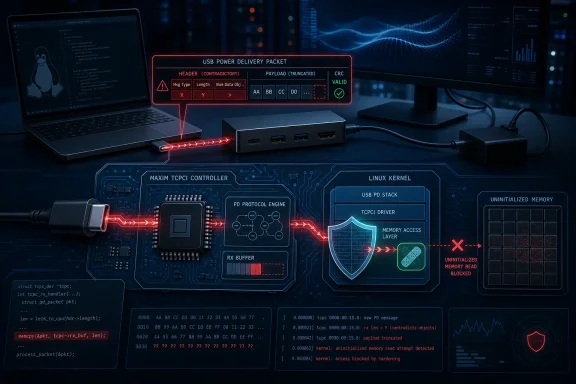
CVE-2026-63959 addresses an inconsistency between what a USB Power Delivery message header claims to contain and how many bytes the receiving controller says it actually received. The vulnerable path could accept a CRC-valid frame whose header advertised more data objects than were present in the received body.NDO Versus RX_BYTE_CNT
In USB PD terminology, the header contains a field that specifies the number of data objects, often abbreviated as NDO. Each data object is four bytes long. A message can advertise up to seven data objects, meaning its declared payload can require up to 28 bytes after the two-byte header.The controller also exposes a received-byte count, represented in the affected code path as
RX_BYTE_CNT. That count is the practical boundary for the bytes made available to the driver from the received frame. The vulnerability arose because the driver did not adequately verify that the count implied by the header’s NDO field was compatible with the count of bytes actually received.A Valid CRC Does Not Mean a Safe Message
Cyclic Redundancy Check validation detects accidental corruption during transmission. It tells the receiver that the bits sent by the other side arrived consistently with the packet’s CRC. It does not establish that the packet describes itself honestly or that its semantic fields are internally consistent.A malicious device can therefore produce a frame that is structurally intact at the transport level while still being logically invalid: the header declares several data objects, but the actual received payload ends early. A broken controller could cause the same condition unintentionally.
That distinction is central to this CVE. Integrity validation is not bounds validation. Secure parsers need both.
The Unsafe Outcome
If code trusts the header’s object count and attempts to retrieve objects that were never present in the received body, it can read data from an uninitialized portion of a stack buffer. The Linux kernel’s own description makes this outcome explicit: the fixed driver rejects the contradictory message rather than reading uninitialized stack memory.Uninitialized stack reads are serious because the data may contain remnants of earlier kernel activity. The immediate behavior can vary depending on compiler behavior, stack layout, kernel configuration, and the subsequent handling of parsed fields. Potential consequences range from faulty state transitions and unpredictable device behavior to information exposure or use of unintended values in kernel logic.
The Affected Component
The affected file is the Maxim-specific TCPCI core driver used by Linux for supported Maxim USB Type-C port controllers. This scope matters because Linux’s USB-C support spans numerous controller families and transport implementations.Hardware Exposure Is More Important Than Distribution Name
An affected kernel version alone does not prove that a particular laptop, server, embedded board, or virtual machine is exposed. The hardware must also use a controller that binds to the affected Maxim driver, and that controller must be reachable through an exposed or otherwise attacker-controlled Type-C connection.Conversely, a machine can be more exposed than its owner realizes. The relevant controller may be integrated into a laptop’s internal design, connected through I2C, mediated by firmware, or used in a docking architecture that masks the underlying hardware from ordinary system inventories.
Not Every USB-C Port Uses the Same Driver
A computer with USB-C ports may rely on a different TCPCI controller vendor, an embedded controller-managed implementation, a USB4 or Thunderbolt subsystem, proprietary firmware, a platform-specific driver, or an entirely different kernel path. The existence of USB-C branding is not enough to establish impact.Administrators should avoid both extremes:
- Do not assume every Linux system with USB-C is vulnerable.
- Do not assume a system is safe merely because its hardware documentation does not mention Maxim by name.
- Do not substitute broad device-family guesses for driver and kernel verification.
The Long Tail of Embedded Linux
This category of bug deserves special attention in embedded products. Type-C controllers are common in industrial tablets, point-of-sale terminals, automotive systems, lab instruments, rugged mobile devices, networking appliances, development boards, and custom electronics. Such products often run vendor kernels long after upstream stable releases have moved on.For that reason, the practical remediation window may be much longer than the headline CVE suggests. The patch may exist upstream while a device maker still needs to merge it into a board-support package, validate power behavior, generate a firmware image, and distribute it through an update channel.
Why the Attack Surface Is Physical but Not Trivial
CVE-2026-63959 is best understood as a proximal hardware-interface vulnerability. An attacker generally needs a malicious or compromised Type-C partner to send the inconsistent PD frame to the target. That requirement meaningfully reduces Internet-scale exposure, but it does not make the vulnerability irrelevant.Potential Delivery Paths
The most straightforward scenario is a specially designed USB-C device, cable assembly, charger, dock, or inline accessory that emulates a Type-C/PD partner. A capable adversary could use programmable hardware to generate syntactically valid but semantically inconsistent traffic.Other plausible pathways include:
- A malicious charging kiosk or compromised public charging accessory.
- A tampered dock or monitor in a shared workspace.
- A counterfeit accessory that contains unexpected controller firmware.
- A compromised embedded device connected directly through Type-C.
- A test tool or lab fixture that emits malformed traffic because of a bug rather than hostile intent.
- A supply-chain compromise affecting a device that normally presents itself as a trusted accessory.
Physical Access Often Has Organizational Value
In a consumer setting, a user may be most likely to encounter the vulnerable path when attaching an unfamiliar charger or dock. In an enterprise, the risk model expands. Shared hot desks, meeting rooms, shipping and receiving areas, repair depots, kiosks, conference facilities, and unattended devices all create situations in which a physical peripheral attack may be realistic.A local hardware attack can also be chained with other weaknesses. For example, an adversary who already has brief access to a machine may use a malicious accessory as part of a broader attempt to gain persistence, evade ordinary network controls, or capture diagnostic behavior.
Understanding the Fix
The upstream remediation is conceptually simple: compare the amount of payload implied by the PD header’s NDO value with the amount of data the controller reports receiving, then reject impossible combinations.Defensive Parsing at the Boundary
The corrected logic applies a basic but indispensable rule: never parse beyond the validated length of input. Before reading a sequence of data objects, the driver must establish that the received byte count is sufficient for the header and every object the header advertises.This is a textbook example of defensive parsing, but it is particularly valuable in kernel driver code. Drivers operate at high privilege and commonly sit between external hardware and complex kernel subsystems. A small missing check can carry outsized consequences.
Rejecting the Message Is the Right Behavior
The patch does not attempt to infer the missing data or quietly pad the payload with zeros. It rejects the contradictory frame. That is the right design choice because the host cannot know which portion of the message is truthful: the header could be wrong, the byte count could reflect an incomplete transfer, or the remote device could be intentionally deceptive.Failing closed keeps malformed traffic from entering higher-level Type-C and PD policy handling. It reduces ambiguity, contains the error at the protocol boundary, and makes diagnostic logging more meaningful when supported by the platform.
Compatibility Impact Should Be Limited
Proper USB PD partners should never need to send a header that claims more data objects than are available in the payload. As a result, the fix should not disrupt compliant chargers, docks, displays, and cables.There is, however, a useful caveat. Some devices in the field may already be defective and may have relied on tolerant host behavior. After updating, those devices may show clearer failure symptoms—such as failed negotiation, charging fallback, or intermittent dock behavior—because the kernel is now rejecting messages it previously parsed unsafely. That is not a regression in the security fix; it is evidence of a compatibility defect in the accessory or controller firmware.
Fixed Linux Kernel Releases
The published affected-version information identifies several stable kernel releases that incorporate the correction. Systems are considered fixed in the following release lines:- Linux 6.6.143 and later in the 6.6 stable series.
- Linux 6.12.93 and later in the 6.12 stable series.
- Linux 6.18.35 and later in the 6.18 stable series.
- Linux 7.0.12 and later in the 7.0 stable series.
- Linux 7.1 and later, where the original upstream correction is present.
Why Version Checking Needs Care
Kernel version strings are useful, but they are not always conclusive. Enterprise Linux vendors frequently backport individual security fixes to older-looking kernel versions. A distribution may report a kernel version below an upstream fixed release while still including the relevant patch in its vendor package.The reverse risk also exists in custom environments. A kernel built from a vendor tree or maintained internally may carry a modern base version but omit a particular stable backport. The safest approach is to consult the distribution’s security advisory, package changelog, or source patch record alongside the running kernel version.
A Practical Verification Sequence
Administrators can use a staged process rather than relying on a single check:- Identify the running kernel with
uname -rand record the exact package build. - Determine whether the platform uses the affected Maxim TCPCI driver by reviewing loaded modules, kernel configuration, boot logs, device-tree definitions, ACPI entries, or vendor hardware documentation.
- Check the Linux vendor’s security update information to confirm whether its kernel package includes the CVE fix or an equivalent backport.
- Update through the supported operating system mechanism, then reboot into the new kernel when required.
- Validate Type-C functions after reboot, including charging, docking, display output, and role negotiation where relevant.
- Document any abnormal accessories that begin failing after the update, because they may be generating invalid PD traffic.
Support Lifecycles Matter
For long-term support distributions, the applicable fix may appear in a vendor-maintained kernel stream rather than a headline upstream release. Organizations should not decide that a host is safe merely because it runs an LTS-branded operating system. LTS refers to support duration, not automatic immunity from newly disclosed flaws.Custom kernels deserve an especially rigorous review. Devices based on Android-derived trees, appliance firmware, specialized edge distributions, or old board-support packages can lag behind mainstream Linux security maintenance by months or years.
What This Means for Windows Users
CVE-2026-63959 is a Linux kernel vulnerability, not a vulnerability in Windows 11, Windows 10, or Windows Server. Windows systems do not use the Linuxtcpci_maxim_core.c driver, and the disclosed affected component does not apply directly to Microsoft’s native USB-C driver stack.The Windows PC Can Still Be Part of the Story
WindowsForum readers should nevertheless understand why this CVE is relevant to mixed-platform environments. The same USB-C charger, dock, display, cable, or programmable accessory may be used across Windows laptops, Linux workstations, Chromebooks, embedded devices, and development boards.A Windows user who shares peripherals with a Linux system is not exposed to this specific Linux kernel bug by virtue of owning the accessory. But the incident reinforces a broader hardware-security principle: accessories that negotiate power and alternate modes should be purchased from reputable suppliers, kept under physical control, and treated as intelligent devices rather than passive wires.
Windows Subsystem for Linux Is Different
Windows Subsystem for Linux typically runs Linux workloads inside a managed virtualization environment rather than granting the guest direct ownership of the host’s internal Type-C port controller. Therefore, this CVE should not normally be interpreted as a WSL vulnerability.The picture changes if an organization uses full Linux virtual machines with direct device assignment, developer workstations with specialized USB passthrough arrangements, or external Linux systems managed from Windows. In those cases, the Linux guest or attached Linux hardware should be patched according to its own kernel exposure.
Cross-Platform Fleet Hygiene
For organizations that support both Windows and Linux endpoints, this CVE is a reason to coordinate endpoint and accessory policies rather than to create unnecessary alarm about Windows. The immediate patch action belongs to affected Linux devices. The broader operational action belongs to everyone who manages USB-C hardware.Enterprise Impact
Enterprises should assess CVE-2026-63959 through asset ownership, physical-access patterns, and firmware governance. The vulnerability is unlikely to become a conventional drive-by compromise, but it can matter significantly in environments where adversaries can introduce or tamper with peripherals.Prioritize High-Exposure Linux Endpoints
Security teams should give first attention to Linux laptops, developer systems, engineering workstations, kiosks, and embedded endpoints that satisfy two conditions: they have Type-C ports exposed to physical interaction, and they use hardware associated with the affected Maxim TCPCI path.Systems in secure racks with no accessible Type-C port may be low priority. Portable devices used during travel, in labs, at customer sites, in classrooms, or in shared conference rooms deserve more scrutiny.
Docks Are Security-Relevant Infrastructure
Docking stations increasingly combine power delivery, USB hubs, Ethernet, display conversion, audio, storage support, and firmware-updatable controllers. They are not merely convenience accessories. Their placement at the boundary between portable endpoints and shared workspace infrastructure makes them relevant to both endpoint security and supply-chain security.IT teams should maintain inventories of approved dock and charger models, establish firmware update practices where vendors provide them, and remove unknown accessories from sensitive work areas. A corporate USB-C policy should address cables and chargers, not only thumb drives.
Embedded Fleet Challenges
The enterprise burden may be greatest for device manufacturers and operators of embedded Linux fleets. A vulnerable controller driver can be compiled into an immutable appliance image, and the port may be required for charging, maintenance, or field configuration.A sound embedded response includes source-tree review, kernel backport assessment, regression testing against real accessories, signed update deployment, and a customer communication plan. Organizations that cannot update quickly may need compensating controls, such as limiting physical access to Type-C ports or using controlled, known-good charging equipment.
Consumer Guidance
For individual Linux users, the response is straightforward: update the operating system and reboot into the patched kernel when the distribution provides it. There is no need to stop using USB-C broadly, discard legitimate accessories, or assume that every charging cable is a threat.Update Before Troubleshooting Random Hardware Problems
A malformed-frame issue can also appear as an ordinary reliability symptom. If a Linux laptop experiences erratic charging, repeated dock reconnects, unstable display output through USB-C, or failed power-role negotiation, applying current kernel updates is a sensible early troubleshooting step.That does not mean CVE-2026-63959 is the explanation for every USB-C problem. USB-C failures can arise from cable quality, PD profile mismatches, controller firmware, connector wear, display firmware, operating system power management, or physical damage. The CVE fix is a security and robustness improvement, not a universal compatibility cure.
Use Trustworthy Accessories
Consumers can reduce exposure to many hardware-level risks by following a few durable practices:- Use branded or well-vetted chargers, docks, monitors, and cables for routine charging and data connections.
- Avoid connecting unknown accessories found in public places, hotel rooms, conference spaces, or shared charging areas.
- Keep firmware current on laptops, docks, and displays when vendors provide reliable updates.
- Replace visibly damaged, overheating, or unreliable cables rather than treating intermittent behavior as normal.
- Use a charge-only adapter cautiously, recognizing that it may change functionality and may not address every Type-C negotiation path.
Strengths and Opportunities
The disclosure and remediation of CVE-2026-63959 highlight several positive aspects of modern kernel security maintenance.A Clear and Narrow Fix
The patch targets the exact trust boundary that failed: the relationship between declared object count and actual received length. This is generally preferable to broad behavioral changes that might destabilize Type-C handling across unrelated hardware.Stable Backports Reduce Waiting Time
The correction has been carried into multiple maintained kernel branches rather than being left only in a future mainline release. That approach gives distributions and device builders a clearer path to remediation without forcing an upgrade to an entirely new kernel generation.The Bug Produces a Reusable Security Lesson
The most valuable engineering lesson is applicable far beyond USB PD:- Validate metadata against buffer length before parsing nested fields.
- Treat checksums and CRCs as integrity signals, not proof of semantic validity.
- Reject contradictory hardware input early, before policy logic consumes it.
- Design driver error paths so malformed traffic does not become stale-memory input.
- Test controllers with truncated, over-declared, and otherwise internally inconsistent frames.
Risks and Concerns
The patch is important, but responsible assessment requires avoiding assumptions that the current record does not support.Severity Is Not Yet Scored
As of July 21, 2026, the NVD record has no NIST-provided CVSS 4.0 or CVSS 3.x score. That means there is no authoritative severity rating to quote from the NVD at this time. Organizations should avoid treating the absence of a score as proof of low impact.Exploitability Is Unclear
The available description identifies an uninitialized stack-memory read but does not establish a reliable path to code execution, privilege escalation, information disclosure outside the kernel, or denial of service. Those outcomes may depend heavily on the architecture, compiler mitigations, the exact driver behavior, and how resulting values propagate.The absence of a public proof of concept or documented exploitation should be read carefully. It lowers the evidence of immediate abuse; it does not erase the underlying flaw.
Hardware Identification Can Be Difficult
A common operational risk is inaccurate scoping. Asset inventories often record a laptop model and operating system but not the Type-C port controller, controller firmware, driver binding, or board-level design. This makes it easy to over-report or under-report exposure.Regression Testing Remains Necessary
Type-C and USB PD are timing-sensitive, interoperability-heavy subsystems. Even a small validation patch should be tested against the organization’s real-world charger, dock, monitor, and cable combinations, especially in environments that depend on high-power charging, USB4, display alternate modes, or role swapping.What to Watch Next
The most important near-term development is the emergence of distribution-specific advisories and package updates. Linux vendors may assign their own severity assessments, publish fixed package identifiers, and clarify which supported products use a backported fix.Watch for Vendor Backports
Administrators should monitor their distribution’s kernel security notices rather than waiting for a version-number match alone. The relevant question is whether the installed package includes the fix, not whether its visible version looks newer than an upstream stable release.Watch for Hardware and Firmware Clarifications
Laptop makers, board vendors, and dock manufacturers may clarify whether their products use affected Maxim controllers or whether firmware updates are relevant to handling malformed PD traffic. Such statements can materially improve asset scoping, particularly for enterprise fleets and embedded designs.Watch for Exploit Research, but Do Not Wait for It
Security researchers may eventually provide more detail about practical impact, including whether carefully controlled PD messages can produce useful data leakage or reliable system disruption. Organizations should not defer patching solely because technical exploitability remains uncertain. A validated kernel fix already exists for a condition in which untrusted external input could cause uninitialized memory to be read.Watch the Broader USB-C Security Landscape
This CVE is part of a wider pattern: USB-C’s flexibility increases the value of careful validation across controllers, firmware, operating systems, docks, and cables. Future disclosures may involve role switching, alternate modes, UCSI notifications, controller firmware, Thunderbolt or USB4 interoperability, or the increasingly complex relationship between embedded controllers and host operating systems.CVE-2026-63959 is unlikely to change how ordinary users perceive USB-C overnight, but it should change how technical teams think about the port. USB-C is now a power-management interface, a display interface, a peripheral interface, and a programmable protocol boundary in one connector. Updating affected Linux kernels to the fixed releases, verifying vendor backports, and applying sensible accessory controls are practical steps that turn a subtle driver flaw into a manageable maintenance task rather than an overlooked weakness at the edge of the system.
References
- Primary source: NVD / Linux Kernel
Published: 2026-07-21T01:02:06-07:00
NVD - CVE-2026-63959
 nvd.nist.gov
- Security advisory: MSRC
Published: 2026-07-21T01:02:06-07:00
Original feed URL
Security Update Guide - Microsoft Security Response Center
 msrc.microsoft.com
