

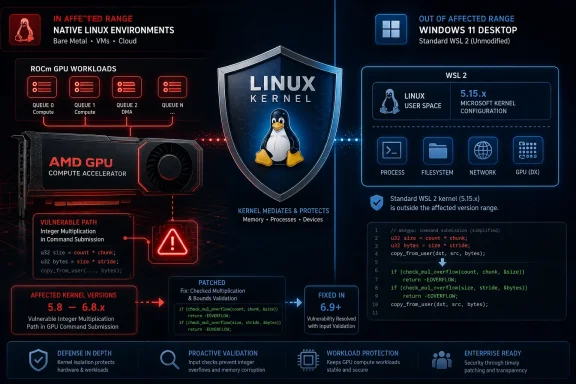
CVE-2026-63881 is a newly published Linux kernel vulnerability in AMD’s Kernel Fusion Driver, or KFD, that deserves attention from GPU-compute users even though its practical exposure is narrower than its High severity label initially suggests. The flaw sits in the AMDGPU KFD debugger path, where an unchecked multiplication used to calculate the byte length of a user-supplied queue-ID array can wrap on a 32-bit kernel build. Kernel developers have fixed the issue in the supported stable branches, and the immediate priority for administrators is straightforward: identify Linux systems running KFD-capable AMD GPU compute workloads on kernels from the affected range, then move to a patched kernel release. For Windows users, the most important distinction is that this is not a vulnerability in the Windows AMD display driver, and current mainstream WSL 2 deployments based on Microsoft’s 5.15 kernel line are outside the affected version range. It is, however, relevant to developers and enterprises using native Linux, custom kernels, AMD ROCm environments, containers, virtualized GPU compute stacks, or forward-looking WSL GPU software configurations.
CVE-2026-63881 addresses an integer-overflow weakness in
The vulnerable calculation was conceptually simple:
The code uses
That is the familiar and dangerous pattern behind many low-level memory-safety bugs: a program believes it has correctly sized a buffer, but arithmetic truncation produces an undersized allocation. A later operation may then act on the original item count rather than the wrapped byte count, potentially creating an out-of-bounds write, read, corruption condition, or crash.
Kernel.org has assigned a CVSS 3.1 score of 7.8 High for the vulnerability. Its vector identifies the issue as locally exploitable, low complexity, requiring low privileges, requiring no user interaction, and potentially affecting confidentiality, integrity, and availability. That score should guide patch urgency, but it should not be read as proof that every Linux PC with an AMD graphics card is equally exposed.
KFD should not be confused with the Windows display driver installed through AMD Software: Adrenalin Edition or enterprise Radeon and Radeon Pro packages. It is a Linux kernel component. On a typical desktop Linux installation, the presence of an AMD GPU does not automatically mean that the vulnerable debugger route is practically reachable in a meaningful way. The risk rises where users can access GPU-compute APIs, where ROCm is installed, where debugging features are exposed, and where local users are not fully trusted.
The KFD debugger infrastructure needs to inspect and manage queue state. In a debugging scenario, a user-space process may need to identify queues to suspend, resume, invalidate, or examine. That requires passing queue identifiers between user space and kernel space.
This boundary is security-sensitive because the kernel must distrust all dimensions and pointer values supplied by an application. A count field is not harmless simply because it is an integer. When that count controls allocation size, iteration length, copying, or address calculations, it becomes part of the security boundary.
That early-record state is worth noting. NVD entries are often useful for product inventories and automated scanner correlation, but the most operationally valuable information in a Linux kernel CVE frequently comes from the upstream fix history and stable-backport list. In this case, the precise release boundaries are more actionable than waiting for broader database enrichment.
On a 64-bit kernel, the limit is extraordinarily large in theory, although practical memory and other validation limits still apply. On a 32-bit kernel, the mathematical ceiling is much lower. The calculation can overflow once the queue count exceeds approximately 1,073,741,823 entries, because multiplying that count by four exceeds the largest 32-bit unsigned size.
For example, an application might provide a value that logically means, “I am supplying an array containing more than one billion queue IDs.” The raw number is implausible as a legitimate hardware workload, but security code cannot assume malicious input will be plausible. If the multiplication wraps, the kernel may compute a size that no longer reflects the declared number of items.
The vulnerability is not about a GPU physically having one billion usable queues. It is about the kernel accepting a numeric input at a privileged boundary and deriving a buffer size incorrectly before it has safely rejected the impossible request.
Instead of silently wrapping,
This is a small code change with a substantial security effect. It turns a potentially deceptive arithmetic result into an unambiguous failure condition.
Why
The Linux kernel has spent years reducing memory-safety risks caused by hand-written size arithmetic. Developers frequently need to calculate the storage required for arrays, structures with flexible array members, page ranges, buffers, and serialized data. Any expression involving a count multiplied by an element size is a potential overflow site.
The modern kernel provides helpers such as
If code says it will process
Using
This same KFD debugger area has received scrutiny for other input-validation problems. That is not an indictment of AMD’s Linux support alone; debugging interfaces are complex by nature. They often bridge user-controlled data and highly privileged device-management operations, making meticulous validation essential.
A conventional AMD-powered Linux desktop used only for web browsing and office work may still include AMDGPU components, but its practical exposure to a KFD debugging interface may be limited. Limited exposure is not the same as immunity; it simply means that patch prioritization should consider real deployment configuration rather than product names alone.
Administrators of shared compute hosts should treat the CVE as a prompt to review more than patch state. They should also ask whether KFD debugging is required for regular tenants, whether device nodes are overly broad in their permissions, and whether container access to GPU devices is granted only where necessary.
A 32-bit kernel that includes recent AMDGPU KFD code may be unusual, but unusual does not mean irrelevant. Security teams should avoid treating an architecture-specific trigger as a reason to skip inventory work. A small number of overlooked engineering systems can still become a useful foothold in a larger network.
The more nuanced question concerns Windows Subsystem for Linux. WSL 2 runs a real Linux kernel in a lightweight virtualized environment, and Windows users increasingly use it for Docker, development tooling, AI frameworks, and GPU-accelerated workloads. AMD’s ROCm ecosystem also supports GPU compute use cases under WSL.
That is a meaningful distinction. A Windows user who runs
However, WSL is not a single immutable configuration. Advanced users can work with custom kernels, experimental distributions, vendor appliances, or environments that differ from the normal Microsoft-provided kernel. The correct question is always: what kernel is actually running?
Even so, ROCm use under WSL does not automatically make a system vulnerable to this issue. The kernel-version requirement remains decisive. A WSL setup based on 5.15 is not brought into scope merely because it uses AMD GPU acceleration.
The practical checklist for Windows users is short:
The safest remediation is to install the first available distribution kernel package that incorporates one of the fixed upstream versions or the equivalent vendor backport. Enterprise Linux distributions often backport security fixes without changing the public-looking kernel base version dramatically, so administrators should rely on their vendor security advisories and package changelogs rather than comparing only the first few digits of a kernel release string.
A manually rebuilt kernel can complicate Secure Boot, DKMS driver compatibility, out-of-tree modules, crash support, update management, and compliance evidence. A supported distribution update is usually the correct operational choice.
A local vulnerability with a High severity score can matter greatly when one user’s code runs on a machine that also handles another team’s models, datasets, deployment credentials, or production inference services.
That means an organization should not assume that a containerized workload is harmless simply because it has no root privileges inside the container. If the workload can reach a vulnerable device-driver interface, the relevant question becomes whether a host-kernel flaw can be exercised from that limited context.
Most consumer systems do not have multiple untrusted local users. That substantially reduces the typical risk compared with a university cluster or corporate compute farm. Still, malware, malicious development dependencies, compromised plugins, and untrusted container images can all provide the local execution foothold assumed by the CVSS vector.
At the same time, it would be misleading to describe the flaw as a universal threat to every AMD Radeon owner. The vulnerable path requires a particular Linux kernel lineage, KFD-related functionality, and a local attacker able to interact with the relevant interface.
Administrators should monitor their vendor’s advisories for confirmation that the kernel package contains the relevant backport. This is especially important for distributions that build from LTS branches but use vendor-specific release identifiers. A kernel whose version string does not visibly match 6.6.143, 6.12.93, 6.18.35, or 7.0.12 may still be protected if the vendor has incorporated the patch.
The right response is precision, not alarm. Stock WSL 2 systems using Microsoft’s 5.15-based kernel are not affected by a vulnerability introduced in Linux 6.5. But custom-kernel users and organizations operating mixed Windows/Linux development estates should keep kernel provenance and GPU-stack configuration visible in their asset records.
CVE-2026-63881 is a concise example of why secure systems programming depends on disciplined arithmetic as much as on access control: a single unchecked multiplication at a kernel/user boundary can turn an impossible request into a dangerous memory-management error. The upstream Linux fix is already available across the relevant stable branches, and most Windows users have no direct exposure through native Windows or standard WSL 2 kernels. For Linux GPU-compute operators, however, the message is clear: patch the affected kernels, verify the reboot, restrict unnecessary device access, and treat accelerator-driver security as a first-class part of modern endpoint and enterprise infrastructure management.
 Overview
CVE-2026-63881 addresses an integer-overflow weakness in get_queue_ids(), a helper in the AMD KFD device queue manager. KFD is part of the upstream Linux AMDGPU ecosystem and supports heterogeneous compute workloads by helping user-space software interact with GPU execution queues. Those queues are fundamental to modern accelerator workflows: they represent scheduled streams of GPU work rather than ordinary graphical rendering commands.The vulnerable calculation was conceptually simple:
array_size = num_queues * sizeof(uint32_t)The code uses
num_queues to determine how much kernel memory should be allocated or copied for queue identifiers. On a 32-bit build, size_t has a maximum representable value of 4,294,967,295 bytes. Since each queue ID occupies four bytes, a sufficiently large num_queues can make the multiplication wrap around to a much smaller value.That is the familiar and dangerous pattern behind many low-level memory-safety bugs: a program believes it has correctly sized a buffer, but arithmetic truncation produces an undersized allocation. A later operation may then act on the original item count rather than the wrapped byte count, potentially creating an out-of-bounds write, read, corruption condition, or crash.
Kernel.org has assigned a CVSS 3.1 score of 7.8 High for the vulnerability. Its vector identifies the issue as locally exploitable, low complexity, requiring low privileges, requiring no user interaction, and potentially affecting confidentiality, integrity, and availability. That score should guide patch urgency, but it should not be read as proof that every Linux PC with an AMD graphics card is equally exposed.
The key version boundaries
The CVE record identifies the vulnerable code as having been introduced in Linux kernel version 6.5. The fixed releases are:- Linux 6.6.143 or later in the 6.6 long-term-support series.
- Linux 6.12.93 or later in the 6.12 long-term-support series.
- Linux 6.18.35 or later in the 6.18 stable series.
- Linux 7.0.12 or later in the 7.0 stable series.
- Linux 7.1 and later, where the upstream development line includes the original fix.
Background
AMD’s Linux graphics stack has evolved from a graphics-focused driver model into a broad platform supporting gaming, professional visualization, machine learning, scientific computing, virtualization, and data-center acceleration. Theamdgpu driver manages the underlying hardware, while KFD provides a compute-facing layer used by the ROCm ecosystem and related software.KFD should not be confused with the Windows display driver installed through AMD Software: Adrenalin Edition or enterprise Radeon and Radeon Pro packages. It is a Linux kernel component. On a typical desktop Linux installation, the presence of an AMD GPU does not automatically mean that the vulnerable debugger route is practically reachable in a meaningful way. The risk rises where users can access GPU-compute APIs, where ROCm is installed, where debugging features are exposed, and where local users are not fully trusted.
Why GPU queues matter
Modern GPUs execute large volumes of parallel work. Rather than treating every request as an isolated command, user-space runtimes establish queues that feed work to the GPU. Machine-learning frameworks, media processing pipelines, high-performance computing applications, and debugging tools can all depend on this architecture.The KFD debugger infrastructure needs to inspect and manage queue state. In a debugging scenario, a user-space process may need to identify queues to suspend, resume, invalidate, or examine. That requires passing queue identifiers between user space and kernel space.
This boundary is security-sensitive because the kernel must distrust all dimensions and pointer values supplied by an application. A count field is not harmless simply because it is an integer. When that count controls allocation size, iteration length, copying, or address calculations, it becomes part of the security boundary.
The timing of this disclosure
The CVE was published to the National Vulnerability Database on July 19, 2026, and the record was modified on July 20, 2026 as kernel.org’s CVSS assessment and affected-version information were added. As of July 21, 2026, the NVD has not published its own CVSS score, but kernel.org’s High assessment is available.That early-record state is worth noting. NVD entries are often useful for product inventories and automated scanner correlation, but the most operationally valuable information in a Linux kernel CVE frequently comes from the upstream fix history and stable-backport list. In this case, the precise release boundaries are more actionable than waiting for broader database enrichment.
The Technical Fault
The direct cause of CVE-2026-63881 is an arithmetic operation that assumes the multiplication of a user-controlled queue count by the size of a 32-bit queue ID will always fit insize_t. That assumption is valid only when the count remains below the platform’s representable allocation limit.On a 64-bit kernel, the limit is extraordinarily large in theory, although practical memory and other validation limits still apply. On a 32-bit kernel, the mathematical ceiling is much lower. The calculation can overflow once the queue count exceeds approximately 1,073,741,823 entries, because multiplying that count by four exceeds the largest 32-bit unsigned size.
What arithmetic wraparound changes
Unsigned integer overflow does not necessarily produce an obvious error. In many low-level C contexts, it produces a wrapped value. A huge request can therefore turn into a tiny byte count after multiplication.For example, an application might provide a value that logically means, “I am supplying an array containing more than one billion queue IDs.” The raw number is implausible as a legitimate hardware workload, but security code cannot assume malicious input will be plausible. If the multiplication wraps, the kernel may compute a size that no longer reflects the declared number of items.
The vulnerability is not about a GPU physically having one billion usable queues. It is about the kernel accepting a numeric input at a privileged boundary and deriving a buffer size incorrectly before it has safely rejected the impossible request.
The corrected approach
The fix replaces the open-coded multiplication with the kernel’sarray_size() helper. This is a defensive arithmetic facility intended specifically for array-size calculations.Instead of silently wrapping,
array_size() uses saturating behavior. If the multiplication overflows, it produces SIZE_MAX, the maximum representable size_t value. That result is deliberately unsuitable for an ordinary allocation request and allows the surrounding allocation or validation flow to fail safely rather than proceed with a falsely small allocation.This is a small code change with a substantial security effect. It turns a potentially deceptive arithmetic result into an unambiguous failure condition.
Why array_size() Is the Right Kernel Primitive
The Linux kernel has spent years reducing memory-safety risks caused by hand-written size arithmetic. Developers frequently need to calculate the storage required for arrays, structures with flexible array members, page ranges, buffers, and serialized data. Any expression involving a count multiplied by an element size is a potential overflow site.The modern kernel provides helpers such as
array_size(), array3_size(), struct_size(), and safe addition and multiplication operations. These helpers encode a security expectation that ordinary arithmetic syntax cannot: overflow is exceptional and must not be converted into a valid small size.Saturation is not merely a coding preference
A common misunderstanding is that safer helper macros are just stylistic cleanup. In security-critical kernel paths, they are a mechanism for preserving the relationship between a logical object and the storage assigned to it.If code says it will process
N 32-bit entries, then its storage request must represent N × 4 bytes exactly. If that representation is impossible, the operation must stop. The correct response is not to wrap, clamp quietly to a small value, or hope that a later check catches the discrepancy.Using
array_size() makes this policy visible in the source. A reviewer can immediately see that the calculation was intended to be overflow aware.Defense in depth remains necessary
The patch is important, but safe size arithmetic is one layer of defense. Robust kernel code must also validate pointer accessibility, count ranges, allocation failures, user-space copy results, object lifetimes, locking rules, and relationships between queue ownership and process state.This same KFD debugger area has received scrutiny for other input-validation problems. That is not an indictment of AMD’s Linux support alone; debugging interfaces are complex by nature. They often bridge user-controlled data and highly privileged device-management operations, making meticulous validation essential.
Affected Systems and Exposure
The vulnerable code was introduced in Linux 6.5. Therefore, a system’s exposure depends on more than whether it has an AMD GPU. Administrators need to evaluate four variables together:- The running kernel version must be in the affected range.
- The kernel must include the AMDGPU KFD component.
- The system must expose a path to the KFD debugger functionality.
- A local attacker must have sufficient access to use that path.
Native Linux workstations
A developer workstation running a current Ubuntu, Fedora, Arch, openSUSE, or similar distribution could be affected if it uses a kernel based on 6.5 or later but has not yet integrated the relevant stable fix. The most relevant installations are likely to be workstations configured for ROCm development, local AI training and inference, GPU debugging, scientific workloads, or proprietary applications that interact directly with AMD compute features.A conventional AMD-powered Linux desktop used only for web browsing and office work may still include AMDGPU components, but its practical exposure to a KFD debugging interface may be limited. Limited exposure is not the same as immunity; it simply means that patch prioritization should consider real deployment configuration rather than product names alone.
Servers and shared compute systems
The highest-value environments are shared Linux systems with AMD Instinct, Radeon Pro, or compatible accelerator deployments. These systems may host multiple researchers, developers, container workloads, batch jobs, CI agents, or tenant-like users. A local privilege-escalation weakness is more consequential when an untrusted or semi-trusted user can submit code to a machine that holds confidential data, expensive GPU capacity, credentials, or orchestration access.Administrators of shared compute hosts should treat the CVE as a prompt to review more than patch state. They should also ask whether KFD debugging is required for regular tenants, whether device nodes are overly broad in their permissions, and whether container access to GPU devices is granted only where necessary.
Custom and embedded 32-bit builds
The bug specifically calls out 32-bitsize_t behavior. That makes 32-bit kernel builds the technical center of gravity for the overflow condition. Although 64-bit Linux dominates desktops and servers, 32-bit configurations remain relevant in specialized embedded deployments, compatibility environments, test labs, and older hardware.A 32-bit kernel that includes recent AMDGPU KFD code may be unusual, but unusual does not mean irrelevant. Security teams should avoid treating an architecture-specific trigger as a reason to skip inventory work. A small number of overlooked engineering systems can still become a useful foothold in a larger network.
The Windows and WSL Perspective
For WindowsForum readers, the first message is reassuring: CVE-2026-63881 does not apply to the native Windows kernel or the normal Windows AMD display-driver stack. Updating AMD Adrenalin solely to address this Linux KFD CVE would not remediate the underlying issue because the vulnerable code is not in that driver path.The more nuanced question concerns Windows Subsystem for Linux. WSL 2 runs a real Linux kernel in a lightweight virtualized environment, and Windows users increasingly use it for Docker, development tooling, AI frameworks, and GPU-accelerated workloads. AMD’s ROCm ecosystem also supports GPU compute use cases under WSL.
Why mainstream WSL 2 is not in the listed affected range
Microsoft’s widely deployed WSL kernel track is based on the Linux 5.15 series. Because CVE-2026-63881 was introduced in Linux 6.5, a standard WSL 2 instance using the Microsoft 5.15 kernel is outside the affected range for this vulnerability.That is a meaningful distinction. A Windows user who runs
uname -r inside a standard WSL 2 distribution and sees a Microsoft 5.15-based kernel does not need to treat CVE-2026-63881 as an immediate exposure.However, WSL is not a single immutable configuration. Advanced users can work with custom kernels, experimental distributions, vendor appliances, or environments that differ from the normal Microsoft-provided kernel. The correct question is always: what kernel is actually running?
ROCm under WSL changes the relevance, not the basic version test
AMD’s current ROCm documentation continues to position WSL as a supported route for GPU-accelerated Linux workloads on selected hardware and software combinations. That creates a genuine reason for Windows-based AI developers to understand KFD-related CVEs.Even so, ROCm use under WSL does not automatically make a system vulnerable to this issue. The kernel-version requirement remains decisive. A WSL setup based on 5.15 is not brought into scope merely because it uses AMD GPU acceleration.
The practical checklist for Windows users is short:
- Check the WSL kernel version with
uname -rinside the distribution. - Confirm whether the environment uses Microsoft’s standard kernel or a custom build.
- Apply Microsoft WSL kernel updates and AMD’s supported GPU software updates as part of normal maintenance.
- Avoid treating this CVE as a reason for emergency changes to a stock 5.15-based WSL 2 system.
Patch Status and Upgrade Priorities
The upstream remediation has been backported to multiple stable kernel lines. That is good news because it allows organizations to fix the issue without moving to an entirely new kernel generation solely for this CVE.The safest remediation is to install the first available distribution kernel package that incorporates one of the fixed upstream versions or the equivalent vendor backport. Enterprise Linux distributions often backport security fixes without changing the public-looking kernel base version dramatically, so administrators should rely on their vendor security advisories and package changelogs rather than comparing only the first few digits of a kernel release string.
The practical update sequence
For systems that may be affected, remediation should follow a disciplined process:- Determine the running kernel version, not just the installed version, using
uname -r. - Identify AMD KFD and ROCm usage, including GPU debugging, developer workloads, containers, and shared accelerator access.
- Install the vendor-provided kernel update that includes the stable fix or explicitly documents an equivalent backport.
- Reboot into the updated kernel, because a downloaded kernel package does not protect a currently running vulnerable kernel.
- Verify the active kernel after reboot and confirm that the previous kernel is no longer the default boot target.
- Retain rollback capability, especially for production GPU clusters where kernel and ROCm compatibility must be tested together.
Avoid unsupported source-level hot fixes
Some technically capable users may be tempted to patch the one-line calculation locally. That can be appropriate in a controlled engineering environment with a repeatable kernel build pipeline, but it is generally not the best response for ordinary workstations or enterprise fleets.A manually rebuilt kernel can complicate Secure Boot, DKMS driver compatibility, out-of-tree modules, crash support, update management, and compliance evidence. A supported distribution update is usually the correct operational choice.
Enterprise Impact
For enterprises, CVE-2026-63881 is less about emergency internet-facing exposure and more about local trust boundaries. Shared GPU infrastructure is increasingly common as organizations build internal AI platforms, simulation farms, data-processing systems, virtual desktops, and developer environments. Those systems concentrate valuable compute resources and sensitive workloads behind a Linux kernel boundary.A local vulnerability with a High severity score can matter greatly when one user’s code runs on a machine that also handles another team’s models, datasets, deployment credentials, or production inference services.
Containerization is not a complete answer
Containers isolate many user-space resources, but GPU access complicates that model. A container granted access to GPU device nodes may be interacting with host-kernel driver code directly. The host kernel remains the actual security boundary.That means an organization should not assume that a containerized workload is harmless simply because it has no root privileges inside the container. If the workload can reach a vulnerable device-driver interface, the relevant question becomes whether a host-kernel flaw can be exercised from that limited context.
Recommended enterprise controls
- Patch GPU worker nodes on the same priority tier as other privileged compute infrastructure.
- Restrict GPU device access to jobs and service accounts that genuinely require it.
- Review debugger-related access in multi-user ROCm environments.
- Separate experimental workloads from production inference and data-processing hosts.
- Track kernel, ROCm, firmware, and driver compatibility as a tested stack rather than independent components.
- Use monitoring to detect unexpected local privilege escalation attempts, crashes, or anomalous GPU-debugging activity.
Consumer and Developer Impact
For individual Linux users, the most realistic impact is on enthusiasts running AMD GPU compute software, local large-language-model inference, machine-learning projects, Blender or rendering workflows tied to compute stacks, hardware debugging, and custom kernels.Most consumer systems do not have multiple untrusted local users. That substantially reduces the typical risk compared with a university cluster or corporate compute farm. Still, malware, malicious development dependencies, compromised plugins, and untrusted container images can all provide the local execution foothold assumed by the CVSS vector.
Do not overreact to the word “debugger”
The presence of “debugger” in the vulnerability title may lead some users to dismiss the issue as relevant only to kernel developers. That would be too casual. Debugging interfaces are often exposed through ordinary user-space APIs intended for software tooling, and the security impact depends on access control and input handling rather than the job title of the person using the system.At the same time, it would be misleading to describe the flaw as a universal threat to every AMD Radeon owner. The vulnerable path requires a particular Linux kernel lineage, KFD-related functionality, and a local attacker able to interact with the relevant interface.
A sensible home-user response
For a single-user Linux desktop, the correct response is routine but timely maintenance:- Install the distribution’s current security kernel update.
- Reboot rather than postponing the new kernel indefinitely.
- Avoid executing untrusted GPU-compute demonstrations, containers, or binary packages as a privileged user.
- Keep ROCm and related packages aligned with supported kernel versions.
- Remove unnecessary development tools and experimental device-access permissions from systems that do not need them.
Strengths and Opportunities
The response to CVE-2026-63881 illustrates several positive aspects of upstream Linux security maintenance.- The fix is narrowly targeted. Replacing a vulnerable arithmetic expression with a safe size-calculation helper reduces risk without redesigning the KFD debugger subsystem.
- Multiple stable branches received backports. Users on supported long-term and stable releases have a clear upgrade path without a forced migration to the newest development kernel.
- The root cause is understandable. Integer-overflow issues can be subtle in large codebases, but this case has a direct explanation that maintainers and downstream vendors can audit.
- The kernel already provides the appropriate defensive primitive.
array_size()is an established mechanism designed to reject the exact class of error involved here. - The affected-range information is unusually useful. The fact that the problem starts with Linux 6.5 and that specific fixed versions are listed helps teams avoid both under-patching and unnecessary disruption.
- The issue reinforces secure GPU-platform engineering. As GPU compute becomes normal on desktops, servers, and Windows-adjacent development environments, better scrutiny of driver APIs benefits the entire ecosystem.
Risks and Concerns
Despite the clean fix, several operational and technical concerns remain.- A High CVSS score may create uneven responses. Some organizations may ignore the issue because it is local-only, while others may overreact without checking whether their kernels are even in the affected range.
- Kernel-version strings can be deceptive. Enterprise vendors commonly backport fixes, and custom kernels may contain or omit patches in ways that simple version comparison does not reveal.
- GPU compute hosts often have unusually broad local code execution. CI workers, research clusters, developer sandboxes, and notebook platforms can turn “local” vulnerabilities into meaningful multi-user risks.
- Containers can obscure host-kernel exposure. A workload that looks isolated at the application layer may still be permitted to reach privileged graphics and compute driver interfaces.
- 32-bit systems can be forgotten. The specific overflow scenario centers on 32-bit
size_t, and less common architectures can fall outside normal desktop patch-management assumptions. - The patch addresses one arithmetic point, not every debugger-path hazard. Security teams should avoid assuming that a single CVE fix is a comprehensive security assessment of AMDGPU KFD debugging functionality.
What to Watch Next
The next development to watch is distribution adoption. Upstream stable fixes are the foundation, but actual protection depends on how quickly Linux distributions, appliance vendors, cloud-image maintainers, and enterprise platform teams package and deploy those changes.Administrators should monitor their vendor’s advisories for confirmation that the kernel package contains the relevant backport. This is especially important for distributions that build from LTS branches but use vendor-specific release identifiers. A kernel whose version string does not visibly match 6.6.143, 6.12.93, 6.18.35, or 7.0.12 may still be protected if the vendor has incorporated the patch.
Questions security teams should answer
Security teams should use this CVE to validate their GPU-compute inventory process:- Which systems run AMD GPU compute workloads rather than graphics-only workloads?
- Which of those systems run kernels derived from Linux 6.5 through the affected stable release thresholds?
- Which machines permit untrusted users, jobs, containers, or tenants to access GPU devices?
- Are kernel updates rebooted promptly on accelerator hosts?
- Can the organization prove which kernel was running when a workload executed?
- Are ROCm upgrades tested alongside kernel updates so security remediation does not create avoidable service disruption?
Watch the WSL ecosystem carefully, but precisely
Windows users should also keep an eye on the evolution of AMD’s ROCm support under WSL. GPU acceleration under WSL is becoming more capable and more broadly supported, which is positive for local AI and development workflows. It also means that Linux-side driver and runtime security advisories will increasingly matter to Windows-centric teams.The right response is precision, not alarm. Stock WSL 2 systems using Microsoft’s 5.15-based kernel are not affected by a vulnerability introduced in Linux 6.5. But custom-kernel users and organizations operating mixed Windows/Linux development estates should keep kernel provenance and GPU-stack configuration visible in their asset records.
CVE-2026-63881 is a concise example of why secure systems programming depends on disciplined arithmetic as much as on access control: a single unchecked multiplication at a kernel/user boundary can turn an impossible request into a dangerous memory-management error. The upstream Linux fix is already available across the relevant stable branches, and most Windows users have no direct exposure through native Windows or standard WSL 2 kernels. For Linux GPU-compute operators, however, the message is clear: patch the affected kernels, verify the reboot, restrict unnecessary device access, and treat accelerator-driver security as a first-class part of modern endpoint and enterprise infrastructure management.
References
- Primary source: NVD / Linux Kernel
Published: 2026-07-21T01:03:35-07:00
NVD - CVE-2026-63881
 nvd.nist.gov
- Security advisory: MSRC
Published: 2026-07-21T01:03:35-07:00
Original feed URL
Security Update Guide - Microsoft Security Response Center
 msrc.microsoft.com
