

Dell Federal Systems was awarded a five-year, single-award blanket purchase agreement worth about $9.69 billion to supply Microsoft software licenses, Microsoft 365 cloud subscriptions, Software Assurance, and related enterprise licensing to the Department of War, the intelligence community, and the Coast Guard. The deal is not just another procurement notice buried in a federal contracting digest. It is a map of where the Windows estate of the U.S. national-security bureaucracy is going: more centralized, more cloud-aware, more hybrid, and still deeply dependent on Microsoft’s operating system and productivity stack. For Windows administrators and federal IT watchers, the headline number matters less than the architecture it reveals.
The biggest contract in this batch is not for aircraft, ships, missiles, or sensors. It is for the software layer that lets a sprawling defense bureaucracy log in, write, collaborate, patch, audit, classify, disconnect, reconnect, and keep working across networks that range from office desktops to operational environments.
That should not surprise anyone who has watched defense IT over the last decade. The modern military does not merely buy weapons; it buys ecosystems. A P-8A maritime patrol aircraft, a tactical mesh network, a submarine maintenance yard, and a civil engineering program all depend on software, identity, licensing, configuration control, and secure collaboration.
The Dell agreement sits under the Enterprise Software Initiative and is described as a second-generation follow-on enterprise software agreement. In plainer English, the government is taking an existing Microsoft dependency and trying to impose order on it. The contract covers familiar terrain — Windows Enterprise, Office Professional Plus, Microsoft 365 licensing, cloud subscriptions, and Software Assurance — but the scale changes the story.
A $9.69 billion agreement does not mean every dollar is new spending on new capability. Blanket purchase agreements are vehicles, not simple one-time shopping carts. But the structure matters because it consolidates Microsoft acquisition across the Department of War, the intelligence community, and the Coast Guard, pushing a vast customer base toward a common procurement channel.
That is a governance move disguised as a software buy.
Enterprise Windows is not just a desktop operating system in this context. It is a policy surface. It is where identity, device posture, encryption, endpoint detection, update cadence, and access control meet the daily reality of millions of users. Office is not merely a productivity suite; it is the document substrate of the federal bureaucracy.
That helps explain why the agreement includes both traditional on-premises licensing and cloud subscriptions. The government is not flipping a switch from “old Microsoft” to “new Microsoft.” It is paying for the privilege of operating in both worlds at once.
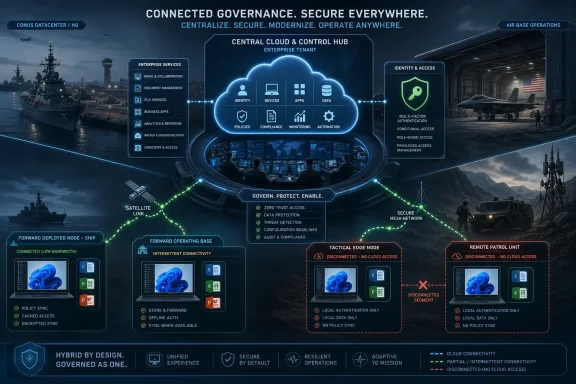
This is the uncomfortable truth of hybrid modernization. Agencies want cloud elasticity, identity-driven access, managed collaboration, and AI-adjacent data platforms. They also have classified environments, disconnected missions, legacy applications, austere locations, and risk thresholds that make ordinary commercial cloud assumptions look naïve.
The contract’s reference to a “Disconnected No Cloud Access” license is therefore more revealing than any marketing phrase about transformation. It acknowledges that the future of defense computing is not uniformly cloud-first. Some of it is cloud-never, or at least cloud-not-now.
Defense users cannot always live that way. A ship, forward-deployed unit, classified enclave, test range, or intelligence environment may need modern software without dependable or permissible cloud access. The “Disconnected No Cloud Access” bundle is a quiet admission that the operational edge does not care about subscription ideology.
For Windows professionals, this is a familiar tension. Microsoft’s enterprise roadmap has leaned hard into cloud-based management, Entra identity, Intune, Defender integrations, and Microsoft 365 as the center of gravity. But the government still needs durable software rights, predictable offline behavior, and support for networks that cannot be treated like ordinary corporate tenants.
That is not nostalgia. It is operational design.
The result is a split personality that federal IT must manage for years. One side of the house will use Microsoft 365 and cloud-connected security tooling as intended. Another side will demand local survivability, tightly controlled updates, and licensing models that work when the network boundary is not merely a firewall but a mission requirement.
That distinction matters. The Pentagon already has a broader cloud strategy, and the Joint Warfighting Cloud Capability contract is designed to provide access to multiple major cloud providers. The Dell-Microsoft agreement is not replacing that structure. It is smoothing part of the software and licensing path around it.
This is where procurement language becomes architecture. If Microsoft 365 and Windows licensing live under one enterprise agreement, while broader cloud workloads move through a separate multi-cloud vehicle, then agencies get a more coherent way to manage the Microsoft layer without pretending that every workload belongs in Azure.
That is both pragmatic and politically useful. It avoids the appearance that Microsoft has swallowed the entire cloud modernization program, while still acknowledging that Microsoft is deeply embedded in the endpoint, identity, productivity, and collaboration layers that surround cloud migration.
For administrators, the practical question will be whether the licensing consolidation actually reduces friction. Big enterprise agreements often promise simplification and deliver a new kind of complexity: fewer contract vehicles, but more centralized rules; fewer ad hoc purchases, but more dependency on a single catalog and approval chain.
Still, the center of gravity is plainly Microsoft. The agreement exists because the government’s Microsoft estate is too large and too strategically important to buy piecemeal. Dell may be the contracting face, but Windows, Office, Microsoft 365, Software Assurance, and Azure-adjacent transition support are the substance.
That dynamic is common in federal IT. The government may contract through one vendor while operational dependence accumulates around another vendor’s platform. The prime contractor manages the road; the platform company determines where many of the roads can go.
For Microsoft, the deal reinforces something more valuable than a one-time revenue figure. It preserves strategic incumbency. If defense agencies standardize procurement, licensing, and hybrid bundles around Microsoft’s ecosystem for another five years, the next wave of security tooling, collaboration services, AI features, and endpoint management decisions will likely start from that same baseline.
The lock-in debate is easy to caricature. Yes, standardization can reduce duplication and improve negotiating leverage. Yes, it can also make exit harder. Both are true, and federal IT leaders know it.
That is the connective tissue of this entire batch. Fuse Integration receives a $96.1 million order for CORE 5 network controller kits and KRAKEN systems supporting tactical edge networking for targeting in contested long-range environments. IBM receives a $46.2 million Air Force modification for advisory and assistance support to optimize resource allocation and civil engineering programs. Torch Technologies receives Army funding for technical services supporting aviation mission systems and architecture.
These are not Microsoft contracts, but they live in the same reality. Defense modernization is no longer neatly divided between “IT” and “weapons.” The aircraft needs software updates. The tactical network needs resilient data movement. The base needs digital resource optimization. The logistics enterprise needs systems support. The desktop estate and collaboration layer may seem mundane, but they are part of the same operating fabric.
That is why the Dell agreement deserves attention from a Windows audience. The endpoint is not a back-office afterthought. It is one of the few layers common enough to touch nearly every mission, office, program, and command.
Centralization gives the government a fighting chance to rationalize licenses. It can negotiate at scale, standardize offerings, and reduce the administrative waste of overlapping agreements. It can also give security leaders a clearer picture of which products and support rights exist across the enterprise.
But consolidation has a cost. A single-award vehicle concentrates responsibility. If the catalog is slow to adapt, everyone feels it. If licensing terms do not match operational edge cases, the workarounds multiply. If administrators need flexibility that the agreement does not anticipate, they may find themselves trapped inside a system designed for efficiency rather than agility.
The federal government has lived this trade before. Enterprise agreements can produce savings on paper while shifting complexity into implementation. The most successful ones do not merely lower unit prices; they reduce the number of decisions that local teams must relitigate without stripping them of the authority to solve real mission problems.
That balance will determine whether ESA II feels like modernization or bureaucracy with a cloud subscription.
The inclusion of Office Professional Plus alongside Microsoft 365 is especially telling. Agencies are not abandoning perpetual-style or on-premises-friendly software overnight. They are creating a portfolio that allows different environments to move at different speeds.
That means administrators will need to be bilingual. They must understand the older world of imaging, group policy, local update control, Office deployment tooling, and air-gapped constraints. They must also understand the newer world of tenant governance, conditional access, cloud security posture, Defender integration, and subscription entitlements.
The danger is that organizations treat the contract as a procurement event rather than an operational transformation. Buying access to Microsoft 365 does not modernize identity. Owning Software Assurance does not guarantee disciplined patch management. Consolidating licenses does not automatically reduce attack surface.
The contract enables choices. It does not make them.
A fragmented Microsoft estate is hard to defend. Different versions, patch levels, license entitlements, tenant configurations, and support arrangements create uneven risk. Standardizing the acquisition channel can help standardize the security baseline, at least in theory.
Microsoft’s security stack has also become increasingly integrated with its productivity and identity platforms. Defender, Entra, Purview, Intune, and Microsoft 365 security features are most powerful when deployed coherently. A government customer trying to defend millions of endpoints and users has an incentive to reduce the number of unsupported islands.
Yet integration cuts both ways. A common platform can improve visibility, but it also creates high-value systemic risk. Misconfiguration at scale becomes more consequential. Identity compromise becomes more damaging. A licensing or service disruption can ripple widely.
For national-security environments, the answer is not to avoid standard platforms altogether. That is unrealistic. The answer is to treat standardization as a security engineering project, not merely a purchasing convenience.
But the phrase “software integration” is doing real work. Modern aircraft are software-defined systems wrapped in airframes, sensors, communications gear, and sustainment chains. Keeping them useful requires code, interfaces, cybersecurity updates, and hardware refreshes that can survive long acquisition timelines.
Fuse Integration’s KRAKEN order is more overtly digital. The contract supports aircraft and fleet introduction of systems using tactical edge networking for targeting in contested long-range environments. That is the language of a military trying to move data under pressure: beyond line of sight, in denied or degraded conditions, across nodes that cannot assume perfect connectivity.
Put that beside the Dell Microsoft agreement and the pattern becomes clearer. At headquarters, the government wants consolidated collaboration and licensing. At the edge, it wants resilient mesh networks and disconnected operation. In between, it wants aircraft, logistics, bases, and mission systems that can keep data moving.
The procurement notices are separate. The architecture is not.
They are, however, part of the same institutional capacity problem. A military cannot modernize digitally if its facilities, shipyards, bases, supply chains, and uniforms fail in the physical world. The cloud does not preserve a submarine hull. Microsoft 365 does not run a base sewage system. Tactical data links do not replace storm-risk engineering for a vulnerable coastal city.
The federal contracting record is a reminder that defense modernization is layered. At the top are enterprise software agreements and cloud vehicles. In the middle are aircraft, networks, advisory services, and mission systems. At the bottom are maintenance, construction, logistics, and apparel.
The temptation in technology coverage is to treat the software contract as the future and the rest as legacy. That is wrong. The future is the interaction between them.
The government is effectively buying a bridge from today’s mixed estate to that next operating model. It is not clear how smooth the bridge will be. Federal agencies have different security classifications, mission rhythms, legacy dependencies, and tolerance for cloud services.
Microsoft will also have to serve customers that do not look like its commercial ideal. Defense users may want the benefits of modern productivity software without the assumptions of permanent connectivity, rapid feature churn, telemetry-rich cloud services, or consumer-like update experiences. That tension will not vanish because a contract vehicle exists.
The contract’s success will be measured less by the award amount than by whether agencies can retire redundant agreements, improve security baselines, support disconnected users, and move appropriate workloads toward cloud environments without breaking mission continuity.
The practical read is narrower than the headline and more important than the marketing.
 The Pentagon Is Standardizing the Office Before It Standardizes the Battlefield
The biggest contract in this batch is not for aircraft, ships, missiles, or sensors. It is for the software layer that lets a sprawling defense bureaucracy log in, write, collaborate, patch, audit, classify, disconnect, reconnect, and keep working across networks that range from office desktops to operational environments.That should not surprise anyone who has watched defense IT over the last decade. The modern military does not merely buy weapons; it buys ecosystems. A P-8A maritime patrol aircraft, a tactical mesh network, a submarine maintenance yard, and a civil engineering program all depend on software, identity, licensing, configuration control, and secure collaboration.
The Dell agreement sits under the Enterprise Software Initiative and is described as a second-generation follow-on enterprise software agreement. In plainer English, the government is taking an existing Microsoft dependency and trying to impose order on it. The contract covers familiar terrain — Windows Enterprise, Office Professional Plus, Microsoft 365 licensing, cloud subscriptions, and Software Assurance — but the scale changes the story.
A $9.69 billion agreement does not mean every dollar is new spending on new capability. Blanket purchase agreements are vehicles, not simple one-time shopping carts. But the structure matters because it consolidates Microsoft acquisition across the Department of War, the intelligence community, and the Coast Guard, pushing a vast customer base toward a common procurement channel.
That is a governance move disguised as a software buy.
Microsoft’s Real Moat Is Not Word or Windows, but Institutional Memory
The contract brief names Windows Enterprise Operating System and Office Professional Plus almost casually, as if they were office furniture. That casualness is the point. Microsoft’s position inside government is not merely the result of feature comparisons against rival products; it is the accumulated weight of workflows, macros, document formats, authentication models, endpoint management tools, compliance regimes, and administrator muscle memory.Enterprise Windows is not just a desktop operating system in this context. It is a policy surface. It is where identity, device posture, encryption, endpoint detection, update cadence, and access control meet the daily reality of millions of users. Office is not merely a productivity suite; it is the document substrate of the federal bureaucracy.
That helps explain why the agreement includes both traditional on-premises licensing and cloud subscriptions. The government is not flipping a switch from “old Microsoft” to “new Microsoft.” It is paying for the privilege of operating in both worlds at once.
This is the uncomfortable truth of hybrid modernization. Agencies want cloud elasticity, identity-driven access, managed collaboration, and AI-adjacent data platforms. They also have classified environments, disconnected missions, legacy applications, austere locations, and risk thresholds that make ordinary commercial cloud assumptions look naïve.
The contract’s reference to a “Disconnected No Cloud Access” license is therefore more revealing than any marketing phrase about transformation. It acknowledges that the future of defense computing is not uniformly cloud-first. Some of it is cloud-never, or at least cloud-not-now.
The “Disconnected” License Is the Most Honest Line in the Notice
Commercial enterprise software increasingly assumes continuous connectivity. Licenses phone home. Updates stream down. Identity is brokered through cloud services. Collaboration platforms blur the line between local document, shared workspace, and managed data lake.Defense users cannot always live that way. A ship, forward-deployed unit, classified enclave, test range, or intelligence environment may need modern software without dependable or permissible cloud access. The “Disconnected No Cloud Access” bundle is a quiet admission that the operational edge does not care about subscription ideology.
For Windows professionals, this is a familiar tension. Microsoft’s enterprise roadmap has leaned hard into cloud-based management, Entra identity, Intune, Defender integrations, and Microsoft 365 as the center of gravity. But the government still needs durable software rights, predictable offline behavior, and support for networks that cannot be treated like ordinary corporate tenants.
That is not nostalgia. It is operational design.
The result is a split personality that federal IT must manage for years. One side of the house will use Microsoft 365 and cloud-connected security tooling as intended. Another side will demand local survivability, tightly controlled updates, and licensing models that work when the network boundary is not merely a firewall but a mission requirement.
Azure Gets a Narrower Role Than the Headline Suggests
The Dell agreement includes a limited scope for Microsoft Azure, but the notice is careful about why. Azure is included to support the transition of specific workloads to the Joint Warfighting Cloud Capability contract, not to make this BPA the government’s all-purpose cloud vehicle.That distinction matters. The Pentagon already has a broader cloud strategy, and the Joint Warfighting Cloud Capability contract is designed to provide access to multiple major cloud providers. The Dell-Microsoft agreement is not replacing that structure. It is smoothing part of the software and licensing path around it.
This is where procurement language becomes architecture. If Microsoft 365 and Windows licensing live under one enterprise agreement, while broader cloud workloads move through a separate multi-cloud vehicle, then agencies get a more coherent way to manage the Microsoft layer without pretending that every workload belongs in Azure.
That is both pragmatic and politically useful. It avoids the appearance that Microsoft has swallowed the entire cloud modernization program, while still acknowledging that Microsoft is deeply embedded in the endpoint, identity, productivity, and collaboration layers that surround cloud migration.
For administrators, the practical question will be whether the licensing consolidation actually reduces friction. Big enterprise agreements often promise simplification and deliver a new kind of complexity: fewer contract vehicles, but more centralized rules; fewer ad hoc purchases, but more dependency on a single catalog and approval chain.
Dell Wins the Prime Seat, but Microsoft Owns the Gravity
Dell Federal Systems is the named awardee, and that is important. Federal software procurement often relies on integrators, resellers, and contract holders that can satisfy acquisition rules, handle ordering mechanics, and support government-specific requirements. Dell’s role is not ornamental.Still, the center of gravity is plainly Microsoft. The agreement exists because the government’s Microsoft estate is too large and too strategically important to buy piecemeal. Dell may be the contracting face, but Windows, Office, Microsoft 365, Software Assurance, and Azure-adjacent transition support are the substance.
That dynamic is common in federal IT. The government may contract through one vendor while operational dependence accumulates around another vendor’s platform. The prime contractor manages the road; the platform company determines where many of the roads can go.
For Microsoft, the deal reinforces something more valuable than a one-time revenue figure. It preserves strategic incumbency. If defense agencies standardize procurement, licensing, and hybrid bundles around Microsoft’s ecosystem for another five years, the next wave of security tooling, collaboration services, AI features, and endpoint management decisions will likely start from that same baseline.
The lock-in debate is easy to caricature. Yes, standardization can reduce duplication and improve negotiating leverage. Yes, it can also make exit harder. Both are true, and federal IT leaders know it.
The Rest of the Contract Batch Shows the Software Layer in Context
The same contracting digest includes Boeing receiving an $854.7 million modification tied to four P-8A Lot 13 aircraft for foreign military sales customers, along with engineering work for diminishing manufacturing sources, material shortages, software integration, and hardware updates. Even in an aircraft procurement notice, software integration is part of the sentence.That is the connective tissue of this entire batch. Fuse Integration receives a $96.1 million order for CORE 5 network controller kits and KRAKEN systems supporting tactical edge networking for targeting in contested long-range environments. IBM receives a $46.2 million Air Force modification for advisory and assistance support to optimize resource allocation and civil engineering programs. Torch Technologies receives Army funding for technical services supporting aviation mission systems and architecture.
These are not Microsoft contracts, but they live in the same reality. Defense modernization is no longer neatly divided between “IT” and “weapons.” The aircraft needs software updates. The tactical network needs resilient data movement. The base needs digital resource optimization. The logistics enterprise needs systems support. The desktop estate and collaboration layer may seem mundane, but they are part of the same operating fabric.
That is why the Dell agreement deserves attention from a Windows audience. The endpoint is not a back-office afterthought. It is one of the few layers common enough to touch nearly every mission, office, program, and command.
Consolidation Is a Cure That Creates Its Own Symptoms
The strongest argument for the Dell BPA is simple: the government is too large to let every component negotiate Microsoft licensing in isolation. Fragmented procurement creates duplicative spending, inconsistent entitlements, uneven support, and poor visibility into what is actually deployed.Centralization gives the government a fighting chance to rationalize licenses. It can negotiate at scale, standardize offerings, and reduce the administrative waste of overlapping agreements. It can also give security leaders a clearer picture of which products and support rights exist across the enterprise.
But consolidation has a cost. A single-award vehicle concentrates responsibility. If the catalog is slow to adapt, everyone feels it. If licensing terms do not match operational edge cases, the workarounds multiply. If administrators need flexibility that the agreement does not anticipate, they may find themselves trapped inside a system designed for efficiency rather than agility.
The federal government has lived this trade before. Enterprise agreements can produce savings on paper while shifting complexity into implementation. The most successful ones do not merely lower unit prices; they reduce the number of decisions that local teams must relitigate without stripping them of the authority to solve real mission problems.
That balance will determine whether ESA II feels like modernization or bureaucracy with a cloud subscription.
Windows Administrators Should Read This as a Roadmap
For Windows admins in or around government environments, the agreement signals which skills will remain valuable. Traditional Windows administration is not going away, but it is being folded into a larger Microsoft cloud and hybrid management model. Endpoint policy, identity, compliance, update governance, data protection, and licensing literacy are becoming the same conversation.The inclusion of Office Professional Plus alongside Microsoft 365 is especially telling. Agencies are not abandoning perpetual-style or on-premises-friendly software overnight. They are creating a portfolio that allows different environments to move at different speeds.
That means administrators will need to be bilingual. They must understand the older world of imaging, group policy, local update control, Office deployment tooling, and air-gapped constraints. They must also understand the newer world of tenant governance, conditional access, cloud security posture, Defender integration, and subscription entitlements.
The danger is that organizations treat the contract as a procurement event rather than an operational transformation. Buying access to Microsoft 365 does not modernize identity. Owning Software Assurance does not guarantee disciplined patch management. Consolidating licenses does not automatically reduce attack surface.
The contract enables choices. It does not make them.
The Security Argument Is Stronger Than the Savings Pitch
Large software agreements are often sold through savings. That is understandable; federal budgets demand a number. But the more compelling argument here is security governance.A fragmented Microsoft estate is hard to defend. Different versions, patch levels, license entitlements, tenant configurations, and support arrangements create uneven risk. Standardizing the acquisition channel can help standardize the security baseline, at least in theory.
Microsoft’s security stack has also become increasingly integrated with its productivity and identity platforms. Defender, Entra, Purview, Intune, and Microsoft 365 security features are most powerful when deployed coherently. A government customer trying to defend millions of endpoints and users has an incentive to reduce the number of unsupported islands.
Yet integration cuts both ways. A common platform can improve visibility, but it also creates high-value systemic risk. Misconfiguration at scale becomes more consequential. Identity compromise becomes more damaging. A licensing or service disruption can ripple widely.
For national-security environments, the answer is not to avoid standard platforms altogether. That is unrealistic. The answer is to treat standardization as a security engineering project, not merely a purchasing convenience.
The Boeing and KRAKEN Awards Point to the Same Digital Dependency
The Boeing modification for P-8A aircraft looks, at first glance, like a conventional aerospace award. Four aircraft for foreign military sales customers, engineering for material shortages, software integration, and hardware updates: this is the familiar rhythm of defense aviation procurement.But the phrase “software integration” is doing real work. Modern aircraft are software-defined systems wrapped in airframes, sensors, communications gear, and sustainment chains. Keeping them useful requires code, interfaces, cybersecurity updates, and hardware refreshes that can survive long acquisition timelines.
Fuse Integration’s KRAKEN order is more overtly digital. The contract supports aircraft and fleet introduction of systems using tactical edge networking for targeting in contested long-range environments. That is the language of a military trying to move data under pressure: beyond line of sight, in denied or degraded conditions, across nodes that cannot assume perfect connectivity.
Put that beside the Dell Microsoft agreement and the pattern becomes clearer. At headquarters, the government wants consolidated collaboration and licensing. At the edge, it wants resilient mesh networks and disconnected operation. In between, it wants aircraft, logistics, bases, and mission systems that can keep data moving.
The procurement notices are separate. The architecture is not.
Small Contracts Still Tell a Big Story About Capacity
The batch also includes submarine preservation and maintenance extensions, base operations support at Naval Submarine Base Kings Bay, design-build work in Hawaii, coastal storm risk management in Charleston, logistics support at Joint Base Charleston, and clothing contracts through the Defense Logistics Agency. These are not glamorous software stories.They are, however, part of the same institutional capacity problem. A military cannot modernize digitally if its facilities, shipyards, bases, supply chains, and uniforms fail in the physical world. The cloud does not preserve a submarine hull. Microsoft 365 does not run a base sewage system. Tactical data links do not replace storm-risk engineering for a vulnerable coastal city.
The federal contracting record is a reminder that defense modernization is layered. At the top are enterprise software agreements and cloud vehicles. In the middle are aircraft, networks, advisory services, and mission systems. At the bottom are maintenance, construction, logistics, and apparel.
The temptation in technology coverage is to treat the software contract as the future and the rest as legacy. That is wrong. The future is the interaction between them.
The Department’s Microsoft Bet Now Has a Five-Year Clock
The timing matters because five years is long enough to shape habits but short enough to collide with rapid platform change. By 2031, Microsoft’s enterprise stack will likely be more AI-infused, more identity-centric, and more subscription-dependent than it is today. Windows itself may be less defined by the local machine and more by cloud policy, endpoint intelligence, and managed services.The government is effectively buying a bridge from today’s mixed estate to that next operating model. It is not clear how smooth the bridge will be. Federal agencies have different security classifications, mission rhythms, legacy dependencies, and tolerance for cloud services.
Microsoft will also have to serve customers that do not look like its commercial ideal. Defense users may want the benefits of modern productivity software without the assumptions of permanent connectivity, rapid feature churn, telemetry-rich cloud services, or consumer-like update experiences. That tension will not vanish because a contract vehicle exists.
The contract’s success will be measured less by the award amount than by whether agencies can retire redundant agreements, improve security baselines, support disconnected users, and move appropriate workloads toward cloud environments without breaking mission continuity.
The Contract Briefs Say More Than Their Dollar Values
The most concrete lesson from this batch is that federal IT and defense operations are now inseparable. The Dell award is the largest and most WindowsForum-relevant item, but it is not isolated. It sits beside aircraft software integration, tactical edge networking, logistics support, civil engineering optimization, and base operations.The practical read is narrower than the headline and more important than the marketing.
- The Dell BPA centralizes Microsoft licensing for a vast defense and intelligence customer base, but it does not by itself modernize the environments that will consume those licenses.
- The inclusion of both Microsoft 365 and traditional Microsoft products confirms that hybrid and disconnected operations remain central to defense IT.
- The limited Azure scope suggests the agreement is meant to complement broader cloud vehicles rather than replace them.
- The “Disconnected No Cloud Access” bundle is a clear signal that cloud-first assumptions still break down in classified, deployed, or operationally constrained environments.
- The surrounding aircraft, networking, logistics, and base-support awards show that software is now embedded in nearly every defense procurement category.
- The main risk is not that the government standardizes on Microsoft; it is that standardization becomes a substitute for disciplined configuration, identity, patch, and security governance.
References
- Primary source: Aerotech News & Review
Published: 2026-06-05T16:30:17.781028
Contract Briefs
Navy Dell Federal Systems, L.P., Round Rock, Texas, is being awarded a single-award, firm-fixed-price blanket purchase agreement (BPA) under the Department ofwww.aerotechnews.com - Related coverage: news.clearancejobs.com
Dell Technologies Wins $9.7B Pentagon Software Contract - ClearanceJobs
Dell won a $9.7 billion Pentagon agreement to provide Microsoft software licenses, cloud subscriptions, and enterprise support services.news.clearancejobs.com
- Related coverage: mirrorreview.com
Dell Secures $9.7B Pentagon Software Contract for Microsoft
Pentagon software contract gives Dell a $9.7B Microsoft deal to modernize military cloud, AI, and cybersecurity systems.www.mirrorreview.com - Official source: microsoft.com
Microsoft Federal Contract Vehicles - Microsoft US Government | Microsoft Learn
Microsoft Federal Contract Vehicles: Explore comprehensive guidance on federal contract vehicles for Microsoft products and services. Identify your purchasing options and get started.www.microsoft.com - Related coverage: investing.com
Dell stock jumps on $9.7 billion Pentagon software contract By Investing.com
Dell stock jumps on $9.7 billion Pentagon software contractwww.investing.com - Related coverage: breakingdefense.com
Pentagon awards Dell $9.7 billion contract to consolidate software licenses - Breaking Defense
The five-year blanket purchase agreement consolidates Microsoft 365 licenses into a single contract vehicle.breakingdefense.com
- Related coverage: dlt.com
Print
War Concept. Armored vehicle silhouette fighting scene on war fog sky background. American tank at sunset. Creative decorationwww.dlt.com
