

Microsoft released World Update 22: United States National Parks for Microsoft Flight Simulator 2024 on July 2, 2026, two days before its announced July 4 launch, making the free scenery package available now on Xbox, Windows PC, and PlayStation 5. The timing is not subtle: this is Microsoft’s Independence Day update, wrapped around America’s 250th birthday and built around the landscapes most likely to make a flight sim player stop chasing checklists and simply look out the window. It is also a reminder that Flight Simulator’s most persuasive feature is not the aircraft roster, the flight model, or the marketplace. It is the idea that Windows-era simulation can still make the planet feel newly explorable.
World Update 22 is an unusually clean piece of product theater. Announced during the Xbox Games Showcase at Summer Game Fest with a July 4 date, it was positioned as a patriotic sweep over U.S. national parks and monuments, then quietly arrived early enough to catch the long holiday weekend. For players, that means the headline is simple: update the simulator, open the in-game Marketplace, and claim the World Update 22 package.
The package focuses on more than 30 new or upgraded locations across the United States, with attention centered on national parks and monumental scenery. The familiar names do much of the marketing on their own: the Grand Canyon, Yellowstone, the Rocky Mountains, Mount Rushmore, Bryce Canyon, Grand Teton, and other postcard-scale terrain now get the handcrafted or enhanced treatment that Flight Simulator players have come to expect from the World Update cadence.
There is a reason this lands differently from a livery pack or a new avionics tweak. Flight Simulator has always been a technical product masquerading as a game, but the modern version has become something else as well: a subscription-age atlas. When Microsoft and Asobo add a region, they are not merely filling in polygons. They are making a claim about what counts as a destination in a sim whose map is already technically global.
The national parks framing is especially savvy because it gives the update an emotional center. America’s landscapes are already overrepresented in aviation culture, road-trip mythology, and screensaver nostalgia. Bringing them into the sim for the country’s semiquincentennial lets Microsoft sell spectacle without needing to invent a fictional event or overexplain why players should care.
Flight Simulator 2024 arrived with enormous ambition and, at times, the operational strain that comes with trying to stream a planet into people’s homes. The sim’s cloud-heavy design promises a lighter local footprint and a richer, more dynamic world, but that architecture also makes players sharply aware of server load, content delivery, account authentication, Marketplace behavior, and the many failure points that traditional boxed software could hide behind discs and installers.
That is why an early World Update reads as more than a nice surprise. It suggests a release pipeline that, at least for this content drop, had enough confidence to go live before the symbolic date. In an ecosystem where players often brace for hotfixes, delays, or staggered platform availability, a free update appearing ahead of schedule is the kind of quiet competence Microsoft needs to normalize.
The caveat is that scenery availability is not the same thing as universal player satisfaction. Some users will still judge Flight Simulator 2024 by performance, loading behavior, controller support, VR stability, career-mode bugs, peripheral compatibility, or the quality of aircraft systems. World Update 22 does not solve all of that. It does, however, give Microsoft a more favorable story to tell: the sim is still being fed, the world is still being upgraded, and the platform’s post-launch machinery is moving.
National parks sharpen that appeal because they are both visually dramatic and culturally legible. You do not need to know how to tune a VOR, file an IFR plan, or manage a turboprop descent to understand why flying over the Grand Canyon is compelling. The terrain itself does the onboarding.
That makes World Update 22 a smart bridge between casual explorers and sim lifers. A new player can launch a guided tour and experience the update as interactive sightseeing. A more serious flyer can plan low-and-slow VFR routes, test bush aircraft, or build longer cross-country legs around park overflights. The same content supports two very different uses of the sim without requiring Microsoft to split the product into “game” and “study sim” lanes.
The guided tours are especially important here. Microsoft is introducing or emphasizing a mission style that gives players narration and structure while they explore Bryce Canyon, Grand Teton, and the Grand Canyon. That may sound modest, but it addresses one of Flight Simulator’s recurring tensions: a full-scale Earth is liberating, but it can also be directionless. The guided tour format tells players not just where to look, but why the flight is worth taking.
But the blimp also matters because it expands the emotional vocabulary of the simulator. Most aircraft in a flight sim encourage speed, precision, altitude, or mastery. A blimp asks the opposite: slow down, loiter, look around, and accept that the journey is mostly the view.
That fits the national parks update almost too well. The Grand Canyon does not need to be crossed at jet speed. Yellowstone is not improved by racing over it at cruise altitude. A slow aircraft over a scenic landscape turns Flight Simulator from transportation simulation into observation software, and that is one of the modern franchise’s underappreciated strengths.
The partnership branding is obvious, but it works because the Goodyear Blimp already occupies a peculiar place in American visual culture. It is aircraft, billboard, sports-broadcast icon, and nostalgia object all at once. Dropping it into a July 4 national parks update may be corporate synergy, but it is synergy with a sense of humor.
That is why they remain central to the product’s identity. A simulator with the whole world available can still feel thin if the places people care about are generic. Conversely, a handful of carefully improved regions can make the entire platform feel more alive, because they remind players that the world is not just a background texture.
World Update 22 benefits from landscapes that are naturally legible from the air. Canyons, mountains, geyser basins, desert formations, and monumental rock faces translate well to flight. They give pilots orientation points, photographers dramatic compositions, and streamers the kind of “wait, look at that” moments that sell the game better than a feature checklist.
There is also a preservation-adjacent appeal, though Microsoft should be careful not to overclaim it. A flight sim is not a substitute for visiting a national park, learning its history, understanding its ecology, or supporting its conservation. But for players who cannot travel easily, cannot afford the trip, or live far away from the United States, a well-made virtual overflight offers a meaningful approximation of wonder.
For Windows users, this modularity can be a blessing. It lets simmers decide what to install, how much space to allocate, and which regions deserve local storage. It also allows Microsoft to keep adding to the sim without turning every update into a monolithic download that punishes users with slower connections or smaller drives.
For less technical players, the same model can feel oddly indirect. “The update is live” does not always mean the content appears automatically in the world at full fidelity. Often it means the sim itself needs updating, the Marketplace package needs claiming, and sometimes content needs restarting, indexing, or otherwise coaxing into place.
This is not unique to Flight Simulator, but Flight Simulator exposes it more starkly because content is the world. If a shooter fails to download a skin, the game still functions as expected. If a scenery package is missing, the player may not know whether the Grand Canyon looks wrong because of a failed install, a graphics setting, a streaming issue, or the limits of the data itself.
That matters because Flight Simulator is not a conventional single-player game that most people finish and uninstall. Its value grows when players return between major releases, buy aircraft, browse the Marketplace, subscribe to services, watch creators, and treat the sim as a long-term hobby environment. Free first-party updates are the trust deposit that keeps that economy from feeling purely extractive.
World Update 22 is therefore both a gift and a reminder. It tells players that ownership still carries forward content value. It also nudges them back into a Marketplace where free packages sit beside paid aircraft, airports, utilities, and scenery expansions.
There is nothing inherently sinister about that. The sim community has always had an add-on economy, long before Microsoft’s modern Marketplace brought it under a more console-friendly roof. The question is whether the free cadence remains strong enough to make the platform feel maintained for everyone, not just monetized for the most committed users. On that measure, a national parks update landing early is a useful win.
For WindowsForum readers, the PC angle remains the natural center. Flight Simulator is still one of the great “why I built this rig” workloads: CPU-sensitive, GPU-hungry, storage-aware, peripheral-rich, and capable of turning graphics settings into a weekend project. But the expansion of platform reach changes the audience around the sim.
Cross-platform availability raises expectations for synchronized content delivery. If the update is free and live, players increasingly expect it to be free and live everywhere. That is easier to say in a press blurb than to execute across PC storefronts, Xbox infrastructure, and PlayStation packaging rules.
The upside is that a larger player base strengthens the case for continued investment. Microsoft does not keep building handcrafted scenery out of sentiment alone. A sim that spans more devices, more storefronts, and more casual users has a better shot at sustaining the expensive data, licensing, engineering, and art pipeline that makes World Updates possible.
World Update 22 leans into that. The United States national parks are not just pretty locations; they are civic imagery. Putting them into Flight Simulator on the eve of July 4, 2026, lets Microsoft participate in a national anniversary without making a heavy political statement. It celebrates landscape, not policy.
That is safer than many forms of corporate patriotism, but it is still a choice. The update frames America through public land, natural wonder, aviation, tourism, and spectacle. It is an America seen from above, smoothed by altitude and rendered for admiration.
That perspective has limits. National parks have complicated histories involving Indigenous lands, federal authority, environmental pressure, overcrowding, access, and commercialization. Flight Simulator is not the venue that will unpack all of that. But the guided-tour format gives Microsoft at least some opportunity to add context rather than merely turn protected landscapes into backdrops.
World Update 22 is designed to break that inertia. A holiday weekend helps. A familiar national theme helps. A free blimp helps more than any sober product manager might want to admit.
The update gives lapsed players an easy excuse to return without asking them to study a new aircraft manual. Launch the sim, install the package, start a guided tour, and look at the canyon. That is a very different proposition from “come back because we adjusted turbine behavior” or “come back because the career economy is better balanced.”
This is where Microsoft Flight Simulator’s dual identity becomes an advantage. It can serve the simmer who wants procedural depth and the player who wants a virtual vacation. The danger is that satisfying both groups requires constant balancing: too much spectacle and the sim feels shallow; too much systems obsession and the broader audience leaves.
National parks are not all equally demanding in the same way. Big terrain can look stunning without the object density of a city, but high-resolution elevation data, detailed rock formations, vegetation, water features, and long draw distances can still punish hardware. A scenic update is only as convincing as the performance envelope that lets players move through it smoothly.
For sysadmins and IT pros who also happen to be sim hobbyists, Flight Simulator remains a reminder that consumer software has become deeply cloud-dependent. The install is local, the GPU is local, the peripherals are local, but the experience is braided with remote data and service availability. When it works, it feels magical. When it stutters, stalls, or streams poorly, it feels like troubleshooting a distributed system disguised as leisure.
That is why Microsoft’s continued work on content must be matched by continued work on reliability. The company can add every national park in the country, but if users encounter Marketplace confusion, inconsistent downloads, or server-side rough edges, the goodwill leaks away. World Update 22 gives Microsoft a beautiful stage. The platform still has to perform on it.
Guided tours make that explicit. A tour is an editorial product inside a simulation product. It says this route matters, this view matters, this place has a story, and the sim can be more than a sandbox if someone designs a path through it.
That has implications beyond national parks. Microsoft could use the same structure for historical aviation routes, climate and geography lessons, architectural tours, aerospace museums, famous approaches, disaster-response education, or seasonal events. Some of that already exists in fragments across the sim and its community, but World Update 22 shows how first-party curation can make the experience less intimidating.
The trick will be avoiding theme-park flattening. Flight Simulator’s magic comes from freedom, not from being dragged along a rail. The best guided content should open the world, not reduce it to a sequence of narrated checkpoints.
Air racing is a smart counterweight to national parks sightseeing. Where the parks update emphasizes scale, beauty, and slow exploration, racing emphasizes speed, skill, competition, and repeatability. In live-service terms, that gives Microsoft a better chance of pulling in different kinds of players across multiple beats.
It also underlines the broader challenge for Flight Simulator 2024. A beautiful world is not automatically a sticky game. Players need reasons to return, routes to fly, missions to complete, aircraft to master, and communities to compare experiences with. World Update 22 contributes to that, but the long-term health of the sim depends on how well Microsoft connects scenery, aircraft, activities, and progression into a coherent whole.
The risk is overextension. Every new mode or partnership adds surface area. The more Flight Simulator 2024 becomes a platform for sightseeing, training, missions, racing, branded aircraft, and third-party commerce, the more Microsoft must keep the foundations stable.
But the larger story is how naturally this kind of release now fits into Microsoft’s gaming strategy. A free content update arrives across platforms, tied to a showcase announcement, linked to a national holiday, distributed through an in-game Marketplace, and designed to produce shareable images. That is modern Xbox publishing in miniature.
It is also a reminder that Flight Simulator remains one of Microsoft’s most unusual assets. Halo can struggle with identity. Forza can be compared against other racing franchises. Windows itself is often treated as plumbing. Flight Simulator, when it is working, gives Microsoft something rarer: awe.
That awe is not automatic. It depends on the painstaking accumulation of terrain data, art passes, aircraft licensing, mission design, cloud infrastructure, and community trust. World Update 22 succeeds if it makes all that machinery disappear behind the simple pleasure of flying over a place most players know by name and many will never see in person.
 Microsoft Turns a Holiday Release Into a Geography Lesson
World Update 22 is an unusually clean piece of product theater. Announced during the Xbox Games Showcase at Summer Game Fest with a July 4 date, it was positioned as a patriotic sweep over U.S. national parks and monuments, then quietly arrived early enough to catch the long holiday weekend. For players, that means the headline is simple: update the simulator, open the in-game Marketplace, and claim the World Update 22 package.The package focuses on more than 30 new or upgraded locations across the United States, with attention centered on national parks and monumental scenery. The familiar names do much of the marketing on their own: the Grand Canyon, Yellowstone, the Rocky Mountains, Mount Rushmore, Bryce Canyon, Grand Teton, and other postcard-scale terrain now get the handcrafted or enhanced treatment that Flight Simulator players have come to expect from the World Update cadence.
There is a reason this lands differently from a livery pack or a new avionics tweak. Flight Simulator has always been a technical product masquerading as a game, but the modern version has become something else as well: a subscription-age atlas. When Microsoft and Asobo add a region, they are not merely filling in polygons. They are making a claim about what counts as a destination in a sim whose map is already technically global.
The national parks framing is especially savvy because it gives the update an emotional center. America’s landscapes are already overrepresented in aviation culture, road-trip mythology, and screensaver nostalgia. Bringing them into the sim for the country’s semiquincentennial lets Microsoft sell spectacle without needing to invent a fictional event or overexplain why players should care.
The Early Launch Is Small News With a Useful Signal
The two-day jump from July 4 to July 2 is not, by itself, a revolution in live-service operations. Nobody should confuse an early scenery release with a deep change in the simulator’s broader update reliability. But it is still the kind of scheduling detail that matters because Microsoft Flight Simulator 2024 has had to earn back patience since its rough launch period.Flight Simulator 2024 arrived with enormous ambition and, at times, the operational strain that comes with trying to stream a planet into people’s homes. The sim’s cloud-heavy design promises a lighter local footprint and a richer, more dynamic world, but that architecture also makes players sharply aware of server load, content delivery, account authentication, Marketplace behavior, and the many failure points that traditional boxed software could hide behind discs and installers.
That is why an early World Update reads as more than a nice surprise. It suggests a release pipeline that, at least for this content drop, had enough confidence to go live before the symbolic date. In an ecosystem where players often brace for hotfixes, delays, or staggered platform availability, a free update appearing ahead of schedule is the kind of quiet competence Microsoft needs to normalize.
The caveat is that scenery availability is not the same thing as universal player satisfaction. Some users will still judge Flight Simulator 2024 by performance, loading behavior, controller support, VR stability, career-mode bugs, peripheral compatibility, or the quality of aircraft systems. World Update 22 does not solve all of that. It does, however, give Microsoft a more favorable story to tell: the sim is still being fed, the world is still being upgraded, and the platform’s post-launch machinery is moving.
The National Parks Are the Perfect Flight Simulator Subject
Aviation sims are usually sold through machines, but Flight Simulator’s modern revival has always been strongest when it sells place. The cockpit matters, of course, and serious simmers will never stop caring about procedures, weather, systems depth, and whether a given aircraft behaves as it should. But the reason Microsoft Flight Simulator broke out beyond the usual sim audience in 2020 was that it made flying over your house, your hometown, or a famous landmark feel like a consumer-tech miracle.National parks sharpen that appeal because they are both visually dramatic and culturally legible. You do not need to know how to tune a VOR, file an IFR plan, or manage a turboprop descent to understand why flying over the Grand Canyon is compelling. The terrain itself does the onboarding.
That makes World Update 22 a smart bridge between casual explorers and sim lifers. A new player can launch a guided tour and experience the update as interactive sightseeing. A more serious flyer can plan low-and-slow VFR routes, test bush aircraft, or build longer cross-country legs around park overflights. The same content supports two very different uses of the sim without requiring Microsoft to split the product into “game” and “study sim” lanes.
The guided tours are especially important here. Microsoft is introducing or emphasizing a mission style that gives players narration and structure while they explore Bryce Canyon, Grand Teton, and the Grand Canyon. That may sound modest, but it addresses one of Flight Simulator’s recurring tensions: a full-scale Earth is liberating, but it can also be directionless. The guided tour format tells players not just where to look, but why the flight is worth taking.
The Goodyear Blimp Is More Than a Gimmick
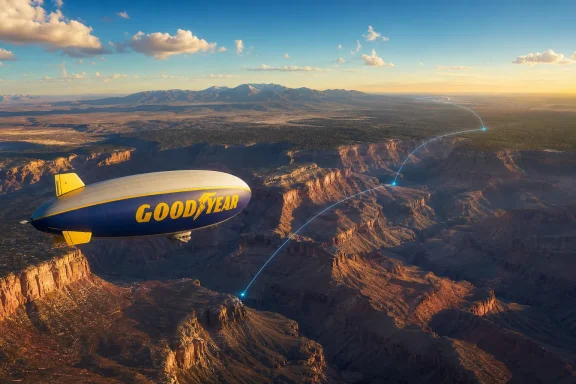
The Goodyear Blimp’s arrival as a free aircraft could be dismissed as novelty, and on one level that is exactly what it is. Players will inevitably fly it over stadiums, cities, coastlines, and anywhere else that makes the airship’s slow, floating presence feel ridiculous in the best possible way. Flight Simulator has always had room for that kind of play.But the blimp also matters because it expands the emotional vocabulary of the simulator. Most aircraft in a flight sim encourage speed, precision, altitude, or mastery. A blimp asks the opposite: slow down, loiter, look around, and accept that the journey is mostly the view.
That fits the national parks update almost too well. The Grand Canyon does not need to be crossed at jet speed. Yellowstone is not improved by racing over it at cruise altitude. A slow aircraft over a scenic landscape turns Flight Simulator from transportation simulation into observation software, and that is one of the modern franchise’s underappreciated strengths.
The partnership branding is obvious, but it works because the Goodyear Blimp already occupies a peculiar place in American visual culture. It is aircraft, billboard, sports-broadcast icon, and nostalgia object all at once. Dropping it into a July 4 national parks update may be corporate synergy, but it is synergy with a sense of humor.
Flight Simulator’s Best Updates Make the World Feel Handcrafted Again
The paradox of Microsoft Flight Simulator is that its world is both astonishingly broad and unevenly convincing. The global data pipeline can approximate the planet at scale, but players know when they are flying through auto-generated scenery and when an area has received extra care. World Updates exist to close that gap, region by region, landmark by landmark.That is why they remain central to the product’s identity. A simulator with the whole world available can still feel thin if the places people care about are generic. Conversely, a handful of carefully improved regions can make the entire platform feel more alive, because they remind players that the world is not just a background texture.
World Update 22 benefits from landscapes that are naturally legible from the air. Canyons, mountains, geyser basins, desert formations, and monumental rock faces translate well to flight. They give pilots orientation points, photographers dramatic compositions, and streamers the kind of “wait, look at that” moments that sell the game better than a feature checklist.
There is also a preservation-adjacent appeal, though Microsoft should be careful not to overclaim it. A flight sim is not a substitute for visiting a national park, learning its history, understanding its ecology, or supporting its conservation. But for players who cannot travel easily, cannot afford the trip, or live far away from the United States, a well-made virtual overflight offers a meaningful approximation of wonder.
The Marketplace Route Keeps the Sim Modular, and That Still Cuts Both Ways
To get World Update 22, players need the latest simulator build and the free package from the Marketplace. That distribution model is now familiar, but it remains one of Flight Simulator’s defining trade-offs. Microsoft can push major world content without requiring a traditional expansion purchase, yet players must navigate an ecosystem that can feel fragmented between core updates, optional world packages, aircraft downloads, third-party add-ons, rolling cache settings, and platform-specific storage constraints.For Windows users, this modularity can be a blessing. It lets simmers decide what to install, how much space to allocate, and which regions deserve local storage. It also allows Microsoft to keep adding to the sim without turning every update into a monolithic download that punishes users with slower connections or smaller drives.
For less technical players, the same model can feel oddly indirect. “The update is live” does not always mean the content appears automatically in the world at full fidelity. Often it means the sim itself needs updating, the Marketplace package needs claiming, and sometimes content needs restarting, indexing, or otherwise coaxing into place.
This is not unique to Flight Simulator, but Flight Simulator exposes it more starkly because content is the world. If a shooter fails to download a skin, the game still functions as expected. If a scenery package is missing, the player may not know whether the Grand Canyon looks wrong because of a failed install, a graphics setting, a streaming issue, or the limits of the data itself.
A Free Update Is Also a Retention Strategy
Microsoft calls World Update 22 free, and for owners of Microsoft Flight Simulator 2024 that is accurate in the straightforward consumer sense. You are not being charged separately for the national parks package or the Goodyear Blimp. But free updates inside a premium simulator also serve a business purpose: they keep the install alive.That matters because Flight Simulator is not a conventional single-player game that most people finish and uninstall. Its value grows when players return between major releases, buy aircraft, browse the Marketplace, subscribe to services, watch creators, and treat the sim as a long-term hobby environment. Free first-party updates are the trust deposit that keeps that economy from feeling purely extractive.
World Update 22 is therefore both a gift and a reminder. It tells players that ownership still carries forward content value. It also nudges them back into a Marketplace where free packages sit beside paid aircraft, airports, utilities, and scenery expansions.
There is nothing inherently sinister about that. The sim community has always had an add-on economy, long before Microsoft’s modern Marketplace brought it under a more console-friendly roof. The question is whether the free cadence remains strong enough to make the platform feel maintained for everyone, not just monetized for the most committed users. On that measure, a national parks update landing early is a useful win.
The PlayStation 5 Detail Changes the Optics
The user-provided report notes World Update 22 as available to players on Xbox, PC, and PS5, which is notable because Microsoft Flight Simulator has historically been one of Microsoft’s clearest demonstrations of Xbox-and-Windows ecosystem thinking. If Flight Simulator 2024 is now part of Microsoft’s broader multiplatform reality, then World Update 22 also becomes a small case study in how Xbox Game Studios content is being handled outside the old console-war frame.For WindowsForum readers, the PC angle remains the natural center. Flight Simulator is still one of the great “why I built this rig” workloads: CPU-sensitive, GPU-hungry, storage-aware, peripheral-rich, and capable of turning graphics settings into a weekend project. But the expansion of platform reach changes the audience around the sim.
Cross-platform availability raises expectations for synchronized content delivery. If the update is free and live, players increasingly expect it to be free and live everywhere. That is easier to say in a press blurb than to execute across PC storefronts, Xbox infrastructure, and PlayStation packaging rules.
The upside is that a larger player base strengthens the case for continued investment. Microsoft does not keep building handcrafted scenery out of sentiment alone. A sim that spans more devices, more storefronts, and more casual users has a better shot at sustaining the expensive data, licensing, engineering, and art pipeline that makes World Updates possible.
The Update Also Shows Microsoft’s Softer Power
There is a particular kind of Microsoft product that works not because it locks users in, but because it makes the company look infrastructural. Flight Simulator is one of them. It combines Azure-scale streaming, Bing-derived mapping heritage, Xbox publishing, Windows performance culture, and a decades-old PC simulation brand into something that feels less like a single game than a demonstration of institutional reach.World Update 22 leans into that. The United States national parks are not just pretty locations; they are civic imagery. Putting them into Flight Simulator on the eve of July 4, 2026, lets Microsoft participate in a national anniversary without making a heavy political statement. It celebrates landscape, not policy.
That is safer than many forms of corporate patriotism, but it is still a choice. The update frames America through public land, natural wonder, aviation, tourism, and spectacle. It is an America seen from above, smoothed by altitude and rendered for admiration.
That perspective has limits. National parks have complicated histories involving Indigenous lands, federal authority, environmental pressure, overcrowding, access, and commercialization. Flight Simulator is not the venue that will unpack all of that. But the guided-tour format gives Microsoft at least some opportunity to add context rather than merely turn protected landscapes into backdrops.
The Real Competition Is Not Another Sim, but Attention
For all the focus on flight physics and scenery fidelity, Microsoft Flight Simulator’s toughest competitor is often not X-Plane, DCS, or a third-party aircraft developer. It is inertia. Many players admire Flight Simulator more than they play it, keeping it installed as a technological monument they intend to revisit when they have the time, bandwidth, storage, hardware patience, and mental energy.World Update 22 is designed to break that inertia. A holiday weekend helps. A familiar national theme helps. A free blimp helps more than any sober product manager might want to admit.
The update gives lapsed players an easy excuse to return without asking them to study a new aircraft manual. Launch the sim, install the package, start a guided tour, and look at the canyon. That is a very different proposition from “come back because we adjusted turbine behavior” or “come back because the career economy is better balanced.”
This is where Microsoft Flight Simulator’s dual identity becomes an advantage. It can serve the simmer who wants procedural depth and the player who wants a virtual vacation. The danger is that satisfying both groups requires constant balancing: too much spectacle and the sim feels shallow; too much systems obsession and the broader audience leaves.
Windows Players Will Judge the Update by the Frame Pacing, Not the Trailer
The trailer sells vistas. PC players will judge delivery. That means frame pacing over dense scenery, terrain level-of-detail behavior, photogrammetry consistency where applicable, memory usage, shader stutter, VR performance, and how well the sim handles low-altitude sightseeing over complex terrain.National parks are not all equally demanding in the same way. Big terrain can look stunning without the object density of a city, but high-resolution elevation data, detailed rock formations, vegetation, water features, and long draw distances can still punish hardware. A scenic update is only as convincing as the performance envelope that lets players move through it smoothly.
For sysadmins and IT pros who also happen to be sim hobbyists, Flight Simulator remains a reminder that consumer software has become deeply cloud-dependent. The install is local, the GPU is local, the peripherals are local, but the experience is braided with remote data and service availability. When it works, it feels magical. When it stutters, stalls, or streams poorly, it feels like troubleshooting a distributed system disguised as leisure.
That is why Microsoft’s continued work on content must be matched by continued work on reliability. The company can add every national park in the country, but if users encounter Marketplace confusion, inconsistent downloads, or server-side rough edges, the goodwill leaks away. World Update 22 gives Microsoft a beautiful stage. The platform still has to perform on it.
The Holiday Package Hints at a More Curated Future
The most interesting part of World Update 22 may not be any single landmark. It is the increasing sense that Microsoft Flight Simulator is moving from “the whole world is there” to “the world needs editors.” The launch promise of a digital Earth was breadth; the ongoing update strategy is curation.Guided tours make that explicit. A tour is an editorial product inside a simulation product. It says this route matters, this view matters, this place has a story, and the sim can be more than a sandbox if someone designs a path through it.
That has implications beyond national parks. Microsoft could use the same structure for historical aviation routes, climate and geography lessons, architectural tours, aerospace museums, famous approaches, disaster-response education, or seasonal events. Some of that already exists in fragments across the sim and its community, but World Update 22 shows how first-party curation can make the experience less intimidating.
The trick will be avoiding theme-park flattening. Flight Simulator’s magic comes from freedom, not from being dragged along a rail. The best guided content should open the world, not reduce it to a sequence of narrated checkpoints.
The Air-Racing Tease Keeps the Roadmap Moving
The earlier showcase material also pointed toward air racing over New Mexico later in the year, tied to the National Championship Air Races. That matters because it shows Microsoft is not treating World Update 22 as a standalone patriotic postcard. The company is trying to keep a rhythm: scenery now, structured activity later.Air racing is a smart counterweight to national parks sightseeing. Where the parks update emphasizes scale, beauty, and slow exploration, racing emphasizes speed, skill, competition, and repeatability. In live-service terms, that gives Microsoft a better chance of pulling in different kinds of players across multiple beats.
It also underlines the broader challenge for Flight Simulator 2024. A beautiful world is not automatically a sticky game. Players need reasons to return, routes to fly, missions to complete, aircraft to master, and communities to compare experiences with. World Update 22 contributes to that, but the long-term health of the sim depends on how well Microsoft connects scenery, aircraft, activities, and progression into a coherent whole.
The risk is overextension. Every new mode or partnership adds surface area. The more Flight Simulator 2024 becomes a platform for sightseeing, training, missions, racing, branded aircraft, and third-party commerce, the more Microsoft must keep the foundations stable.
The Blimp Over the Canyon Is the Screenshot, but the Platform Is the Story
For many players, the defining image of this update will be absurd and wonderful: the Goodyear Blimp drifting over some vast American landmark, moving slowly enough that the sim becomes less about piloting and more about witnessing. That is good product design. It creates a memory.But the larger story is how naturally this kind of release now fits into Microsoft’s gaming strategy. A free content update arrives across platforms, tied to a showcase announcement, linked to a national holiday, distributed through an in-game Marketplace, and designed to produce shareable images. That is modern Xbox publishing in miniature.
It is also a reminder that Flight Simulator remains one of Microsoft’s most unusual assets. Halo can struggle with identity. Forza can be compared against other racing franchises. Windows itself is often treated as plumbing. Flight Simulator, when it is working, gives Microsoft something rarer: awe.
That awe is not automatic. It depends on the painstaking accumulation of terrain data, art passes, aircraft licensing, mission design, cloud infrastructure, and community trust. World Update 22 succeeds if it makes all that machinery disappear behind the simple pleasure of flying over a place most players know by name and many will never see in person.
The Weekend Flight Plan Writes Itself
World Update 22 is not the kind of update that needs a spreadsheet to justify its existence. It is a holiday-timed invitation to reopen the sim, install the free package, and let America’s most famous protected landscapes do what they have always done: make people feel small in a useful way. The concrete implications are straightforward.- Microsoft released World Update 22 on July 2, two days before the previously announced July 4 timing.
- The update is free for Microsoft Flight Simulator 2024 owners and is obtained through the in-game Marketplace after updating the simulator.
- The package focuses on more than 30 U.S. national parks and monuments, with headline locations including the Grand Canyon, Yellowstone, Bryce Canyon, Grand Teton, the Rocky Mountains, and Mount Rushmore.
- Three guided tours add a more curated sightseeing structure around Bryce Canyon, Grand Teton, and the Grand Canyon.
- The Goodyear Blimp joins the aircraft roster as a free addition and may be the update’s smartest tool for slow scenic flying.
- The release gives Microsoft a timely holiday win, but long-term player confidence will still depend on performance, download reliability, and continued platform polish.
References
- Primary source: Windows Central
Published: 2026-07-03T11:58:07.697145
Microsoft Flight Simulator 2024 gets its American holiday World Update 22 a little early; fly the stunning new landscapes right now | Windows Central
The update announced for July 4 has already dropped and takes in some of the most stunning landscapes in the United States.www.windowscentral.com - Related coverage: simulationdaily.com
Microsoft Flight Simulator 2024 Gets Free Goodyear Blimp & World Update 22: US National Parks - Simulation Daily
Microsoft and Asobo Studio released World Update 22 for Microsoft Flight Simulator 2024, focusing on the national parks and monuments of the US.simulationdaily.com - Related coverage: simflight.com
Microsoft Flight Simulator 2024 – World Update 22: US National Parks and Air Racing Announced - simFlight
Microsoft Flight Simulator 2024 World Update 22 will celebrate the landscapes of the United States with a dedicated US National Parks edition, announcedwww.simflight.com - Related coverage: flightsimulator.com
Microsoft Flight Simulator Releases World Update 22: United States National Parks - Microsoft Flight Simulator
The United States of America is home to some of the most beautiful landscapes in the world, including breathtaking mountains, serene coastlines, austere deserts…www.flightsimulator.com - Related coverage: msfsaddons.com
World Update 22 is out now with 31 US National Parks and the debut of guided tours in MSFS 2024 - MSFS Addons
The free update arrives right on schedule for America's 250th birthday, and it delivers a mission type that was planned to launch with the sim.msfsaddons.com - Related coverage: gematsu.com
Microsoft Flight Simulator 2024 - Gematsu
Microsoft Flight Simulator 2024 is a simulation video game developed by Asobo Studio and published by Xbox Game Studios. About Explore the world with our…www.gematsu.com
- Related coverage: windowsreport.com
Microsoft Flight Simulator 2024 World Update 22 Launches July 4 With 30+ US Landmarks
Microsoft Flight Simulator 2024 World Update 22 launches July 4 with 30+ US landmarks, National Parks, the Goodyear blimp, and more. windowsreport.com
- Related coverage: winbuzzer.com
Microsoft Flight Simulator 2024 Adds U.S. National Parks Update on July 4
Microsoft Flight Simulator 2024 gets a July 4 World Update 22 with U.S. national parks, the Goodyear Blimp, and fall air-racing content still pending.winbuzzer.com - Related coverage: gamereactor.cz
Nová aktualizace pro Flight Simulator 2024 zlepšuje americké národní parky
A také máme národní šampionát leteckých závodů.www.gamereactor.cz
- Related coverage: fselite.net
Microsoft Flight Simulator Announces World Update 22: US National Parks, Plus New Air Racing - FSElite
Shown as part of the XBOX Games Showcase earlier today.fselite.net - Related coverage: xboxdynasty.de
Microsoft Flight Simulator 2024: World Update 22 bringt US-Nationalparks und Air Racing
Microsoft Flight Simulator 2024 zeigt neue US-Nationalparks und Air Racing.www.xboxdynasty.de
