

A1 Technologies has earned Microsoft’s Infrastructure and Database Migration to Azure specialisation in Australia after an independent audit of completed customer migration projects across financial services, construction, and scientific research. The badge is not a revolution in cloud computing, but it is a useful signal in a market where every managed service provider claims to be “Azure-first.” For mid-market and enterprise customers, the meaningful part is not the logo; it is the evidence trail behind it. Microsoft’s partner economy is full of designations, but this one asks a more practical question: has the provider actually delivered complex migrations, or merely staffed up for them?
The Microsoft partner ecosystem has long depended on a mixture of certification, sales performance, customer success metrics, and marketplace visibility. That system is useful, but it can also blur the difference between a company that is commercially aligned with Microsoft and one that has repeatedly moved real workloads under pressure. A1 Technologies’ new specialisation matters because Microsoft’s Azure migration credential sits closer to the second category.
Microsoft’s Infrastructure and Database Migration to Azure specialisation is intended for partners that can demonstrate experience moving production infrastructure and database workloads to Azure. The requirements include an aligned Solutions Partner designation, recent Azure consumption tied to relevant workloads, specific technical certifications, and a third-party audit. In other words, it is not awarded solely because a partner has passed exams or sold enough licenses.
That distinction is important for Australian customers. Many organisations have already completed the easy part of cloud adoption: Microsoft 365, identity, some SaaS consolidation, and perhaps a few opportunistic Azure workloads. The harder phase is the migration of core systems, SQL databases, legacy virtual machines, governance models, cost controls, and security baselines. That is where partner marketing tends to collide with architectural reality.
A1 already held five Microsoft Solutions Partner designations, covering Modern Work, Security, Azure Infrastructure, Digital and App Innovation on Azure, and Data and AI on Azure. Adding the Azure migration specialisation narrows the claim. It says the company is not merely a broad Microsoft shop, but one that has been externally assessed on infrastructure and database migration delivery.
The audit examined a large Azure migration for an 800-seat financial services organisation, an Azure Landing Zone and Well-Architected Framework deployment for a 300-seat construction business, and an Azure build for a scientific research organisation using landing zones alongside Azure AI Foundry for modelling work. Those examples matter because they span different risk profiles. Financial services brings compliance and resilience pressure, construction often brings distributed operations and cost discipline, and research workloads tend to push compute, data, and experimentation patterns in less predictable ways.
A provider can pass certification exams in isolation. It cannot easily fake migration scars across multiple customer environments. The audit focus on virtual server migration, SQL database migration, database modernisation, governance, automation, and cloud architecture suggests Microsoft is trying to separate partners that can talk about cloud adoption from those that can operationalise it.
That does not make the badge a guarantee of success. No certification can remove the need for due diligence, reference checks, scope control, and hard conversations about cost and security. But it does raise the baseline. For customers choosing between providers, an externally reviewed delivery record is a stronger signal than a slide deck full of Azure icons.
Modern Azure migration work increasingly begins with landing zones, identity boundaries, management groups, policy, tagging, logging, network segmentation, and cost governance. If those foundations are wrong, the migrated workload may run, but the environment becomes difficult to govern. The bill grows, security exceptions multiply, and administrators end up recreating on-premises complexity in a more expensive venue.
That is why A1’s emphasis on Azure Landing Zones and the Microsoft Well-Architected Framework is more than partner boilerplate. Landing zones provide a structured foundation for subscriptions, networking, identity, management, and governance. The Well-Architected Framework gives teams a way to evaluate workloads against reliability, security, cost optimisation, operational excellence, and performance efficiency. Together, they represent Microsoft’s preferred answer to a familiar enterprise problem: how to move fast without creating a cloud estate nobody can safely manage.
The practical lesson for WindowsForum readers is that migration quality is now measured less by whether the workload boots in Azure and more by whether the customer can operate it confidently six months later. A clean migration should leave behind repeatable deployment patterns, useful monitoring, documented governance, and a cost model that finance can understand. Anything less is just relocation.
The dirty secret of managed services is that many providers still rely too heavily on hero engineers. The best people know where the scripts live, which customer has the strange routing exception, and why a particular SQL migration needs a workaround. That can work for a while, but it does not scale cleanly, and it creates operational risk for both the provider and the customer.
Standardisation is how an MSP turns knowledge into a delivery system. GitHub-based deployment patterns, repeatable landing zone templates, automated alerting, and consistent assessment outputs can reduce variance across projects. They can also make handover less painful when a migration becomes a managed environment.
There is a commercial angle too. The more repeatable the work becomes, the more confidently a provider can take on larger projects without multiplying labour at the same rate. That matters for A1’s stated target market of mid-market and enterprise customers in Australia and New Zealand, where project complexity can be high but internal cloud engineering capacity may be uneven.
That is not simply a productivity story. It points to the next competitive frontier for cloud partners: turning assessment and optimisation into software-assisted services. If migration was the first act of cloud professional services, continuous governance and cost optimisation are the annuity.
Well-Architected reviews are valuable, but they are often constrained by time, customer documentation quality, and the patience of engineers who would rather be building than filling out assessment templates. A tool that can inspect environments, correlate findings, and accelerate report generation could make reviews more frequent and less painful. The danger, as always with AI-assisted operations, is that speed can produce false confidence if findings are not grounded in accurate telemetry and reviewed by experienced engineers.
The use of a custom Model Context Protocol setup is also notable. MCP has become shorthand for connecting AI systems to external tools and context sources in a more structured way. In a cloud operations setting, that could mean giving an AI-assisted review process controlled access to configuration data, policy states, cost information, architecture artefacts, or documentation. The promise is faster analysis; the risk is that sensitive operational context becomes another surface to secure.
A1 says it is developing the tool into a standalone service. That is sensible, but it will need careful positioning. Customers should ask what data the tool accesses, how recommendations are validated, whether findings are reproducible, how it handles tenant boundaries, and what human review sits between machine-generated analysis and production decisions.
That gap is where Microsoft-focused MSPs make their pitch. The best of them provide architectural discipline, operational coverage, and access to specialised skills a customer cannot justify hiring full time. The weaker ones become license resellers with a migration practice bolted on.
A1’s new specialisation is therefore a market signal. It tells prospective customers that the company has invested in Azure migration capability deeply enough to pass Microsoft’s specialised review process. It also tells competitors that broad Microsoft alignment is no longer enough; the argument is shifting toward validated delivery in specific technical domains.
For customers, the badge should open the conversation, not close it. A migration partner still needs to explain its methodology, staffing model, escalation paths, documentation standards, security approach, cost management practices, and post-migration operating model. The specialisation is evidence, but it is not a substitute for procurement discipline.
A Windows Server estate moved to Azure is rarely just a compute story. It can pull in backup, monitoring, Defender for Cloud, Azure Policy, Microsoft Sentinel, SQL modernisation, identity redesign, network architecture, and managed services. A database migration can become a broader data platform conversation. A landing zone can become the basis for application modernisation and AI experimentation.
Microsoft needs partners that can do this work because the constraint is not merely platform capability. It is customer confidence, migration planning, risk management, and hands-on execution. Specialisations give Microsoft a way to steer customers toward partners that have cleared a higher bar, while giving those partners marketplace visibility and differentiation.
That does not make the system altruistic. Partner badges are also a go-to-market instrument. They reward companies that drive Azure consumption, maintain certified staff, and align with Microsoft’s preferred architectures. Customers should understand that dual purpose. A partner specialisation is both a capability marker and a sales-channel asset.
That is why the Infrastructure and Database Migration to Azure specialisation is more practical than fashionable. It is concerned with the workloads many organisations actually have. It recognises that moving production systems requires database expertise, identity planning, network design, governance, and operational readiness, not just enthusiasm for cloud-native architecture.
Azure’s appeal to Windows-heavy organisations remains obvious. Licensing benefits, hybrid management, familiar identity patterns, and Microsoft’s own migration tooling all make Azure the default candidate for many Windows Server and SQL Server estates. But default does not mean automatic. Poorly planned migrations can increase cost, degrade performance, and create security gaps.
The most useful partners are the ones willing to say when a workload should be modernised, when it should be rehosted, when it should be retired, and when it should stay where it is for now. A badge cannot prove that level of judgment by itself, but a serious audit process at least tests whether the partner has handled enough real environments to develop it.
Cloud cost waste is rarely caused by one spectacular error. It accumulates through oversized virtual machines, idle resources, misaligned reserved capacity, unmanaged storage growth, duplicate monitoring, forgotten test environments, and architectures copied from on-premises assumptions. The customer gets the promised agility, then discovers the bill has become its own operational workload.
That is why cost optimisation now sits beside security and reliability as a core managed services discipline. The Well-Architected Framework treats cost as an architectural pillar, not an accounting afterthought. A migration partner that cannot explain how it will manage cost after cutover is leaving the customer exposed.
The rise of AI-assisted assessment tools may accelerate this shift. If partners can review environments more quickly, they can make optimisation a recurring service rather than a once-a-year exercise. But customers should still demand transparency. A recommendation to resize, reserve, shut down, or replatform a workload must be backed by evidence, not a generic “best practice” finding.
The industry tends to celebrate transformation, but customers live with operations. They need identity to work, backups to restore, monitoring to fire, costs to stay within reason, and auditors to accept the controls. They need migrations that do not become months of post-cutover remediation.
External validation cannot guarantee those outcomes, but it can reduce information asymmetry. Customers rarely have perfect visibility into an MSP’s internal delivery quality before signing. A third-party audit of completed projects gives them one more piece of evidence. In a market where sales language often outruns engineering proof, that evidence has value.
The stronger interpretation of A1’s announcement is not that it has won a trophy. It is that the company has chosen a lane: deep Microsoft cloud delivery for customers with enough complexity to need repeatable architecture, governance, and automation. That is a more defensible position than trying to be everything to everyone.
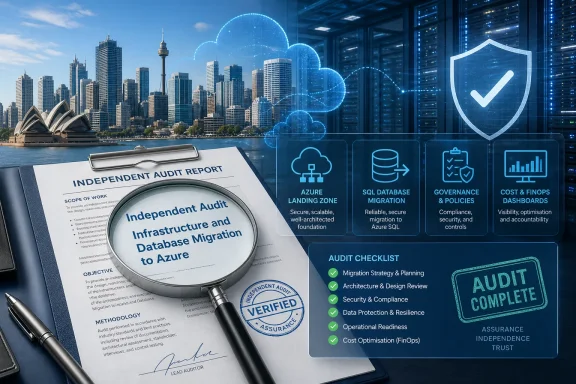 Microsoft’s Badge Economy Gets a Harder Edge
The Microsoft partner ecosystem has long depended on a mixture of certification, sales performance, customer success metrics, and marketplace visibility. That system is useful, but it can also blur the difference between a company that is commercially aligned with Microsoft and one that has repeatedly moved real workloads under pressure. A1 Technologies’ new specialisation matters because Microsoft’s Azure migration credential sits closer to the second category.Microsoft’s Infrastructure and Database Migration to Azure specialisation is intended for partners that can demonstrate experience moving production infrastructure and database workloads to Azure. The requirements include an aligned Solutions Partner designation, recent Azure consumption tied to relevant workloads, specific technical certifications, and a third-party audit. In other words, it is not awarded solely because a partner has passed exams or sold enough licenses.
That distinction is important for Australian customers. Many organisations have already completed the easy part of cloud adoption: Microsoft 365, identity, some SaaS consolidation, and perhaps a few opportunistic Azure workloads. The harder phase is the migration of core systems, SQL databases, legacy virtual machines, governance models, cost controls, and security baselines. That is where partner marketing tends to collide with architectural reality.
A1 already held five Microsoft Solutions Partner designations, covering Modern Work, Security, Azure Infrastructure, Digital and App Innovation on Azure, and Data and AI on Azure. Adding the Azure migration specialisation narrows the claim. It says the company is not merely a broad Microsoft shop, but one that has been externally assessed on infrastructure and database migration delivery.
The Audit Is the Story, Not the Plaque
The most interesting detail in A1’s announcement is not that it earned another Microsoft credential. It is that the audit reportedly required evidence from completed client projects and ended with no follow-up actions required. In a services market crowded with partner tiers, that is the part customers should actually notice.The audit examined a large Azure migration for an 800-seat financial services organisation, an Azure Landing Zone and Well-Architected Framework deployment for a 300-seat construction business, and an Azure build for a scientific research organisation using landing zones alongside Azure AI Foundry for modelling work. Those examples matter because they span different risk profiles. Financial services brings compliance and resilience pressure, construction often brings distributed operations and cost discipline, and research workloads tend to push compute, data, and experimentation patterns in less predictable ways.
A provider can pass certification exams in isolation. It cannot easily fake migration scars across multiple customer environments. The audit focus on virtual server migration, SQL database migration, database modernisation, governance, automation, and cloud architecture suggests Microsoft is trying to separate partners that can talk about cloud adoption from those that can operationalise it.
That does not make the badge a guarantee of success. No certification can remove the need for due diligence, reference checks, scope control, and hard conversations about cost and security. But it does raise the baseline. For customers choosing between providers, an externally reviewed delivery record is a stronger signal than a slide deck full of Azure icons.
Azure Migration Has Moved Past the Lift-and-Shift Era
The phrase cloud migration still carries the baggage of the 2010s, when too many projects meant picking up virtual machines and dropping them into a hyperscaler with minimal redesign. That approach can still be valid in narrow cases, especially when deadlines are driven by datacentre exits or hardware refresh cycles. But it is no longer the strategic prize.Modern Azure migration work increasingly begins with landing zones, identity boundaries, management groups, policy, tagging, logging, network segmentation, and cost governance. If those foundations are wrong, the migrated workload may run, but the environment becomes difficult to govern. The bill grows, security exceptions multiply, and administrators end up recreating on-premises complexity in a more expensive venue.
That is why A1’s emphasis on Azure Landing Zones and the Microsoft Well-Architected Framework is more than partner boilerplate. Landing zones provide a structured foundation for subscriptions, networking, identity, management, and governance. The Well-Architected Framework gives teams a way to evaluate workloads against reliability, security, cost optimisation, operational excellence, and performance efficiency. Together, they represent Microsoft’s preferred answer to a familiar enterprise problem: how to move fast without creating a cloud estate nobody can safely manage.
The practical lesson for WindowsForum readers is that migration quality is now measured less by whether the workload boots in Azure and more by whether the customer can operate it confidently six months later. A clean migration should leave behind repeatable deployment patterns, useful monitoring, documented governance, and a cost model that finance can understand. Anything less is just relocation.
A1’s Real Bet Is Standardisation
Technical Director Clint Shiels framed the specialisation as part of A1’s ongoing push into Microsoft 365 and Azure, with a focus on automation and standardisation through GitHub deployments, onboarding patterns, Azure Landing Zones, alerting, and Well-Architected reporting. That is the language of a services business trying to reduce artisanal delivery. It is also the language customers should want to hear.The dirty secret of managed services is that many providers still rely too heavily on hero engineers. The best people know where the scripts live, which customer has the strange routing exception, and why a particular SQL migration needs a workaround. That can work for a while, but it does not scale cleanly, and it creates operational risk for both the provider and the customer.
Standardisation is how an MSP turns knowledge into a delivery system. GitHub-based deployment patterns, repeatable landing zone templates, automated alerting, and consistent assessment outputs can reduce variance across projects. They can also make handover less painful when a migration becomes a managed environment.
There is a commercial angle too. The more repeatable the work becomes, the more confidently a provider can take on larger projects without multiplying labour at the same rate. That matters for A1’s stated target market of mid-market and enterprise customers in Australia and New Zealand, where project complexity can be high but internal cloud engineering capacity may be uneven.
The AI Foundry Tool Points to the Next Services Battleground
A1’s internal tool may be the most revealing part of the announcement. The company says it has built a system using Azure AI Foundry and a custom Model Context Protocol setup to run Well-Architected reviews against customer environments, producing reports in about a quarter of the time required for a manual review. In one eight-subscription environment, the tool reportedly identified annual cost savings worth tens of thousands of dollars.That is not simply a productivity story. It points to the next competitive frontier for cloud partners: turning assessment and optimisation into software-assisted services. If migration was the first act of cloud professional services, continuous governance and cost optimisation are the annuity.
Well-Architected reviews are valuable, but they are often constrained by time, customer documentation quality, and the patience of engineers who would rather be building than filling out assessment templates. A tool that can inspect environments, correlate findings, and accelerate report generation could make reviews more frequent and less painful. The danger, as always with AI-assisted operations, is that speed can produce false confidence if findings are not grounded in accurate telemetry and reviewed by experienced engineers.
The use of a custom Model Context Protocol setup is also notable. MCP has become shorthand for connecting AI systems to external tools and context sources in a more structured way. In a cloud operations setting, that could mean giving an AI-assisted review process controlled access to configuration data, policy states, cost information, architecture artefacts, or documentation. The promise is faster analysis; the risk is that sensitive operational context becomes another surface to secure.
A1 says it is developing the tool into a standalone service. That is sensible, but it will need careful positioning. Customers should ask what data the tool accesses, how recommendations are validated, whether findings are reproducible, how it handles tenant boundaries, and what human review sits between machine-generated analysis and production decisions.
The Mid-Market Has Enterprise Problems Without Enterprise Headcount
The Australian and New Zealand market gives this story a particular shape. Many mid-sized organisations now run environments that look enterprise-grade in complexity but not in staffing. They may have Microsoft 365 E5 controls, hybrid identity, Azure subscriptions, Power Platform sprawl, line-of-business SQL workloads, remote sites, compliance obligations, and board-level AI pressure. What they often do not have is a deep bench of cloud architects, database specialists, security engineers, and FinOps practitioners.That gap is where Microsoft-focused MSPs make their pitch. The best of them provide architectural discipline, operational coverage, and access to specialised skills a customer cannot justify hiring full time. The weaker ones become license resellers with a migration practice bolted on.
A1’s new specialisation is therefore a market signal. It tells prospective customers that the company has invested in Azure migration capability deeply enough to pass Microsoft’s specialised review process. It also tells competitors that broad Microsoft alignment is no longer enough; the argument is shifting toward validated delivery in specific technical domains.
For customers, the badge should open the conversation, not close it. A migration partner still needs to explain its methodology, staffing model, escalation paths, documentation standards, security approach, cost management practices, and post-migration operating model. The specialisation is evidence, but it is not a substitute for procurement discipline.
Microsoft Wants Partners to Carry the Hard Parts of Azure Growth
There is a strategic reason Microsoft keeps refining its partner designations and specialisations. Azure growth depends not only on selling cloud capacity, but on getting customers to move difficult workloads and keep expanding once they arrive. Infrastructure and database migration are central to that strategy because they often anchor long-term cloud consumption.A Windows Server estate moved to Azure is rarely just a compute story. It can pull in backup, monitoring, Defender for Cloud, Azure Policy, Microsoft Sentinel, SQL modernisation, identity redesign, network architecture, and managed services. A database migration can become a broader data platform conversation. A landing zone can become the basis for application modernisation and AI experimentation.
Microsoft needs partners that can do this work because the constraint is not merely platform capability. It is customer confidence, migration planning, risk management, and hands-on execution. Specialisations give Microsoft a way to steer customers toward partners that have cleared a higher bar, while giving those partners marketplace visibility and differentiation.
That does not make the system altruistic. Partner badges are also a go-to-market instrument. They reward companies that drive Azure consumption, maintain certified staff, and align with Microsoft’s preferred architectures. Customers should understand that dual purpose. A partner specialisation is both a capability marker and a sales-channel asset.
The Windows Estate Is Still the Migration Gravity Well
For WindowsForum readers, the Windows Server and SQL Server angle remains central. The cloud conversation has moved toward containers, serverless platforms, AI services, and data fabrics, but a large portion of real enterprise migration work still begins with conventional infrastructure. Domain-joined servers, SQL databases, file services, scheduled jobs, legacy applications, and third-party dependencies do not disappear because a CIO has adopted an AI strategy.That is why the Infrastructure and Database Migration to Azure specialisation is more practical than fashionable. It is concerned with the workloads many organisations actually have. It recognises that moving production systems requires database expertise, identity planning, network design, governance, and operational readiness, not just enthusiasm for cloud-native architecture.
Azure’s appeal to Windows-heavy organisations remains obvious. Licensing benefits, hybrid management, familiar identity patterns, and Microsoft’s own migration tooling all make Azure the default candidate for many Windows Server and SQL Server estates. But default does not mean automatic. Poorly planned migrations can increase cost, degrade performance, and create security gaps.
The most useful partners are the ones willing to say when a workload should be modernised, when it should be rehosted, when it should be retired, and when it should stay where it is for now. A badge cannot prove that level of judgment by itself, but a serious audit process at least tests whether the partner has handled enough real environments to develop it.
Cost Optimisation Is Becoming the Migration Aftermarket
A1’s claim that its internal review tool found annual savings worth tens of thousands of dollars in one eight-subscription environment highlights a familiar post-migration pattern. Once workloads are in Azure, the next problem is not simply uptime. It is waste.Cloud cost waste is rarely caused by one spectacular error. It accumulates through oversized virtual machines, idle resources, misaligned reserved capacity, unmanaged storage growth, duplicate monitoring, forgotten test environments, and architectures copied from on-premises assumptions. The customer gets the promised agility, then discovers the bill has become its own operational workload.
That is why cost optimisation now sits beside security and reliability as a core managed services discipline. The Well-Architected Framework treats cost as an architectural pillar, not an accounting afterthought. A migration partner that cannot explain how it will manage cost after cutover is leaving the customer exposed.
The rise of AI-assisted assessment tools may accelerate this shift. If partners can review environments more quickly, they can make optimisation a recurring service rather than a once-a-year exercise. But customers should still demand transparency. A recommendation to resize, reserve, shut down, or replatform a workload must be backed by evidence, not a generic “best practice” finding.
Independent Validation Matters Most When the Stakes Are Boring
Rob Rattray’s comment that independent sign-off matters when customers move critical systems to Azure gets to the heart of the issue. The most important enterprise IT work is often boring from the outside. Nobody gets a keynote slot for a clean SQL migration, a well-governed landing zone, or an alerting setup that catches a problem before users notice. Yet those are exactly the things that determine whether cloud adoption succeeds.The industry tends to celebrate transformation, but customers live with operations. They need identity to work, backups to restore, monitoring to fire, costs to stay within reason, and auditors to accept the controls. They need migrations that do not become months of post-cutover remediation.
External validation cannot guarantee those outcomes, but it can reduce information asymmetry. Customers rarely have perfect visibility into an MSP’s internal delivery quality before signing. A third-party audit of completed projects gives them one more piece of evidence. In a market where sales language often outruns engineering proof, that evidence has value.
The stronger interpretation of A1’s announcement is not that it has won a trophy. It is that the company has chosen a lane: deep Microsoft cloud delivery for customers with enough complexity to need repeatable architecture, governance, and automation. That is a more defensible position than trying to be everything to everyone.
The Badge Is Useful Only If Buyers Ask Harder Questions
The practical value of A1’s specialisation will depend on how customers use it. Treated as a procurement shortcut, it is just another logo. Treated as the start of a deeper technical conversation, it can help buyers separate serious Azure migration providers from firms that are still relying on partner-program vocabulary.- A1 Technologies has added Microsoft’s Infrastructure and Database Migration to Azure specialisation to an existing set of five Solutions Partner designations.
- The specialisation required an independent audit of completed migration and architecture work, not just evidence of certifications or sales performance.
- The reviewed projects included financial services, construction, and scientific research environments with Azure Landing Zones, SQL/database migration, governance, and architecture components.
- A1’s internal Azure AI Foundry-based review tooling suggests cloud partners are moving toward software-assisted governance, cost optimisation, and Well-Architected assessments.
- Customers should treat the badge as a credible signal, but still require detailed evidence of methodology, security controls, cost management, documentation, and post-migration support.
References
- Primary source: IT Brief Australia
Published: 2026-06-21T23:00:09.727405
A1 Technologies gains Microsoft Azure migration badge
Independent validation of its Azure migration work gives A1 Technologies added credibility with clients moving critical systems to the cloud. itbrief.com.au
- Official source: partner.microsoft.com
Infra and Database Migration to Microsoft Azure specialization
For partners who demonstrate deep knowledge, extensive experience, and proven success in migrating to Windows Server and SQL Server-based production workloads.partner.microsoft.com
- Official source: learn.microsoft.com
Apply for specializations - Partner Center | Microsoft Learn
Strengthen your business profile in the Microsoft partner directory. Learn how to use Partner Center to apply for and earn advanced specializations.learn.microsoft.com - Official source: microsoft.com
Your request has been blocked. This could be due to several reasons.
www.microsoft.com
- Official source: techcommunity.microsoft.com
Performance and certification updates coming to Microsoft Infra and Database Migration specialization
Learn more about updates coming to the Infra and Database Migration to Microsoft Azure specialization as well as a new requirement for the Azure Security... techcommunity.microsoft.com
- Related coverage: teksystems.com
TEKsystems Global Services Earns Infrastructure and Database Migration to Microsoft Azure Specialization
Microsoft recognizes TEKsystems Global Services for customer success and proven technical capabilities.www.teksystems.com
- Official source: azure.microsoft.com
Azure Partners – Find an Azure Expert Partner | Microsoft Azure
Get technical advice and support from expert Microsoft Azure partners to deliver solutions that help your business grow. Find a partner that meets your needs.azure.microsoft.com
- Official source: info.microsoft.com
- Official source: download.microsoft.com
Migrating your Windows Azure Applications between Data Centers
Considerations, approaches and risk managementdownload.microsoft.com
- Official source: microsoft.github.io
