

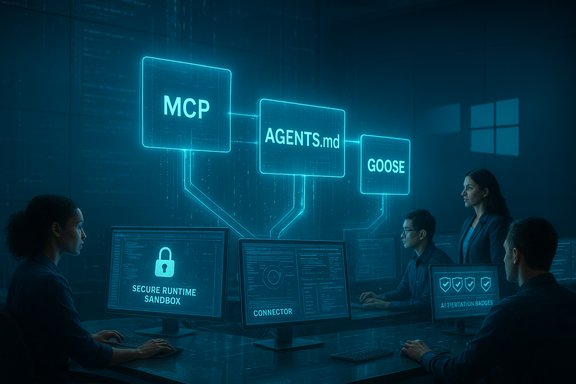
NinjaTech AI’s announcement that it has joined the Linux Foundation’s newly formed Agentic AI Foundation (AAIF) as a Silver member is a practical footnote in a much larger industry pivot: three working, production-oriented artifacts—Anthropic’s Model Context Protocol (MCP), Block’s goose runtime, and OpenAI’s AGENTS.md—have been placed under neutral stewardship to accelerate interoperability and governance for the rapidly emerging era of autonomous, agentic AI. This move matters because these projects are not theoretical specs; they are live plumbing already embedded in developer workflows and mainstream products, and their transition into a Linux Foundation-hosted foundation materially changes how enterprises, OS vendors, and independent developers should approach agent safety, deployment, and lifecycle management.
Background / Overview
The Agentic AI Foundation (AAIF) is a directed fund under the Linux Foundation created to provide neutral governance and long-term stewardship for the components that let AI agents discover tools, invoke services, and coordinate multi-step workflows. The foundation’s initial portfolio—MCP, goose, and AGENTS.md—were contributed by Anthropic, Block, and OpenAI respectively, and the AAIF launch is supported by a broad coalition of platinum-level backers that includes Amazon Web Services, Anthropic, Block, Bloomberg, Cloudflare, Google, Microsoft, and OpenAI. This coalition gives the AAIF immediate technical weight while also raising legitimate governance questions about influence, transparency, and vendor capture. Why does this matter now? Agentic systems shift the engineering model from single-turn conversations to multi-step, stateful processes that discover, call, and coordinate services (including on-device components). That shift introduces new attack surfaces—tool invocation, connector registries, attestation, and audit trails—all of which need shared, auditable conventions to scale safely. The AAIF’s stated purpose is to provide that neutral forum and to seed the ecosystem with a combination of open protocol (MCP), a runnable reference runtime (goose), and a repository-level convention (AGENTS.md) that make agents predictable across platforms.What the founding projects are — a clear-eyed summary
Model Context Protocol (MCP)
- What it is: MCP is an open protocol (HTTP/JSON-based) that standardizes how AI agents discover and invoke external tools and data sources via networked connectors (commonly called “MCP servers” or “connectors”). The protocol defines descriptor schemas, discovery semantics, transports (HTTP, SSE, stdio), roles (clients, hosts, servers), and extension points for asynchronous execution and stateless connectors.
- Adoption claims: Anthropic and AAIF launch materials report more than 10,000 active public MCP servers and a broad set of platform integrations (ChatGPT/Apps, Microsoft Copilot, Gemini, VS Code, Cursor, etc.. Those figures come from vendor announcements and major industry coverage, but they should be treated as vendor‑reported metrics until independently audited.
AGENTS.md
- What it is: AGENTS.md is a deliberately simple, repository‑level Markdown convention that provides machine-readable project guidance for coding agents (build/test steps, files to avoid, environment setup, and constraints). The format is intentionally lightweight so that agents can read human-authored intent inside repositories rather than rely on ad hoc prompts.
- Adoption claims: OpenAI reports adoption by more than 60,000 open-source projects and agent frameworks since its August 2025 release; again, a strong momentum signal but vendor-reported.
goose
- What it is: goose is Block’s open-source, local‑first agent runtime and reference framework that demonstrates secure workflows, local execution semantics, and tight MCP integration. It offers a runnable testbed for real-world UX and security trade-offs. The project is intended as a concrete reference implementation, not a prescriptive runtime everyone must use.
NinjaTech AI’s membership: what it means
NinjaTech AI—described in its public materials as a Silicon Valley agentic‑AI company with a Linux-based virtual machine approach for per-user agent isolation—joined the AAIF as a Silver member. The company frames its AAIF participation as a commitment to open standards, best-practice sharing, and interoperability work rather than a code donation. The announcement cites the company’s experience building autonomous agents and positions its Linux‑VM architecture as directly relevant to AAIF priorities like runtime isolation and connector vetting. The company’s CEO, Babak Pahlavan, is quoted emphasizing fragmentation and developer pain points as primary motivations for joining.This is typical for a smaller vendor’s membership: being inside AAIF gives the company a seat at the table where specifications, conformance programs, and registries are defined. For NinjaTech AI, the benefits are practical: influence over interoperability rules, an early view into conformance tests (which matter if you want to sell or certify connectors), and the ability to shape best practices around agent isolation and attestation.
Caveat: much of NinjaTech’s technical pitch (Linux‑VMs, “Super Agent” product names, or MyNinja branding) comes from vendor materials. These statements are directional and require hands‑on validation in independent tests and security reviews before being treated as operational guarantees.
Technical verification — what can be confirmed now
Several of the launch’s most consequential technical claims can be verified from multiple independent sources; others remain vendor‑reported and should be treated as indicators rather than audited facts.- AAIF formation and Linux Foundation hosting: Confirmed by the Linux Foundation announcement and AAIF press materials. This is a formal structural change: the projects have been placed in a Linux Foundation-hosted directed fund intended for neutral stewardship.
- MCP specification changes (async, stateless modes, server identity, SDKs): These technical features are documented in Anthropic’s MCP donation post and in the MCP project documentation and registry blog. The public MCP Registry and specification are live in preview. These technical details are verifiable in project docs and the MCP blog.
- MCP adoption footprint (10,000+ published MCP servers): This figure appears in Anthropic’s public announcement and is echoed in AAIF launch materials and the Linux Foundation press release. Independent telemetry validating the precise count is not yet public, so the number should be used as a momentum signal not as an audited market statistic.
- AGENTS.md adoption (60,000+ projects): This claim is published by OpenAI in its AAIF announcement and repeated in the Linux Foundation’s materials and multiple trade outlets; it likewise remains a vendor-sourced metric pending neutral verification.
- Platform integration signals (Microsoft, Google, VS Code, Cursor, Copilot): Multiple vendor blogs and product pages confirm MCP/AGENTS.md support across major platforms; Microsoft has publicly documented MCP support and OS-level registry work for Windows. These platform integrations are independently observable in vendor docs and developer materials.
Why this matters for Windows users and enterprise IT
Microsoft has actively embraced MCP and is building OS-level primitives to manage MCP connectors. Windows’ MCP work includes a secure On-device Agent Registry (ODR), a command-line tool (odr.exe) for managing MCP servers, and guidance for building MCP hosts and connectors. Microsoft’s documentation and Windows blogs explicitly map MCP concepts into Windows management and security models—proxy-mediated routing, signed connectors, runtime isolation, and tool-level authorization are core design elements. For enterprises that manage Windows fleets, this elevates MCP connectors to networked assets that must be governed through standard IT controls. Practical implications:- OS-level registry and vetting change distribution models: connectors should be treated like managed services rather than ad‑hoc SDKs.
- Proxy-mediation and attestation enable centralized auditing and policy enforcement, but they also centralize control—raising questions about how registries are governed and who signs connectors.
- Runtime isolation and least-privilege are essential because an MCP connector with excessive privileges vastly increases blast radius on a managed endpoint.
Governance and security analysis — strengths, risks, and unknowns
Strengths
- Practicality over theory: AAIF’s initial contributions are working code and conventions already used in the wild, not whitepapers. That makes the foundation’s work immediately actionable.
- Platform buy-in: Major cloud and OS vendors are participating, which helps the protocols and conventions reach production-grade integration and developer tooling.
- Open registry and conformance potential: An MCP Registry plus conformance suites can create a neutral marketplace for connectors, auditing, and observability tooling. The MCP Registry preview and open spec are useful early signals.
Key risks
- Vendor‑reported metrics and opaque telemetry: Adoption numbers (10,000 MCP servers, 60,000 AGENTS.md repos) are powerful marketing indicators—but they currently rely on vendor reporting. Without independent measurement methods and transparent registry telemetry, procurement decisions based on these figures are premature. Flag: these figures are vendor-reported and need neutral auditing.
- Governance capture and imbalance: Launch membership includes hyperscalers and incumbents. If AAIF governance structures (charter, voting, conflict‑of‑interest policies, maintainer selection) are not explicit and enforceable, the foundation risks being perceived as vendor-controlled. Watch for the AAIF’s contributor and maintainer charters and member voting rules.
- Security concentration: Standardization reduces integration costs but concentrates risk. A single exploited MCP connector or compromised registry could have outsized impact at scale. Robust attestation, code signing, immutable connector definitions, and independent audits are required to lower this systemic risk.
- Commercial consolidation: Even with open specs, managed services (hosted MCP registries, certified connector marketplaces, conformance-as-a-service) may centralize value and create de‑facto gatekeepers unless AAIF explicitly designs for neutrality and interoperable governance.
Practical, platform-focused guidance for Windows developers and administrators
Adopting agentic technologies requires rapid operational discipline. The following checklist converts AAIF’s promise into actionable steps for teams that manage Windows endpoints, developer tooling, and enterprise services.- Immediate posture (30–90 days)
- Treat MCP connectors as networked services: require code signing, short-lived OAuth tokens (or equivalent), and vetting before adding any public connector to an enterprise registry.
- Adopt AGENTS.md into CI/CD for any repo an agent may modify; require a passing AGENTS.md validation step before agent‑driven changes are permitted.
- Pilot MCP-enabled agent features in isolated environments with strict telemetry, immutable logs, and human-in-the-loop authorization for sensitive tool calls.
- Medium-term architecture (3–9 months)
- Deploy an internal MCP gateway/proxy that enforces auditing, credential management, connector attestation, and RBAC between agents and protected systems.
- Require third‑party MCP connectors to pass a conformance suite or independent security assessment before production onboarding. If AAIF provides a conformance program, participate early to shape test criteria.
- Use runtime isolation (VMs, containers, Linux sandboxing) and least privilege for agent runtimes; consider per-agent, per-user VMs for high-sensitivity tasks as a mitigation pattern—these are consistent with what vendors like NinjaTech AI propose, but validate vendor claims with forensic tests.
- Long-term governance and procurement (9–18 months)
- Insist on transparent registry telemetry and published measurement methodologies for adoption claims before making high-stakes procurement decisions. Vendor-provided metrics should be validated against neutral registries and independent audits.
- Participate in AAIF working groups or submit whitepapers on security baselines, signing infrastructure, and audit requirements so the foundation’s standards reflect enterprise needs rather than only vendor preferences.
Business and competitive implications
Open standards lower integration friction and create an adjacent market for value-added services: registries, conformance testing, signing authorities, observability and incident response for agentic workflows. That is both an opportunity and a threat: while interoperability can democratize innovation, hyperscalers and platform hosts may capture value by offering managed MCP stacks, certified connector marketplaces, and premium security bundles. Enterprises should therefore distinguish between aligning with open standards and depending on a single managed provider for critical glue logic.For smaller vendors like NinjaTech AI, AAIF membership is a rational strategy: it grants access to governance, shapes conformance tests that will become techno‑commercial gatekeepers, and signals trustworthiness to potential customers. But getting from “membership” to “meaningful influence” requires sustained participation, expertise contribution, and public work on conformance, security, and measurement—things that cost time and engineering resources.
What to watch next — milestones that will determine whether AAIF delivers
- AAIF governance charters, contributor and maintainer rules, and voting rights—these documents determine whether the foundation is truly neutral.
- Public conformance suites and a neutral MCP registry with transparent telemetry—these are the mechanisms that make vendor momentum auditable and interoperable.
- Independent security audits and bug-bounty reports for MCP connectors and reference runtimes like goose—real security confidence requires external verification.
- Platform rollouts that map MCP into OS-level controls (Windows ODR, macOS and Linux integration plans) and timelines for enterprise management features. Microsoft’s Windows documentation already provides a clear roadmap for on-device registries and enforcement; watch how these features mature in preview channels and enterprise documentation.
- Neutral adoption audits from independent researchers or open registries to corroborate or correct vendor-reported adoption numbers. Without those, marketing metrics remain directional rather than authoritative.
Final assessment — pragmatic optimism, guarded oversight
The Agentic AI Foundation is a consequential, pragmatic step that materially increases the odds that agentic AI will coalesce around shared interfaces and auditable practices rather than splinter into incompatible, vendor-locked stacks. Donating working artifacts—MCP, AGENTS.md and goose—to neutral stewardship is the kind of practical move that historically precedes broader ecosystem growth: open protocols plus reference implementations create markets for tooling, auditing, registries, and conformance labs. That said, the launch’s most eye‑catching metrics are currently vendor‑reported. Independent registries, published measurement methodologies, and public security audits are essential to convert vendor momentum into durable, trustworthy infrastructure. For Windows developers, administrators, and product leaders, the imperative is immediate and operational: treat MCP servers and agent runtimes as managed network assets, adopt AGENTS.md validation as part of CI/CD, require signed connectors, and insist on sandboxed execution and auditable telemetry before enabling broad agentic automation at scale. Participation in AAIF working groups and conformance programs is also a practical route to influence the security defaults the ecosystem ships with. NinjaTech AI’s entry as a Silver member is meaningful primarily in that it enlarges the pool of practitioner voices shaping standards and conformance—and it signals demand among smaller agent vendors for open, interoperable platforms. The larger test for AAIF will not be membership breadth: it will be whether the foundation produces transparent governance documents, neutral registries, and auditable conformance suites that the wider community—developers, security researchers, and enterprise IT—can inspect, rely upon, and improve over time.In short: the AAIF and contributions from Anthropic, OpenAI, and Block have moved the industry into a new, more structured phase. That is a major step forward for interoperability and safety, but it is only the first phase; independent measurement, clear governance, and hard security engineering will determine whether the agentic era matures into a resilient ecosystem or into another cycle of powerful but concentrated platform control.
Source: headlinesoftoday.com NinjaTech AI Joins Linux Foundation’s Agentic AI Foundation (AAIF), Advancing Open Standards for Autonomous AI Systems - The Headlines of Today
