

ABB’s B&R Automation Studio versions earlier than 6.5 and version 6.5 are affected by a critical set of third-party component vulnerabilities, republished by CISA on May 21, 2026, after ABB first issued advisory SA25P007 on February 18, 2026. The awkward part is not that a vendor patched an embedded library; it is that an industrial engineering tool can inherit years of upstream security debt and suddenly present as a 9.8 CVSS problem. For Windows-heavy automation shops, this advisory is a reminder that the engineering workstation is not a harmless programming terminal. It is part of the control-system attack surface.
The headline vulnerability here is not a glamorous zero-day in a PLC runtime or a cinematic remote takeover of a plant floor. ABB says the issue is addressed by replacing an outdated third-party component in B&R Automation Studio, with the advisory naming a long list of CVEs tied to memory corruption, input validation, information exposure, and other familiar software failure modes.
That makes this advisory easy to underestimate. “Outdated third-party component” sounds like inventory hygiene, the kind of thing a vulnerability scanner nags about until the next maintenance window. But in operational technology, boring dependencies become consequential because they sit inside tools that engineers use to create, modify, deploy, and troubleshoot systems that may run for years.
Automation Studio is not just another Windows application in the enterprise software catalog. It is an engineering environment for B&R automation projects, the sort of software that may touch controller configuration, application logic, diagnostics, and project files that define machine behavior. If an attacker can abuse the workstation or the files it handles, the distinction between IT compromise and OT consequence starts to blur.
ABB’s own advisory language is careful. The company says no successful exploitation was observed during testing of affected B&R products, but that the vulnerabilities could present attack vectors for unauthorized access, data exposure, or remote code execution. That is not panic language. It is vendor-speak for “do not assume this is theoretical just because we did not reproduce a full exploit chain in the product context.”
The advisory also lands in a broader pattern: industrial products increasingly disclose vulnerabilities that originate not in the vendor’s control logic but in ordinary software components. SQLite, OpenSSL, web servers, compression libraries, VPN clients, licensing services, installers, and remote access tools keep showing up in ICS advisories because modern OT software is still modern software. The plant floor may be conservative, but its toolchain is not magically exempt from the software supply chain.
That exception culture is understandable. Patch the wrong machine at the wrong time and a commissioning schedule slips. Lock down the wrong directory and an engineer cannot build a project. Remove local admin rights and a vendor support session turns into a ticket storm. OT has legitimate reasons to move cautiously, but attackers benefit when caution hardens into neglect.
A flaw in a development environment does not need to leap directly into a controller to matter. It can compromise project data. It can expose credentials or configuration details. It can give an attacker code execution on the workstation used to connect to automation assets. It can become the middle step between a phished engineer and a manipulated control environment.
That is why the affected product category deserves attention from Windows administrators as much as control engineers. The workstation running Automation Studio may look like a niche OT asset, but it runs in the Windows estate, relies on Windows patching practices, often uses Windows identity, and may depend on Windows file shares, remote desktop tooling, endpoint protection, and backup systems. If the IT and OT teams disagree about who owns it, the attacker effectively does.
The phrase “engineering workstation” can lull organizations into thinking of a machine as an appliance. It is not. It is a general-purpose computer running specialized software, and that software has dependencies, installers, libraries, parsers, file handlers, and update mechanisms. Every one of those becomes relevant when an advisory like this arrives.
In a well-segmented environment, exploitation may require a more elaborate path. An attacker may first need access to a file share, a support channel, an engineer’s laptop, or a network path that can reach the affected software. In a looser environment, where engineering tools are installed on multipurpose laptops and project archives move through email, the practical exposure can be much higher.
This is where the advisory’s list of weakness categories matters more than any single CVE name. Numeric truncation errors, heap-based buffer overflows, out-of-bounds writes, use-after-free bugs, integer overflows, uncontrolled recursion, and classic buffer overflows are not cosmetic flaws. They are the vocabulary of memory safety risk, and in the wrong parsing or processing context they can become code execution primitives.
The advisory also includes exposure of sensitive information and incorrect user management among the weakness classes. Those issues can be just as useful to an attacker as a crash or memory corruption bug. Credentials, project metadata, network paths, server details, and configuration secrets are often the connective tissue of an OT intrusion.
ABB’s statement that no successful exploitation was observed during product testing should reduce speculation, not urgency. It means the vendor did not validate a working exploit against the affected B&R product during testing. It does not mean the component defects are harmless, nor does it prove that future researchers or adversaries cannot assemble a working path in a particular deployment.
This is not a uniquely ABB problem. Every major industrial vendor relies on third-party code. The real question is how quickly vendors inventory those components, track upstream defects, test whether they are reachable in product context, and deliver updates that customers can actually deploy. The advisory’s existence is evidence that ABB is at least surfacing the issue; the operational challenge now moves to customers.
For asset owners, the uncomfortable lesson is that software bills of materials are not academic paperwork. If an engineering tool includes an outdated database engine, parser, web component, or compression library, that component becomes part of the risk model. A vulnerability management program that only tracks Windows Update status and antivirus health is missing the layer where many OT advisories now live.
The dependency problem is amplified by the long life of industrial software. Enterprise applications may update monthly or quarterly. Engineering environments can remain pinned for compatibility with validated machine projects, vendor toolchains, site standards, or customer acceptance requirements. The result is a world where old libraries persist because change is expensive.
That tension is not solved by yelling “patch faster” at plant teams. It is solved by making updates testable, reversible, and visible. If Automation Studio 6.5 or a relevant fixed build is the answer, organizations need a way to validate project compatibility, confirm vendor support, stage the update, and document what happens if a legacy machine cannot move immediately.
That matters because many industrial organizations still rely on CISA advisories as a trigger for internal triage. The republication date becomes the moment the issue hits ticket queues, risk registers, and vulnerability management meetings. For some shops, May 21, 2026, will be the first time this February advisory becomes operationally visible.
The advisory also identifies the energy sector and worldwide deployment, which is CISA’s way of saying the affected environments are not hypothetical. Automation vendors ship globally, and B&R systems appear in machinery and industrial settings that cross national boundaries. A vulnerability in an engineering tool can therefore affect not only asset owners but OEMs, integrators, and service providers who maintain fleets of customer projects.
CISA’s recommended practices are familiar: minimize network exposure, keep control systems off the internet, use firewalls, isolate control networks from business networks, and treat remote access with caution. Those lines appear so often that readers may skim them. They should not. In this case, those recommendations are less about the affected component itself and more about reducing the number of paths an attacker can use to reach the workstation, project files, or control-system communications around it.
The agency’s reminder to perform impact analysis before deploying defensive measures is also not boilerplate. Industrial software updates can affect engineering workflows, project compatibility, and vendor support. The correct response is not reckless deployment; it is disciplined urgency.
A normal enterprise vulnerability program might prioritize by asset count and internet exposure. That approach can under-rank engineering systems because there are only a few of them and they are supposed to be isolated. But scarcity is not safety. A single compromised engineering workstation can have more operational significance than a hundred ordinary office desktops.
The first job is inventory. Security teams need to know where B&R Automation Studio is installed, which versions are present, who uses them, what projects they access, and what networks they can reach. If the answer requires asking around in chat, the organization has already found a governance problem.
The second job is ownership. The machine may be maintained by IT, used by engineering, supported by an OEM, governed by OT policy, and excluded from standard patching. That split ownership is common, but it cannot be allowed to block action. Someone needs authority to schedule the update, test it, and document compensating controls where immediate remediation is not possible.
The third job is to look beyond the application version. If the workstation is used for email, browsing, vendor portals, file transfer, remote desktop, and engineering tasks, the attack surface is much larger than Automation Studio alone. The update matters, but so do least privilege, application control, endpoint monitoring, backup integrity, removable media rules, and segmentation.
Industrial project files move through messy channels. OEMs send them to customers. Integrators receive them from machine builders. Engineers copy them between laptops and shares. Vendors request them for support. Old versions sit in archives for years, then reappear during troubleshooting. The file supply chain is its own security domain.
That domain is often poorly defended. An organization may restrict inbound network connections to the control network while still allowing project files to arrive by email, cloud storage, USB drive, or remote support session. If the vulnerable code path is triggered by handling crafted content, perimeter segmentation alone will not be enough.
This does not mean every Automation Studio project file should be treated as hostile malware. It means organizations need procedures that reflect the value of the systems those files influence. Project intake, scanning, provenance checks, controlled opening environments, and separation between review machines and production-connected engineering workstations become practical controls rather than bureaucratic extras.
For Windows teams, this is a familiar story in a different costume. Office macros, CAD files, PDF readers, archive utilities, and developer tooling have all been abused through crafted files. OT engineering software belongs in that same mental category: powerful applications that process complex inputs and run with meaningful user privileges.
Automation projects are tied to machines, firmware, libraries, runtime versions, customer acceptance tests, and sometimes regulatory constraints. Upgrading the engineering tool can be simple in one environment and politically difficult in another. A plant may have to confirm that existing projects open correctly, builds remain reproducible, controller communication still works, and support contracts remain intact.
That reality is why compensating controls matter. If an organization cannot update immediately, it should not stop at recording an exception. It should reduce exposure around the affected systems: isolate the workstation, restrict file intake, limit remote access, monitor unusual process behavior, remove unnecessary internet access, and ensure backups of project files are offline or otherwise protected.
But compensating controls should not become a permanent substitute for patching. The phrase “we cannot update because production” can be reasonable for a defined period. It becomes dangerous when it turns into a standing exemption with no owner and no review date.
The best organizations treat OT patching as a lifecycle discipline. They maintain test environments, vendor contact paths, known-good project backups, rollback plans, and scheduled maintenance opportunities. That discipline is expensive, but the alternative is discovering during a critical advisory that nobody knows whether an engineering tool can be safely updated.
A vulnerability in an engineering tool becomes more serious when the workstation is reachable through vendor remote access, jump hosts, poorly segmented VPNs, or shared credentials. Even if the affected software is not exposed directly to the internet, the path to it may be only one compromised account away.
This is the part of the story where IT and OT incentives collide. Remote support reduces downtime and travel costs. It lets a specialist troubleshoot a machine without boarding a plane. It is also a persistent doorway into environments that were once protected mainly by physical separation.
The answer is not to ban remote access outright. The answer is to make it accountable. Sessions should be approved, time-limited, logged, tied to individual identities, protected by strong authentication, and constrained to the systems needed for the task. Vendor accounts should not become immortal skeleton keys.
For Automation Studio systems, remote access reviews should include a simple question: can a remote user open, modify, import, or deploy project content from this workstation? If yes, that access path belongs in the risk assessment for this advisory.
But the broader lesson is that version 6.5 should not be treated as a permanent safe harbor. Automation software will continue to absorb upstream vulnerabilities because its components will continue to age. Today’s fixed build is tomorrow’s legacy baseline.
That is not an argument against patching. It is an argument against one-off patching. Organizations need to know how they will track future ABB advisories, how they will map those advisories to installed systems, and how they will test updates without reinventing the process every time.
The strongest programs build an evidence trail. They record the installed version, advisory applicability, test result, deployment date, exception rationale, compensating controls, and next review. That sounds dull until a regulator, insurer, customer, or incident-response team asks what happened after a critical advisory landed.
Security maturity is often visible in the boring artifacts. A site that can answer “which engineering workstations still run affected Automation Studio builds?” within an hour is in a different universe from a site that needs a week of emails, screenshots, and tribal knowledge.
Engineering workstations need software inventory, patch governance, controlled privilege, endpoint telemetry, backup discipline, and network segmentation. They also need respect for operational constraints. The trick is not choosing between IT rigor and OT caution; it is making them work together.
The following are the concrete moves that matter most for organizations with B&R Automation Studio in scope:
That convergence cuts both ways. It gives defenders more familiar tools and more mature practices to borrow from enterprise security. It also gives attackers more familiar paths into environments whose consequences are less forgiving than a compromised office laptop.
For ABB customers, the immediate answer is straightforward: identify affected Automation Studio installations, apply the available update after proper testing, and reduce exposure while that work is underway. For everyone else, the message is broader. If your control-system security model still begins at the PLC and ends at the firewall, it is missing the workstation where the project is built, the file where the logic is stored, and the aging library quietly waiting inside the toolchain.
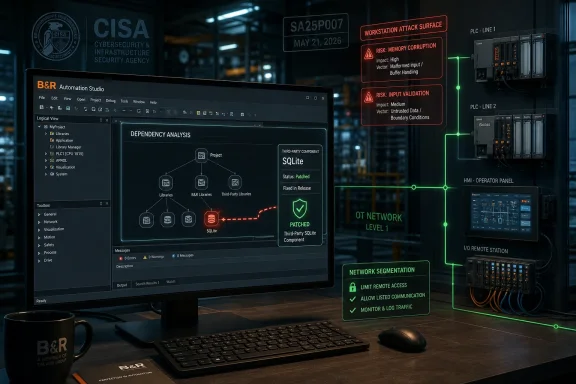 A Patch for SQLite Becomes a Warning About Engineering Workstations
The headline vulnerability here is not a glamorous zero-day in a PLC runtime or a cinematic remote takeover of a plant floor. ABB says the issue is addressed by replacing an outdated third-party component in B&R Automation Studio, with the advisory naming a long list of CVEs tied to memory corruption, input validation, information exposure, and other familiar software failure modes.That makes this advisory easy to underestimate. “Outdated third-party component” sounds like inventory hygiene, the kind of thing a vulnerability scanner nags about until the next maintenance window. But in operational technology, boring dependencies become consequential because they sit inside tools that engineers use to create, modify, deploy, and troubleshoot systems that may run for years.
Automation Studio is not just another Windows application in the enterprise software catalog. It is an engineering environment for B&R automation projects, the sort of software that may touch controller configuration, application logic, diagnostics, and project files that define machine behavior. If an attacker can abuse the workstation or the files it handles, the distinction between IT compromise and OT consequence starts to blur.
ABB’s own advisory language is careful. The company says no successful exploitation was observed during testing of affected B&R products, but that the vulnerabilities could present attack vectors for unauthorized access, data exposure, or remote code execution. That is not panic language. It is vendor-speak for “do not assume this is theoretical just because we did not reproduce a full exploit chain in the product context.”
The advisory also lands in a broader pattern: industrial products increasingly disclose vulnerabilities that originate not in the vendor’s control logic but in ordinary software components. SQLite, OpenSSL, web servers, compression libraries, VPN clients, licensing services, installers, and remote access tools keep showing up in ICS advisories because modern OT software is still modern software. The plant floor may be conservative, but its toolchain is not magically exempt from the software supply chain.
The Most Dangerous Word in the Advisory Is “Studio”
Automation Studio’s role matters because engineering environments often sit at a privileged crossroads. They are usually Windows machines, joined or semi-joined to corporate domains, used by engineers with broad access, and permitted to communicate with networks that ordinary business laptops should never see. In many facilities, they are also treated as special-purpose tools rather than ordinary endpoints subject to the full weight of enterprise security controls.That exception culture is understandable. Patch the wrong machine at the wrong time and a commissioning schedule slips. Lock down the wrong directory and an engineer cannot build a project. Remove local admin rights and a vendor support session turns into a ticket storm. OT has legitimate reasons to move cautiously, but attackers benefit when caution hardens into neglect.
A flaw in a development environment does not need to leap directly into a controller to matter. It can compromise project data. It can expose credentials or configuration details. It can give an attacker code execution on the workstation used to connect to automation assets. It can become the middle step between a phished engineer and a manipulated control environment.
That is why the affected product category deserves attention from Windows administrators as much as control engineers. The workstation running Automation Studio may look like a niche OT asset, but it runs in the Windows estate, relies on Windows patching practices, often uses Windows identity, and may depend on Windows file shares, remote desktop tooling, endpoint protection, and backup systems. If the IT and OT teams disagree about who owns it, the attacker effectively does.
The phrase “engineering workstation” can lull organizations into thinking of a machine as an appliance. It is not. It is a general-purpose computer running specialized software, and that software has dependencies, installers, libraries, parsers, file handlers, and update mechanisms. Every one of those becomes relevant when an advisory like this arrives.
A 9.8 Score Does Not Mean the Same Thing in Every Plant
The advisory carries a vendor CVSS v3 score of 9.8, the kind of number that makes dashboards turn red and risk committees ask for status by close of business. That score is important, but it should not be treated as a substitute for local analysis. CVSS describes technical severity under modeled conditions; it does not know whether your Automation Studio machines are isolated, whether project files arrive from third parties, whether engineers browse the web from the same workstation, or whether vendor support connects remotely.In a well-segmented environment, exploitation may require a more elaborate path. An attacker may first need access to a file share, a support channel, an engineer’s laptop, or a network path that can reach the affected software. In a looser environment, where engineering tools are installed on multipurpose laptops and project archives move through email, the practical exposure can be much higher.
This is where the advisory’s list of weakness categories matters more than any single CVE name. Numeric truncation errors, heap-based buffer overflows, out-of-bounds writes, use-after-free bugs, integer overflows, uncontrolled recursion, and classic buffer overflows are not cosmetic flaws. They are the vocabulary of memory safety risk, and in the wrong parsing or processing context they can become code execution primitives.
The advisory also includes exposure of sensitive information and incorrect user management among the weakness classes. Those issues can be just as useful to an attacker as a crash or memory corruption bug. Credentials, project metadata, network paths, server details, and configuration secrets are often the connective tissue of an OT intrusion.
ABB’s statement that no successful exploitation was observed during product testing should reduce speculation, not urgency. It means the vendor did not validate a working exploit against the affected B&R product during testing. It does not mean the component defects are harmless, nor does it prove that future researchers or adversaries cannot assemble a working path in a particular deployment.
The Supply Chain Is Already Inside the Control Room
Industrial security conversations often use “supply chain” to mean a compromised vendor update or a malicious dependency sneaking into a build. Those are real risks, but this advisory shows a more mundane version: a legitimate product includes a legitimate third-party component, that component accumulates vulnerabilities over time, and the risk eventually lands on customers who may not even know the component is present.This is not a uniquely ABB problem. Every major industrial vendor relies on third-party code. The real question is how quickly vendors inventory those components, track upstream defects, test whether they are reachable in product context, and deliver updates that customers can actually deploy. The advisory’s existence is evidence that ABB is at least surfacing the issue; the operational challenge now moves to customers.
For asset owners, the uncomfortable lesson is that software bills of materials are not academic paperwork. If an engineering tool includes an outdated database engine, parser, web component, or compression library, that component becomes part of the risk model. A vulnerability management program that only tracks Windows Update status and antivirus health is missing the layer where many OT advisories now live.
The dependency problem is amplified by the long life of industrial software. Enterprise applications may update monthly or quarterly. Engineering environments can remain pinned for compatibility with validated machine projects, vendor toolchains, site standards, or customer acceptance requirements. The result is a world where old libraries persist because change is expensive.
That tension is not solved by yelling “patch faster” at plant teams. It is solved by making updates testable, reversible, and visible. If Automation Studio 6.5 or a relevant fixed build is the answer, organizations need a way to validate project compatibility, confirm vendor support, stage the update, and document what happens if a legacy machine cannot move immediately.
CISA’s Republication Turns a Vendor Notice Into an Operational Deadline
CISA’s May 21 republication does not create the vulnerability, and the agency’s own conversion disclaimer makes clear that this is a verbatim republishing of ABB’s CSAF advisory. Still, CISA republication changes the audience. A vendor advisory can sit in a product-security portal; a CISA ICS advisory enters the workflow of government, critical infrastructure, managed service providers, insurers, auditors, and security teams that may never read ABB’s website directly.That matters because many industrial organizations still rely on CISA advisories as a trigger for internal triage. The republication date becomes the moment the issue hits ticket queues, risk registers, and vulnerability management meetings. For some shops, May 21, 2026, will be the first time this February advisory becomes operationally visible.
The advisory also identifies the energy sector and worldwide deployment, which is CISA’s way of saying the affected environments are not hypothetical. Automation vendors ship globally, and B&R systems appear in machinery and industrial settings that cross national boundaries. A vulnerability in an engineering tool can therefore affect not only asset owners but OEMs, integrators, and service providers who maintain fleets of customer projects.
CISA’s recommended practices are familiar: minimize network exposure, keep control systems off the internet, use firewalls, isolate control networks from business networks, and treat remote access with caution. Those lines appear so often that readers may skim them. They should not. In this case, those recommendations are less about the affected component itself and more about reducing the number of paths an attacker can use to reach the workstation, project files, or control-system communications around it.
The agency’s reminder to perform impact analysis before deploying defensive measures is also not boilerplate. Industrial software updates can affect engineering workflows, project compatibility, and vendor support. The correct response is not reckless deployment; it is disciplined urgency.
Windows Admins Cannot Outsource This One to OT
For WindowsForum readers, the practical question is where this lands in the Windows estate. Many Automation Studio installations will live on Windows engineering workstations, commissioning laptops, virtual machines, or support systems. Those endpoints may not be numerous, but they are high-value.A normal enterprise vulnerability program might prioritize by asset count and internet exposure. That approach can under-rank engineering systems because there are only a few of them and they are supposed to be isolated. But scarcity is not safety. A single compromised engineering workstation can have more operational significance than a hundred ordinary office desktops.
The first job is inventory. Security teams need to know where B&R Automation Studio is installed, which versions are present, who uses them, what projects they access, and what networks they can reach. If the answer requires asking around in chat, the organization has already found a governance problem.
The second job is ownership. The machine may be maintained by IT, used by engineering, supported by an OEM, governed by OT policy, and excluded from standard patching. That split ownership is common, but it cannot be allowed to block action. Someone needs authority to schedule the update, test it, and document compensating controls where immediate remediation is not possible.
The third job is to look beyond the application version. If the workstation is used for email, browsing, vendor portals, file transfer, remote desktop, and engineering tasks, the attack surface is much larger than Automation Studio alone. The update matters, but so do least privilege, application control, endpoint monitoring, backup integrity, removable media rules, and segmentation.
The File Is Often the Attack Path
When people hear “remote code execution,” they often imagine a listening service on a network port waiting to be exploited. Engineering tools can present a different shape of risk: the malicious or malformed project file, archive, configuration, library, or imported object. That possibility is especially relevant when advisories involve parsing-heavy components and memory safety bugs.Industrial project files move through messy channels. OEMs send them to customers. Integrators receive them from machine builders. Engineers copy them between laptops and shares. Vendors request them for support. Old versions sit in archives for years, then reappear during troubleshooting. The file supply chain is its own security domain.
That domain is often poorly defended. An organization may restrict inbound network connections to the control network while still allowing project files to arrive by email, cloud storage, USB drive, or remote support session. If the vulnerable code path is triggered by handling crafted content, perimeter segmentation alone will not be enough.
This does not mean every Automation Studio project file should be treated as hostile malware. It means organizations need procedures that reflect the value of the systems those files influence. Project intake, scanning, provenance checks, controlled opening environments, and separation between review machines and production-connected engineering workstations become practical controls rather than bureaucratic extras.
For Windows teams, this is a familiar story in a different costume. Office macros, CAD files, PDF readers, archive utilities, and developer tooling have all been abused through crafted files. OT engineering software belongs in that same mental category: powerful applications that process complex inputs and run with meaningful user privileges.
The Real Risk Is the Gap Between Patch Availability and Patch Reality
ABB says an update is available. In enterprise IT, that sentence usually starts the clock on deployment. In industrial environments, it starts a negotiation.Automation projects are tied to machines, firmware, libraries, runtime versions, customer acceptance tests, and sometimes regulatory constraints. Upgrading the engineering tool can be simple in one environment and politically difficult in another. A plant may have to confirm that existing projects open correctly, builds remain reproducible, controller communication still works, and support contracts remain intact.
That reality is why compensating controls matter. If an organization cannot update immediately, it should not stop at recording an exception. It should reduce exposure around the affected systems: isolate the workstation, restrict file intake, limit remote access, monitor unusual process behavior, remove unnecessary internet access, and ensure backups of project files are offline or otherwise protected.
But compensating controls should not become a permanent substitute for patching. The phrase “we cannot update because production” can be reasonable for a defined period. It becomes dangerous when it turns into a standing exemption with no owner and no review date.
The best organizations treat OT patching as a lifecycle discipline. They maintain test environments, vendor contact paths, known-good project backups, rollback plans, and scheduled maintenance opportunities. That discipline is expensive, but the alternative is discovering during a critical advisory that nobody knows whether an engineering tool can be safely updated.
Remote Access Is the Multiplier Nobody Wants to Talk About
CISA’s advisory repeats the standard warning that VPNs are only as secure as the connected devices. That sentence deserves more attention than it usually gets. Many automation environments depend on remote support, and remote support often terminates on or near engineering workstations.A vulnerability in an engineering tool becomes more serious when the workstation is reachable through vendor remote access, jump hosts, poorly segmented VPNs, or shared credentials. Even if the affected software is not exposed directly to the internet, the path to it may be only one compromised account away.
This is the part of the story where IT and OT incentives collide. Remote support reduces downtime and travel costs. It lets a specialist troubleshoot a machine without boarding a plane. It is also a persistent doorway into environments that were once protected mainly by physical separation.
The answer is not to ban remote access outright. The answer is to make it accountable. Sessions should be approved, time-limited, logged, tied to individual identities, protected by strong authentication, and constrained to the systems needed for the task. Vendor accounts should not become immortal skeleton keys.
For Automation Studio systems, remote access reviews should include a simple question: can a remote user open, modify, import, or deploy project content from this workstation? If yes, that access path belongs in the risk assessment for this advisory.
Version 6.5 Is a Fix, Not a Finish Line
The affected versions list includes B&R Automation Studio earlier than 6.5 and 6.5 for the named CVEs in the supplied advisory text. ABB’s alert page describes the February advisory as “B&R Automation Studio Update of SQLite version,” with a critical score. The immediate operational task is to identify the corrected update path from ABB and apply it according to site testing requirements.But the broader lesson is that version 6.5 should not be treated as a permanent safe harbor. Automation software will continue to absorb upstream vulnerabilities because its components will continue to age. Today’s fixed build is tomorrow’s legacy baseline.
That is not an argument against patching. It is an argument against one-off patching. Organizations need to know how they will track future ABB advisories, how they will map those advisories to installed systems, and how they will test updates without reinventing the process every time.
The strongest programs build an evidence trail. They record the installed version, advisory applicability, test result, deployment date, exception rationale, compensating controls, and next review. That sounds dull until a regulator, insurer, customer, or incident-response team asks what happened after a critical advisory landed.
Security maturity is often visible in the boring artifacts. A site that can answer “which engineering workstations still run affected Automation Studio builds?” within an hour is in a different universe from a site that needs a week of emails, screenshots, and tribal knowledge.
The Lesson for Windows Shops Hiding in an ICS Advisory
This advisory is not just an OT story with a Windows footnote. It is a Windows endpoint story with OT consequences. The affected application may be specialized, but the defensive muscle required to manage it is familiar to any serious Windows administrator.Engineering workstations need software inventory, patch governance, controlled privilege, endpoint telemetry, backup discipline, and network segmentation. They also need respect for operational constraints. The trick is not choosing between IT rigor and OT caution; it is making them work together.
The following are the concrete moves that matter most for organizations with B&R Automation Studio in scope:
- Identify every Windows workstation, laptop, virtual machine, and support host where B&R Automation Studio is installed, and record the exact installed version.
- Obtain ABB’s fixed update guidance for SA25P007 and test the update against representative projects before deploying it broadly.
- Treat project files, imports, archives, and vendor-supplied engineering content as controlled inputs, especially when they arrive from outside the organization.
- Restrict remote access to engineering systems so that only named users with approved sessions can reach the affected workstations.
- Document compensating controls and review dates for any system that cannot be updated immediately.
- Keep Automation Studio systems out of general-purpose workstation duty, including routine email, web browsing, and unmanaged file exchange.
Industrial Security Is Becoming Ordinary Software Security With Higher Stakes
The ABB advisory is a small window into a larger industry shift. Industrial control environments are still physically grounded in motors, drives, panels, pumps, lines, substations, and plants. But the software stack around them increasingly resembles the rest of computing: third-party components, complex parsers, encrypted protocols, remote access, development environments, Windows endpoints, and a relentless flow of CVEs.That convergence cuts both ways. It gives defenders more familiar tools and more mature practices to borrow from enterprise security. It also gives attackers more familiar paths into environments whose consequences are less forgiving than a compromised office laptop.
For ABB customers, the immediate answer is straightforward: identify affected Automation Studio installations, apply the available update after proper testing, and reduce exposure while that work is underway. For everyone else, the message is broader. If your control-system security model still begins at the PLC and ends at the firewall, it is missing the workstation where the project is built, the file where the logic is stored, and the aging library quietly waiting inside the toolchain.
References
- Primary source: CISA
Published: 2026-05-21T12:00:00+00:00
ABB B&R Automation Studio | CISA
 www.cisa.gov
- Related coverage: feed.craftedsignal.io
ABB B&R Automation Studio Improper Certificate Validation Vulnerability – CraftedSignal Threat Feed
ABB B&R Automation Studio versions before 6.5 are vulnerable to improper certificate validation (CVE-2025-11043), potentially allowing an unauthenticated attacker to intercept and interfere with data exchanges, necessitating patching and secure network configurations. feed.craftedsignal.io
- Related coverage: cyber.gc.ca
[Control systems] B&R security advisory (AV26-056) - Canadian Centre for Cyber Security
[Control systems] B&R security advisory (AV26-056)www.cyber.gc.ca - Related coverage: otwarden.com
ICSA-26-125-04 — ABB B&R Automation Studio — OTWarden
ICSA-26-125-04: ABB B&R Automation Studio. Severity: HIGH, CVSS 7.4. Affects ABB.otwarden.com
- Related coverage: assurantcyber.com
ABB B&R Automation Studio - ASSURANT™
ABB B&R Automation Studio All CISA Advisories, CISA, May 5, 2026 View CSAF Summary ABB became aware of vulnerability in the product versions listed as affected in the advisory. An update is available that resolves a vulnerability. Successful exploitation of this vulnerability may enable an... www.assurantcyber.com
- Related coverage: br-automation.com
V6.0 HW Upgrade (4PPC80.121E-12B) | B&R Industrial Automation
 www.br-automation.com
