

CISA republished ABB’s advisory for B&R industrial PCs on May 21, 2026, warning that multiple xPC firmware versions remain exposed to nine PixieFail UEFI network-stack vulnerabilities that can let a network attacker trigger code execution, denial of service, DNS cache poisoning, or data exposure. The important word is not merely firmware; it is industrial. These are not gaming rigs waiting for a BIOS update utility and a reboot after dinner. They are control-room machines, machine-side panels, and long-lived PCs that often sit where normal IT patch reflexes go to die.
PixieFail was disclosed in early 2024 as a set of vulnerabilities in the IPv6 network boot code used by TianoCore EDK II, the open-source UEFI implementation that underpins a large part of the modern firmware ecosystem. The bugs sit in the pre-boot networking path, especially around PXE-style behavior, DHCPv6 handling, DNS behavior, buffer handling, and weak random-number generation.
That placement matters. A Windows vulnerability can often be boxed into an operating-system lifecycle: patch Tuesday, reboot window, telemetry, rollback plan. A UEFI vulnerability lives beneath Windows, Linux, hypervisors, endpoint agents, and most of the security tooling administrators rely on to tell them what happened.
ABB’s B&R advisory brings that same old lesson into a sharper industrial frame. The affected products are not generic beige boxes but industrial PCs intended for operational technology environments, including energy-sector deployments. In that world, a firmware flaw is not just a firmware flaw. It is a maintenance outage, a vendor ticket, a risk acceptance memo, and sometimes a plant-floor scheduling problem.
The CVE list is the familiar PixieFail run: CVE-2023-45229 through CVE-2023-45237. ABB’s own severity rating lands at CVSS v3 8.3, a high-severity score that is serious without quite sounding the air raid siren. That is probably the right tone. These are not magic Internet-wide worms, but they are exactly the kind of bugs that punish flat networks, neglected firmware, and overconfident segmentation diagrams.
The advisory says a network attacker could exploit the flaws by sending specially crafted messages to an affected node. In practical terms, that means the attacker needs access to the relevant network path. For a well-run industrial environment, that should be a meaningful barrier. For a plant with aging remote-access gear, vendor laptops, shared engineering workstations, and “temporary” firewall exceptions that became permanent sometime during the previous decade, it may not be much of a barrier at all.
But pre-boot networking is uncomfortable security territory. It runs before the operating system has loaded. It may parse network traffic before endpoint detection has a chance to observe anything. It depends on firmware update practices that vary wildly by vendor, product line, age, and customer environment.
That is why PixieFail has aged badly. The original research was not merely “there are nine CVEs.” It was a reminder that common firmware components can propagate across suppliers and equipment classes, then take years to flush out of real deployments. ABB’s 2026 advisory is not late in the moral sense; industrial firmware validation takes time. But it is a useful demonstration that ecosystem vulnerabilities do not end when the first research blog post drops.
That hybrid identity creates a responsibility gap. IT teams often own vulnerability scanners, patch policy, and network architecture. OT teams own uptime, safety constraints, vendor qualification, and process impact. Firmware updates for industrial PCs fall directly between those worlds.
The result is familiar: the operating system may be patched while the firmware sits untouched, because the firmware is perceived as either too risky to change or too obscure to inventory. That calculus is understandable. It is also exactly why attackers like firmware and pre-boot surfaces. They are quiet, durable, and administratively inconvenient.
Still, “requires network access” is not the comfort it used to be. Modern intrusions often begin in IT networks and move toward OT through identity abuse, remote management tools, VPN credentials, vendor access, and poorly monitored jump hosts. The hard perimeter has become a set of assumptions, and assumptions are not controls.
For Windows administrators, this should sound familiar. The industry spent years learning that domain segmentation, privileged-access workstations, and management-plane isolation are not optional extras. OT networks now face the same lesson, but with less tolerance for downtime and a much longer equipment lifecycle.
Secure Boot, BitLocker, VBS, driver blocklists, credential isolation, and EDR can all be valuable. None of them magically fixes a vulnerable UEFI network stack. Once the bug is in firmware that can process packets before the OS is alive, the operating system is downstream of the problem.
That does not make Windows irrelevant. Windows administrators are often the people who can inventory hardware, coordinate vendor updates, confirm firmware baselines, and verify whether network boot is enabled. They also understand the organizational pain of reboot windows, staged deployment, and rollback planning. In many shops, the Windows team may be the only group with enough tooling discipline to help OT turn an advisory into an actual remediation plan.
But “disable PXE” becomes less tidy in industrial settings. Some organizations use network boot for recovery. Some depend on vendor workflows that assume pre-boot networking. Some have fleets where firmware settings are inconsistent because hardware was commissioned across many years by different integrators.
The right answer is not a universal switch-flip. It is an asset-by-asset decision: identify affected models, determine firmware version, confirm whether network boot is enabled, establish whether it is operationally required, and then either patch, disable, or isolate the exposure. That is slower than a slogan, but it is how risk reduction actually survives contact with production.
In vulnerability management, republication often serves a practical purpose. Vendor advisories do not always reach the right teams, especially when a product sits in OT procurement records rather than conventional IT asset databases. CISA’s ICS channel gives the issue a second path into security operations, governance teams, and sector-specific alerting.
The downstream effect is useful pressure. Once CISA republishes a vendor advisory, it becomes harder for organizations to argue that the issue was too obscure to track. The advisory may still require vendor coordination and downtime planning, but it is now part of the public industrial-security record.
That does not excuse inaction. It does mean the remediation clock has to include testing, backups, maintenance windows, spare hardware, and coordination with production owners. Firmware updates should be treated as change-controlled engineering work, not as a casual desktop helpdesk task.
For affected ABB B&R deployments, the practical first move is inventory. Security teams need to know whether the listed APC, PPC, MPC, and C80 systems exist in their environment, what firmware they run, whether PXE or network boot is enabled, and which network segments can reach them. Without that baseline, the advisory becomes yet another PDF in the risk register.
Those machines are attractive pivot points. They may sit on trusted OT segments, run old software, and receive less monitoring than servers. They may also be excluded from aggressive scanning because operations teams fear disruption. That combination creates an attacker’s favorite kind of asset: important enough to be trusted, boring enough to be ignored.
PixieFail-style bugs sharpen that danger because the vulnerable code path is not where defenders usually look. If the only control is “our EDR would catch it,” the organization is defending the wrong layer. Firmware exposure has to be reduced before the operating system becomes the battlefield.
This is the less glamorous side of supply-chain security. It is not always a malicious update or a compromised vendor portal. Sometimes it is a common open-source firmware component embedded across many products, wrapped by multiple vendors, shipped into long-lived equipment, and discovered years later to contain network-reachable flaws.
For buyers, this should change procurement conversations. Industrial PC purchasing cannot stop at CPU, I/O, temperature range, and operating-system support. Customers should ask how firmware updates are delivered, how long platforms receive security maintenance, whether advisories are machine-readable, and how vendors communicate inherited component risk.
Good segmentation turns PixieFail from a broad operational scare into a narrower maintenance problem. If only approved provisioning infrastructure can reach pre-boot services, and if remote access is brokered through hardened jump hosts, the attacker’s path gets longer and noisier. If OT devices sit on flat networks reachable from office subnets, the attacker’s path gets shorter and quieter.
VPNs deserve special caution. CISA rightly notes that VPNs are only as secure as the devices and software behind them. In too many environments, “protected by VPN” is used as a substitute for identity hygiene, device posture, least privilege, and monitoring. That is not protection; it is a tunnel into the blast radius.
If those answers are unavailable, the vulnerability is only part of the problem. The larger issue is operational opacity. You cannot patch what you cannot name, and you cannot prioritize what you cannot place on a network map.
Windows-heavy organizations already learned this lesson with BIOS updates, Secure Boot changes, TPM dependencies, and hardware-backed security features. OT teams need the same muscle, adapted to production realities. Firmware is now part of the security baseline, not an occasional vendor errand.
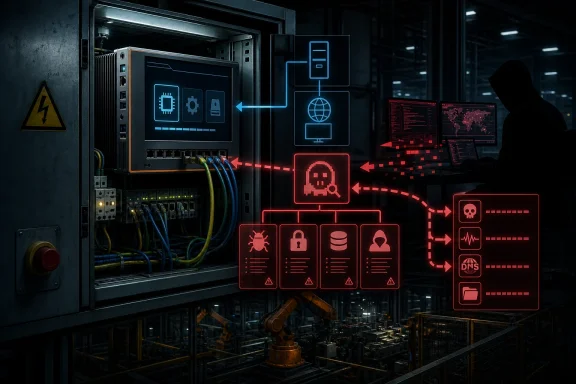 The Firmware Bug That Refuses to Stay in the Data Center
PixieFail was disclosed in early 2024 as a set of vulnerabilities in the IPv6 network boot code used by TianoCore EDK II, the open-source UEFI implementation that underpins a large part of the modern firmware ecosystem. The bugs sit in the pre-boot networking path, especially around PXE-style behavior, DHCPv6 handling, DNS behavior, buffer handling, and weak random-number generation.That placement matters. A Windows vulnerability can often be boxed into an operating-system lifecycle: patch Tuesday, reboot window, telemetry, rollback plan. A UEFI vulnerability lives beneath Windows, Linux, hypervisors, endpoint agents, and most of the security tooling administrators rely on to tell them what happened.
ABB’s B&R advisory brings that same old lesson into a sharper industrial frame. The affected products are not generic beige boxes but industrial PCs intended for operational technology environments, including energy-sector deployments. In that world, a firmware flaw is not just a firmware flaw. It is a maintenance outage, a vendor ticket, a risk acceptance memo, and sometimes a plant-floor scheduling problem.
ABB’s Advisory Is Really About Exposure Discipline
The affected B&R models span a broad slice of the company’s industrial PC portfolio: APC4100, APC910, C80, MPC3100, PPC1200, PPC900, APC2200, PPC2200, APC3100, and PPC3100. ABB lists firmware thresholds for each, with vulnerable versions at or below the specified releases depending on the model. The company says updates are now available to remediate the issue.The CVE list is the familiar PixieFail run: CVE-2023-45229 through CVE-2023-45237. ABB’s own severity rating lands at CVSS v3 8.3, a high-severity score that is serious without quite sounding the air raid siren. That is probably the right tone. These are not magic Internet-wide worms, but they are exactly the kind of bugs that punish flat networks, neglected firmware, and overconfident segmentation diagrams.
The advisory says a network attacker could exploit the flaws by sending specially crafted messages to an affected node. In practical terms, that means the attacker needs access to the relevant network path. For a well-run industrial environment, that should be a meaningful barrier. For a plant with aging remote-access gear, vendor laptops, shared engineering workstations, and “temporary” firewall exceptions that became permanent sometime during the previous decade, it may not be much of a barrier at all.
Pre-Boot Networking Is a Bigger Attack Surface Than It Looks
PXE and UEFI network boot exist because administrators need machines to boot, provision, recover, and reinstall without walking around with removable media. In enterprise IT, that is an efficiency story. In industrial environments, it can also be a survivability story, especially when a machine needs to be restored quickly or standardized across production lines.But pre-boot networking is uncomfortable security territory. It runs before the operating system has loaded. It may parse network traffic before endpoint detection has a chance to observe anything. It depends on firmware update practices that vary wildly by vendor, product line, age, and customer environment.
That is why PixieFail has aged badly. The original research was not merely “there are nine CVEs.” It was a reminder that common firmware components can propagate across suppliers and equipment classes, then take years to flush out of real deployments. ABB’s 2026 advisory is not late in the moral sense; industrial firmware validation takes time. But it is a useful demonstration that ecosystem vulnerabilities do not end when the first research blog post drops.
Industrial PCs Sit in the Gap Between IT and OT
The awkwardness of B&R xPCs is that they look enough like PCs to be mentally filed under IT, while behaving enough like industrial assets to be governed by OT rules. They may run Windows, Linux, automation software, visualization stacks, HMI workloads, or vendor-specific tooling. They may also be physically mounted in places where “just update it” is not a serious sentence.That hybrid identity creates a responsibility gap. IT teams often own vulnerability scanners, patch policy, and network architecture. OT teams own uptime, safety constraints, vendor qualification, and process impact. Firmware updates for industrial PCs fall directly between those worlds.
The result is familiar: the operating system may be patched while the firmware sits untouched, because the firmware is perceived as either too risky to change or too obscure to inventory. That calculus is understandable. It is also exactly why attackers like firmware and pre-boot surfaces. They are quiet, durable, and administratively inconvenient.
The Threat Model Is Local Network Access, Not Remote Magic
ABB’s language is careful: a network attacker needs access to the system network, either directly, through a misconfigured or compromised firewall, or by planting malware on a node already inside the environment. That is not the same as saying any attacker on the public Internet can trivially exploit every affected device.Still, “requires network access” is not the comfort it used to be. Modern intrusions often begin in IT networks and move toward OT through identity abuse, remote management tools, VPN credentials, vendor access, and poorly monitored jump hosts. The hard perimeter has become a set of assumptions, and assumptions are not controls.
For Windows administrators, this should sound familiar. The industry spent years learning that domain segmentation, privileged-access workstations, and management-plane isolation are not optional extras. OT networks now face the same lesson, but with less tolerance for downtime and a much longer equipment lifecycle.
The Windows Angle Is Below Windows
WindowsForum readers may reasonably ask where Windows fits into a B&R firmware advisory. The answer is that Windows is often the visible operating environment on top of machinery whose deeper trust chain Windows does not control.Secure Boot, BitLocker, VBS, driver blocklists, credential isolation, and EDR can all be valuable. None of them magically fixes a vulnerable UEFI network stack. Once the bug is in firmware that can process packets before the OS is alive, the operating system is downstream of the problem.
That does not make Windows irrelevant. Windows administrators are often the people who can inventory hardware, coordinate vendor updates, confirm firmware baselines, and verify whether network boot is enabled. They also understand the organizational pain of reboot windows, staged deployment, and rollback planning. In many shops, the Windows team may be the only group with enough tooling discipline to help OT turn an advisory into an actual remediation plan.
“Disable PXE” Is Sensible, but It Is Not a Strategy
One obvious mitigation is to disable network boot where it is not needed. That is good advice. If a device never needs to boot from the network, leaving PXE or IPv6 network boot paths exposed is needless attack surface.But “disable PXE” becomes less tidy in industrial settings. Some organizations use network boot for recovery. Some depend on vendor workflows that assume pre-boot networking. Some have fleets where firmware settings are inconsistent because hardware was commissioned across many years by different integrators.
The right answer is not a universal switch-flip. It is an asset-by-asset decision: identify affected models, determine firmware version, confirm whether network boot is enabled, establish whether it is operationally required, and then either patch, disable, or isolate the exposure. That is slower than a slogan, but it is how risk reduction actually survives contact with production.
CISA’s Republication Is a Visibility Move, Not a New Discovery
The May 21, 2026 CISA item is a republication of ABB PSIRT advisory SA24P003, not a brand-new vulnerability disclosure. ABB’s advisory was originally released earlier in 2026 and later updated before CISA mirrored it through the ICS advisory channel. That distinction matters because organizations should not treat the CISA posting as day zero.In vulnerability management, republication often serves a practical purpose. Vendor advisories do not always reach the right teams, especially when a product sits in OT procurement records rather than conventional IT asset databases. CISA’s ICS channel gives the issue a second path into security operations, governance teams, and sector-specific alerting.
The downstream effect is useful pressure. Once CISA republishes a vendor advisory, it becomes harder for organizations to argue that the issue was too obscure to track. The advisory may still require vendor coordination and downtime planning, but it is now part of the public industrial-security record.
Firmware Patching Needs a Different Clock
The hardest part of this advisory is not understanding the bug. It is getting the update deployed without breaking something that matters. Industrial PCs often run validated images, vendor-supported automation stacks, and workloads that are less tolerant of surprise firmware changes than office laptops.That does not excuse inaction. It does mean the remediation clock has to include testing, backups, maintenance windows, spare hardware, and coordination with production owners. Firmware updates should be treated as change-controlled engineering work, not as a casual desktop helpdesk task.
For affected ABB B&R deployments, the practical first move is inventory. Security teams need to know whether the listed APC, PPC, MPC, and C80 systems exist in their environment, what firmware they run, whether PXE or network boot is enabled, and which network segments can reach them. Without that baseline, the advisory becomes yet another PDF in the risk register.
The Real Risk Is the Forgotten Box That Still Boots
The most dangerous affected system is not necessarily the most critical one. Critical systems tend to be documented, watched, and argued over. The bigger risk may be the forgotten engineering station, spare HMI, lab controller, or cabinet-mounted PC that still has network boot enabled because nobody changed the default.Those machines are attractive pivot points. They may sit on trusted OT segments, run old software, and receive less monitoring than servers. They may also be excluded from aggressive scanning because operations teams fear disruption. That combination creates an attacker’s favorite kind of asset: important enough to be trusted, boring enough to be ignored.
PixieFail-style bugs sharpen that danger because the vulnerable code path is not where defenders usually look. If the only control is “our EDR would catch it,” the organization is defending the wrong layer. Firmware exposure has to be reduced before the operating system becomes the battlefield.
The Automation Supply Chain Is the Patch Surface
ABB is not alone in dealing with PixieFail. The vulnerabilities affected a shared firmware ecosystem, with major firmware and hardware vendors involved in the broader remediation wave. That is the point: modern industrial equipment inherits security debt from layers customers may never see.This is the less glamorous side of supply-chain security. It is not always a malicious update or a compromised vendor portal. Sometimes it is a common open-source firmware component embedded across many products, wrapped by multiple vendors, shipped into long-lived equipment, and discovered years later to contain network-reachable flaws.
For buyers, this should change procurement conversations. Industrial PC purchasing cannot stop at CPU, I/O, temperature range, and operating-system support. Customers should ask how firmware updates are delivered, how long platforms receive security maintenance, whether advisories are machine-readable, and how vendors communicate inherited component risk.
Segmentation Still Earns Its Keep
CISA’s recommended practices are the familiar industrial-control baseline: minimize network exposure, keep control-system devices off the public Internet, place control networks behind firewalls, isolate them from business networks, and use secure remote-access methods when remote access is necessary. None of that is novel. Novelty is not the point.Good segmentation turns PixieFail from a broad operational scare into a narrower maintenance problem. If only approved provisioning infrastructure can reach pre-boot services, and if remote access is brokered through hardened jump hosts, the attacker’s path gets longer and noisier. If OT devices sit on flat networks reachable from office subnets, the attacker’s path gets shorter and quieter.
VPNs deserve special caution. CISA rightly notes that VPNs are only as secure as the devices and software behind them. In too many environments, “protected by VPN” is used as a substitute for identity hygiene, device posture, least privilege, and monitoring. That is not protection; it is a tunnel into the blast radius.
The ABB Advisory Should Trigger a Firmware Inventory Drill
The narrow task is to update affected B&R PCs. The broader opportunity is to test whether the organization can answer basic firmware questions quickly. Which industrial PCs do we have? Which models and firmware versions? Which are exposed to provisioning networks? Which can be updated remotely, and which require hands-on intervention?If those answers are unavailable, the vulnerability is only part of the problem. The larger issue is operational opacity. You cannot patch what you cannot name, and you cannot prioritize what you cannot place on a network map.
Windows-heavy organizations already learned this lesson with BIOS updates, Secure Boot changes, TPM dependencies, and hardware-backed security features. OT teams need the same muscle, adapted to production realities. Firmware is now part of the security baseline, not an occasional vendor errand.
The Practical Lesson Hidden in ABB’s Version Table
The concrete response to this advisory is not panic; it is controlled execution. ABB says updates are available, CISA has amplified the advisory, and there were no reports of exploitation against B&R products at the time of the original vendor notice. That gives defenders room to be methodical, but not room to be passive.- Organizations should identify whether any APC4100, APC910, C80, MPC3100, PPC1200, PPC900, APC2200, PPC2200, APC3100, or PPC3100 systems are present in production, labs, spares, or vendor-managed environments.
- Administrators should compare installed firmware versions against ABB’s affected thresholds instead of assuming that operating-system patch compliance says anything about UEFI exposure.
- Network boot, PXE, and IPv6 pre-boot paths should be disabled wherever they are not operationally required.
- Control-system networks should be reviewed for unnecessary reachability from business networks, remote-access pools, vendor laptops, and general-purpose management subnets.
- Firmware updates should be tested and deployed through a change-controlled process that includes rollback planning, production-owner signoff, and vendor support where needed.
- Security teams should treat the advisory as a reason to improve firmware inventory, not merely as a one-time ABB patch ticket.
References
- Primary source: CISA
Published: 2026-05-21T12:00:00+00:00
ABB B&R PCs | CISA
 www.cisa.gov
- Related coverage: ami.com
Security Advisories from the AMI Security Team - AMI
Discover essential Security Advisories from the AMI Security Team, dedicated to rapid response and product security.www.ami.com - Related coverage: br-automation.com
Cyber Security Advisories and Notices | B&R Industrial Automation
Current information and concrete recommendations from B&R for action around cyber security.www.br-automation.com - Related coverage: psirt.bosch.com
Public advisories containing security information from Bosch and its brands | Bosch PSIRT
Find here all public security advisories from Bosch and its brands including information about vulnerabilities, updates, and recommendationspsirt.bosch.com
- Related coverage: cyber.gc.ca
[Control systems] B&R security advisory (AV24-067) - Canadian Centre for Cyber Security
[Control systems] B&R security advisory (AV24-067)www.cyber.gc.ca - Related coverage: cert.europa.eu
