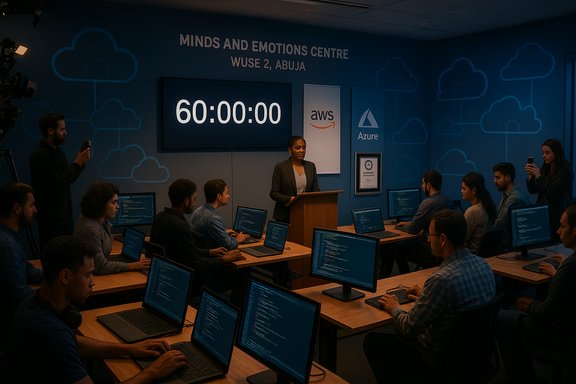
Guinness World Records has officially recognised Nigerian-born cloud engineer Abel Yakubu for a continuous 60-hour Longest Computer Programming Lesson held in Abuja between 21 and 23 November 2025, a Guinness-listed adjudication that has already generated widespread national and international coverage.
Background
Abel Yakubu, described in reports as a Nigerian-born cloud engineer affiliated with NexEdge Technologies and based in Germany, organised and delivered a sustained, three-day teaching marathon in Abuja intended to both set a world record and showcase practical cloud-computing skills to a large cohort of learners. Coverage in national outlets tied to the event reports a start time of 11:00 a.m. on 21 November and a finish at 11:00 p.m. on 23 November 2025, producing the 60:00:00 duration now reflected in Guinness’ record listing. This attempt was pitched as more than an endurance stunt: organisers emphasised upskilling in mainstream cloud platforms — Amazon Web Services (AWS), Google Cloud Platform (GCP) and Microsoft Azure — and the session was livestreamed to broaden reach and to supply an audit trail for verification. Local reports said the event took place at the Minds and Emotions Centre in Wuse 2, Abuja, and included both in‑person students and several categories of witnesses.What Guinness’ listing actually confirms
The core facts
- Record title: Longest Computer Programming Lesson (continuous duration).
- Record holder: Abel Yakubu (Nigeria).
- Recorded duration: 60:00:00 (hours:minutes:seconds).
- Location shown: Abuja, Nigeria.
- Date listed: 21 November 2025 (the session ran through to 23 November 2025 according to event reporting).
How the attempt was organised and delivered
Venue, format and technology
Reports by multiple outlets state the event was held at a local training centre in Wuse 2 and streamed live to social platforms to ensure transparency and to reach remote learners. The delivery model blended lecture, live demonstration and guided hands‑on labs; organisers said preconfigured cloud lab environments were used to minimise downtime and ensure participants could follow along. Several outlets cited the curriculum’s focus on cloud fundamentals, identity and access management, virtual machines, storage, containerisation, serverless and CI/CD toolchains.People on site: participants and witnesses
Accounts differ slightly across reports, which is common in breaking news. The numbers most often quoted are:- Approximately 60 students attended in person.
- 20–25 independent witnesses (different outlets report 20 or 25).
- 30 committed participants cited by Yakubu and the organisers in statements.
How this record compares with previous benchmarks
The previous widely publicised benchmark for the Longest Computer Programming Lesson was 48 hours 15 minutes, set by Santosh Kumar and St. Xavier’s School in Ranchi, India, in January 2024. Guinness still lists that result historically, but the new 60‑hour entry replaces the previous numeric high for the title and establishes a clear new ceiling for continuous instructional marathons. The prior Ranchi attempt was classroom-based and focused on Java; Yakubu’s session emphasised cloud multi‑platform breadth as its pedagogical signature.Why the record matters — a practical assessment
Visibility and signalling
A Guinness World Record creates an attention vector that is hard to buy with ordinary PR budgets. For Nigeria’s tech ecosystem this kind of milestone:- Raises the country’s visibility in global conversations about skills and digital talent.
- Provides a tangible narrative for policymakers and donors to engage with training and certification initiatives.
- Attracts corporate partners and employers who may be more willing to sponsor or pilot hiring initiatives tied to a high-profile campaign.
Skills alignment
Focusing a long session on cloud fundamentals and practical labs aligns well with current labour-market demand for cloud and DevOps competencies. If organisers can convert the exposure into certification passes, portfolio artifacts (GitHub projects, IaC templates) and measurable placements, the initiative could move beyond spectacle to create durable outcomes. Multiple outlets emphasised that the session aimed to instil career-oriented skills rather than merely chase a headline.Community-building potential
Bringing learners together for extended, hands-on sessions fosters local mentorship networks — a practical benefit that often outlives the media cycle. A concentrated, multi-day environment can accelerate peer learning, pairing less-experienced students with mentors on real problems, and that networking effect can seed local study groups and bootcamps.Strong points observed in this attempt
- Official adjudication: A Guinness entry listing the 60:00:00 figure is the single most authoritative confirmation for the headline claim. Guinness adjudication implies the evidence package met the organisation’s standards.
- Livestreamed evidence: Continuous live video provides a timestamped record that can be replayed for independent verification and for pedagogical reuse. Several outlets reported that the entire session was broadcast.
- Skills-focused syllabus: The emphasis on cloud platforms (AWS, GCP, Azure) reflects high-demand market skills and provides direct pathways to certification and employment when paired with follow-up mentoring and assessment.
- Local impact narrative: The record is highly resonant in national media and social feeds, which can be leveraged to secure partnerships and funding for scaled programs.
Caveats, risks and open questions
While the headline is clear, a careful read of the available public material suggests several prudent caveats.1. Evidence transparency
Guinness’ public listing confirms the title and duration, but it does not publish the full evidence bundle. Journalists and analysts should therefore treat the public page as a decisive but partial record: the headline is verified while granular supporting documents (witness statements, minute-by-minute logs, medical supervision notes) are generally not public. Stakeholders seeking deeper verification should press organisers to publish the evidence package or request access through Guinness’ record application tools.2. Reporting inconsistencies
Local coverage variably reports witness and participant counts (20 vs 25 witnesses; 30 committed participants vs 60 students). These differences are not surprising in early reporting, but they matter for auditability because witness independence and quantity are part of Guinness’ rules for marathon records. Any post-event transparency should clarify the independent witness list, observer affiliations and signed declarations.3. Pedagogical effectiveness vs endurance spectacle
Sixty continuous hours of instruction is an endurance feat for any instructor and a test of cognitive stamina for learners. Learning science emphasises that retention and consolidation benefit from spaced practice, retrieval practice and sleep — conditions that marathon, continuous delivery may not optimally provide. Without structured follow-up (homework, spaced revision, certification assessments), the long-term educational return may be limited. Organisers must therefore design robust post-event assessment and mentoring to convert exposure into competence.4. Health and safety
Extended live events raise genuine health concerns for instructors, volunteers and participants. Guinness requires medical supervision for long endurance records; public reporting should include confirmation of on-site medical staff, rest protocols for speakers and volunteers, and contingency plans. If those documents are not public, they should be made available to reassure stakeholders.5. PR vs measurable outcomes
Records generate press, but the most meaningful measure of success is follow-through: certification pass rates, portfolio projects produced, job placements, internships and concrete pathway metrics. As of the time of reporting, there is no publicly available outcomes tracking showing conversion of participants into certified practitioners or hires. That is a gap organisers should close quickly to cement the event’s legacy.Lessons for organisers and policymakers
For future attempts and for those seeking to convert media attention into lasting gains, the following checklist translates lessons from this event into operational best practice.- Pre-register with Guinness and confirm exact evidence requirements well in advance.
- Publish a minute-by-minute schedule and module plan so observers can see the pacing and learning objectives.
- Preconfigure cloud lab environments, automate participant account creation and prepare a redundancy plan for outages.
- Establish medical supervision, enforce rest windows for presenters and set mandatory breaks for on-site volunteers.
- Publish the independent witness roster and make signed witness statements publicly available after the event.
- Commit to transparent post-event outcome reporting at 3 and 6 months (certifications achieved, GitHub portfolios created, placement metrics).
- Build committed employer pathways (internships, assessment days, hiring challenges) to convert visibility into jobs.
Comparative context and global precedent
Records of this kind fall into two broad tactical models used by organisers worldwide:- Scale-first: events that prioritise participant numbers (e.g., the University of Lisbon’s 1,668-person lesson) and position the achievement as mass literacy or outreach.
- Endurance-first: marathon, long-duration classes that emphasise sustained instruction and depth over time.
Media coverage and narrative framing
National outlets — including Vanguard, The Nation, Punch and others — have run similar explanatory pieces that restate the Guinness confirmation and emphasise the inspiration and national pride aspects. Independent outlets and tech newsletters framed the event as an opportunity to spotlight cloud skills and to advocate for structural investments in training. Coverage has generally been celebratory; critical and inquisitive reporting has rightly focused on the need for transparency around evidence, witness independence and post-event outcome data. At the same time, social media amplified clips from the livestream and testimonials from participants and sponsors. That amplification has value: it creates role-model narratives that may encourage youth to pursue STEM careers. The empirical test is whether the story translates into measurable opportunities — scholarships, internships or employer partnerships — in the months ahead.Practical implications for employers and recruiters
- Employers should treat the record as a signal of local motivation and local training capacity, but standard hiring processes should still apply: technical assessments, review of project portfolios, certification checks and trial projects.
- Recruiters looking to hire from the cohort should ask for demonstrable outputs: GitHub repos, tests taken, and certification attempts, not merely attendance records.
- Corporates and NGOs interested in scale should consider sponsoring follow-up cohorts with embedded assessment and placement guarantees to convert visibility into talent pipeline benefits.
Final assessment and conclusion
The Guinness World Records confirmation of a 60-hour Longest Computer Programming Lesson led by Abel Yakubu in Abuja represents a high-profile achievement that, on the face of it, resets the endurance benchmark for instructional marathons and spotlights Nigeria’s tech-training ecosystem. The official Guinness entry is the load-bearing factual anchor; multiple national and regional outlets corroborate the chronology, location and headline numbers. At the same time, the long-term value of the event depends on transparency and follow-through. Key next steps to secure a durable legacy include publishing the full evidence and witness statements used for Guinness adjudication, releasing post-event metrics on participant outcomes (certifications, GitHub projects, placements) and establishing employer pathways that convert attention into paid opportunities and apprenticeships. Without those follow-up measures, the attempt risks remaining a singular media moment rather than an engine for scalable skills development.In short: the record is verified at the headline level; it is a useful signal for Nigeria’s growing digital-skills narrative; and its ultimate educational and economic value will be determined by the degree to which organisers, partners and policymakers convert that signal into measurable, tracked outcomes.
Source: Vanguard News https://www.vanguardngr.com/2025/12...erian-engineer-yakubus-60-hour-coding-record/