

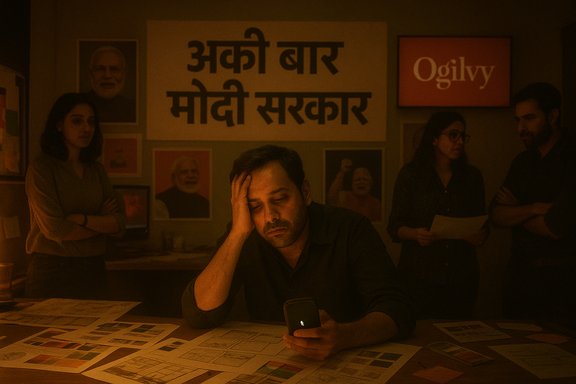
In a revelation that reframes the origin story of one of modern India’s most recognisable election lines, Union Minister Piyush Goyal says the now‑iconic slogan “Abki Baar Modi Sarkar” nearly never existed after advertising legend Piyush Pandey initially declined to work on the campaign — a refusal that, according to Goyal, followed a seven‑hour meeting and was reversed only when Pandey called back the next morning to say, “Yeh desh ki zaroorat hai.”
Piyush Pandey’s authorship and creative leadership behind “Abki Baar Modi Sarkar” is widely acknowledged in retrospectives of the 2014 election campaign. Pandey — the long‑time creative force at Ogilvy India who shaped vernacular, emotional advertising for brands such as Fevicol, Cadbury and Asian Paints — is repeatedly credited with translating political ambition into a compact, repeatable phrase that could travel across languages and social strata. The Storyboard18 account of Goyal’s remarks places a human moment behind that transition: initial reluctance on principle, prolonged persuasion, and a late‑night decision reversed by a morning call.
Ogilvy’s historical stance on direct political work and Pandey’s personal reservations about partisan assignments are documented themes in reporting about his career. That institutional caution — common across major agencies — frames the anecdote as more than theatrical detail: it underscores real reputational and ethical trade‑offs agencies confront when offered political clients. Multiple contemporaneous analyses trace how Pandey’s sensibility for colloquial Indian speech and emotional clarity translated seamlessly into a political slogan that performed like a consumer brand line.
Pandey’s advertising playbook — vernacular expression, emotional simplicity, and visual consistency — was adapted to political ends. The creative avoided policy detail and instead crystallised a single behavioral ask: vote for a Modi‑led government. That allowed the line to function simultaneously as a promise, a rallying cry, and a cultural touchpoint.
Two lessons from cross‑campaign study are relevant here:
Any single telling of that seven‑hour meeting and the morning reversal should be read as an illuminating testimony — meaningful and plausible — but not yet exhaustively corroborated. Preserving provenance, insisting on independent verification, and applying ethical governance to political creative work are the practical and civic responses the episode most urgently recommends.
Source: Storyboard18 Piyush Goyal reveals ‘Abki Baar Modi Sarkar’ almost didn’t happen after Piyush Pandey initially said no
 Background: the slogan, the man and a short history of the claim
Piyush Pandey’s authorship and creative leadership behind “Abki Baar Modi Sarkar” is widely acknowledged in retrospectives of the 2014 election campaign. Pandey — the long‑time creative force at Ogilvy India who shaped vernacular, emotional advertising for brands such as Fevicol, Cadbury and Asian Paints — is repeatedly credited with translating political ambition into a compact, repeatable phrase that could travel across languages and social strata. The Storyboard18 account of Goyal’s remarks places a human moment behind that transition: initial reluctance on principle, prolonged persuasion, and a late‑night decision reversed by a morning call.Ogilvy’s historical stance on direct political work and Pandey’s personal reservations about partisan assignments are documented themes in reporting about his career. That institutional caution — common across major agencies — frames the anecdote as more than theatrical detail: it underscores real reputational and ethical trade‑offs agencies confront when offered political clients. Multiple contemporaneous analyses trace how Pandey’s sensibility for colloquial Indian speech and emotional clarity translated seamlessly into a political slogan that performed like a consumer brand line.
Anatomy of a slogan: why five words changed a campaign
The power of “Abki Baar Modi Sarkar” lies in formal economy and cultural fluency. Structurally, the line is:- Short and rhythmic — five Hindi words with a chant‑like cadence.
- Colloquial — using conversational Hindi rather than party jargon.
- Transportable — easily repeated across regional languages and media formats.
Pandey’s advertising playbook — vernacular expression, emotional simplicity, and visual consistency — was adapted to political ends. The creative avoided policy detail and instead crystallised a single behavioral ask: vote for a Modi‑led government. That allowed the line to function simultaneously as a promise, a rallying cry, and a cultural touchpoint.
Campaign engineering: from line to movement
A slogan becomes a movement when messaging design meets operational discipline. The 2014 campaign paired Pandey’s phrase with a coordinated multimedia strategy:- Synchronous placement across television, radio, outdoor hoardings, print and early social media.
- Consistent visual identity, colour palettes and spokesperson framing to reduce friction in recognition.
- Amplification through rallies, party literature and a highly mobilised ground operation.
Why the line resonated: context and timing
Slogans do more than advertise; they ride existing public sentiment. In 2014, the political environment combined three practical conditions that magnified the line’s effect:- A widespread appetite for leadership change and promises of administrative competence.
- A centralised organisational machinery capable of saturating media markets.
- A campaign narrative that emphasised development and governance in concise, emotive language.
The hesitation: principle, reputation and the Ogilvy precedent
Pandey’s reported initial refusal matters because it highlights a broader institutional question: should creative agencies, whose reputations hinge on neutrality and corporate relationships, undertake direct political assignments?- Agencies often set internal policies to avoid direct partisan work to protect client neutrality and long‑term brand value.
- Creative leaders take reputational risk when they attach their craft to a political cause; the stakes include future business, public perception and regulatory scrutiny.
Craft vs. ethics: when persuasion becomes power
The episode raises thorny ethical questions for agencies and society:- Professional craft: Skilled communicators can significantly amplify political messages, turning persuasion into a powerful lever of influence.
- Democratic risk: When advertising techniques are applied to partisan aims, they can streamline messages in ways that reduce policy nuance and limit deliberative space.
- Transparency gaps: Large, disciplined campaigns that deploy paid, earned and organic content across platforms may obscure origin, funding and targeting practices from citizens.
Comparative perspective: where this fits in global political marketing
Comparatively, the phrase fits a global pattern: short, evocative political slogans often emerge at moments of high public receptivity and are then amplified by disciplined campaign infrastructure. Scholars of political communication compare such taglines to historical global examples where rhythm, repetition and emotional clarity turned messaging into a social chant.Two lessons from cross‑campaign study are relevant here:
- Simplicity scales: brief, rhythmic slogans travel faster and are easier to embed in public ritual.
- Engineering matters: the most enduring slogans are backed by coordinated visuals, spokespeople and distribution channels.
The limits of the anecdote: what we can and cannot verify
A responsible reading of the new anecdote requires careful verification. Several points are well attested across retrospectives:- Piyush Pandey’s central role in crafting influential advertising and in leading Ogilvy India’s creative voice is well documented.
- The 2014 campaign’s use of professional advertising techniques and the slogan’s wide cultural uptake are attested in multiple contemporaneous analyses.
What this episode teaches communicators and watchdogs
For practitioners, the case offers concrete lessons:- Design clarity wins: messaging that reduces cognitive load and uses vernacular idiom is more likely to be repeated and adopted.
- Campaign engineering is decisive: consistent visual identity, channel orchestration and disciplined amplification convert recall into momentum.
- Governance matters: agencies and creatives must define clear policies on political work, including transparency and conflict‑of‑interest checks.
Risks and reputational trade‑offs for agencies
Accepting political clients can produce immediate gains — prestige, visibility and lucrative contracts — but also significant long‑term costs:- Business risk: current or prospective corporate clients may avoid agencies perceived as partisan.
- Reputational risk: leadership attachment to political messaging can become a liability if public sentiment later shifts or controversies arise.
- Regulatory and legal risk: the blurring of state resources, campaign spending, and paid media can trigger legal scrutiny in multiple jurisdictions.
Memory, myth and the provenance of political creativity
Behind‑the‑scenes anecdotes — the late‑night phone call, the long meeting, the dramatic change of heart — do more than entertain: they contribute to the mythologising of political history. These origin stories humanise campaigns and give creative makers agency in political narratives. For communication historians, distinguishing between verifiable production facts and retrospective myth is essential.- Provenance matters: preserving primary records, memos and contemporaneous documents helps future researchers validate origin stories.
- Multiple confirmations: when a revealing anecdote emerges, corroboration from independent witnesses, contemporaneous notes or archival material elevates its evidentiary value.
- Myth versus history: a compelling anecdote can become part of political lore; rigorous archival practice keeps lore from hardening into unexamined fact.
Practical checklist for agencies considering political work
- Codify a written political‑work policy with board approval.
- Require conflict checks and client‑portfolio assessments before engagement.
- Institute transparency rules for public disclosure of political assignments.
- Establish an ethics review panel to assess public‑interest implications.
- Maintain separate teams (or firewalls) for political work to reduce client conflicts.
- Invest in staff training on the ethical boundaries of persuasion and targeted messaging.
The long view: legacy of a five‑word line
More than a decade after 2014, “Abki Baar Modi Sarkar” remains a case study in the power of marketing craft applied to political ends. Its legacy is twofold:- On craft: it demonstrates how disciplined advertising techniques — vernacular voice, formal economy, omnichannel distribution — can produce extraordinary reach and cultural uptake.
- On institutions: it forces agencies, platforms, regulators and citizens to confront how professional persuasion reshapes public discourse and democratic choice.
Conclusion: craft, conscience and the politics of messaging
The revelation that one of India’s defining election lines “almost didn’t happen” is both a human anecdote and a professional litmus test. It reminds readers that behind the brief phrases that shape public life sit ethical choices, institutional trade‑offs and skilled practitioners whose work can tip political outcomes. The industry lesson is clear: professional craft in political communication demands institutional safeguards, transparent disclosure and ongoing public literacy so that memorable lines do not become instruments of opaque persuasion.Any single telling of that seven‑hour meeting and the morning reversal should be read as an illuminating testimony — meaningful and plausible — but not yet exhaustively corroborated. Preserving provenance, insisting on independent verification, and applying ethical governance to political creative work are the practical and civic responses the episode most urgently recommends.
Source: Storyboard18 Piyush Goyal reveals ‘Abki Baar Modi Sarkar’ almost didn’t happen after Piyush Pandey initially said no
