

Absa’s Kenya unit has quietly listed a mid‑level QRM Engineer role that tells a clear story about how large African banks are reshaping risk technology: they want engineers who can operate at the intersection of legacy treasury modelling and modern cloud/DevOps practices, and they’re prepared to ask for an unusual mix of financial‑domain familiarity and hands‑on infrastructure chops.
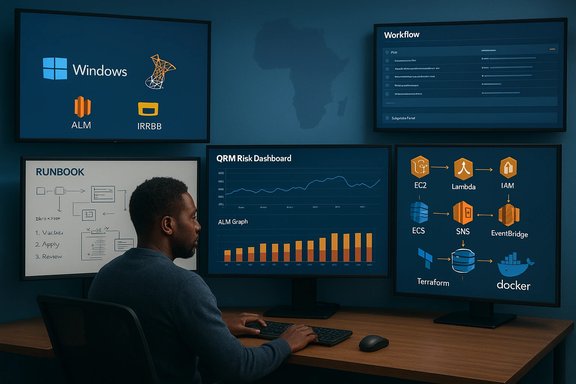
Absa’s posted role for a QRM Engineer (Kenya) frames the job as part operator, part platform engineer and part domain specialist: maintain and stabilise the QRM risk platform; implement scenarios and models; automate deployments and infrastructure; and partner closely with Risk, Treasury and Finance stakeholders. The ad lists a concise, non‑negotiable technology stack—AWS (EC2, Lambda, IAM, DynamoDB, ECS, SNS, EventBridge), CI/CD (ADO preferred), Docker, Terraform, Windows Server and Microsoft SQL Server (including 2019/2022/2025), plus automation in Python and PowerShell. It also calls out daily QRM operational responsibilities: metadata and feed troubleshooting, job scheduling, and familiarity with ALM, Liquidity, IRRBB, FTP and balance‑sheet modelling as advantageous. This is notable for two reasons. First, it’s a practical example of banks migrating specialist risk tooling from siloed, vendor‑managed estates into a cloud‑orchestrated, IaC‑driven operational model. Second, it signals the skills employers now prize: people who can straddle risk business logic and modern infrastructure automation, reducing the gap between model owners and platform operators.
Absa’s QRM Engineer posting is a compact snapshot of current enterprise demands: engineers who can operate across cloud and Windows worlds while understanding the precise, audit‑heavy needs of treasury and regulatory systems. For candidates who can pair practical automation with an appetite to learn treasury modelling details, it’s a high‑impact role; for hiring managers, it’s a reminder that successful modernization requires not just tools, but operational design, vendor governance, and clear expectations about people and processes.
Source: Opportunities for Young Kenyans ABSA Hiring QRM Engineer (KE) - Opportunities for Young Kenyans
 Overview
Absa’s posted role for a QRM Engineer (Kenya) frames the job as part operator, part platform engineer and part domain specialist: maintain and stabilise the QRM risk platform; implement scenarios and models; automate deployments and infrastructure; and partner closely with Risk, Treasury and Finance stakeholders. The ad lists a concise, non‑negotiable technology stack—AWS (EC2, Lambda, IAM, DynamoDB, ECS, SNS, EventBridge), CI/CD (ADO preferred), Docker, Terraform, Windows Server and Microsoft SQL Server (including 2019/2022/2025), plus automation in Python and PowerShell. It also calls out daily QRM operational responsibilities: metadata and feed troubleshooting, job scheduling, and familiarity with ALM, Liquidity, IRRBB, FTP and balance‑sheet modelling as advantageous. This is notable for two reasons. First, it’s a practical example of banks migrating specialist risk tooling from siloed, vendor‑managed estates into a cloud‑orchestrated, IaC‑driven operational model. Second, it signals the skills employers now prize: people who can straddle risk business logic and modern infrastructure automation, reducing the gap between model owners and platform operators.Background: Absa, QRM and the broader hiring context
Where Absa sits today
Absa Group is a major pan‑African bank headquartered in Johannesburg with operations across multiple African markets. The group presents itself as a regional bank with international expertise; in practice this means country units—Kenya among them—are integrating group standards with local regulatory and treasury needs. Public corporate profiles document Absa’s multinational footprint and evolution as a leading African banking group. Absa’s employer messaging—used repeatedly across recruitment posts—emphasises a long corporate lineage (“over 100 years” in career copy) and a structured career portal for internal development. That language appears repeatedly in local job listings, including the QRM Engineer posting. The “over 100 years” phrasing is a marketing claim used in recruitment materials and should be read as a corporate narrative tying Absa to predecessor institutions rather than a strict legal founding date; corporate and historical records show the group’s modern corporate form arose from mergers and rebrands across decades. Treat that marketing line as employer positioning rather than a precise historical fact.What QRM means in practice
“QRM” here refers to the QRM platform from Quantitative Risk Management, Inc. (the vendor that builds enterprise balance‑sheet and ALM tools). QRM’s software is widely used in financial institutions for interest‑rate, liquidity, balance‑sheet and credit scenarios; it has modules for ALM, IRRBB and stress testing and is designed to integrate with both front‑line and regulatory reporting processes. QRM’s RiskFramework and Balance Sheet Management tools are explicitly aimed at the use cases listed in Absa’s posting (scenario updates, model adjustments, daily job monitoring). The vendor‑centric nature of QRM means engineering teams are expected to operate both the vendor software and the supporting infrastructure that keeps it running, patchable and auditable.Why this hiring brief matters — technical and business signals
A convergence of two worlds
The ad’s technical stack is a compact map of current enterprise priorities:- Financial domain tools and workflows (QRM, ALM, IRRBB, FTP, balance‑sheet modelling).
- Cloud, serverless and event‑driven services (AWS EC2, Lambda, EventBridge).
- Modern DevOps toolchain (CI/CD with Azure DevOps, Terraform for IaC, Docker for containerization).
- Classic enterprise OS and databases (Windows Server, Microsoft SQL Server).
Cloud choices and implications
Absa’s preference for AWS services (EC2, Lambda, IAM, DynamoDB, ECS, SNS, EventBridge) signals a production environment that uses both enduring VM instances and serverless/evented patterns. Those services are broadly used for:- EC2: lift‑and‑shift workloads, database instances, or heavy compute for batch jobs.
- Lambda: lightweight automation, event‑driven tasks, or glue code for feeds and imports.
- EventBridge / SNS: event routing and distributed workflow orchestration between systems.
- DynamoDB / ECS: high‑scale, low‑latency storage and container runtime respectively.
Modernisation: IaC, containers and CI/CD
Terraform, Docker and ADO pipelines are the modern trifecta for reproducible deployments:- Terraform (IaC): codifies infrastructure and reduces manual configuration drift.
- Docker: standardises runtime across environments.
- Azure DevOps (ADO): handles CI/CD workflows, approvals and release gates.
What the role will likely look like day‑to‑day
Operational priorities (typical sequence)
- Monitor QRM jobs and feed pipelines: confirm nightly jobs, scenario runs and imports succeeded.
- Troubleshoot data feed failures: link symptoms to metadata, ETL, or vendor configuration.
- Implement configuration and scenario updates: apply model changes, test in UAT, push to production with documented change control.
- Maintain IaC and CI pipelines: update Terraform modules, container images, and ADO releases.
- Performance tuning and stability: diagnose slow scenarios, tune SQL Server or Windows host settings, adjust compute sizing.
- Security & compliance: maintain RBAC for QRM, ensure encryption, auditing and vendor patching cycles are documented.
Interfaces and stakeholders
- Risk and Treasury teams — model owners who define scenarios and business rules.
- Finance and regulatory reporting — consumers of output requiring scheduled and certified runs.
- Vendor (QRM) — for upgrades, patches, and feature requests.
- Infrastructure/Cloud teams — for networking, IAM, and cost controls.
- Engineering — for CI/CD, automation and incident response.
Strengths in the job brief
- Clear, modern toolset — the ad names specific cloud services, IaC and CI tools, which removes ambiguity and helps applicants match experience precisely.
- Domain + infrastructure balance — requiring QRM operational knowledge alongside cloud/DevOps skills avoids role misalignment: the engineer isn’t just a “platform” person who knows nothing about treasury logic.
- Emphasis on automation and continuous improvement — requests for Terraform, Docker and scripting show Absa wants to reduce manual intervention and standardise deployments.
- Regulatory awareness — the role explicitly supports regulatory reporting, a crucial skill for risk platform engineers.
Key risks and gaps applicants and hiring managers should watch
Risk: Expectation mismatch on domain expertise
The posting requests familiarity with ALM, IRRBB, FTP and balance‑sheet modelling as advantageous, not mandatory. That creates a potential expectation gap: hiring managers may implicitly prefer candidates who already understand treasury modelling while applicants from purely DevOps backgrounds may underestimate the learning curve. Recruiters should clarify whether deep treasury experience is required or if the bank will train strong platform engineers.Risk: Single‑vendor and single‑cloud dependency
The stack description is AWS‑centric and ties to a single vendor platform (QRM). Such concentration increases strategic risk: vendor upgrades, licensing, and single‑cloud failures can cascade into business impact. Hiring teams should include contingency planning in architecture reviews (multi‑region, DR strategies, vendor SLA clauses, and porting plans). Applicants should be prepared to discuss vendor management and risk mitigation strategies.Risk: Security and access management on sensitive data
QRM runs involve sensitive financial data and model results used for regulatory filing. Misconfigured IAM, poorly controlled SMB shares, or insufficient SQL Server hardening can expose the bank to compliance and reputational risk. The job brief mentions SMB share management and Windows Server—two historically risky surfaces if not governed. Candidates must demonstrate secure defaults, audit trail implementation and data residency knowledge.Risk: Hidden operational load
Daily monitoring, feed support and vendor patching can become a 24/7 operational burden. The job ad expects end‑to‑end ownership; applicants should ask about team size, on‑call rotation, and runbook maturity before accepting an offer. Recruiters should surface the operational cadence during the interview process to prevent early attrition.Hiring and interview guidance for candidates
How to prepare your CV (practical checklist)
- Mirror the job’s exact phrasing for key skills (QRM, ALM, IRRBB, FTP, AWS EC2/Lambda, EventBridge, Terraform, Docker, ADO, Windows Server, SQL Server). Applicant tracking and recruiter screens reward exact keyword matches.
- Provide concrete examples (Tool → Action → Outcome). For example: “Implemented Terraform modules for dev/UAT/prod resulting in 75% faster environment provisioning and zero drift incidents over six months.”
- Openly describe any QRM experience (vendor upgrades, scenario config, job schedule tuning). If you lack QRM experience, list analogous systems (other treasury platforms or risk engines) and demonstrate how you migrated knowledge.
- Include automation artifacts: Git repo links to Terraform modules, container build scripts, PowerShell tooling or Python automation. Employers value reproducible evidence over certificates alone.
Technical topics to rehearse
- QRM operational tasks: data feed troubleshooting, metadata management, nightly scenario orchestration.
- SQL Server tuning: indexing strategies, query plan analysis and backup/recovery.
- Windows Server hardening: update management, group policy and SMB controls.
- AWS core services: explain EC2 sizing choices, Lambda cost/scale trade‑offs, EventBridge vs alternative event buses.
- Terraform: state management, modules, remote backends and drift handling.
- CI/CD: pipeline design (build/test/deploy) with Azure DevOps YAML pipelines and release gates.
Questions to ask hiring managers
- What is the current QRM architecture (on‑prem, cloud, hybrid)? How is the vendor engaged for upgrades?
- What is the scale and cadence of regulatory runs (daily, weekly, monthly)?
- What is the on‑call expectation and team coverage model?
- How are environments separated and moved from dev→uat→prod (manual, automated, approvals)?
- What observability and runbook tooling exists today?
Practical roadmap for teams modernising QRM environments
For hiring managers and engineering leads tasked with modernising QRM or similar risk platforms, a practical 6‑ to 12‑month roadmap looks like this:- Inventory and map (Month 0–1)
- Document existing QRM jobs, data feeds, dependencies, and SLAs.
- Hardening and observability (Month 1–3)
- Implement logging, retention, and centralised metrics; codify access controls and encryption.
- IaC baseline (Month 2–6)
- Migrate infrastructure to Terraform modules; place state in secure remote backend with RBAC.
- Containerisation pilot (Month 4–8)
- Identify stateless QRM auxiliary services and containerise for easier deployments via ECS or EKS.
- CI/CD & release management (Month 5–9)
- Build ADO pipelines with environment approvals and integrated tests for model runs.
- Vendor upgrade and patch cadence (Ongoing)
- Establish scheduled maintenance windows, vendor communication protocols, and rollback plans.
Tools and technologies: what the job posting is actually asking you to know
- QRM (Quantitative Risk Management): enterprise ALM and risk suite used for balance‑sheet and regulatory modelling; engineers must support job orchestration, metadata and feed management.
- AWS (EC2, Lambda, IAM, DynamoDB, ECS, SNS, EventBridge): core compute, serverless, identity and event infrastructure for cloud orchestration and evented workflows. Candidate familiarity with IAM policies and cost governance is expected.
- CI/CD (Azure DevOps preferred): pipelines for build, test and deploy; used to enforce audited, repeatable releases.
- Terraform: infrastructure as code to declare, version and provision cloud and on‑prem resources. The role requires practical Terraform experience for reproducible, compliant infrastructure.
- Docker: containerization to standardise runtimes and simplify deployment across environments.
- Windows Server / Microsoft SQL Server (2019/2022/2025): the ad specifically lists these versions; modern SQL Server editions (2025) include AI‑ready capabilities and cloud integration that may tie into QRM’s data stores and analytics needs. Be prepared to discuss SQL Server performance tuning and high‑availability patterns.
- Scripting & Automation (Python, PowerShell): used for job orchestration, feed transformations, and day‑to‑day platform automation.
Final assessment: who should apply and why this is an opportunity
This role fits engineers who:- Enjoy operational ownership and can own problems end‑to‑end from incident detection to root cause and remediation.
- Are comfortable working with both financial domain stakeholders (Risk, Treasury) and technical teams.
- Want to expand from pure systems/DevOps work into a regulated, model‑centric environment that rewards both technical and domain knowledge.
- Wish to build automation and modern deployment pipelines in an enterprise setting with real regulatory impact.
Practical next steps for interested candidates (actionable)
- Update your résumé to highlight: Terraform modules, ADO pipeline YAML, Docker image builds, SQL Server tuning, and any treasury/risk system experience.
- Build a short portfolio: a small Terraform repo, an ADO pipeline example, and a documented PowerShell/Python automation script for scheduled jobs.
- Prepare domain narratives: three concise STAR stories showing model‑run troubleshooting, data feed resolution, and a stability/automation win.
- Ask the interviewers about: team on‑call model, vendor patch cadence, staging/production parity, and observability tooling.
- Negotiate for: explicit on‑call compensation, professional development budget (for risk domain training), and a clear SLA for vendor support.
Absa’s QRM Engineer posting is a compact snapshot of current enterprise demands: engineers who can operate across cloud and Windows worlds while understanding the precise, audit‑heavy needs of treasury and regulatory systems. For candidates who can pair practical automation with an appetite to learn treasury modelling details, it’s a high‑impact role; for hiring managers, it’s a reminder that successful modernization requires not just tools, but operational design, vendor governance, and clear expectations about people and processes.
Source: Opportunities for Young Kenyans ABSA Hiring QRM Engineer (KE) - Opportunities for Young Kenyans
