

adesso’s M365 Governance Framework is an enterprise consulting and implementation offering from adesso SE that helps organizations standardize Microsoft 365 roles, policies, provisioning, access controls, lifecycle rules, and change management across Teams, SharePoint, Exchange Online, and related Microsoft cloud services. It is not a shrink-wrapped app so much as a governance operating model for tenants that have grown faster than their owners can explain. That distinction matters, because Microsoft 365 sprawl is no longer merely an annoyance in the left rail of Teams. It is now a compliance, security, cost, and AI-readiness problem hiding in plain sight.
The modern Microsoft 365 tenant is a record of every compromise an organization has made between productivity and control. A project team needed a workspace quickly, so someone created a Team. A department needed to share files with a vendor, so someone loosened a SharePoint permission. A merger added another geography, another regulatory regime, and another set of naming habits.
None of those decisions is irrational in isolation. The trouble is that Microsoft 365 makes collaboration easy enough that organizational design often arrives late. By the time a CIO asks for a clean map of who owns which workspace, which guest users still have access, and which documents sit in abandoned SharePoint sites, the tenant has already become a kind of archaeological dig.
That is the opening adesso is trying to exploit with its M365 Governance Framework. The company is positioning the framework as a structured way to turn scattered Microsoft 365 practices into defined policies and repeatable workflows. The sales pitch is not that Microsoft lacks controls. The pitch is that most enterprises have not turned those controls into a durable system.
This is a familiar European systems integrator move, but it lands differently in 2026. Microsoft 365 is no longer just email plus Office plus Teams. It is also the substrate for Purview, Entra, SharePoint, Copilot, Viva, Loop, and an expanding universe of data-aware services. If the tenant is messy, every higher-level promise inherits the mess.
adesso’s framework appears to sit precisely at that intersection. It starts with discovery: how Teams, SharePoint sites, Microsoft 365 groups, mailboxes, and collaboration patterns are currently being used. It then moves into policy design, where the organization decides who can create workspaces, what classifications exist, when external sharing is allowed, and how abandoned spaces are archived or deleted.
The value is not in inventing an abstract doctrine called governance. It is in translating vague intent into Microsoft 365 behavior. “Only approved project spaces may contain customer data” is not a control. A request workflow, approval chain, naming convention, sensitivity label, SharePoint sharing configuration, retention rule, and ownership review process together begin to resemble one.
That is why the framework should be understood as a services-led product. It is not a button a tenant admin clicks in the Microsoft 365 admin center. It is a packaged way for adesso consultants to diagnose the state of a tenant, define an operating model, and implement that model using Microsoft tooling and, where needed, orchestration around it.
For adesso, that is commercially attractive. Governance work creates an opening into security, compliance, automation, managed services, Copilot readiness, and workplace transformation. For the customer, the question is whether the framework reduces entropy or simply formalizes it.
A small business can tolerate informal ownership. A multinational insurer, manufacturer, bank, healthcare provider, or public-sector body cannot. Those organizations need to know which workspaces contain regulated data, whether guests still need access, whether documents are being retained correctly, and whether users can share files in ways that violate policy.
Microsoft provides many of the underlying mechanisms. Sensitivity labels can apply to Teams, Microsoft 365 groups, SharePoint sites, and other containers. SharePoint permissions can be restricted. Guest access can be governed through Entra. Retention and data loss prevention policies can be layered on top. Conditional Access can shape how data is reached from unmanaged devices.
The difficulty is that those controls are interdependent. A label strategy that ignores Teams provisioning will fail. A retention policy that ignores business ownership will collect stale content. A guest access rule that ignores vendor workflows will be bypassed. A governance handbook that ignores user experience will be treated as decorative paperwork.
adesso’s bet is that enterprises need a bridge between Microsoft’s feature set and their own messy operating reality. That is not a trivial bet. It is also not a glamorous one. But in enterprise IT, unglamorous work often becomes budget-stable work, especially when auditors, cyber insurers, and boards start asking the same questions administrators have been asking for years.
Every enterprise has reasons for delay. The legal team wants stricter external sharing. Sales wants fewer barriers. Engineering wants fast project setup. HR wants confidential spaces. Finance wants license savings. Regional subsidiaries want local autonomy. IT wants something it can operate without becoming the help desk for every collaboration decision.
A successful governance framework has to turn those tensions into enforceable defaults. It cannot merely declare that all Teams must have owners. It has to make owner assignment part of provisioning. It cannot merely warn against guest sprawl. It has to define when guests are allowed, who approves them, how they are reviewed, and when access expires.
That is where the RACI-chart side of adesso’s approach matters. Roles and responsibilities are not bureaucratic ornamentation in Microsoft 365 governance. They are the difference between a policy that survives staff turnover and one that disappears when the original project sponsor changes jobs.
The same is true for lifecycle management. Enterprises are good at creating new collaboration spaces and bad at retiring old ones. Without expiration, review, archival, and deletion rules, Teams and SharePoint sites become permanent by accident. That permanence creates security risk, discovery burden, search noise, storage growth, and user confusion.
The credibility of adesso’s framework depends on whether it gets beyond that stage. The supplied description emphasizes implementation: request forms, automated provisioning, naming conventions, sensitivity labels, predefined channels, permissions, approvals, and lifecycle rules. Those are the details that determine whether governance becomes muscle memory.
Consider the act of creating a new Team. In an unmanaged tenant, a user creates one with a friendly name, adds colleagues, invites a vendor, uploads documents, and moves on. In a governed tenant, the same request might require a project ID, data classification, business owner, expiration date, external sharing justification, and template selection.
That sounds slower, and sometimes it is. But the trade-off is not between speed and bureaucracy. It is between speed at creation and cost over the life of the workspace. A few extra fields at provisioning can prevent months or years of uncertainty about ownership, access, retention, and compliance.
The implementation challenge is making the governed path feel like the easiest path. If users experience governance only as denial, they will route around it. If they see templates, consistent permissions, automatic channels, predictable naming, and fewer cleanup battles later, the framework has a chance.
Copilot does not magically grant users access to documents they could not otherwise reach. But that reassurance misses the operational point. If users already have access to too much, AI can make that overexposure easier to discover, summarize, and reuse. A buried SharePoint folder is one thing; an assistant that can surface its contents in response to a plain-language prompt is another.
That is why governance frameworks around Microsoft 365 now have an AI-readiness subtext even when they do not lead with AI. Sensitivity labels, access reviews, ownership, retention, and workspace lifecycle are no longer only compliance topics. They are prerequisites for deploying AI into a data estate without turning existing permission mistakes into front-page incidents.
adesso’s presence in Microsoft’s broader partner ecosystem, including Microsoft 365 and Copilot-related services, gives the framework a more strategic angle. A customer may begin with Teams sprawl and end up in a conversation about Purview, Entra, Copilot readiness, and business process redesign. That is exactly the kind of adjacency a services firm wants.
For WindowsForum readers, the practical lesson is simple: Copilot does not create the need for governance, but it removes the illusion that governance can wait. The tenant you had before AI is the tenant AI will inherit. If that tenant is chaotic, the assistant will not be the root cause. It will be the mirror.
US enterprises with European operations often discover this during acquisitions, integrations, and shared platform rollouts. A Microsoft 365 tenant that feels acceptable for a US-only business unit may look underdefined when applied to a German subsidiary, Swiss operation, or EU-regulated customer environment. External sharing, data residency, guest access, and employee monitoring all become more sensitive.
The adesso pitch benefits from that background. The company can present itself not merely as a Microsoft implementer, but as a partner comfortable with European compliance expectations and enterprise process design. For US organizations operating globally, that can be useful when Microsoft 365 becomes the common collaboration layer across regions.
There is a risk, however, that European rigor can become over-engineering if transplanted without adaptation. A governance model that fits a regulated insurer may be too heavy for a fast-moving industrial design team. A framework that imposes too many approval gates can push work back into email attachments, personal OneDrive folders, or unsanctioned tools.
The better reading is that the framework should be tailored, not worshipped. Governance maturity is not measured by the number of rules. It is measured by whether the rules map to real risk and are actually followed.
This is not likely to be a product story in the classic software-margin sense. There is no indication that the M365 Governance Framework is a mass-market SaaS product with transparent per-seat pricing and self-service onboarding. It appears to be project-based consulting and implementation work, with pricing shaped by tenant complexity, organization size, compliance burden, and automation scope.
That does not make it uninteresting. Services companies often create value by packaging repeatable methods around messy problems. If adesso can reuse discovery templates, governance models, provisioning patterns, training assets, and implementation accelerators, it can make project work more scalable while still selling tailored expertise.
The strategic upside is pull-through. A governance engagement can lead to managed Microsoft services, security work, Purview implementation, Copilot readiness, Power Platform workflows, Azure integration, and change management. In enterprise IT, the first trusted project is often the most expensive sale; the later adjacent work can be easier to win.
The downside is that services revenue is still services revenue. It depends on utilization, hiring, delivery quality, customer budgets, and competition from Microsoft partners with similar capabilities. Investors should not confuse a framework with a moat. The moat, if one exists, is execution quality, sector knowledge, customer relationships, and the ability to turn repeatable governance patterns into profitable engagements.
The adesso framework appears designed to move friction earlier and make it more predictable. A request form is friction. An approval workflow is friction. A required sensitivity label is friction. But those are knowable frictions, and knowable frictions are easier to train, automate, and defend.
The alternative is hidden friction. Hidden friction arrives when no one knows who owns a Team, whether a guest account is still valid, why a SharePoint site has unique permissions, or whether an old project folder contains regulated records. Hidden friction is more expensive because it shows up under pressure.
This is the reason governance should not be sold internally as a security clampdown. It is better understood as operational hygiene. A company with clean workspace provisioning, defined ownership, and lifecycle rules can move faster later because it is not constantly renegotiating basic collaboration norms.
That is also why change management is not a sidecar. Training users to understand why Team creation is controlled, why external sharing is reviewed, and why templates exist is part of the product. Without it, even the most elegant governance model becomes another IT imposition.
That is not necessarily a failure. Microsoft serves tenants ranging from small businesses to multinational banks. It cannot know every organization’s approval hierarchy, risk appetite, industry obligations, or internal politics. It can provide the levers, defaults, documentation, and admin surfaces. Customers still need to decide what the levers should do.
The constitution analogy is useful. A Microsoft 365 governance model defines who has authority, how decisions are made, what rights users have, what restrictions apply, and how exceptions are handled. The technical implementation is the legal code that gives that constitution force.
This is why the best governance conversations begin outside the admin center. They begin with data categories, business processes, ownership, regulatory exposure, and user behavior. Only then should the tenant configuration follow.
For IT admins, that can be both validating and maddening. Validating, because many have warned for years that Teams and SharePoint sprawl would become a problem. Maddening, because they may now be asked to fix with tooling what leadership failed to define as policy. A framework can help, but it cannot substitute for executive decisions.
A serious discovery phase should expose uncomfortable facts. It may reveal that sensitive data sits in broadly accessible SharePoint libraries. It may show that external users remain attached to projects completed years ago. It may uncover departments running parallel collaboration systems because Microsoft 365 provisioning was too slow or confusing.
The temptation is to treat those findings as cleanup tickets. Some are. But many are symptoms of missing governance decisions. If a department created its own structure, perhaps official provisioning did not meet its needs. If guest access is uncontrolled, perhaps the business had no practical process for vendor collaboration. If naming is chaotic, perhaps no one ever defined a standard users could live with.
adesso’s credibility will rest on whether it distinguishes symptoms from causes. A framework that merely tidies up visible mess will produce temporary improvement. A framework that changes how new workspaces are requested, classified, owned, reviewed, and retired can alter the trajectory of the tenant.
That distinction matters because Microsoft 365 is dynamic. New Teams, sites, groups, labels, policies, applications, and AI integrations will keep appearing. Governance is not a one-time remediation project. It is a maintenance model for a platform that never stops changing.
License optimization is rarely as simple as “turn off unused seats.” Enterprises have role requirements, bundled plans, regulatory needs, and contractual terms. Still, a governed environment makes it easier to see who uses what, which collaboration patterns are active, and where redundant solutions can be retired.
Workspace lifecycle also affects cost indirectly. Old project sites consume storage, complicate search, create backup and retention considerations, and increase administrative overhead. Every abandoned Team is not a major line item by itself, but thousands of poorly owned spaces become a tax on the organization.
There is also a labor cost. Admins spend time resolving permission confusion, answering ownership questions, investigating guest access, and cleaning up after unclear processes. A good governance model does not eliminate that work, but it reduces the number of bespoke mysteries.
For executives, this may be the most persuasive framing. Governance is not only about preventing a hypothetical breach or satisfying a future auditor. It is about lowering the operational drag of a collaboration platform that employees use every day.
Governance theater is easy to spot. The handbook exists, but provisioning does not follow it. Labels exist, but users do not understand them. Owners are named, but never reviewed. Guest access is theoretically restricted, but exceptions are permanent. Retention is documented, but old workspaces never age out.
The cure is operational telemetry. A governed Microsoft 365 environment should be measurable. How many Teams were created through approved workflows? How many have valid owners? How many guests are overdue for review? How many sites carry sensitivity labels? How many workspaces have passed their expiration date without renewal?
adesso’s framework will be judged by whether customers can answer those questions after implementation. If the answer is yes, the framework is doing more than producing documents. If the answer is no, it risks becoming another layer of policy prose floating above the same unmanaged tenant.
This is where managed services can either help or hurt. Ongoing operations can keep governance alive, but they can also outsource accountability in unhealthy ways. The business still has to own its data and decisions. A partner can operate the machinery; it should not become the conscience of the organization.
For sysadmins and IT pros, the key is to evaluate frameworks by their operational consequences rather than their vocabulary. A credible project should leave behind working controls, clear ownership, measurable lifecycle processes, and users who understand the new rules well enough not to sabotage them on day one.
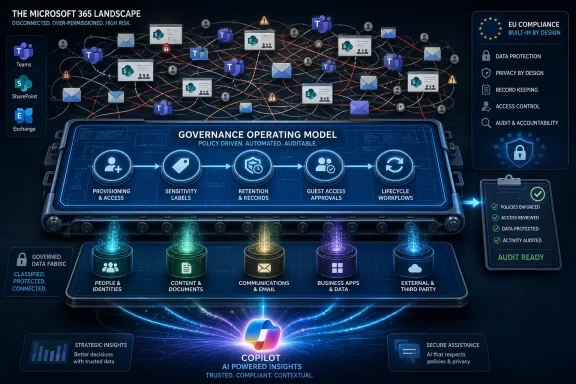 Microsoft 365 Has Become the Place Where Governance Debt Accumulates
The modern Microsoft 365 tenant is a record of every compromise an organization has made between productivity and control. A project team needed a workspace quickly, so someone created a Team. A department needed to share files with a vendor, so someone loosened a SharePoint permission. A merger added another geography, another regulatory regime, and another set of naming habits.None of those decisions is irrational in isolation. The trouble is that Microsoft 365 makes collaboration easy enough that organizational design often arrives late. By the time a CIO asks for a clean map of who owns which workspace, which guest users still have access, and which documents sit in abandoned SharePoint sites, the tenant has already become a kind of archaeological dig.
That is the opening adesso is trying to exploit with its M365 Governance Framework. The company is positioning the framework as a structured way to turn scattered Microsoft 365 practices into defined policies and repeatable workflows. The sales pitch is not that Microsoft lacks controls. The pitch is that most enterprises have not turned those controls into a durable system.
This is a familiar European systems integrator move, but it lands differently in 2026. Microsoft 365 is no longer just email plus Office plus Teams. It is also the substrate for Purview, Entra, SharePoint, Copilot, Viva, Loop, and an expanding universe of data-aware services. If the tenant is messy, every higher-level promise inherits the mess.
adesso Is Selling the Boring Part That Makes the Exciting Part Possible
The phrase “governance framework” can sound like a euphemism for binders, workshops, and invoices. In the Microsoft 365 world, though, the boring layer is often the one that determines whether the expensive layer works. Sensitivity labels, retention policies, guest access rules, conditional access, lifecycle workflows, and provisioning templates are powerful only when they reflect decisions the business has actually made.adesso’s framework appears to sit precisely at that intersection. It starts with discovery: how Teams, SharePoint sites, Microsoft 365 groups, mailboxes, and collaboration patterns are currently being used. It then moves into policy design, where the organization decides who can create workspaces, what classifications exist, when external sharing is allowed, and how abandoned spaces are archived or deleted.
The value is not in inventing an abstract doctrine called governance. It is in translating vague intent into Microsoft 365 behavior. “Only approved project spaces may contain customer data” is not a control. A request workflow, approval chain, naming convention, sensitivity label, SharePoint sharing configuration, retention rule, and ownership review process together begin to resemble one.
That is why the framework should be understood as a services-led product. It is not a button a tenant admin clicks in the Microsoft 365 admin center. It is a packaged way for adesso consultants to diagnose the state of a tenant, define an operating model, and implement that model using Microsoft tooling and, where needed, orchestration around it.
For adesso, that is commercially attractive. Governance work creates an opening into security, compliance, automation, managed services, Copilot readiness, and workplace transformation. For the customer, the question is whether the framework reduces entropy or simply formalizes it.
The Product Exists Because Microsoft 365 Is Too Permissive by Default for Large Organizations
Microsoft’s collaboration tools are designed to remove friction. That design goal helped Teams and SharePoint Online become central to daily work, but it also created a governance paradox. The more successful Microsoft 365 becomes inside a company, the more likely it is that no single person understands the whole collaboration estate.A small business can tolerate informal ownership. A multinational insurer, manufacturer, bank, healthcare provider, or public-sector body cannot. Those organizations need to know which workspaces contain regulated data, whether guests still need access, whether documents are being retained correctly, and whether users can share files in ways that violate policy.
Microsoft provides many of the underlying mechanisms. Sensitivity labels can apply to Teams, Microsoft 365 groups, SharePoint sites, and other containers. SharePoint permissions can be restricted. Guest access can be governed through Entra. Retention and data loss prevention policies can be layered on top. Conditional Access can shape how data is reached from unmanaged devices.
The difficulty is that those controls are interdependent. A label strategy that ignores Teams provisioning will fail. A retention policy that ignores business ownership will collect stale content. A guest access rule that ignores vendor workflows will be bypassed. A governance handbook that ignores user experience will be treated as decorative paperwork.
adesso’s bet is that enterprises need a bridge between Microsoft’s feature set and their own messy operating reality. That is not a trivial bet. It is also not a glamorous one. But in enterprise IT, unglamorous work often becomes budget-stable work, especially when auditors, cyber insurers, and boards start asking the same questions administrators have been asking for years.
The Real Competition Is Not Another Framework, but Organizational Drift
It is tempting to compare adesso’s offering with other Microsoft 365 governance tools, managed service providers, or consulting playbooks. That comparison is useful, but incomplete. The biggest rival to any governance project is not a product. It is the organization’s own habit of letting exceptions become patterns.Every enterprise has reasons for delay. The legal team wants stricter external sharing. Sales wants fewer barriers. Engineering wants fast project setup. HR wants confidential spaces. Finance wants license savings. Regional subsidiaries want local autonomy. IT wants something it can operate without becoming the help desk for every collaboration decision.
A successful governance framework has to turn those tensions into enforceable defaults. It cannot merely declare that all Teams must have owners. It has to make owner assignment part of provisioning. It cannot merely warn against guest sprawl. It has to define when guests are allowed, who approves them, how they are reviewed, and when access expires.
That is where the RACI-chart side of adesso’s approach matters. Roles and responsibilities are not bureaucratic ornamentation in Microsoft 365 governance. They are the difference between a policy that survives staff turnover and one that disappears when the original project sponsor changes jobs.
The same is true for lifecycle management. Enterprises are good at creating new collaboration spaces and bad at retiring old ones. Without expiration, review, archival, and deletion rules, Teams and SharePoint sites become permanent by accident. That permanence creates security risk, discovery burden, search noise, storage growth, and user confusion.
From Slideware to Controls Is the Only Test That Counts
Many governance programs fail because they stop at the moment the executive deck looks convincing. The policy says “confidential data must be protected.” The slide says “standardized lifecycle.” The operating model says “business owners are accountable.” Then users return to the same buttons and behaviors they had before.The credibility of adesso’s framework depends on whether it gets beyond that stage. The supplied description emphasizes implementation: request forms, automated provisioning, naming conventions, sensitivity labels, predefined channels, permissions, approvals, and lifecycle rules. Those are the details that determine whether governance becomes muscle memory.
Consider the act of creating a new Team. In an unmanaged tenant, a user creates one with a friendly name, adds colleagues, invites a vendor, uploads documents, and moves on. In a governed tenant, the same request might require a project ID, data classification, business owner, expiration date, external sharing justification, and template selection.
That sounds slower, and sometimes it is. But the trade-off is not between speed and bureaucracy. It is between speed at creation and cost over the life of the workspace. A few extra fields at provisioning can prevent months or years of uncertainty about ownership, access, retention, and compliance.
The implementation challenge is making the governed path feel like the easiest path. If users experience governance only as denial, they will route around it. If they see templates, consistent permissions, automatic channels, predictable naming, and fewer cleanup battles later, the framework has a chance.
Copilot Raises the Price of a Messy Tenant
The Microsoft 365 governance conversation has changed because of Copilot. Before generative AI entered the productivity suite, over-permissioned files were already a problem. With AI assistants indexing and reasoning across workplace data, the problem becomes more visible and more politically charged.Copilot does not magically grant users access to documents they could not otherwise reach. But that reassurance misses the operational point. If users already have access to too much, AI can make that overexposure easier to discover, summarize, and reuse. A buried SharePoint folder is one thing; an assistant that can surface its contents in response to a plain-language prompt is another.
That is why governance frameworks around Microsoft 365 now have an AI-readiness subtext even when they do not lead with AI. Sensitivity labels, access reviews, ownership, retention, and workspace lifecycle are no longer only compliance topics. They are prerequisites for deploying AI into a data estate without turning existing permission mistakes into front-page incidents.
adesso’s presence in Microsoft’s broader partner ecosystem, including Microsoft 365 and Copilot-related services, gives the framework a more strategic angle. A customer may begin with Teams sprawl and end up in a conversation about Purview, Entra, Copilot readiness, and business process redesign. That is exactly the kind of adjacency a services firm wants.
For WindowsForum readers, the practical lesson is simple: Copilot does not create the need for governance, but it removes the illusion that governance can wait. The tenant you had before AI is the tenant AI will inherit. If that tenant is chaotic, the assistant will not be the root cause. It will be the mirror.
The European Angle Is More Than a Marketing Detail
adesso is a German-headquartered IT services company, and that matters for this particular product category. Microsoft 365 governance is not culturally neutral. European clients tend to bring stricter expectations around data protection, works councils, cross-border processing, records retention, and formalized responsibility. Those expectations can be frustrating, but they also sharpen the governance discipline.US enterprises with European operations often discover this during acquisitions, integrations, and shared platform rollouts. A Microsoft 365 tenant that feels acceptable for a US-only business unit may look underdefined when applied to a German subsidiary, Swiss operation, or EU-regulated customer environment. External sharing, data residency, guest access, and employee monitoring all become more sensitive.
The adesso pitch benefits from that background. The company can present itself not merely as a Microsoft implementer, but as a partner comfortable with European compliance expectations and enterprise process design. For US organizations operating globally, that can be useful when Microsoft 365 becomes the common collaboration layer across regions.
There is a risk, however, that European rigor can become over-engineering if transplanted without adaptation. A governance model that fits a regulated insurer may be too heavy for a fast-moving industrial design team. A framework that imposes too many approval gates can push work back into email attachments, personal OneDrive folders, or unsanctioned tools.
The better reading is that the framework should be tailored, not worshipped. Governance maturity is not measured by the number of rules. It is measured by whether the rules map to real risk and are actually followed.
Investors Should See a Services Signal, Not a Software Jackpot
The supplied article explicitly flags adesso SE stock, traded on Xetra under ADN1 with ISIN DE000A0Z23Q5. That makes the governance framework relevant not only to CIOs, but to investors trying to understand where adesso’s Microsoft-related services portfolio is pointed. The answer is: toward the high-friction, high-trust parts of enterprise cloud adoption.This is not likely to be a product story in the classic software-margin sense. There is no indication that the M365 Governance Framework is a mass-market SaaS product with transparent per-seat pricing and self-service onboarding. It appears to be project-based consulting and implementation work, with pricing shaped by tenant complexity, organization size, compliance burden, and automation scope.
That does not make it uninteresting. Services companies often create value by packaging repeatable methods around messy problems. If adesso can reuse discovery templates, governance models, provisioning patterns, training assets, and implementation accelerators, it can make project work more scalable while still selling tailored expertise.
The strategic upside is pull-through. A governance engagement can lead to managed Microsoft services, security work, Purview implementation, Copilot readiness, Power Platform workflows, Azure integration, and change management. In enterprise IT, the first trusted project is often the most expensive sale; the later adjacent work can be easier to win.
The downside is that services revenue is still services revenue. It depends on utilization, hiring, delivery quality, customer budgets, and competition from Microsoft partners with similar capabilities. Investors should not confuse a framework with a moat. The moat, if one exists, is execution quality, sector knowledge, customer relationships, and the ability to turn repeatable governance patterns into profitable engagements.
The Customer’s Hardest Choice Is Where to Put the Friction
Every governance project eventually confronts the same design question: where should friction live? If friction is removed from creation, it reappears in audit, cleanup, incident response, legal discovery, and user confusion. If friction is inserted too aggressively at the front door, users resent the system and seek shortcuts.The adesso framework appears designed to move friction earlier and make it more predictable. A request form is friction. An approval workflow is friction. A required sensitivity label is friction. But those are knowable frictions, and knowable frictions are easier to train, automate, and defend.
The alternative is hidden friction. Hidden friction arrives when no one knows who owns a Team, whether a guest account is still valid, why a SharePoint site has unique permissions, or whether an old project folder contains regulated records. Hidden friction is more expensive because it shows up under pressure.
This is the reason governance should not be sold internally as a security clampdown. It is better understood as operational hygiene. A company with clean workspace provisioning, defined ownership, and lifecycle rules can move faster later because it is not constantly renegotiating basic collaboration norms.
That is also why change management is not a sidecar. Training users to understand why Team creation is controlled, why external sharing is reviewed, and why templates exist is part of the product. Without it, even the most elegant governance model becomes another IT imposition.
Microsoft Has the Controls, but Customers Still Need a Constitution
Microsoft’s role in this story is slightly awkward. On one hand, the company has built a broad and increasingly capable governance stack across Microsoft 365, Entra, Purview, SharePoint, Teams, and related services. On the other hand, the existence of frameworks like adesso’s is evidence that Microsoft’s controls do not organize themselves.That is not necessarily a failure. Microsoft serves tenants ranging from small businesses to multinational banks. It cannot know every organization’s approval hierarchy, risk appetite, industry obligations, or internal politics. It can provide the levers, defaults, documentation, and admin surfaces. Customers still need to decide what the levers should do.
The constitution analogy is useful. A Microsoft 365 governance model defines who has authority, how decisions are made, what rights users have, what restrictions apply, and how exceptions are handled. The technical implementation is the legal code that gives that constitution force.
This is why the best governance conversations begin outside the admin center. They begin with data categories, business processes, ownership, regulatory exposure, and user behavior. Only then should the tenant configuration follow.
For IT admins, that can be both validating and maddening. Validating, because many have warned for years that Teams and SharePoint sprawl would become a problem. Maddening, because they may now be asked to fix with tooling what leadership failed to define as policy. A framework can help, but it cannot substitute for executive decisions.
The Framework’s Promise Depends on How Honestly Discovery Is Done
Discovery is the least glamorous phase of a governance engagement, but it may be the most important. Enterprises cannot govern the tenant they imagine they have. They have to govern the tenant that actually exists, including exceptions, shadow processes, abandoned sites, stale guests, duplicate workspaces, and local workarounds.A serious discovery phase should expose uncomfortable facts. It may reveal that sensitive data sits in broadly accessible SharePoint libraries. It may show that external users remain attached to projects completed years ago. It may uncover departments running parallel collaboration systems because Microsoft 365 provisioning was too slow or confusing.
The temptation is to treat those findings as cleanup tickets. Some are. But many are symptoms of missing governance decisions. If a department created its own structure, perhaps official provisioning did not meet its needs. If guest access is uncontrolled, perhaps the business had no practical process for vendor collaboration. If naming is chaotic, perhaps no one ever defined a standard users could live with.
adesso’s credibility will rest on whether it distinguishes symptoms from causes. A framework that merely tidies up visible mess will produce temporary improvement. A framework that changes how new workspaces are requested, classified, owned, reviewed, and retired can alter the trajectory of the tenant.
That distinction matters because Microsoft 365 is dynamic. New Teams, sites, groups, labels, policies, applications, and AI integrations will keep appearing. Governance is not a one-time remediation project. It is a maintenance model for a platform that never stops changing.
The Governance Story Gets Real When It Touches Money
Security and compliance usually dominate the governance discussion, but cost control is a quieter driver. Microsoft 365 environments accumulate unused accounts, redundant workspaces, unnecessary storage, overlapping tools, and premium licenses assigned by habit rather than need. Governance gives finance a better map.License optimization is rarely as simple as “turn off unused seats.” Enterprises have role requirements, bundled plans, regulatory needs, and contractual terms. Still, a governed environment makes it easier to see who uses what, which collaboration patterns are active, and where redundant solutions can be retired.
Workspace lifecycle also affects cost indirectly. Old project sites consume storage, complicate search, create backup and retention considerations, and increase administrative overhead. Every abandoned Team is not a major line item by itself, but thousands of poorly owned spaces become a tax on the organization.
There is also a labor cost. Admins spend time resolving permission confusion, answering ownership questions, investigating guest access, and cleaning up after unclear processes. A good governance model does not eliminate that work, but it reduces the number of bespoke mysteries.
For executives, this may be the most persuasive framing. Governance is not only about preventing a hypothetical breach or satisfying a future auditor. It is about lowering the operational drag of a collaboration platform that employees use every day.
The Risk Is Turning Governance Into Theater
The danger with any framework is that it becomes performative. Enterprises love the appearance of maturity: diagrams, responsibility matrices, maturity models, steering committees, and policy portals. Those artifacts can be useful, but they can also disguise the absence of enforcement.Governance theater is easy to spot. The handbook exists, but provisioning does not follow it. Labels exist, but users do not understand them. Owners are named, but never reviewed. Guest access is theoretically restricted, but exceptions are permanent. Retention is documented, but old workspaces never age out.
The cure is operational telemetry. A governed Microsoft 365 environment should be measurable. How many Teams were created through approved workflows? How many have valid owners? How many guests are overdue for review? How many sites carry sensitivity labels? How many workspaces have passed their expiration date without renewal?
adesso’s framework will be judged by whether customers can answer those questions after implementation. If the answer is yes, the framework is doing more than producing documents. If the answer is no, it risks becoming another layer of policy prose floating above the same unmanaged tenant.
This is where managed services can either help or hurt. Ongoing operations can keep governance alive, but they can also outsource accountability in unhealthy ways. The business still has to own its data and decisions. A partner can operate the machinery; it should not become the conscience of the organization.
What WindowsForum Readers Should Watch as adesso Pushes This Framework
The practical value of adesso’s M365 Governance Framework will vary by organization, but the larger trend is clear. Microsoft 365 tenants have become too important, too data-rich, and too AI-connected to be governed informally. The next phase of modern workplace projects is less about adoption and more about control that users can live with.For sysadmins and IT pros, the key is to evaluate frameworks by their operational consequences rather than their vocabulary. A credible project should leave behind working controls, clear ownership, measurable lifecycle processes, and users who understand the new rules well enough not to sabotage them on day one.
- Enterprises should treat Microsoft 365 governance as an operating model, not a one-time cleanup campaign.
- Sensitivity labels, guest access controls, retention policies, and lifecycle workflows only matter when they are tied to real business decisions.
- Copilot and other AI features raise the stakes by making existing permission mistakes easier to surface.
- adesso’s framework is best understood as a services-led governance package rather than a conventional standalone software product.
- Investors should view the framework as evidence of adesso’s push into higher-value Microsoft services, not as a guaranteed software-style growth engine.
- Customers should demand measurable outcomes, including owner coverage, guest review rates, labeled workspaces, and automated provisioning adoption.
References
- Primary source: AD HOC NEWS
Published: 2026-07-02T10:43:08.705639
adesso M365 Governance Framework - helping enterprises get control over Microsoft 365
The adesso M365 Governance Framework gives enterprises a structured way to standardize roles, policies and workflows around Microsoft 365. Anyone holding adesso SE stock (Xetra: ADN1, ISIN DE000A0Z23Q5) should know this product.www.ad-hoc-news.de - Official source: partner.microsoft.com
Find a Microsoft partner
Discover how Microsoft partners deliver the technical expertise, services, and solutions you need to grow your business.partner.microsoft.com
- Official source: learn.microsoft.com
Configure Teams with three tiers of file sharing security | Microsoft Learn
Learn how to configure Teams for better file sharing security using three tiers of protection, balancing security with ease of collaboration.learn.microsoft.com - Official source: support.microsoft.com
Sharing files, folders, and list items | Microsoft Support
Sharing files, folders, and list itemssupport.microsoft.com - Official source: microsoftpartners.microsoft.com
- Related coverage: adesso.nl
adesso and Microsoft
Our software development is primarily focused on the implementation of tailor-made solutions: for requirements and missions where off-the-shelf software is not enough.www.adesso.nl
- Related coverage: adesso.de
Microsoft Managed Services
Benefit from our managed services for Microsoft applications. We ensure seamless integration into your IT landscape, as well as the availability and performance of your systems. Contact us.www.adesso.de - Official source: microsoft.com
</rdf:Alt> </dc:title> <dc:description> <rdf:Alt> <rdf:li xml:lang="x-default"/> </rdf:Alt> </dc:description> <dc:creator> <rdf:Seq> <rdf:li>Lukas V
</rdf:Alt> </dc:description> <dc:creator> <rdf:Seq> <rdf:li>Lukas Velushwww.microsoft.com
- Related coverage: adesso-group.de
- Official source: cdn-dynmedia-1.microsoft.com
- Related coverage: syskit.com
