
Adactin’s launch of AFIVE is a timely reminder that the next phase of enterprise AI is not just about generating text, but about making internal knowledge usable at scale. The Australian technology services provider says the new platform is designed to unify scattered information sources, reduce duplication, and speed decision-making through a single conversational interface built on Microsoft Azure services. If the execution matches the promise, AFIVE could become a practical example of how retrieval-augmented generation moves from pilot-project rhetoric to everyday business utility.
Enterprise search has been one of the most persistent frustrations in modern organisations. Companies have spent years investing in SharePoint sites, shared drives, cloud storage, collaboration tools, and document management systems, only to discover that information becomes harder to find as it becomes more abundant. AFIVE is Adactin’s answer to that problem, and the company is positioning it as an AI-powered knowledge platform rather than a conventional search tool.
The launch matters because it reflects a broader shift in the market: enterprises are no longer asking whether generative AI can produce fluent responses, but whether it can do so reliably, securely, and in context. Microsoft has been steadily promoting Azure AI Foundry, Azure OpenAI, and RAG-based application patterns as the foundation for such systems, and AFIVE appears to follow that blueprint closely. In that sense, the announcement is less about novelty in model capability and more about productising a known architecture for a business audience.
Adactin also deserves attention as a vendor. The company describes itself as a next-generation technology services provider with Microsoft and AWS expertise, and its public materials emphasise AI-powered digital engineering, quality assurance, and delivery across public and private sector customers. That background matters because knowledge platforms succeed or fail not only on model quality, but on integration discipline, governance, and the ability to map real enterprise workflows.
The company’s framing is notable too. Rather than presenting AFIVE as a replacement for workers, Adactin says the platform is intended to reduce repetitive retrieval work and support higher-value decision-making. That positioning may help it resonate with enterprise buyers who are wary of AI initiatives that sound transformational but lack operational grounding. It also aligns with the current market preference for systems that augment knowledge workers instead of simply automating them away.
The timing is also important because many organisations have already discovered that generic chat interfaces are not enough. A chatbot that cannot cite the right policy, locate the latest contract, or distinguish between outdated and current source material creates more risk than value. AFIVE’s stated focus on trusted enterprise knowledge sources and contextual responses reflects a market reality: businesses want AI that knows where information came from and can respect access controls.
For buyers, that is not a weakness. In enterprise software, the winning products are often those that make complex infrastructure feel simple and dependable. AFIVE’s differentiator is not that it does RAG at all, but that it packages RAG, repository integration, role-based controls, and workflow triggers into a single business-facing proposition. That bundle is what turns a technology pattern into a usable platform.
Key implications of the launch include:
The platform is built on a Retrieval-Augmented Generation architecture with LangChain, vector databases, and Azure AI Foundry components. In practical terms, that means the system can retrieve relevant documents semantically, not merely by matching keywords. For business users, this is the difference between searching for a phrase and asking a question in natural language and getting an answer that is actually useful.
AFIVE also appears intended to do more than answer questions. Adactin says it can automate workflows and generate actionable insights through integration with Power BI and Power Automate. This is the right direction strategically because the real enterprise payoff of AI usually comes from reducing the gap between knowing something and doing something about it.
Important functional ideas behind the platform include:
The phrase security-by-design is doing a lot of work here, but in this context it is the right phrase. RAG systems can inadvertently surface content the user should not see if permissions are not enforced at both retrieval and presentation layers. Microsoft’s own guidance around using your data in Azure AI Foundry emphasizes authenticated connections, search indices, and managed identities, which reinforces how foundational these controls are to enterprise adoption.
Adactin’s emphasis on authorised access and protected enterprise knowledge suggests it understands this reality. Still, buyers should ask practical questions: which documents are indexed, how permissions propagate, whether prompts are logged, and how hallucinations are controlled. Those answers matter more than marketing language, because governance is where AI projects either become enterprise tools or remain interesting prototypes.
Security takeaways for buyers:
Microsoft has been pushing exactly this type of stack: models, agents, search, and responsible AI tooling integrated into a platform designed for enterprise development. Its documentation explicitly describes Azure AI Foundry as an environment for building RAG solutions and LangChain-based applications, which means Adactin is drawing on a well-supported implementation pattern rather than assembling a speculative one-off.
The choice of LangChain is also telling. LangChain has become one of the more common orchestration layers for LLM applications, especially where developers need flexibility across models, tools, and retrieval steps. Adactin’s use of it suggests the company wants to balance portability with enterprise integration, even if the underlying user experience is meant to feel simple.
The Microsoft-centric design may offer several benefits:
There is a meaningful distinction between saving time and changing work. A tool that merely fetches a document faster is helpful; a platform that can summarise, contextualise, and trigger the next step in a process is more interesting. By integrating with Power Automate and Power BI, AFIVE is attempting to move from passive knowledge retrieval to active decision support.
Still, automation should be treated carefully. Many enterprise processes contain exceptions, approval layers, and edge cases that a generative system may not interpret correctly. The best deployments will therefore keep a human-in-the-loop approach for sensitive actions, especially where data quality or policy interpretation matters.
What productivity improvement could look like:
This positioning may also help Adactin differentiate from generic document management systems. The company explicitly says AFIVE goes beyond storage and retrieval by interpreting and synthesising enterprise data. That is the right framing, because a modern enterprise does not simply need another repository; it needs a layer that makes repositories intelligible.
The competitive test will come from deployment reality. Buyers will compare AFIVE not only with other vendors but also with do-it-yourself internal builds on Azure, Microsoft 365 Copilot-style experiences, and existing knowledge management stacks. Its success will depend on whether it can offer better governance, better retrieval quality, and better workflow integration than those alternatives.
Competitive differentiators to watch:
For enterprises, the value proposition is unusually concrete. They are dealing with scattered storage systems, version sprawl, duplicated documents, and the constant risk of employees making decisions on the basis of outdated information. AFIVE directly addresses those pain points by surfacing contextual answers from approved sources.
There is also a cultural difference. Consumer products thrive on self-service adoption, while enterprise software needs sponsorship, governance, and rollout planning. AFIVE will likely succeed only if it can be piloted in a department, prove measurable time savings, and then expand into broader business functions without creating new operational burden.
Enterprise and consumer differences include:
That strategy is commercially sensible. Services companies often face margin pressure unless they can create repeatable assets, accelerators, or platforms. A product like AFIVE can serve as both a client-facing solution and a proof point that Adactin can execute on enterprise AI at the platform level, not just in consulting engagements.
The broader question is whether AFIVE becomes a flagship product or remains primarily a tailored solution for select customers. Either outcome could be commercially useful, but the long-term strategic value will be highest if Adactin can turn the platform into a repeatable accelerator across industries and departments. That is where platform economics begin to matter.
Strategic takeaways:
The opportunity is larger than faster search. If Adactin can prove the platform in one department and then extend it across the organisation, AFIVE could become a knowledge operating layer rather than just a chatbot.
There are also governance and adoption risks. Security-by-design is essential, but it must be implemented rigorously, especially when multiple repositories and permission models are involved. If the system exposes even one sensitive document incorrectly, trust can erode quickly, and in enterprise software trust is hard to rebuild.
It will also be worth watching whether Adactin develops industry-specific versions or reference implementations. Public sector, financial services, and regulated industries tend to value governance and traceability more than generic productivity claims, so those markets could be especially receptive if AFIVE can demonstrate control and auditability. Equally, an Azure-centric stack may make it easier to land with organisations already standardised on Microsoft services.
Potential next milestones include:
Source: iTWire iTWire - Adactin Launches AFIVE: An Intelligent AI Knowledge Platform Empowering Enterprises with Consistent Data, Reduced Duplication, and Accelerated Decision-Making
 Overview
Enterprise search has been one of the most persistent frustrations in modern organisations. Companies have spent years investing in SharePoint sites, shared drives, cloud storage, collaboration tools, and document management systems, only to discover that information becomes harder to find as it becomes more abundant. AFIVE is Adactin’s answer to that problem, and the company is positioning it as an AI-powered knowledge platform rather than a conventional search tool.The launch matters because it reflects a broader shift in the market: enterprises are no longer asking whether generative AI can produce fluent responses, but whether it can do so reliably, securely, and in context. Microsoft has been steadily promoting Azure AI Foundry, Azure OpenAI, and RAG-based application patterns as the foundation for such systems, and AFIVE appears to follow that blueprint closely. In that sense, the announcement is less about novelty in model capability and more about productising a known architecture for a business audience.
Adactin also deserves attention as a vendor. The company describes itself as a next-generation technology services provider with Microsoft and AWS expertise, and its public materials emphasise AI-powered digital engineering, quality assurance, and delivery across public and private sector customers. That background matters because knowledge platforms succeed or fail not only on model quality, but on integration discipline, governance, and the ability to map real enterprise workflows.
The company’s framing is notable too. Rather than presenting AFIVE as a replacement for workers, Adactin says the platform is intended to reduce repetitive retrieval work and support higher-value decision-making. That positioning may help it resonate with enterprise buyers who are wary of AI initiatives that sound transformational but lack operational grounding. It also aligns with the current market preference for systems that augment knowledge workers instead of simply automating them away.
Why This Launch Fits the Current Enterprise AI Moment
AFIVE arrives at a time when enterprises are increasingly trying to turn scattered content into actionable intelligence. The appeal of RAG is straightforward: rather than relying on a model’s general training data alone, the system retrieves relevant internal documents and uses them to ground responses. Microsoft’s own documentation describes RAG as a common pattern for building applications with your own data, which is precisely the kind of value proposition Adactin is packaging here.The timing is also important because many organisations have already discovered that generic chat interfaces are not enough. A chatbot that cannot cite the right policy, locate the latest contract, or distinguish between outdated and current source material creates more risk than value. AFIVE’s stated focus on trusted enterprise knowledge sources and contextual responses reflects a market reality: businesses want AI that knows where information came from and can respect access controls.
From novelty to utility
The shift from experimentation to utility is visible across the broader AI stack. Microsoft now describes Azure OpenAI in Foundry Models as a way to access foundational and reasoning models, integrate agents, and build securely with responsible AI at the core. That language mirrors the kind of messaging Adactin is using for AFIVE, suggesting the platform is built to ride a larger wave rather than invent a new one.For buyers, that is not a weakness. In enterprise software, the winning products are often those that make complex infrastructure feel simple and dependable. AFIVE’s differentiator is not that it does RAG at all, but that it packages RAG, repository integration, role-based controls, and workflow triggers into a single business-facing proposition. That bundle is what turns a technology pattern into a usable platform.
Key implications of the launch include:
- Enterprise AI is becoming workflow-centric, not just conversational.
- Knowledge fragmentation is now a first-order productivity issue.
- Governance and access control are no longer optional features.
- Model quality alone is not enough to win enterprise trust.
- Integration depth is increasingly the real differentiator.
What AFIVE Appears to Do
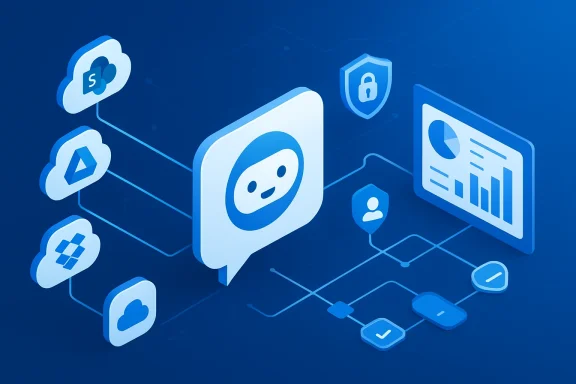
Based on Adactin’s description, AFIVE is designed to pull content from multiple repositories — including SharePoint, Google Drive, Azure Blob Storage, and Dropbox — and present it through a single secure conversational interface. That matters because many organisations do not lack data; they lack a coherent way to query it across systems without forcing users to remember where things are stored.The platform is built on a Retrieval-Augmented Generation architecture with LangChain, vector databases, and Azure AI Foundry components. In practical terms, that means the system can retrieve relevant documents semantically, not merely by matching keywords. For business users, this is the difference between searching for a phrase and asking a question in natural language and getting an answer that is actually useful.
The value of semantic retrieval
The promise of semantic retrieval is that employees should no longer need to know which department owns a document, what folder it sits in, or which version is current. Instead, they can ask a question and receive a contextual response. That is appealing in large organisations where knowledge is distributed across sales, operations, compliance, HR, finance, and project teams.AFIVE also appears intended to do more than answer questions. Adactin says it can automate workflows and generate actionable insights through integration with Power BI and Power Automate. This is the right direction strategically because the real enterprise payoff of AI usually comes from reducing the gap between knowing something and doing something about it.
Important functional ideas behind the platform include:
- Natural-language access to internal knowledge.
- Cross-repository ingestion for fragmented content estates.
- Contextual summarisation rather than raw document dump.
- Workflow automation tied to insights and triggers.
- A unified interface intended to reduce search fatigue.
Security, Governance, and Responsible AI
Security is one of the most important claims in the launch, and also one of the hardest to validate from a press release alone. Adactin says AFIVE includes network isolation, encrypted credential management, and role-based access via Microsoft Entra ID, all of which are sensible design choices for enterprise AI. Those controls are not optional add-ons; they are the difference between a useful internal assistant and an uncontrolled data exposure risk.The phrase security-by-design is doing a lot of work here, but in this context it is the right phrase. RAG systems can inadvertently surface content the user should not see if permissions are not enforced at both retrieval and presentation layers. Microsoft’s own guidance around using your data in Azure AI Foundry emphasizes authenticated connections, search indices, and managed identities, which reinforces how foundational these controls are to enterprise adoption.
Why governance matters more than demo quality
In a demo, a knowledge assistant looks magical. In production, it must be auditable, permission-aware, and predictable under load. That is especially true in regulated industries or public sector environments, where a model that summarises a policy incorrectly may create compliance problems rather than productivity gains.Adactin’s emphasis on authorised access and protected enterprise knowledge suggests it understands this reality. Still, buyers should ask practical questions: which documents are indexed, how permissions propagate, whether prompts are logged, and how hallucinations are controlled. Those answers matter more than marketing language, because governance is where AI projects either become enterprise tools or remain interesting prototypes.
Security takeaways for buyers:
- Role-based access should extend end-to-end.
- Credential handling must be isolated and encrypted.
- Auditability is essential in regulated environments.
- Permission filtering must occur during retrieval.
- Human review paths should exist for high-risk outputs.
Microsoft Azure as the Strategic Backbone
AFIVE’s technology choices are as important as its feature list. Adactin says the platform is built with Azure OpenAI Service and Azure AI Foundry architecture, which places it firmly inside Microsoft’s enterprise AI ecosystem. That has obvious advantages: mature identity tooling, integrated security options, and a widely adopted cloud environment for corporate customers.Microsoft has been pushing exactly this type of stack: models, agents, search, and responsible AI tooling integrated into a platform designed for enterprise development. Its documentation explicitly describes Azure AI Foundry as an environment for building RAG solutions and LangChain-based applications, which means Adactin is drawing on a well-supported implementation pattern rather than assembling a speculative one-off.
Why the stack matters commercially
For customers already invested in Microsoft 365, Entra ID, Power BI, SharePoint, and Azure, the platform feels immediately more adoptable. That is not just a technical advantage; it is a procurement advantage. Enterprises tend to buy what fits their current operating model, and AFIVE seems designed to reduce the friction of adoption by living inside that ecosystem.The choice of LangChain is also telling. LangChain has become one of the more common orchestration layers for LLM applications, especially where developers need flexibility across models, tools, and retrieval steps. Adactin’s use of it suggests the company wants to balance portability with enterprise integration, even if the underlying user experience is meant to feel simple.
The Microsoft-centric design may offer several benefits:
- Faster integration with identity and collaboration tools.
- Lower switching friction for Microsoft-heavy organisations.
- Strong enterprise security primitives already familiar to IT teams.
- A clearer path to governance through Azure-native services.
- Potentially easier scaling for organisations that already standardise on Azure.
Productivity Gains and Workflow Automation
The central business claim behind AFIVE is productivity. Adactin says the platform reduces the time employees spend searching across multiple systems and frees them for higher-value strategic work. That sounds familiar, but it is still one of the strongest use cases for enterprise AI because search and retrieval remain hidden productivity drains in most organisations.There is a meaningful distinction between saving time and changing work. A tool that merely fetches a document faster is helpful; a platform that can summarise, contextualise, and trigger the next step in a process is more interesting. By integrating with Power Automate and Power BI, AFIVE is attempting to move from passive knowledge retrieval to active decision support.
How automation changes the user experience
If a finance manager can ask for a policy summary, see related KPI context, and trigger a workflow without leaving the interface, that is a genuine operational improvement. It reduces context switching, shortens cycle times, and makes internal knowledge feel more connected to execution. That is the kind of workflow change that can survive beyond an AI pilot and become part of daily work.Still, automation should be treated carefully. Many enterprise processes contain exceptions, approval layers, and edge cases that a generative system may not interpret correctly. The best deployments will therefore keep a human-in-the-loop approach for sensitive actions, especially where data quality or policy interpretation matters.
What productivity improvement could look like:
- Faster answers to recurring internal questions.
- Less duplicate work across teams maintaining overlapping files.
- Shorter onboarding for employees learning where information lives.
- Improved collaboration through shared access to consistent sources.
- Fewer manual handoffs when insights can trigger workflows directly.
Competitive Positioning in a Crowded AI Market
AFIVE enters a field crowded with point solutions, enterprise search tools, copilots, and large platform vendors all promising some version of “knowledge work transformation.” Adactin is not competing by claiming to own the foundation model race; instead, it is competing on implementation, integration, and service delivery. That is a sensible move for a technology services provider because the market is rewarding usable outcomes more than abstract AI capability.This positioning may also help Adactin differentiate from generic document management systems. The company explicitly says AFIVE goes beyond storage and retrieval by interpreting and synthesising enterprise data. That is the right framing, because a modern enterprise does not simply need another repository; it needs a layer that makes repositories intelligible.
Why services firms are moving into productised AI
Many consulting and services companies are discovering that their clients want repeatable accelerators, not bespoke proof-of-concepts. AFIVE can be read as a productised response to that demand: one that turns Adactin’s cloud, AI, and software engineering experience into a repeatable platform offering. That matters because services-led AI businesses increasingly need software assets to scale margins and create stickier customer relationships.The competitive test will come from deployment reality. Buyers will compare AFIVE not only with other vendors but also with do-it-yourself internal builds on Azure, Microsoft 365 Copilot-style experiences, and existing knowledge management stacks. Its success will depend on whether it can offer better governance, better retrieval quality, and better workflow integration than those alternatives.
Competitive differentiators to watch:
- Implementation speed versus custom internal builds.
- Multi-repository coverage versus narrow single-source tools.
- Governance depth versus generic chat interfaces.
- Workflow integration versus static search.
- Vendor support versus DIY architecture complexity.
Enterprise vs. Consumer Impact
AFIVE is clearly an enterprise play, and that distinction matters. Consumer AI products are usually judged by convenience and novelty, while enterprise platforms are judged by reliability, control, compliance, and measurable productivity gains. Adactin’s launch is therefore aimed at IT leaders, operations teams, and knowledge workers rather than end consumers browsing a public app store.For enterprises, the value proposition is unusually concrete. They are dealing with scattered storage systems, version sprawl, duplicated documents, and the constant risk of employees making decisions on the basis of outdated information. AFIVE directly addresses those pain points by surfacing contextual answers from approved sources.
Why consumers are not the real audience
A consumer knowledge assistant would need broad general knowledge and lightweight UX. AFIVE, by contrast, needs deep integration into enterprise systems and strict access control. That makes it less flashy but potentially much more valuable, because the cost of a bad answer inside a company is often far higher than the cost of a bad answer in a consumer app.There is also a cultural difference. Consumer products thrive on self-service adoption, while enterprise software needs sponsorship, governance, and rollout planning. AFIVE will likely succeed only if it can be piloted in a department, prove measurable time savings, and then expand into broader business functions without creating new operational burden.
Enterprise and consumer differences include:
- Enterprise buyers demand governance; consumers demand convenience.
- Enterprise value is measured in workflow savings; consumer value is measured in engagement.
- Enterprise deployments need admin controls; consumer deployments need simplicity.
- Enterprise AI must respect permissions; consumer AI prioritises breadth.
- Enterprise adoption is phased; consumer adoption is often immediate.
Adactin’s Broader Strategy
AFIVE does not appear in isolation. Adactin’s public materials show a company leaning hard into AI, digital engineering, and Microsoft/AWS-based transformation services. It has also been highlighting growth recognition, awards, and its role as a provider of consulting and engineering services across public and private sectors. In that context, AFIVE looks like part of a broader strategy to deepen its AI credentials and productise expertise.That strategy is commercially sensible. Services companies often face margin pressure unless they can create repeatable assets, accelerators, or platforms. A product like AFIVE can serve as both a client-facing solution and a proof point that Adactin can execute on enterprise AI at the platform level, not just in consulting engagements.
The signal to the market
AFIVE also sends a message to existing and prospective clients: Adactin wants to be seen as more than a staffing or implementation partner. By showing that it can build a secure, multi-repository AI knowledge system on Azure, the company is telling the market it understands enterprise AI architecture end to end. That is a valuable signal in a market where credibility increasingly depends on shipping real systems rather than talking about them.The broader question is whether AFIVE becomes a flagship product or remains primarily a tailored solution for select customers. Either outcome could be commercially useful, but the long-term strategic value will be highest if Adactin can turn the platform into a repeatable accelerator across industries and departments. That is where platform economics begin to matter.
Strategic takeaways:
- AFIVE strengthens Adactin’s AI narrative.
- It may improve consulting conversion by providing a tangible demo asset.
- It could create recurring revenue if productised effectively.
- It supports cross-sell opportunities across Azure-related services.
- It positions Adactin as a builder, not just an advisor.
Strengths and Opportunities
AFIVE has several strengths that make the announcement more than just another AI press release. The most compelling is that it focuses on a real, persistent enterprise pain point: fragmented knowledge. The platform’s mix of semantic retrieval, repository unification, security controls, and workflow automation gives it a credible path to measurable operational value.The opportunity is larger than faster search. If Adactin can prove the platform in one department and then extend it across the organisation, AFIVE could become a knowledge operating layer rather than just a chatbot.
- Solves a universal enterprise problem: information sprawl.
- Uses a proven architecture: RAG plus enterprise search.
- Fits Microsoft-heavy environments with minimal conceptual friction.
- Supports workflow automation, not just question answering.
- Aligns with governance expectations through Entra ID and security-by-design.
- Can reduce duplicate content and version confusion across teams.
- May strengthen Adactin’s product credibility in a services-led market.
Risks and Concerns
The biggest risk is the gap between promise and production. Many AI knowledge platforms perform well in demonstrations but struggle when confronted with messy content, inconsistent metadata, outdated documents, and human expectations that exceed model reliability. If AFIVE cannot consistently surface the right answer with sufficient confidence, users may revert to familiar search habits.There are also governance and adoption risks. Security-by-design is essential, but it must be implemented rigorously, especially when multiple repositories and permission models are involved. If the system exposes even one sensitive document incorrectly, trust can erode quickly, and in enterprise software trust is hard to rebuild.
- Hallucination risk if grounding is weak or documents conflict.
- Permission leakage risk if access controls are not enforced end to end.
- Content quality risk when source documents are outdated or duplicated.
- Adoption risk if employees do not trust AI-generated summaries.
- Integration complexity across SharePoint, Google Drive, Dropbox, and Blob Storage.
- Maintenance burden as new data sources and workflows are added.
- Scope creep if the platform tries to do too much too soon.
Looking Ahead
The most important question now is whether AFIVE can move from launch language to measurable outcomes. That will mean proving that employees can find answers faster, reduce duplicate work, and make better decisions without adding new administrative overhead. In enterprise AI, the winning products are usually the ones that become invisible because they are so embedded in daily work.It will also be worth watching whether Adactin develops industry-specific versions or reference implementations. Public sector, financial services, and regulated industries tend to value governance and traceability more than generic productivity claims, so those markets could be especially receptive if AFIVE can demonstrate control and auditability. Equally, an Azure-centric stack may make it easier to land with organisations already standardised on Microsoft services.
Potential next milestones include:
- Pilot deployments in knowledge-intensive departments.
- Evidence of time savings and reduced search friction.
- Industry-tailored configurations for regulated sectors.
- Deeper workflow integrations with Microsoft Power Platform.
- Published governance and security practices to support buyer confidence.
- Expanded repository support and better content ingestion controls.
Source: iTWire iTWire - Adactin Launches AFIVE: An Intelligent AI Knowledge Platform Empowering Enterprises with Consistent Data, Reduced Duplication, and Accelerated Decision-Making
