

AGCO Turns AI Curiosity Into a Governance Problem
The first wave of enterprise generative AI was sold as a productivity story. Workers would summarize meetings, draft emails, query documents, and shave minutes off the low-friction rituals of office life. That mattered, but it was also the safest possible version of the pitch: AI as autocomplete for the already digitized workplace.
AGCO’s rollout points to the harder second wave. In Microsoft’s customer story, AGCO leaders describe employees experimenting with AI on personal devices and hunting for faster ways to fix local problems. The danger was not that employees were interested; the danger was that they would solve real problems with unapproved tools, unmanaged data flows, and no path from individual hack to enterprise-grade process.
That is the moment when “AI literacy” stops being a training slogan and becomes infrastructure. Aryn Drawdy, AGCO’s Director of Strategic Partnerships, makes the important distinction plainly in Microsoft’s account: asking how AI can help is the wrong starting point. The better question is where work already breaks down.
That sounds obvious, but it cuts against much of the agent hype cycle. Vendors want to show agents doing impressive things. Enterprises need to know where an agent can survive contact with production, policy, permissions, auditability, and human judgment.
The Friction Point Is the Product
AGCO’s most compelling examples come from manufacturing workflows, where product improvements often arrive as running changes inside active production builds. That is a very different environment from a chatbot answering HR questions. It means quality, warranty, design, supply chain, and manufacturing teams may all have partial context, overlapping responsibilities, and timing pressure.
Microsoft’s story says these processes can stretch for weeks or months as teams review issues, validate data, and align on next steps. The delay is not necessarily because anyone is idle. It is because the work depends on coordination across systems and on a small group of experts who know how to interpret the data.
That is precisely where agents become interesting. Not as autonomous replacements for engineers or quality specialists, but as connective tissue between scattered sources of truth. An agent that brings the right contract, design note, supplier record, warranty signal, or agronomy document into the moment of decision is not doing magic. It is reducing the tax paid every time enterprise knowledge has to cross an organizational boundary.
The key phrase in Microsoft’s account is that AGCO is trying to make expertise easier to apply where it is needed. That is a more realistic ambition than replacing expertise, and it is also more valuable. In complex industrial environments, the bottleneck is often not knowledge creation; it is knowledge routing.
Citizen Development Finally Meets Its Adult Supervision
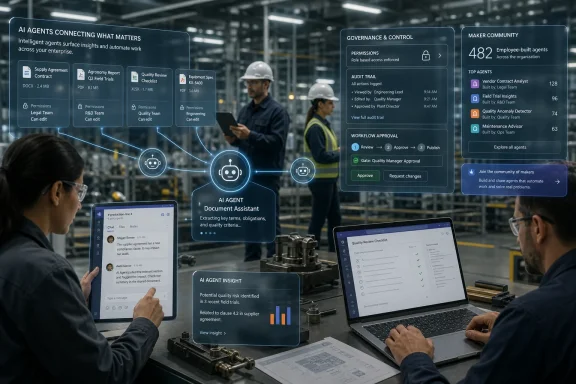
AGCO’s program began with a striking internal response. At a leadership meeting of about 2,200 people, the company asked who wanted to start building agents, and roughly 900 employees volunteered. AGCO then provided access, began training the next day, and used Microsoft Teams to support a maker community.
That is the kind of statistic vendors love, and Microsoft understandably foregrounds it. But the number matters only if it is paired with governance. Otherwise, 900 enthusiastic makers can become 900 future cleanup projects.
Drawdy’s formulation — “It’s not shadow IT—it’s support” — is the hinge of the story. AGCO is not pretending every employee-built agent should immediately be treated as enterprise software. Nor is it trying to suffocate experimentation inside a central approval board. The company is attempting the middle path: employees identify friction, while AI leaders and Microsoft specialists help shape the solution.
That model should sound familiar to anyone who lived through the rise of Power Platform, SharePoint workflows, Excel macros, and departmental databases. The enterprise has always oscillated between empowering the edge and reasserting control from the center. Copilot Studio simply raises the stakes because the new artifacts can reason over documents, invoke actions, summarize sensitive material, and appear more authoritative than they may deserve.
Microsoft’s Platform Bet Is Really a Control Bet
Copilot Studio is not just a low-code agent builder. In Microsoft’s broader documentation, it sits inside the Power Platform governance universe, with controls for publishing agents, managing knowledge sources, applying data policies, and administering agent availability through Microsoft 365. Microsoft also emphasizes data loss prevention, tenant-level controls, environment settings, and lifecycle management for agents.
That matters because the agent market is already crowded with point tools, browser extensions, SaaS copilots, open-source frameworks, and internal experiments. Microsoft’s bet is that enterprises will prefer a governed platform tied to Microsoft 365, SharePoint, Teams, OneDrive, Excel, Word, PowerPoint, and Power Platform over a zoo of disconnected agent runtimes. AGCO is almost a textbook customer for that pitch: a global manufacturer with business-specific workflows, large employee populations, and Microsoft already embedded in daily work.
The practical appeal is obvious. If employees already live in Teams and SharePoint, and if the organization already manages identity, permissions, compliance, and admin controls through Microsoft’s stack, Copilot Studio becomes the sanctioned place where AI curiosity can be channeled. That does not make the technology risk-free. It makes the risk administrable.
For WindowsForum readers, this is the part worth watching. Microsoft’s AI strategy is not confined to Windows 11 Copilot buttons or chat panes in Office apps. It is an attempt to make Microsoft 365 the operating layer for workplace AI, with agents as the next abstraction above documents, chats, workflows, and apps.
Several Hundred Agents Is a Milestone, Not a Victory Lap
Microsoft says AGCO now has several hundred enterprise agents in production, with several hundred more moving through cohorts designed to consolidate and optimize them for enterprise use. The original group of 900-plus makers has reportedly grown to roughly 2,000 across the company. Those are large numbers, but they also reveal the next management problem.
Once agents multiply, the challenge shifts from creation to portfolio discipline. Which agents are redundant? Which ones touch regulated or sensitive data? Which ones are used every day, and which are abandoned after a pilot? Which ones should remain team-level helpers, and which ones deserve enterprise hardening?
This is where many AI programs will either mature or decay. A few clever agents can be celebrated as innovation. Hundreds of agents require inventory, ownership, documentation, monitoring, retirement plans, and accountability when outputs are wrong. If an agent summarizes a contract incorrectly or advances a quality issue based on incomplete context, the enterprise still owns the outcome.
AGCO’s cohort approach is therefore more important than the raw deployment count. It suggests the company understands that agent creation is not the finish line. The serious work is turning successful experiments into governed assets without stripping away the local knowledge that made them useful in the first place.
The Quality Review Claim Shows Both the Promise and the Caveat
The headline operational claim in Microsoft’s story is that AGCO is cutting some quality reviews from weeks to about an hour. That is a big number, and it should be read carefully. Microsoft’s wording says “some” quality reviews, not all quality reviews, and the story frames the improvement around the ability to read, validate, and advance issues more quickly.
That caveat does not make the claim unimportant. In manufacturing, even narrowing the delay on a subset of quality processes can matter because decisions propagate through production schedules, supplier conversations, warranty exposure, and customer support. A faster review cycle can mean faster containment, faster fixes, and fewer people waiting for a constrained expert to become available.
But the claim also illustrates why enterprise agents need tight scoping. A quality workflow is not a generic productivity task. It has operational consequences. The agent’s value depends on the quality of connected data, the clarity of the process boundary, and the human controls around final decisions.
The best reading is not that AGCO has automated quality management. It is that AGCO is using agents to compress the administrative and analytical drag around quality management. That distinction is less glamorous, but it is also more credible.
The Supplier and Agronomy Agents Show the Real Direction of Travel
AGCO’s agent examples move beyond office automation into business-specific knowledge work. Microsoft describes a supplier agent that reads contracts and identifies where AI suppliers could increase value and potential savings over the next year or two. It also describes an agronomy agent that combines AGCO agronomy studies with sales guidance and web content to help sales teams connect agricultural issues to relevant machines.
These are not universal agents. They are domain agents. Their usefulness depends on AGCO’s proprietary context, its supplier relationships, its product lines, its sales motions, and its agronomic expertise.
That is where enterprise AI may finally escape the generic chatbot problem. A general-purpose assistant can draft a note. A domain-specific agent can help a salesperson translate a regional agronomy problem into a machine recommendation, or help a procurement team see where a supplier contract intersects with future AI value. The difference is grounding.
It also explains why AGCO is talking about an agentic framework rather than a single bot. One agent will not understand the full web of product quality, supplier contracts, agronomy, sales, product management, and customer acquisition. Several connected agents, each with a defined scope and governed access to the right sources, is a more plausible architecture.
The Agentic Enterprise Will Be Messier Than the Demo
The vendor dream is a clean agent graph: one agent hands off to another, data flows through approved connectors, actions are logged, users are delighted, and ROI appears on schedule. The enterprise reality will be messier. Departments will build overlapping agents. Permissions will expose uncomfortable truths about badly managed content. Data quality problems will surface in places where manual workarounds previously hid them.
That is not an argument against the approach. It is an argument for realism. AI agents are not just new interfaces; they are diagnostic tools that reveal how brittle enterprise knowledge systems already are. If an agent cannot answer a question because documents are contradictory, permissions are chaotic, or process ownership is unclear, the agent has not created the problem. It has made the problem visible.
AGCO’s friction-first framing is useful because it starts with the mess rather than pretending the platform will erase it. The company is not asking every team to “do AI.” It is asking employees to identify pain points and then matching those pain points with appropriate automation, agent design, or workflow redesign.
That distinction should matter to IT leaders. A mandate to build agents can produce theater. A mandate to remove friction can produce measurable work.
Windows Shops Should Read This as a Microsoft 365 Story
Although AGCO’s announcement is not a Windows feature story in the narrow sense, it is very much a Microsoft ecosystem story. The tools named in Microsoft’s customer account — Copilot Studio, Microsoft 365 Copilot, Teams, Word, Excel, PowerPoint, OneDrive, and SharePoint — are the software fabric of many Windows-heavy organizations. That makes this less about one manufacturer and more about where Microsoft wants enterprise work to go.
The traditional Windows endpoint is becoming only one surface for AI-enabled work. Agents may be built in Copilot Studio, surfaced through Teams or Microsoft 365 Copilot, grounded in SharePoint or OneDrive, and governed through admin centers that IT already uses. The PC remains important, but the locus of control is increasingly the tenant.
For admins, this changes the checklist. Device management, patching, identity, and endpoint security remain table stakes. But AI governance now means understanding who can create agents, where they can publish them, what sources they can ground on, whether public web content is allowed, how data movement is controlled, and how agent inventory is reviewed.
That is a new layer of operational responsibility. It will not be handled well by organizations that treat Copilot licensing as a procurement event rather than a platform rollout.
The ROI Story Is Really About Time, Trust, and Expertise
Microsoft’s AGCO story repeatedly returns to speed: faster reviews, faster movement from idea to agent, faster access to expertise, faster scaling through makers. Speed is the easiest AI benefit to sell. It is also the easiest to overstate.
The more durable value may be trust. If employees believe the sanctioned tools are useful, responsive, and supported, they have less incentive to paste sensitive data into consumer AI services or build private workarounds. If business teams believe IT is a partner rather than a blocker, they are more likely to bring problems into the open.
Expertise is the third leg. AGCO’s quality and agronomy examples are both about distributing scarce knowledge more effectively. In many organizations, the most valuable employees are not just busy; they are bottlenecks. Agents that help others benefit from their expertise without requiring constant direct involvement can improve throughput without pretending the experts are obsolete.
That is the sober promise of enterprise AI: not fewer humans, but fewer avoidable waits for the right human.
The AGCO Playbook Has a Shape Other Enterprises Can Copy
AGCO’s implementation is specific to agriculture and manufacturing, but the pattern is broadly applicable. It starts with employee curiosity, acknowledges the risk of unmanaged experimentation, creates a sanctioned maker path, pairs that path with governance, and then promotes successful use cases toward enterprise deployment. That is not revolutionary. It is disciplined.
The unresolved question is whether the model scales cleanly as agents become more capable. Today’s agents may summarize, retrieve, validate, and route. Tomorrow’s agents may initiate more actions, coordinate across more systems, and make recommendations that feel uncomfortably close to decisions. The governance burden rises with capability.
Microsoft’s documentation already gestures toward this with controls around publishing, knowledge sources, data policies, responsible AI, and agent lifecycle management. But tools are not governance by themselves. Someone still has to decide which risks are acceptable, which workflows require human approval, and how agent behavior is audited over time.
That will separate durable AI transformations from expensive pilot farms.
AGCO’s Lesson Is That the Agent Boom Needs Managers as Much as Makers
AGCO’s story offers several concrete lessons for Microsoft-centric organizations trying to move beyond AI dabbling without losing control. The important thread is that the company did not start by asking employees to worship the tool. It started by asking them where work hurts.
- AGCO’s most important move was treating employee AI experimentation as a signal to govern, not a behavior to suppress.
- The company’s maker program worked because it paired access and training with support from AI leaders and Microsoft specialists.
- The strongest use cases are grounded in business friction, including quality reviews, supplier contract analysis, and agronomy-guided sales work.
- The reported reduction of some quality reviews from weeks to about an hour is meaningful, but it should be read as process acceleration rather than full automation.
- The growth from roughly 900 volunteer makers to about 2,000 across AGCO shows adoption momentum, but it also increases the need for inventory, lifecycle management, and agent rationalization.
- The broader Microsoft lesson is that Copilot Studio’s enterprise value depends as much on governance, permissions, and data discipline as on generative AI capability.
AGCO’s Copilot Studio rollout is not proof that every enterprise needs hundreds of agents, or that Microsoft has solved the messy human side of AI adoption. It is proof of something narrower and more useful: when a company starts with friction, gives employees a governed place to build, and treats agents as extensions of expertise rather than replacements for it, AI can become part of operational infrastructure instead of another layer of workplace theater. The next phase will test whether that infrastructure can remain coherent as the agent count rises, the workflows get more consequential, and every large Microsoft customer discovers that the real AI transformation is not building bots — it is redesigning how work moves.
References
- AGCO scales employee-built AI agents with Microsoft Copilot Studio Microsoft · 2026-07-06T18:50:08.572061