

Agentic AI is the shift from “helpful text” to “measurable action”: systems that set goals, break them into steps, call tools, verify outcomes, and iterate until the job is done. In 2026 that shift is no longer academic — teams expect agents to close tickets, launch campaigns, reconcile books, and update systems with measurable ROI, and that operational leap demands an engineering-first playbook covering architecture, evals, observability, governance, and staged autonomy.
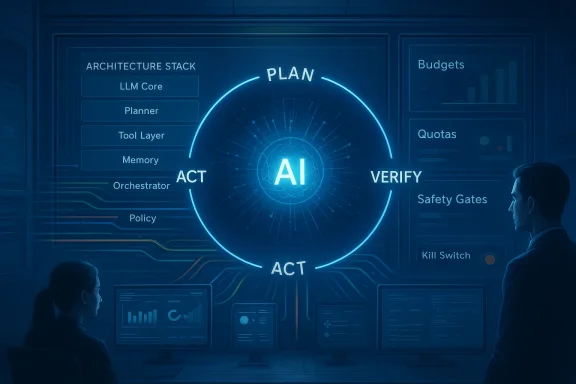
Agentic AI is best understood as a system behavior rather than a single model: an agent perceives goals, plans a sequence of steps, executes those steps through tools or APIs, verifies the results, and repeats or escalates when needed. This cyclical “plan → act → verify → iterate” loop is what separates agentic systems from one-shot generative assistants and is central to production-readiness discussions in 2026.
Platform vendors and educators emphasize different parts of the stack: vendors (especially those building low-code enterprise surfaces) stress deployment, lifecycle management, and governance; educators and researchers focus on evaluation discipline and error analysis. Both messages matter — one gets a pilot running, the other keeps it safe and sustainable.
Source: thevirallines.net Mastering Agentic AI Masterclass (Build AI Agents)
 Background
Agentic AI is best understood as a system behavior rather than a single model: an agent perceives goals, plans a sequence of steps, executes those steps through tools or APIs, verifies the results, and repeats or escalates when needed. This cyclical “plan → act → verify → iterate” loop is what separates agentic systems from one-shot generative assistants and is central to production-readiness discussions in 2026.Platform vendors and educators emphasize different parts of the stack: vendors (especially those building low-code enterprise surfaces) stress deployment, lifecycle management, and governance; educators and researchers focus on evaluation discipline and error analysis. Both messages matter — one gets a pilot running, the other keeps it safe and sustainable.
The Agent Loop: Theory and Practical Implications
What the loop actually does
At the functional level, an agent implements:- Goal understanding: map user intent into constraints and success criteria.
- Planning: decompose work into discrete, verifiable steps.
- Tooling: call external services, run DB queries, open tickets, or run scripts.
- Verification: use tests, checks, or secondary agents to confirm outcomes.
- Iteration / Escalation: retry, change strategy, or hand off to humans when confidence is low.
Why the loop matters to builders
The difference between a prototype and production is not model size or a clever prompt; it’s the loop’s operational controls. Production agents need budgets, quotas, circuit breakers, schema validation for each tool call, and human approval thresholds. Absent these, small hallucination rates become catastrophic action risks (wrong updates, misaddressed emails, or data exfiltration).Agentic AI vs Generative AI: A Builder’s View
Practical contrast
- Generative AI: reactive content generation (answer the prompt).
- Agentic AI: goal-driven workflows that may span many systems and require stateful decision-making.
Failure modes that change everything
Generative failure modes are typically incorrect or misleading text. Agentic failure modes include:- Wrong system changes (bad CRM updates).
- Unauthorized actions (permission misuse).
- Security gaps (leakage via integrations).
- Integrity drift (slowly degrading outputs without detection).
Masterclass Curriculum: Skills & Patterns You Need
A credible “Mastering Agentic AI” program teaches builders to move from “it works on my laptop” to “it runs safely at scale.”Core skill patterns
- Tool-use pattern: define strict schemas for inputs/outputs, validate, retry with backoff, and log every call.
- Reflection pattern: enable agents to self-critique and produce structured failure reasons that feed evals.
- Planning pattern: explicit step decomposition with checkpoints and clear success criteria.
- Role separation: planner, executor, and verifier agents (or modules) with distinct responsibilities.
- Budgeting: caps for tokens, time, and external tool usage.
Deliverables that hiring managers respect
When shipping a portfolio or an internal pilot, produce artifacts that match engineering and audit needs:- Workflow diagrams and dependency maps.
- Tool specs with input/output contracts and error handling.
- Evals dashboards with KPIs and failure breakdowns.
- Observability logs and replay traces for incidents.
- Security posture documents: RBAC, scopes, and audit plans.
- Deployment notes addressing latency, cost, and rollback.
Architecture: Building Production-Grade Agents
Core components
A production architecture typically contains:- LLM core: reasoning and language for planning and interpretation.
- Planner: task decomposition and decision logic.
- Tool layer: typed adapters for APIs, DBs, browsers, and internal systems.
- Memory: short session memory and long-term storage with governance controls.
- Orchestrator: executes flows, handles retries, enforces budgets.
- Policy layer: permission rules, approval thresholds, and consent flows.
- Logging & tracing: comprehensive context for every action.
Reliability and safety layers
Add explicit layers to reduce blast radius:- Approval gates for operations classified as risky.
- Least-privilege tool scopes and short-lived credentials.
- Human-in-the-loop escalation when confidence < threshold.
- Kill switches and anomaly detectors to pause agents in flight.
- Immutable audit logs capturing intent, plan, tool calls, and verification artifacts.
Tooling Landscape: What to Choose and Why
Categories that matter
Select tooling by workflow needs, not vendor marketing:- Orchestration: manages multi-step flows, retries, and branching.
- RAG (Retrieval-Augmented Generation): supplies factual context and policies.
- Monitoring & evals: tracks quality, drift, and cost.
- Security controls: secrets management, RBAC, and audit-ready logs.
- Sandboxing: safe-mode execution for uncertain actions.
Tool-interface design (critical engineering discipline)
Treat each tool as a product API:- Define strict input/output schemas.
- Use typed contracts and validators.
- Provide safe defaults (no destructive actions by default).
- Implement retries, backoff, and circuit breakers.
- Log request/response payloads and decisions for replay.
Use Cases: Start Narrow, Scale Carefully
Single-agent vs multi-agent
- Use single-agent when tasks are linear, low-risk, and verification is simple.
- Use multi-agent when tasks can parallelize, role separation is valuable, or independent verification (“red team” agent) is required.
Five practical, ROI-friendly workflows to ship fast
- Research-to-brief agents that gather sources and draft evidence-backed summaries.
- Support agents that triage tickets, suggest fixes, and update CRM entries.
- Marketing ops agents that generate assets, schedule outreach, and compile performance reports.
- Finance reconciliation agents that pair invoices, flag anomalies, and draft accounting notes.
- Sales enablement agents that produce account insights, draft outreach, and log CRM activity.
Governance, Monitoring, and Operational Playbook
Governance basics
Deploying agents requires formal rules:- Define tool permission scopes and data contracts.
- Set approval thresholds by action risk level.
- Store logs securely with redaction for sensitive fields.
- Create retention policies and compliance evidence collection.
Monitoring and incident response
Production agents need:- Evals dashboards for quality, safety, and cost metrics.
- Drift detection to spot slow degradations.
- Incident workflows: pause, investigate, rollback, and postmortem with exact decision traces.
- Regular error analysis and continuous improvement sprints.
Security Risks and Defenses
Agentic systems expand the attack surface: agents execute actions, hold credentials, and connect systems. Key mitigations include:- Least-privilege credentials and short token lifetimes.
- Runtime anomaly detection with automated kill-switches.
- Hardened integration adapters to prevent data exfiltration.
- Supply-chain controls for third-party models and agents.
- Red-team adversarial testing prior to broad rollout.
Messaging and Go-to-Market: Explaining Agents Without Hype
An effective product page does three things: educate, build trust, convert.- State the job-to-be-done clearly (what workflow it automates).
- Demonstrate how it works at a high level (planner → tools → verifier).
- Surface safety and governance: approvals, RBAC, logs, and audit evidence.
Vendors, Partnerships, and the Service Layer
Platform vendors (product suites and low-code builders) are racing to become the enterprise agent layer, while specialized services offer end-to-end integration and governance. The practical guidance for enterprises:- Start with a pilot that isolates risk and demonstrates ROI.
- Insist on vendor contract clauses about data portability, audit evidence, and model provenance.
- Consider a specialist integration partner for the first production rollouts to avoid common pitfalls.
Common Pitfalls — And How to Avoid Them
- Shipping without an eval framework: measure before you scale.
- Overprivileging agents: apply least privilege and short access windows.
- Treating agents as “finished” at deployment: plan for continuous ops.
- Mixing exploratory experiments with production traffic: separate namespaces and credentials.
- Relying on a single tool: design modularity and the ability to swap components.
A Realistic Roadmap: From Pilot to Scale
- Discover & prioritize: catalog models, data dependencies, and legal exposure. Prioritize high-value, contained workflows.
- Architect & govern: build your AgentOps playbook and clear observability definitions.
- Pilot & iterate: deploy a single pilot with strict guardrails and red-team tests.
- Scale & standardize: create registries, metadata, and automated compliance evidence for audits.
Closing Analysis: Strengths, Risks, and Where to Invest
Agentic AI offers a compelling productivity multiplier: automations that deliver measurable work — not just words. The engineering and governance shifts required are non-trivial, however, and must be funded and staffed deliberately.- Strengths: potential for measurable ROI, automation of complex cross-system workflows, and new product capabilities built on execution rather than content.
- Risks: action-oriented failures, security exposure through tool integrations, and operational drift without solid evals and monitoring.
- High-leverage investments: eval frameworks and error-analysis tooling, robust tool-interface contracts, and AgentOps practices that mirror mature SRE or SecOps workflows.
Final Word
The era of agentic AI is about building systems that do work reliably at scale, not demos that look clever for ten minutes. Success in 2026 demands an engineering-first approach: modular architecture, strict tool contracts, staged autonomy, comprehensive evals, and enterprise-grade governance. If your organization wants to move beyond prompts to operational automation, map workflows narrowly, instrument everything, and insist on measurable KPIs before scaling. The playbook exists — it’s now a matter of discipline, not speculation.Source: thevirallines.net Mastering Agentic AI Masterclass (Build AI Agents)
