

Simplilearn and IIT Patna’s Vishlesan I-Hub Foundation launched a 10-week Professional Certificate Program in Agentic AI and Multi-Agent AI Systems on June 1, 2026, delivered online from India through live virtual classes for technology and product professionals. The announcement is more than another edtech press release in a market already thick with AI certificates. It is a useful snapshot of where the AI training economy is moving: away from “learn prompt engineering” and toward the harder problem of building systems that can plan, call tools, coordinate agents, and survive contact with enterprise workflows. For Windows professionals, Microsoft 365 administrators, developers, and automation-minded IT teams, that shift matters because agentic AI is increasingly being sold not as a chatbot feature, but as the next layer of workplace computing.
Agentic AI has become the phrase every training provider wants on the brochure. A year ago, most enterprise AI courses were still built around generative AI fundamentals: large language models, prompt templates, vector search, retrieval-augmented generation, and the familiar parade of productivity use cases. Now the center of gravity has moved to agents, workflows, orchestration, and multi-step execution.
The Simplilearn–Vishlesan I-Hub program follows that market turn almost exactly. It promises coverage of agentic frameworks, planning systems, multi-agent coordination, prompt engineering, RAG, Model Context Protocol, workflow automation, and go-to-market strategy for agentic AI. The tool list is equally telling: LangChain, AutoGen, CrewAI, n8n, Microsoft Copilot, Hugging Face, Miro, Figma, LangSmith, and Jupyter.
That is not a random shopping list. It maps the current agentic AI stack from experimentation to deployment: notebook prototyping, model access, orchestration, debugging, workflow automation, and the collaboration surfaces where product teams actually work. The program’s stated design goal is to move learners “from building interfaces to designing efficient behaviors,” which is a neat way of saying that the old chatbot demo is no longer enough.
The question is whether a 10-week certificate can actually produce that competence. The honest answer is: sometimes, for the right learner, but not by magic. Agentic AI is not one skill. It is a collision of software engineering, systems design, API security, business process modeling, user experience, data governance, and model evaluation. A short program can introduce that stack and force hands-on practice, but it cannot substitute for production scars.
Simplilearn brings the opposite half of the bargain: distribution, virtual delivery, cohort operations, job assistance, and a catalog built for working professionals. The partnership is therefore a familiar but effective edtech pattern. An academic or research-linked institution supplies legitimacy; the platform supplies scale.
The timing is not subtle. Grand View Research’s India enterprise agentic AI outlook estimates the country’s enterprise agentic AI market at $132.6 million in 2024 and projects it to reach $1.73 billion by 2030, implying a steep growth curve through the second half of the decade. Market forecasts should always be treated as directional rather than sacred, especially in a segment whose definitions are still hardening. But the direction is difficult to dispute: enterprise buyers are asking vendors for AI systems that do more than generate text.
That urgency helps explain why the program targets technology and product professionals rather than only fresh graduates. Agentic AI is not merely a data science topic. It is now a product architecture topic, a business-process redesign topic, and increasingly an IT operations topic. The people being asked to evaluate it inside companies are often product managers, solution architects, automation engineers, cloud administrators, and team leads who already understand the business workflow but need a vocabulary for the AI layer.
That reflects a broader maturation of the AI market. The first wave of generative AI training taught users how to coax useful outputs from a model. The second wave taught developers how to ground model answers in private data using retrieval. The agentic wave asks a more dangerous and useful question: what happens when a model is allowed to decide which tool to use next?
That single change alters the risk profile. A chatbot that drafts an email can be wrong in a visible way. An agent that reads a CRM record, opens a support ticket, updates a spreadsheet, invokes a script, or triggers a workflow can be wrong in a consequential way. The technical problem becomes less about the beauty of a response and more about permissions, audit trails, state management, evaluation, rollback, and human approval.
This is why tools like n8n and LangSmith are not just decorative additions. Workflow tools force learners to think in steps, branches, triggers, and failure modes. Observability and evaluation tools force them to inspect what the system did, not merely admire what it said. If the course meaningfully uses those tools across its promised seven hands-on projects and capstone, it has a better chance of teaching the part of agentic AI that enterprises actually need.
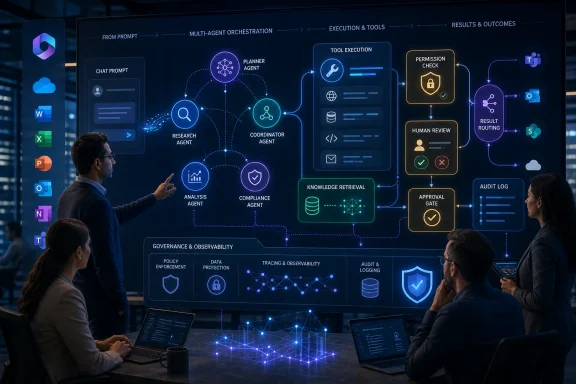
The capstone model also matters. Agentic systems are easiest to understand when they are built around a real sequence of work: gather information, classify intent, retrieve context, call tools, check output, route exceptions, and report status. Without that structure, “multi-agent” can become theater: several chatbots talking to each other in a loop, producing plausible nonsense with extra latency.
Microsoft has spent the last few years pushing Copilot from a branded assistant into a platform surface across Microsoft 365, Windows, GitHub, Power Platform, Azure, Security, and Dynamics. The company’s strategic bet is that AI will become less of a destination app and more of a control plane over documents, meetings, tickets, code, data, and business applications. Agentic AI is the vocabulary that makes that bet legible.
That has practical implications for IT departments. The old model of software adoption was application-centric: install the tool, assign licenses, configure policy, train users, and monitor support tickets. Agentic systems blur that model because the “application” may be a chain of model calls, connectors, plugins, scripts, data sources, and approvals stitched together across cloud services.
Windows administrators and Microsoft 365 tenants are already living with the early version of this shift. Copilot licensing has raised familiar questions about data exposure, retention, permissions hygiene, and measurable productivity. Agents add a second layer: not just “what can the model see?” but “what can the model do?” That question belongs squarely in the world of identity, conditional access, least privilege, endpoint management, logging, and compliance.
A training program that includes Copilot but also teaches independent frameworks like LangChain, AutoGen, CrewAI, and n8n is therefore more useful than a pure vendor course. Real enterprises are rarely single-stack in practice. Even Microsoft-heavy organizations will encounter open-source agent frameworks, SaaS automation tools, custom Python glue, and developer experiments running ahead of central governance.
Agentic AI is unusually resistant to passive learning. A professional can understand the concept of a planner, a retriever, a tool-calling agent, or a multi-agent workflow from a lecture. But the real learning happens when the system fails: the agent loops, selects the wrong tool, fabricates a parameter, mishandles context, overwhelms an API, exposes data it should not, or produces a confident final answer that no intermediate trace supports.
That failure mode is why the distinction between demos and projects matters. Demos show what the instructor wants the learner to see. Projects reveal what the learner forgot to constrain. A serious agentic AI course should make students debug bad tool calls, design guardrails, compare model behavior across prompts, inspect traces, and write approval gates into workflows.
The stated prerequisites suggest the program is not intended as a beginner’s AI literacy course. Learners need a fundamental understanding of programming concepts, must be at least 18 years old, and must have a high school diploma; four or more years of formal work experience is preferred but not mandatory. That is a sensible floor. The audience that benefits most from this kind of course is not necessarily the person who can derive a transformer architecture from first principles. It is the person who can look at a messy business process and decide where autonomy should end.
That is also where many AI training programs underperform. They spend too much time on tools and too little on judgment. The hard part of enterprise AI is often not building an agent that can act. It is deciding whether the agent should act, when it must ask, what it must log, who owns its errors, and how the organization proves that it behaved within policy.
That speed is both strength and risk. On the positive side, Indian professionals have repeatedly used short, intensive credentials to move into new technical tracks: cloud computing, cybersecurity, data engineering, DevOps, and generative AI. A 10-week agentic AI program can be a useful accelerator for someone who already understands software delivery or product operations.
The risk is credential inflation. Once a term becomes marketable, certificates multiply faster than employers can interpret them. “Agentic AI” is especially vulnerable because it sounds advanced even when the underlying project is a thin wrapper around an LLM API. Hiring managers will need to look past the label and ask what the learner actually built.
The Simplilearn–Vishlesan I-Hub course appears aware of this problem, at least in its positioning. It emphasizes projects, tools, frameworks, and a capstone rather than only lectures. It also includes job assistance through Simplilearn’s JobAssist Plus. That service may help learners package their work, but the durable career value will come from portfolios that demonstrate real systems thinking.
For employers, the signal should be the artifact, not the certificate. Did the candidate build an agentic workflow that retrieves from a private knowledge base, calls external tools safely, handles exceptions, and produces auditable output? Did they understand where a human approval step belongs? Did they test the system against failure cases? Those questions matter more than whether the badge uses the right industry phrase.
But multi-agent architecture also invites waste. Many tasks do not need multiple agents. They need one well-constrained workflow, a reliable data source, deterministic business logic, and a model used sparingly. Splitting a problem across agents can increase cost, latency, unpredictability, and debugging complexity.
This is where a good curriculum must teach restraint. The industry has a habit of presenting architectural complexity as sophistication. In agentic AI, complexity is often a liability until proven otherwise. The best systems may look boring: a narrow trigger, a constrained set of tools, strong retrieval, explicit permissions, clear logging, and a human review step before anything irreversible happens.
That lesson is especially important for IT pros who will inherit these systems after pilots become production workloads. An agent built by an innovation team can become an operational headache if it depends on undocumented credentials, fragile prompts, unbounded API usage, or a SaaS connector nobody owns. The difference between demo and production is not aesthetics. It is accountability.
The course’s inclusion of planning systems and workflow automation is promising because those topics can anchor the hype in engineering discipline. Planning systems teach sequencing and dependency. Workflow automation teaches operational boundaries. Together, they push learners toward the real enterprise question: how do we make autonomy legible enough to govern?
For years, enterprises have built integrations through APIs, connectors, identity layers, service buses, and automation platforms. AI agents do not abolish that world. They sit on top of it and introduce a probabilistic decision-maker into the path. That makes interface design more important, not less.
Protocols like MCP matter because they suggest a future in which agent-tool connections are not bespoke hacks for every project. If agent frameworks can discover tools, understand schemas, pass context, and operate within permission boundaries more consistently, the market can move from isolated demos to reusable infrastructure. That does not eliminate governance problems, but it gives administrators something firmer to manage.
This is another reason the Windows and Microsoft ecosystem should pay attention. Microsoft shops already depend on a dense fabric of identities, endpoints, documents, Teams conversations, SharePoint sites, Power Automate flows, Azure resources, and third-party SaaS applications. Agentic systems will either respect that fabric or tear through it.
The professionals who understand both the AI stack and the enterprise integration stack will be unusually valuable. They will know that an agent is not just a prompt with ambition. It is a participant in an existing system of permissions, records, workflows, and liabilities.
Both views are correct. Agentic AI is powerful precisely because it can collapse the distance between suggestion and action. That is also why it demands stricter governance than ordinary productivity AI.
A mature enterprise agent strategy needs identity controls, logging, data classification, approval workflows, model evaluation, red-teaming, incident response plans, and cost monitoring. It also needs mundane operational rules: who owns the agent, who updates it, who reviews its failures, who approves new tools, and who turns it off when it misbehaves. These are not glamorous topics, but they are the topics that separate an enterprise system from a conference demo.
The Simplilearn–Vishlesan I-Hub announcement is largely framed around skills and career advancement, as one would expect. But the strongest version of such a program would treat governance not as a compliance appendix but as a design principle. Every hands-on project should force learners to ask what the agent is allowed to know, what it is allowed to do, and how a human can inspect its decisions.
That is especially true when Microsoft Copilot enters the picture. In many organizations, Copilot is not just another AI tool; it is tied into the productivity substrate where sensitive documents, calendars, chats, emails, and business records already live. Any professional building agentic systems in that environment needs to understand that permissions mistakes do not become less serious because an AI layer is involved.
That is a difficult promise to manage honestly. Agentic AI roles are still forming. Some companies will hire “AI agent engineers.” Others will fold the work into existing roles: automation developer, AI product manager, solution architect, data engineer, platform engineer, prompt engineer, or technical program manager. In many enterprises, the first agentic AI specialists will not have that phrase in their title at all.
This makes career outcomes harder to standardize. A learner with a software engineering background may use the certificate to move toward AI application development. A product manager may use it to specify agentic workflows and evaluate vendors. A business analyst may use it to prototype process automation. An IT administrator may use it to understand what developers are connecting to Microsoft 365 and Azure.
That diversity is useful, but it also means the certificate should not be sold as a single-track passport into an “agentic AI job.” The more realistic value is fluency. Learners who complete a solid program should be able to participate intelligently in architecture discussions, build prototypes, evaluate tools, and recognize bad designs before they become expensive.
Employers, meanwhile, should resist the temptation to treat agentic AI as a hiring keyword detached from context. The best candidates will combine AI familiarity with domain knowledge. A mediocre agent built by someone who understands the workflow may outperform a clever agent built by someone who does not understand the business.
Traditional software asks users to navigate menus, fill forms, click buttons, and interpret results. Agentic software asks users what outcome they want and then attempts to assemble the steps. That creates a new product design problem: how much control should the user surrender, and how much should the system reveal?
The answer will vary by domain. A marketing research agent can draft a competitive summary with low risk if its sources are visible and its claims are checked. A finance agent that initiates payments needs strict authorization. A security agent that quarantines endpoints needs clear policy boundaries and rapid override mechanisms. A developer agent that edits production code needs a review pipeline.
This is why product professionals are a legitimate audience for the program. The agentic shift is not only about Python libraries. It is about designing the relationship between user intent, machine action, and organizational control. Product managers who understand that relationship will make better decisions than those who treat agents as a novelty layer over existing workflows.
The same applies to Windows ecosystem professionals. As AI features seep into familiar tools, users will not always distinguish between local OS behavior, cloud services, tenant configuration, third-party connectors, and custom agents. IT teams will need to explain and manage that blended experience. The professionals who can translate between product ambition and operational reality will become the adults in the room.
The larger implication is more interesting. AI education is moving from model awareness to system assembly. The winners in this next phase will not be the people who know the trendiest framework name. They will be the people who can make agents useful, constrained, observable, and safe enough for real organizations.
For WindowsForum’s audience, this is the point worth underlining. Agentic AI will not remain confined to AI labs or startup demos. It is already entering the Microsoft workplace stack, the automation stack, the developer tooling stack, and the service desk conversation. Even if an administrator never writes a CrewAI workflow, they may soon be asked to govern one.
 The Certificate Boom Has Found Its New Magic Word
Agentic AI has become the phrase every training provider wants on the brochure. A year ago, most enterprise AI courses were still built around generative AI fundamentals: large language models, prompt templates, vector search, retrieval-augmented generation, and the familiar parade of productivity use cases. Now the center of gravity has moved to agents, workflows, orchestration, and multi-step execution.The Simplilearn–Vishlesan I-Hub program follows that market turn almost exactly. It promises coverage of agentic frameworks, planning systems, multi-agent coordination, prompt engineering, RAG, Model Context Protocol, workflow automation, and go-to-market strategy for agentic AI. The tool list is equally telling: LangChain, AutoGen, CrewAI, n8n, Microsoft Copilot, Hugging Face, Miro, Figma, LangSmith, and Jupyter.
That is not a random shopping list. It maps the current agentic AI stack from experimentation to deployment: notebook prototyping, model access, orchestration, debugging, workflow automation, and the collaboration surfaces where product teams actually work. The program’s stated design goal is to move learners “from building interfaces to designing efficient behaviors,” which is a neat way of saying that the old chatbot demo is no longer enough.
The question is whether a 10-week certificate can actually produce that competence. The honest answer is: sometimes, for the right learner, but not by magic. Agentic AI is not one skill. It is a collision of software engineering, systems design, API security, business process modeling, user experience, data governance, and model evaluation. A short program can introduce that stack and force hands-on practice, but it cannot substitute for production scars.
IIT Branding Gives the Course Weight, but the Market Gives It Urgency
The IIT Patna connection is the announcement’s strongest credential. Vishlesan I-Hub Foundation is the Technology Innovation Hub associated with IIT Patna, and its name on the certificate gives the course institutional heft that a standalone commercial bootcamp would struggle to claim. In India’s credential-conscious technology labor market, that matters.Simplilearn brings the opposite half of the bargain: distribution, virtual delivery, cohort operations, job assistance, and a catalog built for working professionals. The partnership is therefore a familiar but effective edtech pattern. An academic or research-linked institution supplies legitimacy; the platform supplies scale.
The timing is not subtle. Grand View Research’s India enterprise agentic AI outlook estimates the country’s enterprise agentic AI market at $132.6 million in 2024 and projects it to reach $1.73 billion by 2030, implying a steep growth curve through the second half of the decade. Market forecasts should always be treated as directional rather than sacred, especially in a segment whose definitions are still hardening. But the direction is difficult to dispute: enterprise buyers are asking vendors for AI systems that do more than generate text.
That urgency helps explain why the program targets technology and product professionals rather than only fresh graduates. Agentic AI is not merely a data science topic. It is now a product architecture topic, a business-process redesign topic, and increasingly an IT operations topic. The people being asked to evaluate it inside companies are often product managers, solution architects, automation engineers, cloud administrators, and team leads who already understand the business workflow but need a vocabulary for the AI layer.
The Real Curriculum Is Orchestration, Not Prompting
The most interesting part of the announcement is what it de-emphasizes. Prompt engineering is still present, but it is no longer the headline. The program’s more important terms are planning systems, multi-agent coordination, workflow automation, RAG, and MCP.That reflects a broader maturation of the AI market. The first wave of generative AI training taught users how to coax useful outputs from a model. The second wave taught developers how to ground model answers in private data using retrieval. The agentic wave asks a more dangerous and useful question: what happens when a model is allowed to decide which tool to use next?
That single change alters the risk profile. A chatbot that drafts an email can be wrong in a visible way. An agent that reads a CRM record, opens a support ticket, updates a spreadsheet, invokes a script, or triggers a workflow can be wrong in a consequential way. The technical problem becomes less about the beauty of a response and more about permissions, audit trails, state management, evaluation, rollback, and human approval.
This is why tools like n8n and LangSmith are not just decorative additions. Workflow tools force learners to think in steps, branches, triggers, and failure modes. Observability and evaluation tools force them to inspect what the system did, not merely admire what it said. If the course meaningfully uses those tools across its promised seven hands-on projects and capstone, it has a better chance of teaching the part of agentic AI that enterprises actually need.
The capstone model also matters. Agentic systems are easiest to understand when they are built around a real sequence of work: gather information, classify intent, retrieve context, call tools, check output, route exceptions, and report status. Without that structure, “multi-agent” can become theater: several chatbots talking to each other in a loop, producing plausible nonsense with extra latency.
Microsoft’s Shadow Sits Over the Whole Announcement
For WindowsForum readers, the Microsoft angle is not incidental. The program includes Microsoft Copilot exposure and says learners can earn Microsoft Learn badges for Microsoft-branded courses. That places the certificate in the orbit of Microsoft’s larger effort to make Copilot, agents, and workflow automation part of the everyday enterprise stack.Microsoft has spent the last few years pushing Copilot from a branded assistant into a platform surface across Microsoft 365, Windows, GitHub, Power Platform, Azure, Security, and Dynamics. The company’s strategic bet is that AI will become less of a destination app and more of a control plane over documents, meetings, tickets, code, data, and business applications. Agentic AI is the vocabulary that makes that bet legible.
That has practical implications for IT departments. The old model of software adoption was application-centric: install the tool, assign licenses, configure policy, train users, and monitor support tickets. Agentic systems blur that model because the “application” may be a chain of model calls, connectors, plugins, scripts, data sources, and approvals stitched together across cloud services.
Windows administrators and Microsoft 365 tenants are already living with the early version of this shift. Copilot licensing has raised familiar questions about data exposure, retention, permissions hygiene, and measurable productivity. Agents add a second layer: not just “what can the model see?” but “what can the model do?” That question belongs squarely in the world of identity, conditional access, least privilege, endpoint management, logging, and compliance.
A training program that includes Copilot but also teaches independent frameworks like LangChain, AutoGen, CrewAI, and n8n is therefore more useful than a pure vendor course. Real enterprises are rarely single-stack in practice. Even Microsoft-heavy organizations will encounter open-source agent frameworks, SaaS automation tools, custom Python glue, and developer experiments running ahead of central governance.
The Hands-On Promise Is the Only Promise That Matters
The announcement advertises more than 40 demos, more than 10 guided practices, more than 25 tools and frameworks, seven hands-on projects, and a capstone. In edtech copy, those numbers can look like garnish. Here, they are the heart of the matter.Agentic AI is unusually resistant to passive learning. A professional can understand the concept of a planner, a retriever, a tool-calling agent, or a multi-agent workflow from a lecture. But the real learning happens when the system fails: the agent loops, selects the wrong tool, fabricates a parameter, mishandles context, overwhelms an API, exposes data it should not, or produces a confident final answer that no intermediate trace supports.
That failure mode is why the distinction between demos and projects matters. Demos show what the instructor wants the learner to see. Projects reveal what the learner forgot to constrain. A serious agentic AI course should make students debug bad tool calls, design guardrails, compare model behavior across prompts, inspect traces, and write approval gates into workflows.
The stated prerequisites suggest the program is not intended as a beginner’s AI literacy course. Learners need a fundamental understanding of programming concepts, must be at least 18 years old, and must have a high school diploma; four or more years of formal work experience is preferred but not mandatory. That is a sensible floor. The audience that benefits most from this kind of course is not necessarily the person who can derive a transformer architecture from first principles. It is the person who can look at a messy business process and decide where autonomy should end.
That is also where many AI training programs underperform. They spend too much time on tools and too little on judgment. The hard part of enterprise AI is often not building an agent that can act. It is deciding whether the agent should act, when it must ask, what it must log, who owns its errors, and how the organization proves that it behaved within policy.
India’s AI Skills Market Is Moving Faster Than Its Job Titles
India is an obvious battleground for this kind of program. The country has a vast developer base, a large IT services sector, a deep bench of product and analytics professionals, and an enterprise market hungry for automation. It also has a training market that moves quickly whenever a new technology category appears.That speed is both strength and risk. On the positive side, Indian professionals have repeatedly used short, intensive credentials to move into new technical tracks: cloud computing, cybersecurity, data engineering, DevOps, and generative AI. A 10-week agentic AI program can be a useful accelerator for someone who already understands software delivery or product operations.
The risk is credential inflation. Once a term becomes marketable, certificates multiply faster than employers can interpret them. “Agentic AI” is especially vulnerable because it sounds advanced even when the underlying project is a thin wrapper around an LLM API. Hiring managers will need to look past the label and ask what the learner actually built.
The Simplilearn–Vishlesan I-Hub course appears aware of this problem, at least in its positioning. It emphasizes projects, tools, frameworks, and a capstone rather than only lectures. It also includes job assistance through Simplilearn’s JobAssist Plus. That service may help learners package their work, but the durable career value will come from portfolios that demonstrate real systems thinking.
For employers, the signal should be the artifact, not the certificate. Did the candidate build an agentic workflow that retrieves from a private knowledge base, calls external tools safely, handles exceptions, and produces auditable output? Did they understand where a human approval step belongs? Did they test the system against failure cases? Those questions matter more than whether the badge uses the right industry phrase.
The Multi-Agent Hype Cycle Needs Adult Supervision
Multi-agent systems are compelling because they map neatly onto human organizations. One agent researches, another plans, another critiques, another executes, another reports. It is an appealing metaphor, and in some workflows it can be genuinely useful.But multi-agent architecture also invites waste. Many tasks do not need multiple agents. They need one well-constrained workflow, a reliable data source, deterministic business logic, and a model used sparingly. Splitting a problem across agents can increase cost, latency, unpredictability, and debugging complexity.
This is where a good curriculum must teach restraint. The industry has a habit of presenting architectural complexity as sophistication. In agentic AI, complexity is often a liability until proven otherwise. The best systems may look boring: a narrow trigger, a constrained set of tools, strong retrieval, explicit permissions, clear logging, and a human review step before anything irreversible happens.
That lesson is especially important for IT pros who will inherit these systems after pilots become production workloads. An agent built by an innovation team can become an operational headache if it depends on undocumented credentials, fragile prompts, unbounded API usage, or a SaaS connector nobody owns. The difference between demo and production is not aesthetics. It is accountability.
The course’s inclusion of planning systems and workflow automation is promising because those topics can anchor the hype in engineering discipline. Planning systems teach sequencing and dependency. Workflow automation teaches operational boundaries. Together, they push learners toward the real enterprise question: how do we make autonomy legible enough to govern?
MCP’s Appearance Shows How Quickly the Stack Is Standardizing
One of the more notable curriculum items is MCP, or Model Context Protocol. Its inclusion signals how fast the agentic AI ecosystem is trying to standardize the messy middle between models and tools. A model that can reason is useful; a model that can securely and consistently reach the right context and invoke the right action is vastly more useful.For years, enterprises have built integrations through APIs, connectors, identity layers, service buses, and automation platforms. AI agents do not abolish that world. They sit on top of it and introduce a probabilistic decision-maker into the path. That makes interface design more important, not less.
Protocols like MCP matter because they suggest a future in which agent-tool connections are not bespoke hacks for every project. If agent frameworks can discover tools, understand schemas, pass context, and operate within permission boundaries more consistently, the market can move from isolated demos to reusable infrastructure. That does not eliminate governance problems, but it gives administrators something firmer to manage.
This is another reason the Windows and Microsoft ecosystem should pay attention. Microsoft shops already depend on a dense fabric of identities, endpoints, documents, Teams conversations, SharePoint sites, Power Automate flows, Azure resources, and third-party SaaS applications. Agentic systems will either respect that fabric or tear through it.
The professionals who understand both the AI stack and the enterprise integration stack will be unusually valuable. They will know that an agent is not just a prompt with ambition. It is a participant in an existing system of permissions, records, workflows, and liabilities.
Certificates Will Not Solve Governance, but They Can Start the Right Arguments
The launch arrives at a moment when enterprises are simultaneously excited by agents and wary of them. Executives see labor leverage, faster workflows, and the possibility of automating work that was previously too judgment-heavy for traditional robotic process automation. Security teams see a new class of systems that can take actions at machine speed based on model outputs that may be difficult to predict.Both views are correct. Agentic AI is powerful precisely because it can collapse the distance between suggestion and action. That is also why it demands stricter governance than ordinary productivity AI.
A mature enterprise agent strategy needs identity controls, logging, data classification, approval workflows, model evaluation, red-teaming, incident response plans, and cost monitoring. It also needs mundane operational rules: who owns the agent, who updates it, who reviews its failures, who approves new tools, and who turns it off when it misbehaves. These are not glamorous topics, but they are the topics that separate an enterprise system from a conference demo.
The Simplilearn–Vishlesan I-Hub announcement is largely framed around skills and career advancement, as one would expect. But the strongest version of such a program would treat governance not as a compliance appendix but as a design principle. Every hands-on project should force learners to ask what the agent is allowed to know, what it is allowed to do, and how a human can inspect its decisions.
That is especially true when Microsoft Copilot enters the picture. In many organizations, Copilot is not just another AI tool; it is tied into the productivity substrate where sensitive documents, calendars, chats, emails, and business records already live. Any professional building agentic systems in that environment needs to understand that permissions mistakes do not become less serious because an AI layer is involved.
The JobAssist Angle Reveals the Real Buyer
Simplilearn’s inclusion of JobAssist Plus is not a throwaway perk. It reveals the program’s real economic promise: not merely education, but employability. In the AI training market, learners are buying a bridge from current job title to future job category.That is a difficult promise to manage honestly. Agentic AI roles are still forming. Some companies will hire “AI agent engineers.” Others will fold the work into existing roles: automation developer, AI product manager, solution architect, data engineer, platform engineer, prompt engineer, or technical program manager. In many enterprises, the first agentic AI specialists will not have that phrase in their title at all.
This makes career outcomes harder to standardize. A learner with a software engineering background may use the certificate to move toward AI application development. A product manager may use it to specify agentic workflows and evaluate vendors. A business analyst may use it to prototype process automation. An IT administrator may use it to understand what developers are connecting to Microsoft 365 and Azure.
That diversity is useful, but it also means the certificate should not be sold as a single-track passport into an “agentic AI job.” The more realistic value is fluency. Learners who complete a solid program should be able to participate intelligently in architecture discussions, build prototypes, evaluate tools, and recognize bad designs before they become expensive.
Employers, meanwhile, should resist the temptation to treat agentic AI as a hiring keyword detached from context. The best candidates will combine AI familiarity with domain knowledge. A mediocre agent built by someone who understands the workflow may outperform a clever agent built by someone who does not understand the business.
The Course Is a Bet That AI-Native Product Strategy Becomes Everyone’s Job
One notable phrase in the announcement is “AI-native product strategies.” That may sound like brochure language, but it points to a real shift. Agentic AI is not simply a feature that product teams bolt onto an existing interface. It changes how products are designed, because the user may increasingly delegate intent rather than execute every step manually.Traditional software asks users to navigate menus, fill forms, click buttons, and interpret results. Agentic software asks users what outcome they want and then attempts to assemble the steps. That creates a new product design problem: how much control should the user surrender, and how much should the system reveal?
The answer will vary by domain. A marketing research agent can draft a competitive summary with low risk if its sources are visible and its claims are checked. A finance agent that initiates payments needs strict authorization. A security agent that quarantines endpoints needs clear policy boundaries and rapid override mechanisms. A developer agent that edits production code needs a review pipeline.
This is why product professionals are a legitimate audience for the program. The agentic shift is not only about Python libraries. It is about designing the relationship between user intent, machine action, and organizational control. Product managers who understand that relationship will make better decisions than those who treat agents as a novelty layer over existing workflows.
The same applies to Windows ecosystem professionals. As AI features seep into familiar tools, users will not always distinguish between local OS behavior, cloud services, tenant configuration, third-party connectors, and custom agents. IT teams will need to explain and manage that blended experience. The professionals who can translate between product ambition and operational reality will become the adults in the room.
A Small Launch That Says Something Big About Enterprise AI
The concrete facts of the announcement are straightforward. The program runs for 10 weeks through live virtual classes, with recordings available through a learning management system. It targets technology and product professionals with basic programming familiarity. It promises hands-on practice across dozens of tools and multiple projects. Successful participants receive a certificate of completion from Vishlesan I-Hub, TIH of IIT Patna, and can earn Microsoft Learn badges for Microsoft-branded courses.The larger implication is more interesting. AI education is moving from model awareness to system assembly. The winners in this next phase will not be the people who know the trendiest framework name. They will be the people who can make agents useful, constrained, observable, and safe enough for real organizations.
For WindowsForum’s audience, this is the point worth underlining. Agentic AI will not remain confined to AI labs or startup demos. It is already entering the Microsoft workplace stack, the automation stack, the developer tooling stack, and the service desk conversation. Even if an administrator never writes a CrewAI workflow, they may soon be asked to govern one.
The Signal Inside the Simplilearn–IIT Patna Launch
This launch is best read less as a single course announcement and more as a marker of where professional AI training is heading. The useful details are concrete enough to separate the program from generic AI awareness workshops, while the unresolved questions are the same ones facing the entire agentic AI market.- The program’s 10-week format makes it an accelerator for professionals with existing technical or product experience, not a substitute for deep software engineering practice.
- The curriculum’s emphasis on planning systems, RAG, MCP, workflow automation, and multi-agent coordination reflects the market’s shift from chat interfaces to action-oriented systems.
- The inclusion of Microsoft Copilot and Microsoft Learn badges gives the course relevance for organizations already invested in Microsoft 365, Windows, Azure, and enterprise productivity tooling.
- The most valuable learner outcome will be a demonstrable portfolio of agentic workflows, not the certificate alone.
- The biggest enterprise risk is not that agents fail in demos, but that they succeed just enough to be deployed without adequate permissions, monitoring, evaluation, and human oversight.
- The professionals most likely to benefit are those who can combine domain knowledge with enough technical fluency to design, test, and govern agentic systems responsibly.
References
- Primary source: newspatrolling.com
Published: 2026-06-01T09:15:31.834803

Simplilearn Launches Agentic AI Program in Partnership with IIT Patna’s Vishlesan I-Hub Foundation - Newspatrolling.com
Bangalore, India, 01 June 2026: Simplilearn, a global leader in digital upskilling, and Vishlesan I-Hub Foundation, Technology innovation hub of IIT Patna, have launched a Professional Certificate Program in Agentic AI and Multi-Agent AI Systems. The program is designed for technology and...
newspatrolling.com
- Related coverage: grandviewresearch.com
India Enterprise Agentic AI Market Size & Outlook, 2030
The enterprise agentic ai market in India is expected to reach a projected revenue of US$ 1,730.5 million by 2030. A compound annual growth rate of 53.9% is expected of India enterprise agentic ai market from 2025 to 2030.www.grandviewresearch.com - Related coverage: simplilearn.com
Applied Agentic AI: Systems, Design & Impact | Microsoft
Build expertise in Agentic AI with Microsoft's 10-week program. Learn RAG, MCP, multi-agent systems, and create AI agents through projects. www.simplilearn.com
- Official source: microsoft.simplilearn.com
Agentic AI Course & Certification
Learn Agentic AI with Microsoft certification. Build autonomous AI agents, explore real-world applications, and gain hands-on experience. microsoft.simplilearn.com
- Related coverage: prnewswire.com
Simplilearn Launches 'Applied Agentic AI: Systems, Design & Impact' Program to Build the Next Generation of Microsoft AI Product and Systems Leaders
/PRNewswire/ -- Simplilearn, a global leader in digital upskilling, today announced the launch of the Applied Agentic AI: Systems, Design & Impact Program in... www.prnewswire.com
- Related coverage: masaischool.com
Certification Program in Data Analytics with Gen & Agentic AI | Vishlesan i-Hub, IIT Patna
Explore the power of AI tools in transforming business strategies and optimizing performancewww.masaischool.com
- Related coverage: ihubiitpatnaonline.com
Artificial Intelligence and Machine Learning
Master AI and Machine Learning with a hands-on program covering Python, ML algorithms, deep learning, NLP, computer vision, and more—designed for real-world application.ihubiitpatnaonline.com - Related coverage: pdf.marketpublishers.com
U.S. Enterprise Agentic AI Market Size, Share & Trends Analysis Report By Technology (Machine Learning, Deep Learning), By Agent System (Single Agent Systems), By Type, By Application (Customer Service & Virtual Assistants), And Segment Forecasts, 20
U.S. Enterprise Agentic AI Market Size, Share & Trends Analysis Report By Technology (Machine Learning, Deep Learning), By Agent System (Single Agent Systems), By Type, By Application (Customer Service & Virtual Assistants), And Segment Forecasts, 2025 - 2030pdf.marketpublishers.com
- Related coverage: ey.com
Is India ready for Agentic AI? The AIdea of India: Outlook 2026
Professionals discussing how AI-powered sales tools can streamline their sales funnel, reduce manual tasks, and improve overall sales performancewww.ey.com
