

 Overview
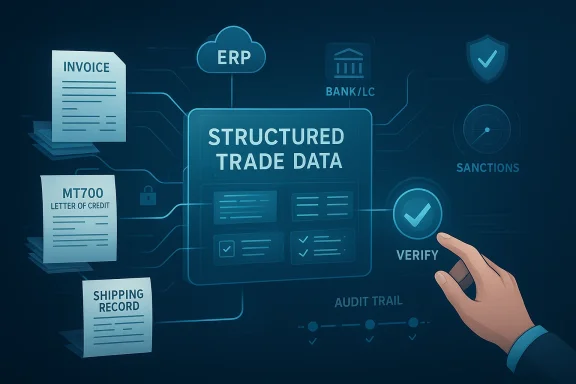
Trade finance has spent decades wrestling with a contradiction: it is one of the world’s most important engines of commerce, yet it still runs on workflows that look stubbornly like the analog era. Every shipment can trigger a cascade of invoices, letters of credit, shipping documents, sanctions checks, and approvals, and the handoffs between parties remain expensive, slow, and error-prone. Now Microsoft, ANZ, HSBC, and Lloyds are showing a different path forward with a collaborative proof of concept that uses agentic AI to extract, validate, and move trade data more intelligently across enterprise systems.The significance of this prototype is not that it simply digitizes paper. It is that it attempts to convert unstructured trade paperwork into structured, actionable, standards-based data that can flow between ERP platforms and banks with far less manual intervention. That distinction matters because the industry has already lived through enough failed “scan-and-store” modernization projects to know that image capture alone does not change operational economics. The new bet is that AI can sit inside the workflow, reason over documents, and help users make decisions faster.
That shift could be more consequential than it first appears. If it scales, it may reduce discrepancies, accelerate funding, improve compliance, and make trade finance more accessible for businesses that do not have the staff to manage paperwork-heavy processes. But it also raises important questions about trust, governance, auditability, and the danger of letting powerful models touch high-stakes financial documents without strong controls. The prototype is therefore best understood not as a finished product, but as an early signal of where the next phase of trade digitization is heading.
Background
Trade finance has always been both foundational and frustrating. It underpins cross-border commerce by giving exporters and importers confidence that payment and delivery obligations will be honored, yet the process has remained heavily document-driven because each participant in the chain historically relied on its own forms, checks, and systems. The result has been a fragmented operating model in which even simple transactions can require repeated verification of the same information across banks, logistics providers, customs authorities, and corporates.The scale of that fragmentation is hard to overstate. Microsoft’s description of the market notes that an average international shipment may involve up to 50 documents and as many as 30 stakeholders, with billions of documents moving through the global trade system every day. The underlying problem is not merely volume; it is the mismatch between paper-era document handling and the digital systems that now surround trade. Even when a document is scanned or converted to text, the underlying data often still has to be rekeyed into separate systems, which creates delay, inconsistency, and the kind of low-grade friction that accumulates into serious cost.
This is why the industry has invested so heavily in standards. The ICC Digital Standards Initiative has pushed the Key Trade Documents and Data Elements framework to identify common fields across key trade documents and to build a more interoperable digital trade environment. That work matters because AI can only do so much if every bank and corporate interprets the same fields differently. Standards create the substrate that allows AI-driven validation, routing, and decisioning to become repeatable rather than bespoke.
At the same time, the technology landscape has changed. Modern large language models are far more capable than traditional OCR or template-based systems at understanding layout variation, context, and relationships among fields. That makes them attractive for trade finance, where real-world documents are messy, incomplete, and often inconsistent across counterparties. The opportunity now is to combine those models with enterprise controls, APIs, and workflow orchestration so that AI can operate as a participant in the process rather than a detached analytics layer.
Why trade finance is such a hard digital problem
Trade finance is not just document-heavy; it is exception-heavy. A bank does not need to process only the happy path where every document matches perfectly. It must also handle discrepancies, amendments, sanctions risks, transport changes, partial shipments, and commercial disputes. That means a good solution has to do more than read text; it has to understand whether the text is operationally acceptable.This is where many earlier efforts stalled. Systems that relied on fixed templates or rigid rules could handle familiar patterns, but they struggled when documents differed by format, wording, or order. In trade finance, those differences are normal, not exceptional. The result is a workflow that often pushes people back into the loop, which is exactly where the industry has been trying to escape.
Why standards matter more now than ever
The partnership’s emphasis on KTDDE-aligned data exchange is strategic, not cosmetic. If banks and corporates can agree on core data elements, then AI can validate those elements across systems rather than guessing at them document by document. That produces a cleaner chain of custody, more consistent compliance logic, and better interoperability across ERP, banking, and logistics environments.Standards also make automation more portable. A solution tied only to one bank’s portal or one ERP’s internal format may work in a pilot, but it rarely scales across the trade ecosystem. Standards-based design is what can turn a proof of concept into a repeatable operating model.
Why this collaboration matters commercially
The involvement of ANZ, HSBC, Lloyds, and Microsoft gives the prototype unusual credibility. In trade finance, vendor experiments are common, but bank participation is what determines whether a workflow can actually survive risk, compliance, and operations scrutiny. Having multiple large banks involved suggests that the prototype is not just a product demo; it is a test of whether the industry can align around a more common digital language.It also suggests competitive pressure. When major institutions demonstrate a shared workflow, they increase the likelihood that other banks will need to respond, either by matching the capability, integrating similar standards, or risk looking slow and operationally dated.
What the Prototype Actually Demonstrates
At the center of the proof of concept is a simple but powerful idea: let an AI agent do the first-pass reading and reconciliation of trade documents, then let humans review exceptions and authorize the next step. In the demo described by Microsoft, the system simulated a corporate seller receiving an MT700 letter of credit and used an AI agent to parse the message, extract key fields, compare them against invoice and shipping data in the ERP, and flag discrepancies in natural language.That workflow is important because it changes the posture of trade operations. Instead of asking humans to inspect every field manually, the system allows the machine to perform structured verification and present the result as an actionable summary. This does not eliminate human judgment, but it shifts human effort toward exceptions and approvals rather than repetitive reading.
The prototype also shows how a conversational interface can sit on top of enterprise data. A treasury user can ask questions such as whether a letter of credit is compliant with agreed terms and receive answers grounded in ERP records and third-party trade documents. That may sound like a modest interface change, but in practice it is a profound usability leap. A single natural-language prompt can replace multiple portal screens, document searches, and manual cross-checks.
From document capture to decision support
The real step-change is not extraction; it is interpretation. OCR can identify that a word exists on a page. LLM-driven agents can determine whether the amount on one document contradicts another, whether a date is outside tolerance, or whether a document description suggests a compliance risk. That moves trade finance from data entry toward decision support.It also creates a new operating model for exception handling. Instead of forcing teams to hunt for mismatches, the AI can highlight anomalies and propose corrections. That is not the same as autopilot, and it should not be treated that way. But it is a significant move toward a more intelligent human-in-the-loop process.
Why conversational trade finance could be a big deal
The conversational layer matters because trade operations are fragmented not just technically, but cognitively. Treasury staff, operations teams, and relationship managers often work from different systems, with different views of the same transaction. A shared natural-language interface can reduce that complexity by making key trade facts searchable and interrogable in a common format.This is especially relevant for smaller teams and mid-market companies. They often lack the bandwidth to manually reconcile document sets or to maintain deep in-house expertise across every trade scenario. A conversational AI layer could make trade finance feel less like navigating a maze and more like asking an expert assistant for a precise answer.
What the demo suggests about future workflows
The prototype points toward a future where trade finance is embedded inside the systems businesses already use. Rather than launching a separate bank portal, a corporate user could initiate or validate trade activity directly in ERP, receive AI support for document checks, and transmit validated data to the bank securely. That is a meaningful shift from “bank as destination” to “bank as integrated service.”If executed well, this model could reduce friction at several stages:
- fewer manual rekeys
- fewer document mismatches
- faster exception resolution
- better transparency across stakeholders
- stronger audit trails
The Technology Stack Behind the Demo
Microsoft says the prototype was built on Microsoft Foundry, its enterprise AI platform, with architecture designed to integrate multiple ERP systems, bank platforms, and third-party supply chain applications. That matters because trade finance is a systems-of-systems problem. Any credible solution must connect not only to the corporate source of truth, but also to bank workflows, standards frameworks, and external logistics data.Foundry is positioned as a platform for building, deploying, and governing AI applications and agents, with observability and control features intended for enterprise use. In trade finance, those are not optional extras. A model that handles sensitive commercial data must be traceable, policy-controlled, and visible to operational and compliance teams. Microsoft’s current platform materials emphasize governance, telemetry, and secure routing as core components of agent deployment.
The ERP angle is especially important. Microsoft’s recent Dynamics 365 work around the Model Context Protocol server shows how agents can be given standardized access to business logic and data in finance and operations systems. That is a strong technical fit for trade finance, because the workflow depends on structured enterprise records, not just document text. If the AI can reason across the ERP and the trade document set, it can become a much more useful operational assistant.
Why agent architecture is different from traditional automation
Traditional automation usually follows a fixed sequence: ingest, classify, route, and maybe approve. Agentic AI is more flexible. It can assess a task, gather context from multiple tools, and decide which steps are needed before producing a response or recommendation. In a trade finance setting, that means the system can compare an LC, an invoice, a shipping record, and perhaps a sanctions or risk feed in one pass.That flexibility is promising, but it also increases the need for governance. The more autonomy you give an agent, the more carefully you must control permissions, data sources, and response quality. This is why observability, guardrails, and explainability are not side topics; they are central to the design.
Why AI beats rigid templates in this setting
Trade documents are notoriously inconsistent. A template system can break when a field moves, a description changes, or a document uses slightly different phrasing. LLMs are better at handling variation because they can infer meaning from context rather than depending entirely on positional logic.That does not mean LLMs are perfect. They can still make mistakes, especially when documents are ambiguous or incomplete. But in a domain where humans already spend a lot of time reconciling inconsistent information, a model that can identify likely matches and discrepancies is a major operational improvement.
The importance of secure enterprise controls
Microsoft’s emphasis on a single control plane, observability, and governed AI operations is not marketing fluff in this context. Trade finance data can contain commercially sensitive terms, personally identifiable information, and compliance-sensitive counterparties. If an AI workflow cannot be audited, it will struggle to win broad adoption inside banks.In practice, the controls that matter most are the ones that support confidence:
- identity and access management
- logging and telemetry
- policy enforcement
- prompt and response governance
- traceable data lineage
The Bank Use Case: Where the Gains Could Be Real
For banks, the first and most obvious benefit is fewer exceptions caused by manual handling. Trade finance operations teams spend enormous amounts of time spotting discrepancies between documents, chasing missing fields, and resolving mismatches with corporates. If an AI agent can catch those issues earlier, the bank can move faster and reduce the operational load on staff.There is also a customer-experience dimension. Corporates often perceive trade finance as slow, opaque, and heavily process-driven. A more seamless workflow embedded in ERP could make the bank feel less like a gatekeeper and more like a service layer. That is a strategic advantage, especially for institutions competing to become the preferred trade partner for growing international clients.
For treasury teams, the payoff could be even broader. If AI can answer questions about compliance status, financing options, currency exposure, or discounting implications, then trade finance becomes more strategic and less administrative. That shift could help treasury leaders make faster decisions about working capital and risk management.
Reducing discrepancy costs
Discrepancies are not minor nuisances in trade finance. They can delay funding, trigger additional checks, create disputes, and generate extra operational costs for both banks and customers. Even when the transaction is ultimately valid, the time lost in correction can undermine the economic value of the deal.An AI validation layer can catch inconsistencies at the source, before the data is transmitted to the bank. That is one of the strongest business cases for the prototype. It moves quality assurance earlier in the chain, where fixes are cheaper and less disruptive.
Faster time to funding
Speed matters in trade finance because working capital timing often determines whether a transaction is attractive. If paper documents need to be couriered, manually reviewed, and re-entered into multiple systems, the funding process slows down. AI-assisted data exchange could compress that timeline materially.This may be one of the clearest competitive differentiators if banks can operationalize it. The bank that funds faster, with fewer surprises, is the bank that is more likely to become embedded in a client’s daily workflows.
Better auditability and control
A properly structured AI workflow can improve traceability, not weaken it. If the system records what data was extracted, what was compared, what discrepancy was flagged, and what human action followed, the bank gets a richer audit trail than it would from a chain of emails and manual edits.That said, auditability only works if the implementation is disciplined. The system must preserve evidence of both the machine’s reasoning and the human approval step. In a regulated environment, good enough transparency is not enough.
The Corporate and Treasury Angle
Corporates are likely to care less about the AI architecture and more about whether the experience becomes simpler. That is exactly where the conversational interface becomes valuable. A treasury manager who can ask a focused question and receive an immediate answer may spend less time navigating documents and more time making commercial decisions.This could be especially powerful for organizations that handle frequent cross-border shipments but do not have large trade operations teams. For them, trade finance complexity is often a drag on growth. Embedded AI could reduce that burden by turning the workflow into something closer to a guided process than a document chase.
It also creates a more unified view of trade activity. If ERP data, trade documents, and market data can be brought together, treasury can move from reactive exception management to more proactive planning. The inclusion of FX and risk ratings in the prototype hints at this broader ambition.
A better user experience is not cosmetic
In enterprise software, usability is often treated as secondary to compliance and integration. That is a mistake. If a tool is too cumbersome, users route around it, fall back on spreadsheets, or preserve shadow processes that recreate the very inefficiencies the system was meant to remove.AI can make trade finance less intimidating by removing much of the mechanical friction. A good interface can improve adoption, and adoption is what ultimately determines whether a digital workflow succeeds.
The embedded workflow opportunity
The prototype’s ERP integration is important because trade finance should ideally happen where business data already lives. When a seller prepares shipping or invoicing data in ERP, the system can help ensure that trade finance documents are already aligned before they are transmitted outward. That reduces duplication and lowers the risk of downstream rework.This is also where embedded finance becomes real rather than rhetorical. The bank is no longer a separate destination; it becomes a connected service within a broader commercial workflow.
Potential impact on small and mid-sized firms
Smaller firms often feel the pain of trade documentation most acutely because they have less operational slack. They may not have dedicated trade specialists or large compliance teams, so each discrepancy has a bigger relative cost. A more intuitive, AI-assisted process could lower the barrier to participation in global trade.That matters beyond convenience. If digitization can reduce complexity, it may expand access to trade finance for firms that previously found the process too burdensome or too opaque.
Compliance, Risk, and the Limits of Automation
The prototype’s compliance angle is one of its most compelling features. Microsoft says the AI can help surface red flags such as sanctioned entities or dual-use goods references by comparing document content against regulatory frameworks. In a field where mistakes can lead to serious legal and reputational exposure, early risk detection is a major advantage.But compliance is also where enthusiasm should be most carefully tempered. AI can assist screening and summarization, but it cannot replace legal judgment, policy interpretation, or escalation discipline. The system can flag potential issues; it cannot decide the bank’s risk appetite or legal posture on its own.
There is also a danger in overconfidence. If users start assuming the AI has “checked everything,” they may miss the fact that the model only saw the information it was given. Missing data, ambiguous language, and outdated source material remain real risks.
Why traceability matters as much as accuracy
In compliance-heavy workflows, a correct answer is not enough unless you can explain how you got there. Trade finance teams need to know which source document was used, what rules were applied, and what exceptions were raised. This is particularly important when regulators or auditors later ask why a transaction was approved.That is why the combination of structured data, observability, and secure logging is so important. Without it, the AI becomes a black box, which is precisely what regulated institutions are trying to avoid.
Data quality remains the hidden dependency
AI cannot fix broken source data by magic. If the underlying ERP records are inaccurate, incomplete, or inconsistent, the model will merely automate the confusion. The prototype therefore depends on disciplined upstream data management, not just clever model prompting.That reality will shape adoption. Banks and corporates that already maintain clean data and strong workflows will likely see the biggest gains. Those with messy processes may struggle longer, because AI will surface their inconsistencies faster than before.
The sanctions and dual-use challenge
The ability to flag sanctions or export-control issues early is attractive, but these areas require careful governance. False positives can slow trade unnecessarily, while false negatives can create severe legal exposure. The AI therefore needs to be tuned to support human review, not replace it.The trade finance market will likely accept this technology only if institutions are transparent about its role. Assistive compliance is much easier to defend than autonomous compliance.
Competitive Implications for Banks and Fintechs
This collaboration could have a broader competitive impact than a typical bank-tech pilot. If Microsoft and its bank partners prove that agentic AI can reduce exceptions and streamline data exchange at scale, the pressure will increase on other global banks to follow. Trade finance is not a segment where institutions can afford to look technologically static for long.The market implication is also significant for fintech vendors. Many have built point solutions for document extraction, workflow orchestration, or trade digitization, but fewer can offer the combination of enterprise cloud infrastructure, AI tooling, and deep bank relationships that Microsoft brings. That does not eliminate fintech competition, but it changes the bar for platform credibility.
There is also a standards angle. The more a large ecosystem aligns around data frameworks like KTDDE, the more important interoperability becomes relative to proprietary lock-in. Vendors that can plug into standards-based workflows are likely to gain an advantage over those that depend on closed formats or bank-specific portals.
Banks may compete on experience, not just rates
Trade finance pricing has always mattered, but user experience is becoming a differentiator too. If one bank can validate documents faster, expose status more clearly, and integrate cleanly into a corporate ERP, it may win clients even without being the cheapest option.That is especially true for large multinational firms, which value operational reliability and integration. But it is also true for smaller firms that simply want fewer headaches.
The fintech challenge
Specialist fintechs should not be dismissed here. They often innovate faster than large banks and can still play a critical role in orchestration, verification, analytics, and niche workflow automation. However, if the biggest institutions begin embedding AI directly into enterprise platforms, fintechs will need to prove they can interoperate rather than compete on isolation.That suggests a future in which successful vendors are the ones that connect into the ecosystem rather than try to own every layer of it.
Why platform partnerships are becoming more important
The Microsoft angle matters because trade finance is increasingly a platform game. A bank may own the customer relationship, but the workflow depends on ERP systems, identity controls, standards bodies, logistics data, and cloud services. No single participant can optimize the whole chain alone.This is why the collaboration model may prove more durable than solo innovation efforts. It spreads the cost of experimentation while increasing the odds that the resulting workflow matches how enterprises actually operate.
Strengths and Opportunities
The prototype’s biggest strength is that it addresses the real bottlenecks in trade finance rather than the superficial ones. It focuses on data reconciliation, interoperability, and decision support, which are exactly where time and cost are lost today. It also benefits from a rare combination of bank credibility, standards alignment, and enterprise platform depth.There is a clear opportunity to expand the model beyond letters of credit into broader trade operations, supply chain finance, and even adjacent document-heavy processes. If the same agentic pattern can work across multiple workflows, the economics improve quickly. Just as important, the prototype could become a template for how banks and corporates modernize other legacy processes.
- Reduced manual rekeying across ERP and bank systems
- Earlier discrepancy detection before transactions hit operational queues
- Faster funding cycles through automated validation
- Stronger compliance workflows with machine-assisted screening
- Better user experience via conversational access to trade data
- Standards-based interoperability across multiple ecosystems
- Scalable architecture that can extend to other processes
Risks and Concerns
The biggest concern is not whether the prototype can work in a demo. It is whether it can operate reliably when exposed to the real messiness of live trade, with incomplete data, unusual document wording, and high-stakes exceptions. AI systems are powerful, but they are also only as trustworthy as their controls, source data, and oversight.There is also a governance challenge. As AI becomes more embedded in financial workflows, institutions will need to prove that outputs are explainable, auditable, and safe for regulated decision-making. Over-automation, model drift, and false confidence are all real hazards. In trade finance, almost right can still be very wrong.
- Hallucinated or incorrect outputs if model guardrails are weak
- Data-quality issues inherited from upstream systems
- Compliance exposure if screening logic is not tightly controlled
- Integration complexity across heterogeneous bank and ERP environments
- User overreliance on AI recommendations without review
- Vendor concentration risk if institutions depend too heavily on one platform
- Change-management friction inside operations-heavy organizations
Looking Ahead
The most likely near-term outcome is not a wholesale replacement of trade finance operations, but a series of targeted deployments that automate the most repetitive and error-prone steps. Banks will probably begin with document validation, discrepancy detection, and conversational assistance, then expand from there as controls mature. That gradual approach is sensible because trade finance demands confidence more than novelty.What matters most now is whether this prototype helps establish a repeatable blueprint for the industry. If the collaboration between Microsoft, ANZ, HSBC, and Lloyds can show that standards-based AI workflows reduce friction without weakening control, it may become one of the more important examples of practical enterprise AI in financial services. In a sector that has spent too long digitizing paper without truly changing process, that would be a meaningful break from the past.
- Pilot-to-production pathways will determine whether this becomes real infrastructure
- Standards adoption will shape interoperability across the ecosystem
- Bank governance frameworks will decide how far agents can be trusted
- ERP-native experiences may become the default interface for trade workflows
- Competitive pressure will likely push other institutions to respond quickly
Source: Microsoft Reimagining trade finance with AI: A collaborative proof of concept from Microsoft, ANZ, HSBC, and Lloyds | The Microsoft Cloud Blog
