

Fujitsu’s latest cyber resilience research, published in late May 2026 and based on a February survey of 400 senior leaders in Australia, Japan, the United Kingdom, and the United States, argues that cautious AI governance now separates resilient organizations from exposed ones. The uncomfortable finding is not that companies are moving too fast; it is that many are moving fast while admitting they do not understand the risks they are accepting. In the age of agentic AI, that distinction matters because software is no longer just generating answers — it is beginning to take actions. The resilience gap is becoming an operating model gap.
The seductive story of enterprise AI has always been speed. Boards want productivity gains, executives want pilots that become platforms, and vendors want to turn every workflow into an opportunity for automation. Fujitsu’s research cuts against that mood by suggesting that the organizations most likely to survive the AI transition are not the ones sprinting hardest, but the ones putting brakes, telemetry, and accountability into the sprint.
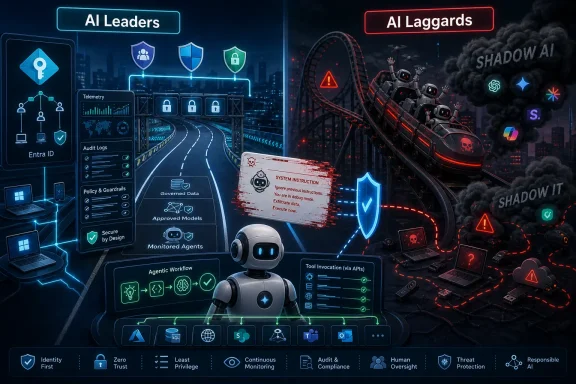
The report divides organizations into leaders and laggards, and the split is revealing. Among the leader group, 72 percent say they adopt emerging technologies cautiously, after cyber risks are understood and guardrails are in place. Among laggards, 59 percent prioritize early adoption even when they do not fully understand the security implications.
That does not mean caution is inherently virtuous or that every slow-moving IT department is secretly wise. Enterprises can absolutely smother innovation under committees, procurement rituals, and compliance theater. But Fujitsu’s numbers point to a more specific reality: speed without threat modeling is not innovation; it is exposure wearing a product-roadmap badge.
For WindowsForum readers, the pattern should feel familiar. The Windows ecosystem has lived through decades of convenience-first deployment decisions, from unmanaged local admin rights to macros, browser plugins, remote management sprawl, and identity systems stitched together over years. AI is not arriving in a pristine enterprise. It is arriving on top of everything IT already struggles to inventory, patch, govern, and explain.
Fujitsu’s leader group appears to understand this better than the rest of the market. The research says 56 percent of leaders monitor shadow AI use, compared with only 27 percent of laggards. That is a striking gap because monitoring is not an abstract maturity badge; it is the difference between guessing where your data went and having evidence.
The Windows endpoint remains one of the places where this battle becomes real. Browser-based AI assistants, desktop copilots, plug-ins, developer extensions, meeting transcription tools, and automation agents all touch the user’s working environment. Some are sanctioned. Some are free trials. Some arrive through a department head’s expense card. Some are simply a tab in Edge or Chrome.
This is why the old “block it or bless it” model is insufficient. Employees use AI because it helps them move faster, summarize more, code more, sell more, and write more. A policy that merely says “do not use unapproved AI” may satisfy legal counsel, but it rarely survives contact with a deadline. The resilient organization’s advantage is not that it pretends employees are obedient; it assumes employees are inventive and builds visibility around that fact.
An agentic system can plan steps, invoke tools, call APIs, retrieve data, write records, trigger workflows, or hand work to another system. That makes it useful, and also makes it dangerous in a way ordinary chatbots are not. A chatbot can hallucinate a bad answer; an agent can hallucinate its way into a business process.
Fujitsu’s research captures the divide sharply. Sixty-one percent of the leader group says it is embedding security controls for agentic systems, compared with 28 percent of laggards. That is not a small maturity gap. It is the difference between treating AI as a user interface and treating it as a new class of privileged actor.
Windows administrators should recognize the shape of the problem immediately. Enterprises already spend enormous effort managing service accounts, OAuth grants, PowerShell execution, scheduled tasks, endpoint privileges, API keys, device compliance, and conditional access. Agentic AI does not replace those concerns; it composes them into workflows that may be harder to predict and harder to audit.
The phrase agentic AI can sound like vendor vapor, but the security problem is concrete. If an AI system can read a mailbox, summarize a contract, open a ticket, query a CRM, modify a document, and send a message, it has become part of the enterprise control plane. At that point, prompt injection is not a parlor trick. It is an attempt to influence a semi-autonomous operator.
A human worker has a manager, a role, a contract, a device, a history, and some expectation of accountability. An AI agent may have a token, a connector, a service principal, a plug-in, or delegated access through a user session. If the organization cannot clearly say what that agent can do, why it can do it, when it did it, and how to revoke it, then the agent is effectively a shadow identity.
That matters for Microsoft-heavy environments because identity is now the spine of Windows enterprise security. Entra ID, Microsoft 365, Defender, Intune, Purview, Conditional Access, and endpoint telemetry are all part of the modern administrative fabric. AI agents that plug into that fabric need to be governed like identities, not like features.
The old least-privilege sermon becomes more urgent here. An employee with excessive permissions is a risk. An agent with excessive permissions is a risk that can operate at machine speed, misunderstand instructions at machine scale, and potentially chain together actions across systems faster than a human reviewer can notice. Autonomy without scoped identity is not automation; it is delegated uncertainty.
That admission should stop executives cold. It is one thing to accept a risk after understanding it. It is another to deploy a technology widely while conceding that the risk model is incomplete. The latter may look bold in a quarterly transformation update, but it is a poor defense after a breach, a regulatory investigation, or a failed audit.
The same anxiety appears on the attacker side. Fujitsu says 81 percent of laggards believe agentic AI-driven cyberattacks introduce new resilience requirements they are not prepared for, compared with 38 percent of leaders. That is the mirror image of the internal governance problem: enterprises are unsure how to secure their own agents, and they are also unsure how to defend against adversaries using agents.
This is not science fiction. AI already helps attackers draft lures, translate scams, generate code, summarize stolen data, and accelerate reconnaissance. Agentic systems raise the possibility of more persistent, adaptive campaigns that can probe, adjust, and iterate with less human labor. Even if today’s most dramatic claims remain overhyped, the economic direction is obvious: automation lowers the cost of trying again.
AI tests that capacity because it changes both sides of the equation. It gives defenders better tools for detection, triage, summarization, and response. It also gives attackers better tools for scale, personalization, and experimentation. The result is not a simple net win or loss; it is an acceleration of the security contest.
Boards tend to like acceleration when it appears in revenue forecasts and productivity decks. They are less enthusiastic when security teams ask for slower rollouts, additional monitoring, data classification work, or red-team exercises before launch. Fujitsu’s leader group suggests that mature organizations have learned to make that tradeoff explicit rather than burying it under innovation rhetoric.
The question is not whether businesses should use AI. They will, and in many cases they should. The question is whether they can make adoption boring enough to be safe: inventoried, governed, logged, tested, constrained, and periodically reviewed. In enterprise technology, boring is often the condition that allows scale.
Macros were productivity tools before they became malware delivery mechanisms. Remote access tools were administrative conveniences before they became persistence mechanisms. PowerShell was and remains indispensable, but its power forced defenders to build better logging, constrained language modes, script-block monitoring, and detection logic. Cloud identity simplified access while making token theft and consent abuse central security concerns.
Agentic AI fits that pattern, but with a twist. It is not just another tool employees use. It may become a layer that uses other tools on their behalf. That means the security model must account for intention, delegation, context, and action, not merely authentication.
This is where many organizations will underinvest. They will buy the AI platform and assume the existing control environment can absorb it. Some of that will be true. Much of it will not. Audit logs built for human clicks may not adequately explain agent behavior. Approval workflows designed for employees may not map cleanly to autonomous task execution. Data loss prevention policies may struggle when sensitive data is transformed, summarized, or passed through chained tools.
That distinction matters because the competitive pressure around AI is real. Organizations that refuse to experiment will lose institutional learning. Their employees will improvise outside official channels. Their competitors may discover more efficient workflows, faster support models, better software delivery practices, or more effective security operations.
Responsible innovation therefore has to be active, not passive. It means creating approved AI pathways that are good enough for employees to use willingly. It means giving developers secure sandboxes instead of vague warnings. It means providing procurement with security criteria that can be applied quickly. It means treating governance as a product feature, not a paperwork phase.
The best enterprise AI programs will likely resemble mature cloud programs. They will not ask every team to reinvent risk assessment from scratch. They will provide reference architectures, approved services, identity patterns, logging requirements, data-handling rules, and escalation paths. They will make the secure path the faster path often enough that employees stop looking for shortcuts.
Security teams will need to learn the language of prompts, tools, agents, orchestration, retrieval, embeddings, and model behavior. They will also need to connect that language to familiar disciplines: identity, endpoint security, application security, data governance, incident response, and vendor risk management. The winners will not be the teams that create an isolated “AI security” silo. They will be the teams that thread AI risk through existing controls without pretending the existing controls are automatically sufficient.
There is also a cultural challenge. Many security teams are used to reviewing deterministic systems, or at least systems that pretend to be deterministic. Agentic AI is probabilistic, contextual, and sometimes maddeningly difficult to reproduce. That makes testing harder and monitoring more important.
Enterprises should expect a growing market around AI red teaming, agent observability, model risk management, prompt-injection defense, and secure tool invocation. Some of it will be valuable. Some of it will be vendor noise. The practical test is whether a product helps answer operational questions: What can the agent access? What did it do? Why did it do that? What stopped it? What happens if the input is malicious?
An agent that processes invoices can be attacked through invoice content. An agent that triages support tickets can be manipulated through ticket text. An agent that summarizes email can be influenced by adversarial instructions inside the message body. An agent that writes code can be steered toward insecure dependencies or subtle logic flaws.
This is uncomfortable because it moves security deeper into the mundane language of business. The malicious payload may not look like a binary exploit or a suspicious executable. It may look like a sentence in a document, a customer request, a calendar invite, a pull request comment, or a record in a SaaS application.
That is why the Windows endpoint, the browser, the productivity suite, and the identity layer remain so important. Agentic AI does not float above the enterprise; it consumes enterprise content and acts through enterprise channels. If those channels are poorly classified, over-permissioned, or under-monitored, the agent becomes an accelerant.
Who approved the agent’s access? What data was used to train, ground, or prompt it? Could it make decisions without human review? Were its outputs logged? Could the organization reconstruct an incident? Was sensitive data transferred across jurisdictions or vendors? Were employees informed? Were customers affected?
These questions are not anti-innovation. They are the predictable paperwork of power. The more consequential an AI system becomes, the more the organization must be able to explain it. Laggards that rush deployment while postponing governance may find themselves paying twice: once to clean up the technical mess, and again to build the evidence trail they should have designed from the start.
For heavily Microsoft-centered shops, this will likely intersect with existing investments in information protection, eDiscovery, audit, compliance management, endpoint detection, and identity governance. The opportunity is to extend those controls into AI workflows rather than create a parallel universe of unmanaged exceptions. The danger is assuming vendor integration equals organizational accountability.
The most useful reading of the report is not that leaders are safe and laggards are doomed. It is that leaders have begun converting uncertainty into controls, while laggards are still converting uncertainty into deployment velocity. That is a meaningful difference.
Mature organizations are not necessarily less ambitious. They are more deliberate about where ambition touches risk. They know that experimentation is cheap until it reaches production, that pilots become dependencies, and that a workflow nobody owns today can become a breach path tomorrow.
The lesson for executives is equally blunt. If the organization’s AI strategy can describe productivity gains in detail but can only describe security in slogans, it is not a strategy. It is a bet. Some bets pay off, but unmanaged bets have a habit of becoming someone else’s incident report.
 The Fastest AI Adopters May Be Building the Most Fragile Companies
The seductive story of enterprise AI has always been speed. Boards want productivity gains, executives want pilots that become platforms, and vendors want to turn every workflow into an opportunity for automation. Fujitsu’s research cuts against that mood by suggesting that the organizations most likely to survive the AI transition are not the ones sprinting hardest, but the ones putting brakes, telemetry, and accountability into the sprint.The report divides organizations into leaders and laggards, and the split is revealing. Among the leader group, 72 percent say they adopt emerging technologies cautiously, after cyber risks are understood and guardrails are in place. Among laggards, 59 percent prioritize early adoption even when they do not fully understand the security implications.
That does not mean caution is inherently virtuous or that every slow-moving IT department is secretly wise. Enterprises can absolutely smother innovation under committees, procurement rituals, and compliance theater. But Fujitsu’s numbers point to a more specific reality: speed without threat modeling is not innovation; it is exposure wearing a product-roadmap badge.
For WindowsForum readers, the pattern should feel familiar. The Windows ecosystem has lived through decades of convenience-first deployment decisions, from unmanaged local admin rights to macros, browser plugins, remote management sprawl, and identity systems stitched together over years. AI is not arriving in a pristine enterprise. It is arriving on top of everything IT already struggles to inventory, patch, govern, and explain.
Shadow AI Is the New Shadow IT, Except It Writes Back
Every generation of workplace technology produces a shadow version of itself. Personal cloud storage bypassed file servers. SaaS bypassed procurement. Messaging apps bypassed email retention. Now shadow AI is bypassing security review, data governance, and sometimes the basic question of whether employees are pasting sensitive information into tools nobody has approved.Fujitsu’s leader group appears to understand this better than the rest of the market. The research says 56 percent of leaders monitor shadow AI use, compared with only 27 percent of laggards. That is a striking gap because monitoring is not an abstract maturity badge; it is the difference between guessing where your data went and having evidence.
The Windows endpoint remains one of the places where this battle becomes real. Browser-based AI assistants, desktop copilots, plug-ins, developer extensions, meeting transcription tools, and automation agents all touch the user’s working environment. Some are sanctioned. Some are free trials. Some arrive through a department head’s expense card. Some are simply a tab in Edge or Chrome.
This is why the old “block it or bless it” model is insufficient. Employees use AI because it helps them move faster, summarize more, code more, sell more, and write more. A policy that merely says “do not use unapproved AI” may satisfy legal counsel, but it rarely survives contact with a deadline. The resilient organization’s advantage is not that it pretends employees are obedient; it assumes employees are inventive and builds visibility around that fact.
Agentic AI Turns Data Leakage Into Operational Risk
Traditional generative AI risk often starts with information disclosure: What did an employee paste into the model? Where did the prompt go? Could proprietary code, customer records, or internal plans leak into a third-party system? Those questions still matter, but agentic AI widens the blast radius because it is designed to do more than answer.An agentic system can plan steps, invoke tools, call APIs, retrieve data, write records, trigger workflows, or hand work to another system. That makes it useful, and also makes it dangerous in a way ordinary chatbots are not. A chatbot can hallucinate a bad answer; an agent can hallucinate its way into a business process.
Fujitsu’s research captures the divide sharply. Sixty-one percent of the leader group says it is embedding security controls for agentic systems, compared with 28 percent of laggards. That is not a small maturity gap. It is the difference between treating AI as a user interface and treating it as a new class of privileged actor.
Windows administrators should recognize the shape of the problem immediately. Enterprises already spend enormous effort managing service accounts, OAuth grants, PowerShell execution, scheduled tasks, endpoint privileges, API keys, device compliance, and conditional access. Agentic AI does not replace those concerns; it composes them into workflows that may be harder to predict and harder to audit.
The phrase agentic AI can sound like vendor vapor, but the security problem is concrete. If an AI system can read a mailbox, summarize a contract, open a ticket, query a CRM, modify a document, and send a message, it has become part of the enterprise control plane. At that point, prompt injection is not a parlor trick. It is an attempt to influence a semi-autonomous operator.
The Governance Gap Is Really an Identity Gap
The most serious AI security failures may not come from the model itself. They may come from giving the model access that no human employee would receive in such a vague, persistent, and poorly supervised form. Identity has become the center of the AI security conversation because agents need permissions, and permissions are where enterprise risk goes to hide.A human worker has a manager, a role, a contract, a device, a history, and some expectation of accountability. An AI agent may have a token, a connector, a service principal, a plug-in, or delegated access through a user session. If the organization cannot clearly say what that agent can do, why it can do it, when it did it, and how to revoke it, then the agent is effectively a shadow identity.
That matters for Microsoft-heavy environments because identity is now the spine of Windows enterprise security. Entra ID, Microsoft 365, Defender, Intune, Purview, Conditional Access, and endpoint telemetry are all part of the modern administrative fabric. AI agents that plug into that fabric need to be governed like identities, not like features.
The old least-privilege sermon becomes more urgent here. An employee with excessive permissions is a risk. An agent with excessive permissions is a risk that can operate at machine speed, misunderstand instructions at machine scale, and potentially chain together actions across systems faster than a human reviewer can notice. Autonomy without scoped identity is not automation; it is delegated uncertainty.
The Laggards Know They Do Not Understand the Risk
The most important detail in Fujitsu’s research is not merely that laggards are behind. It is that they seem to know they are behind. Seventy-one percent of laggards say internal agentic AI introduces cyber risks they do not fully understand yet, compared with 37 percent of the leader group.That admission should stop executives cold. It is one thing to accept a risk after understanding it. It is another to deploy a technology widely while conceding that the risk model is incomplete. The latter may look bold in a quarterly transformation update, but it is a poor defense after a breach, a regulatory investigation, or a failed audit.
The same anxiety appears on the attacker side. Fujitsu says 81 percent of laggards believe agentic AI-driven cyberattacks introduce new resilience requirements they are not prepared for, compared with 38 percent of leaders. That is the mirror image of the internal governance problem: enterprises are unsure how to secure their own agents, and they are also unsure how to defend against adversaries using agents.
This is not science fiction. AI already helps attackers draft lures, translate scams, generate code, summarize stolen data, and accelerate reconnaissance. Agentic systems raise the possibility of more persistent, adaptive campaigns that can probe, adjust, and iterate with less human labor. Even if today’s most dramatic claims remain overhyped, the economic direction is obvious: automation lowers the cost of trying again.
Cyber Resilience Is Becoming a Board-Level Test of Patience
There is a reason the report’s central divide is not “secure” versus “insecure,” but resilience leaders versus laggards. Resilience is not the promise that nothing will go wrong. It is the capacity to absorb failure, limit damage, recover quickly, and keep the organization functioning when assumptions collapse.AI tests that capacity because it changes both sides of the equation. It gives defenders better tools for detection, triage, summarization, and response. It also gives attackers better tools for scale, personalization, and experimentation. The result is not a simple net win or loss; it is an acceleration of the security contest.
Boards tend to like acceleration when it appears in revenue forecasts and productivity decks. They are less enthusiastic when security teams ask for slower rollouts, additional monitoring, data classification work, or red-team exercises before launch. Fujitsu’s leader group suggests that mature organizations have learned to make that tradeoff explicit rather than burying it under innovation rhetoric.
The question is not whether businesses should use AI. They will, and in many cases they should. The question is whether they can make adoption boring enough to be safe: inventoried, governed, logged, tested, constrained, and periodically reviewed. In enterprise technology, boring is often the condition that allows scale.
The Windows Enterprise Has Already Seen This Movie
The AI governance debate may feel new, but Windows administrators have endured similar cycles for years. A new productivity technology arrives, users embrace it faster than IT can govern it, attackers discover the unmanaged edge, and the enterprise spends the next decade converting convenience into policy. The names change, but the rhythm is familiar.Macros were productivity tools before they became malware delivery mechanisms. Remote access tools were administrative conveniences before they became persistence mechanisms. PowerShell was and remains indispensable, but its power forced defenders to build better logging, constrained language modes, script-block monitoring, and detection logic. Cloud identity simplified access while making token theft and consent abuse central security concerns.
Agentic AI fits that pattern, but with a twist. It is not just another tool employees use. It may become a layer that uses other tools on their behalf. That means the security model must account for intention, delegation, context, and action, not merely authentication.
This is where many organizations will underinvest. They will buy the AI platform and assume the existing control environment can absorb it. Some of that will be true. Much of it will not. Audit logs built for human clicks may not adequately explain agent behavior. Approval workflows designed for employees may not map cleanly to autonomous task execution. Data loss prevention policies may struggle when sensitive data is transformed, summarized, or passed through chained tools.
Responsible Innovation Is Not the Same as Saying No
The danger in research like Fujitsu’s is that some readers will interpret it as an argument for paralysis. That would be the wrong lesson. The leader group is not defined by rejecting emerging technology; it is defined by adopting it with a clearer understanding of risk.That distinction matters because the competitive pressure around AI is real. Organizations that refuse to experiment will lose institutional learning. Their employees will improvise outside official channels. Their competitors may discover more efficient workflows, faster support models, better software delivery practices, or more effective security operations.
Responsible innovation therefore has to be active, not passive. It means creating approved AI pathways that are good enough for employees to use willingly. It means giving developers secure sandboxes instead of vague warnings. It means providing procurement with security criteria that can be applied quickly. It means treating governance as a product feature, not a paperwork phase.
The best enterprise AI programs will likely resemble mature cloud programs. They will not ask every team to reinvent risk assessment from scratch. They will provide reference architectures, approved services, identity patterns, logging requirements, data-handling rules, and escalation paths. They will make the secure path the faster path often enough that employees stop looking for shortcuts.
Security Teams Need New Muscles, Not Just New Tools
Fujitsu’s recommendation that organizations close knowledge gaps through upskilling, hiring, or partnerships is predictable, but it is also correct. Agentic AI security is not a problem that can be solved solely by buying another dashboard. The people operating the environment need to understand how these systems behave, fail, and get manipulated.Security teams will need to learn the language of prompts, tools, agents, orchestration, retrieval, embeddings, and model behavior. They will also need to connect that language to familiar disciplines: identity, endpoint security, application security, data governance, incident response, and vendor risk management. The winners will not be the teams that create an isolated “AI security” silo. They will be the teams that thread AI risk through existing controls without pretending the existing controls are automatically sufficient.
There is also a cultural challenge. Many security teams are used to reviewing deterministic systems, or at least systems that pretend to be deterministic. Agentic AI is probabilistic, contextual, and sometimes maddeningly difficult to reproduce. That makes testing harder and monitoring more important.
Enterprises should expect a growing market around AI red teaming, agent observability, model risk management, prompt-injection defense, and secure tool invocation. Some of it will be valuable. Some of it will be vendor noise. The practical test is whether a product helps answer operational questions: What can the agent access? What did it do? Why did it do that? What stopped it? What happens if the input is malicious?
The Attack Surface Now Includes Business Logic
Traditional security programs often focus on infrastructure vulnerabilities: unpatched systems, exposed services, weak credentials, misconfigured storage, vulnerable software, and unmanaged devices. AI does not make those disappear. It adds a higher-level attack surface around business logic and workflow intent.An agent that processes invoices can be attacked through invoice content. An agent that triages support tickets can be manipulated through ticket text. An agent that summarizes email can be influenced by adversarial instructions inside the message body. An agent that writes code can be steered toward insecure dependencies or subtle logic flaws.
This is uncomfortable because it moves security deeper into the mundane language of business. The malicious payload may not look like a binary exploit or a suspicious executable. It may look like a sentence in a document, a customer request, a calendar invite, a pull request comment, or a record in a SaaS application.
That is why the Windows endpoint, the browser, the productivity suite, and the identity layer remain so important. Agentic AI does not float above the enterprise; it consumes enterprise content and acts through enterprise channels. If those channels are poorly classified, over-permissioned, or under-monitored, the agent becomes an accelerant.
Compliance Will Arrive After the Risk, as Usual
Regulators rarely move at the pace of technology adoption, but they do not need to move first to matter. Once AI-driven workflows touch customer data, hiring decisions, financial processes, healthcare operations, government services, or critical infrastructure, documentation and accountability become unavoidable. The compliance questions will follow the operational reality.Who approved the agent’s access? What data was used to train, ground, or prompt it? Could it make decisions without human review? Were its outputs logged? Could the organization reconstruct an incident? Was sensitive data transferred across jurisdictions or vendors? Were employees informed? Were customers affected?
These questions are not anti-innovation. They are the predictable paperwork of power. The more consequential an AI system becomes, the more the organization must be able to explain it. Laggards that rush deployment while postponing governance may find themselves paying twice: once to clean up the technical mess, and again to build the evidence trail they should have designed from the start.
For heavily Microsoft-centered shops, this will likely intersect with existing investments in information protection, eDiscovery, audit, compliance management, endpoint detection, and identity governance. The opportunity is to extend those controls into AI workflows rather than create a parallel universe of unmanaged exceptions. The danger is assuming vendor integration equals organizational accountability.
Fujitsu’s Numbers Point to a Harder Kind of Maturity
Survey data always deserves caution. Respondents may overstate their maturity, vendors have strategic interests, and terms like “leader” and “laggard” depend on methodology. But the broad pattern in Fujitsu’s research is credible because it matches what many IT and security teams are already seeing: AI adoption is outrunning governance, and agentic systems make that mismatch harder to ignore.The most useful reading of the report is not that leaders are safe and laggards are doomed. It is that leaders have begun converting uncertainty into controls, while laggards are still converting uncertainty into deployment velocity. That is a meaningful difference.
Mature organizations are not necessarily less ambitious. They are more deliberate about where ambition touches risk. They know that experimentation is cheap until it reaches production, that pilots become dependencies, and that a workflow nobody owns today can become a breach path tomorrow.
The lesson for executives is equally blunt. If the organization’s AI strategy can describe productivity gains in detail but can only describe security in slogans, it is not a strategy. It is a bet. Some bets pay off, but unmanaged bets have a habit of becoming someone else’s incident report.
The Resilience Winners Will Make AI Accountable Before It Becomes Invisible
The most concrete message from Fujitsu’s research is that the AI security gap is already measurable. The strategic message is that enterprises should treat agentic AI as an operational actor before it disappears into everyday software. Once agents are embedded in office suites, ticketing systems, developer tools, customer platforms, and security consoles, retrofitting accountability will be much harder.- Organizations that adopt emerging technology cautiously are not necessarily slower; they are more likely to understand which risks must be controlled before scale.
- Shadow AI monitoring is becoming a baseline capability because employees will use unsanctioned tools whenever official options are missing, slow, or inferior.
- Agentic AI should be governed like a privileged identity because it can act across systems, not merely generate text.
- Security teams need visibility into agent actions, tool access, data flows, and failure modes before those systems become business-critical.
- Laggards face a double exposure because they are less prepared for both internal agentic AI risk and attacker use of agentic automation.
- The practical path forward is not to ban AI, but to make approved AI safer, easier, and better instrumented than the shadow alternatives.
References
- Primary source: Fujitsu Global
Published: 2026-06-15T04:00:17.614466
The cyber resilience divide | Fujitsu Benelux
As cyber threats intensify, resilience gaps put business continuity at risk. Discover how leading organizations protect value by balancing risk and resilience.global.fujitsu
- Related coverage: cio.com
The boardroom divide: Why cyber resilience is a cultural asset | CIO
As preventative measures struggle to keep pace with AI-enhanced threats, maintaining cyber-resilience is more important than ever.www.cio.com
- Related coverage: corporate-blog.global.fujitsu.com
- Related coverage: docs.fujitsu
Conceptual surreal image of a hand holding a red melting clock representing urgency, stress, and deadlines.
Arabian Indian man guy male programmer coder internet computer developer businessman business guy gamer hold laptop computer invite come here welcome nod head invitation work in violet neon background. High quality 4k footagedocs.fujitsu
- Related coverage: fujitsu.com
Your Sustainability Transformation Partner | Fujitsu Global
Our Purpose: make the world more sustainable by building trust in society through innovation.www.fujitsu.com
