

Wise’s short briefing is more than a fintech vendor’s thought piece; it’s a practical roadmap that places agentic AI, governance and payments into a single business narrative for 2026 — and it should make every IT, finance and operations leader pause, plan and act. The company argues that the next wave of AI adoption will stop being experimental and start doing structured work inside the apps people use every day: task-specific agents that can plan, act and trigger business processes. That is both an enormous productivity opportunity and a governance problem in the making. Wise’s memo, and the wider vendor and analyst chorus that echoes it, points to five interconnected themes enterprises must address now: the rise of agentic systems, the build-vs-buy decision for AI tooling, where AI spending delivers the clearest returns, the embedding of AI into core applications, and the human oversight models that will govern these systems. Wise lays out the business case — and industry reporting and analyst research confirm the scale and urgency of the shift.
Agentic AI describes systems that do more than answer questions or summarise documents: they plan multi-step tasks, call services, and make domain-specific decisions under guardrails. These agents range from a voice-driven support agent that follows scripted escalation rules to supply‑chain assistants that reorder stock when thresholds are crossed. Wise frames this progression as a move from “answers” to “structured work,” placing its predictions inside a larger industry pivot that includes major platform vendors and analysts. Gartner, for example, predicts that by the end of 2026 roughly 40% of enterprise applications will incorporate task‑specific AI agents — up from a tiny baseline today — signalling very rapid operational embedding of agentic capabilities.
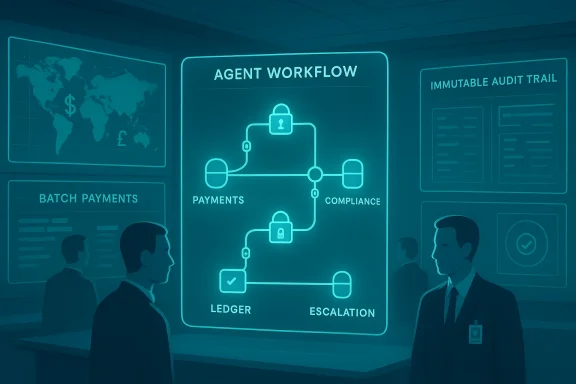
That context matters because the shift from experimental copilots to production agents changes how organisations build, operate and control software. Where a chatbot is a research tool, an agent that can execute payments, update ledgers, or reassign inventory becomes a production service with availability, auditability and compliance requirements.
Why this matters
Practical implications
Consequences for IT and product teams
Governance checklist
Why that product footprint matters for agentic AI
Key takeaways for leaders
Source: IT Brief New Zealand https://itbrief.co.nz/story/wise-predicts-agentic-ai-shift-in-business-by-2026/
 Background / Overview
Agentic AI describes systems that do more than answer questions or summarise documents: they plan multi-step tasks, call services, and make domain-specific decisions under guardrails. These agents range from a voice-driven support agent that follows scripted escalation rules to supply‑chain assistants that reorder stock when thresholds are crossed. Wise frames this progression as a move from “answers” to “structured work,” placing its predictions inside a larger industry pivot that includes major platform vendors and analysts. Gartner, for example, predicts that by the end of 2026 roughly 40% of enterprise applications will incorporate task‑specific AI agents — up from a tiny baseline today — signalling very rapid operational embedding of agentic capabilities.That context matters because the shift from experimental copilots to production agents changes how organisations build, operate and control software. Where a chatbot is a research tool, an agent that can execute payments, update ledgers, or reassign inventory becomes a production service with availability, auditability and compliance requirements.
The five themes Wise highlights — and what they mean in practice
1) Agentic shift: AI that acts, not just advises
Wise’s central claim is simple: generative models will evolve from “explainers” into task‑specific agents that take multi-step actions informed by context and company policy. These agents are not hypothetical; industry product launches and analyst forecasts show vendors already designing tooling for agent creation, orchestration and governance. Microsoft, Google and independent vendors are shipping builder platforms and orchestration layers that treat agents as first-class production workloads.Why this matters
- Agents reduce manual work by automating repetitive, rules-based flows (invoicing, reconciliation, request handling).
- They create new failure modes: an erroneous reorder, a misrouted payment, or an incorrectly escalated customer issue can cause immediate financial, operational or regulatory harm.
- Agents blur the boundary between user intent and machine action — auditable controls and identity for agents become essential.
- Hallucination risk: Agents can produce plausible but incorrect outputs that, if acted upon automatically, lead to real-world loss. Wise’s AI lead explicitly warns about hallucinations in high-stakes domains.
- Escalation design failures: Poorly defined thresholds for human hand-off will either create too many false positives (costly human interventions) or fail to catch dangerous automation mistakes.
2) Build vs buy: control, cost and the model lifecycle
Wise predicts a reassessment of reliance on third‑party AI tooling because rapid model updates and shifting commercial terms can shorten the shelf life of systems built on top of public models. Firms are weighing the trade-off between using hosted LLMs and building bespoke, domain‑specific models or connectors that they control. Wise suggests larger firms with engineering resources will be more inclined to “build” elements of their stack, while smaller firms will likely blend commercial subscriptions with curated internal automation.Practical implications
- Building (own models, fine-tuned domain models, internal agent orchestration) gives you control over updates, retraining cadence and deployment — and makes regulatory compliance and data residency easier to manage.
- Buying gets you speed of innovation and economies around model improvements, but exposes you to vendor changes, pricing shocks, and uncertain SLAs when agents act on systems of record.
- Hybrid approaches — commercial LLMs for base capabilities, local models for sensitive decisioning and connectors to internal data — are becoming the pragmatic middle ground.
- Hosted model costs can scale non-linearly with usage; predicted agent scale across enterprise apps will push organisations to rethink cost models and FinOps for AI.
- MLOps and AgentOps become part of the runbook: versioning, rollback, canarying and observability for agents are required production practices.
3) Where the returns are clearest: content, service, data & finance
Wise calls out three domains where AI will produce the clearest near-term returns: content and marketing, customer service, and data-driven finance.- Content and marketing: AI can dramatically accelerate content creation — blog posts, campaign copy, documentation and translations — while changing discovery economics as AI surfaces sponsored content inside conversational results. Wise points to industry reporting that OpenAI and major platforms are preparing “free-user monetisation” models that will embed adverts or sponsored responses into AI-driven search or chat results. Enterprise teams should prepare for “Generative Engine Optimization” alongside traditional SEO.
- Customer service: Automation of first-line enquiries (voice and text) using company scripts and escalation rules can compress cost-per-contact while improving SLAs. Designing correct escalation thresholds and audit trails will be the crucial design decision to protect customer trust.
- Data and finance: Pattern recognition at scale for accountants, analysts and auditors will change workflows. AI can surface anomalies and accelerate reconciliations, but the outputs must be explainable and auditable for compliance. Wise emphasises the need for traceable decision trails in high-stakes accounting and money-movement scenarios.
4) Integration focus: AI becomes fabric, not bolt‑on
Wise and external analysts predict a material shift: AI will be embedded inside established applications and search engines far more than used via standalone AI sites. Deloitte forecasts that AI inside existing apps will be three times more common than standalone usage by 2026 — a behavioral shift that benefits incumbents who own the user workflow. This trend amplifies the enterprise advantage for software suites that can bake agents into CRM, ERP, finance and HR apps.Consequences for IT and product teams
- Vendors will compete on how well their agents integrate with identity, audit logs, and enterprise data sources.
- The ROI of AI features will increasingly depend on contextual grounding — agents that understand company rules, ledger structures and compliance constraints outperform generic assistants.
- Integrations magnify the attack surface: agent identity, token lifetimes, and cross‑system permissions must be managed as part of the application security posture.
5) Human oversight: control, audit and a new organisation design
Human review is not optional. Wise stresses that businesses must retain responsibility for outcomes and keep checks in place, especially where AI touches accounts, financial flows and regulated activity. Roles will shift: rather than performing routine tasks, staff will be asked to set direction, validate outputs, investigate exceptions and curate models and prompts.Governance checklist
- Define where automatic action is permitted and where human sign-off is required.
- Retain immutable audit trails for agent decisions, inputs, and external data sources used.
- Establish explainability thresholds for decisions that affect customers or regulatory reporting.
- Create an AgentOps function responsible for versioning, security, and cost control.
Payments and cross‑border context: why Wise’s angle matters
Wise situates these predictions inside the reality of cross-border commerce. Its business product already offers multi-currency capabilities and mass-pay features that make it an attractive substrate for companies automating international workflows. Wise lists product facts such as offering local bank details in multiple currencies, holding and sending funds in 40+ currencies, supporting payments to 160+ countries, and batch payments up to 1,000 recipients. Those claims are part of Wise’s current product marketing and press materials and align with its stated product roadmap for business accounts. However, public documents from Wise show minor variations in the exact phrasing of these capability counts (for example: account details in 9+ currencies appears in some product materials). Readers should treat the precise numeric claims as vendor‑published figures that can vary between marketing collateral and regulatory filings.Why that product footprint matters for agentic AI
- Payment agents can do more than suggest invoices: they can execute batch settlements, trigger FX conversions, and reconcile supplier receipts — operations that require strong identity, anti‑fraud and compliance controls.
- The combination of agentic decisioning (e.g., "pay invoice if supplier has delivered and GL account coding is correct") with cross-border execution magnifies risk and regulatory scrutiny.
- Businesses building agentic workflows for global payments must include tightly coupled controls for AML/KYC, FX exposure and reconciliation.
Critical analysis: strengths, gaps and the governance imperative
Notable strengths of Wise’s argument
- Business‑centric framing: Wise ties agentic AI to practical workflows — payments, customer service and finance — which makes the predictions actionable for corporate teams rather than abstract futurism.
- Alignment with analyst consensus: Gartner and Deloitte’s public forecasts back the timing and adoption cadence Wise cites, giving the predictions credibility beyond vendor optimism.
- Emphasis on oversight: Wise repeatedly returns to the theme that organisations remain responsible for outcomes — a pragmatically conservative stance that is appropriate when automation touches regulated processes.
Risks and where the analysis is incomplete
- Over-optimistic timelines: While analyst projections (e.g., Gartner’s 40% by end‑of‑2026) suggest rapid uptake, real-world deployments will face integration complexity, procurement cycles and regulatory reviews that slow some programs. Expect uneven adoption across sectors.
- Monetisation and incentive conflicts: Wise flags that advertising and sponsored responses inside AI surfaces may reshape discovery. Independent reporting shows internal OpenAI projections for “free‑user monetisation” (ads or sponsored placements) that could reach material scale. That creates a structural tension: monetised AI surfaces will need strict disclosure and control to preserve trust. The commercial incentives of ad-funded assistants deserve extra scrutiny.
- Vendor lock‑in and model churn: The “build vs buy” guidance understates the complexity of operating local models at scale: data governance, compute costs and model upkeep are non-trivial. Firms without mature MLOps and SRE practices will struggle if they choose to build in-house prematurely.
- Explainability and auditability: Many agent behaviours will be hard to explain in the terms auditors and regulators expect. Academic work and industry whitepapers now call for AgentOps platforms with identity, provenance, and bounded tokenization strategies to make agent actions traceable — but implementation patterns are immature.
Practical guidance: what IT, security and finance teams should do now
- Inventory agent risk surfaces:
- Catalogue where agents might be allowed to act on systems of record (payments, ledger writes, supplier onboarding).
- Map business-critical flows and rank them by the potential financial, reputational and regulatory impact.
- Define escalation and guardrails:
- For each agent-enabled flow, define explicit hand-off thresholds and human-in-the-loop checkpoints.
- Capture these thresholds in policy and test them with red‑team scenarios.
- Build AgentOps fundamentals:
- Implement versioning, canary rollouts and rollback controls for agent behaviour.
- Require immutably logged inputs, context, and outputs for any automated action affecting customers or money.
- Choose a pragmatic model strategy:
- If you are a SME: favour hybrid approaches that use hosted models for general tasks and pre-built connectors for secure services; avoid premature investment in full in-house model stacks unless you have MLOps capacity.
- If you are a larger firm: invest in domain-specific models and tightly controlled on-prem or private‑cloud deployments for regulated workstreams.
- Prepare procurement and legal teams:
- Update vendor contracts to include SLAs for model behaviour, data use restrictions, and change-notice windows for underlying model updates.
- Require the right to audit vendor behaviour and test model changes before production switches.
- Re-skill people for oversight:
- Shift job descriptions from task execution to agent direction and validation.
- Train finance and customer service staff to interpret model outputs, find edge cases, and apply judgement.
Sector-by-sector impact: who moves fastest and who must move slowest
- Fast movers: e-commerce, digital marketing and support teams will rapidly adopt agentic features because of low regulatory friction and high ROI for automation. Expect early wins in copy generation, in-chat commerce checkouts and automated triage. Wise notes this commercial momentum and the advertising dynamics that will flow through AI discovery surfaces.
- Constrained movers: banking, healthcare, regulated utilities and some government teams will see slower adoption due to compliance, audit and data residency requirements. Where agents do appear, they will be domain-specific and deployed with layered human oversight and stricter provenance controls.
- Cross-border operations: teams working with international suppliers and payroll will use agentic automation to reduce operational friction but must treat payment authority, AML and reconciliation as first-class concerns. Wise’s own product positioning highlights batch payments, multi-currency balances and accounting integrations as practical accelerants for this trend — but those capabilities must be integrated with rigorous controls.
A short note on the advertising question and “free‑user monetisation”
Wise flags a development many observers have already noticed: major AI platforms are experimenting with monetisation models that include ads or sponsored results inside AI responses. Independent reporting, based on internal projections and code leaks, has repeatedly referenced forecasts that OpenAI and other large providers are planning to monetise free users — with some reports projecting substantial near‑term revenue targets. These developments matter because they introduce new incentive layers into assistant responses; transparency, labelling and consumer protection will be important regulatory flashpoints. Readers should treat leaked internal figures as indicative, but not definitive, and monitor vendor announcements and regulatory guidance closely.Final assessment: how to treat Wise’s predictions as a business playbook
Wise’s five themes are not a speculative wishlist — they’re a practical reading of where enterprise software is heading in the next 12 to 18 months. Analyst forecasts from Gartner and Deloitte corroborate the timing and mechanics of the shift, and vendor behaviour (platform agent builders, in‑app AI features, and in-chat commerce pilots) demonstrates supply-side alignment. The net result is an environment where organisations will either prepare by building governance, AgentOps and MLOps capabilities or risk being surprised by automation that acts faster than their controls can respond.Key takeaways for leaders
- Treat agents as production services: require SLAs, observability and rollback plans.
- Prioritise governance where agents touch money, personal data or regulated decisions.
- Expect monetisation and advertising pressures on conversational surfaces; product and legal teams must plan disclosures and opt-outs now.
- Invest in skills for agent oversight and in practical AgentOps tooling rather than ad-hoc prompt engineering.
Appendix: Verified claims and where to watch for updates
- Gartner’s adoption forecast: 40% of enterprise applications will feature task‑specific AI agents by the end of 2026 (public press release and analyst commentary).
- Deloitte’s integration prediction: AI embedded inside established apps and search engines will be significantly more common than standalone AI tool usage by 2026.
- Wise product claims: Wise Business advertises multi-currency balances, local account details for multiple currencies (variously reported as 8–10+ depending on the collateral), batch payments up to 1,000 recipients, and broad accounting integrations; these are vendor-published figures and appear across Wise’s blog and newsroom materials. Treat numerical specifics as vendor-provided and check product documentation for the most current counts.
- Advertising and monetisation: Multiple industry reports and vendor materials reference internal projections and experiments for “free-user monetisation” by major AI providers, including OpenAI; these are based on leaked or internal documents and industry reporting and should be considered indicative but subject to confirmation from vendor statements and regulatory filings.
- Agentic security and operational research: Emerging academic and practitioner research emphasises the need for authenticated workflows, principled AgentOps and technical approaches to detecting and limiting ad-style bias inside model responses.
Source: IT Brief New Zealand https://itbrief.co.nz/story/wise-predicts-agentic-ai-shift-in-business-by-2026/
