

Financial institutions are moving from pilot projects to production with cloud‑hosted, agentic AI systems — and the shift is already changing how banks manage customer conversations, underwriting, fraud detection, and internal workflows.
Cloud platforms have long been the backbone of modern banking infrastructure, but their role is evolving from commoditized compute and storage into an orchestration layer for intelligent, autonomous systems. Hyperscalers now offer not just compute and data services, but integrated AI development environments, safety controls, and lifecycle tools that make it feasible for banks to deploy persistent, business‑focused AI agents at scale. (capgemini.com)
Capgemini’s World Cloud Report — Financial Services 2026 frames this transition as the move from “process automation” to “industry reimagination,” arguing that cloud‑powered AI agents can unlock new revenue streams, reduce operating costs, and reconfigure customer experiences when combined with disciplined governance. The report finds agentic AI adoption is still nascent but accelerating, and recommends that institutions adopt multi‑cloud, multi‑agent strategies aligned with governance and skills uplift. (capgemini.com)
The podcast highlights three recurring themes:
Microsoft’s published customer story reports several operational outcomes since the migration:
But operationalizing agentic AI also introduces new cost centers:
Flag: some claims about long‑term systemic risk remain speculative and are contingent on future regulation and industry standards. Institutions should treat those as substantive planning variables rather than settled facts. (capgemini.com)
The bigger question is how the industry will institutionalize these gains. Capgemini’s research suggests that only about 10% of institutions implement agents at scale today, meaning most firms still face organizational, technical, and governance gaps. Firms that ignore the non‑technical components — training, auditability, legal alignment — risk producing brittle, expensive systems that underdeliver. (capgemini.com)
From a market structure perspective, three dynamics will shape outcomes:
For banks, the opportunity is substantial: improved customer experiences, lower operating costs, and the potential to reimagine core processes. For CIOs and CISOs, the mandate is clear: move from pilots to production only with disciplined governance, transparent auditing, and realistic cost management. The next phase of agentic AI in financial services will reward institutions that treat design, risk, and operations as inseparable parts of the same program. (capgemini.com)
Source: FinAi News Podcast: FIs deploy cloud-based AI agents
 Background
Cloud platforms have long been the backbone of modern banking infrastructure, but their role is evolving from commoditized compute and storage into an orchestration layer for intelligent, autonomous systems. Hyperscalers now offer not just compute and data services, but integrated AI development environments, safety controls, and lifecycle tools that make it feasible for banks to deploy persistent, business‑focused AI agents at scale. (capgemini.com)Capgemini’s World Cloud Report — Financial Services 2026 frames this transition as the move from “process automation” to “industry reimagination,” arguing that cloud‑powered AI agents can unlock new revenue streams, reduce operating costs, and reconfigure customer experiences when combined with disciplined governance. The report finds agentic AI adoption is still nascent but accelerating, and recommends that institutions adopt multi‑cloud, multi‑agent strategies aligned with governance and skills uplift. (capgemini.com)
What the FinAi News podcast revealed
Key claims and themes
On February 24, 2026, Capgemini’s Ravi Khokhar joined FinAi News’ “The Buzz” to explain how financial institutions are using cloud partners to host and operate AI agents. Khokhar emphasized that banks are increasingly tapping established cloud relationships — not merely for hosting, but for the orchestration, scalability, and governance capabilities that hyperscalers provide.The podcast highlights three recurring themes:
- Cloud as an enabler — the cloud is now central to agent deployment rather than only a hosting environment.
- Multi‑agent, multi‑cloud architectures — institutions are experimenting with fleets of specialized agents working together, often across cloud boundaries. (capgemini.com)
- Governance and training — banks are investing in AI supervisors, explainability controls, and staff upskilling to manage agent risk and compliance. (capgemini.com)
Case study: ABN AMRO — a practical example
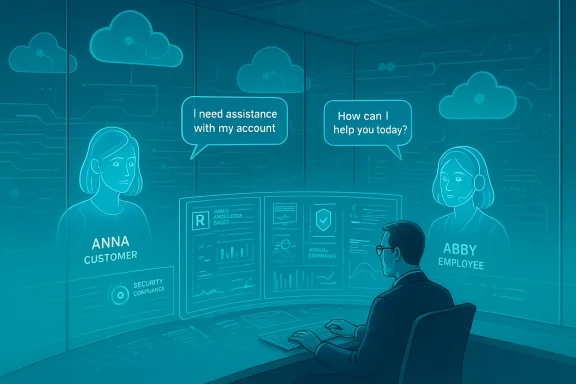
ABN AMRO’s migration from legacy chatbots to Microsoft Copilot Studio is the clearest, most tangible example discussed on the podcast and in vendor case studies. The bank replaced multiple chatbot systems with a family of agents — notably “Anna” for customers and “Abby” for employees — and integrated Azure AI services as part of a re‑architecture designed to scale conversational AI across text and voice channels. (microsoft.com)Microsoft’s published customer story reports several operational outcomes since the migration:
- Support for over 2 million text conversations and 1.5 million voice conversations per year through the customer agent. (microsoft.com)
- A six‑month migration timeline from RFP to production for the initial agent rollout. (microsoft.com)
- A reported 7% increase in intent‑recognition accuracy for Dutch after integrating Azure AI Conversational Language Understanding (CLU) with Copilot Studio, plus reduced IVR drop‑off and transfer rates. (microsoft.com)
Why banks are choosing cloud‑hosted agents
Scalability and lifecycle management
Cloud providers offer elastic compute, integrated model hosting, and managed services (logging, observability, CI/CD for models) — capabilities that are essential once agents move from experimental to production workloads. Agents are not single‑model, single‑endpoint systems; they are orchestrations of intent recognition, retrieval systems, knowledge graphs, workflow engines, and human‑in‑the‑loop controllers. Hyperscaler platforms bundle many of these functions and reduce integration overhead. That matters for risk‑sensitive industries where stability and observability are non‑negotiable. (capgemini.com)Security, compliance, and data residency
Financial services operate under stringent regulatory regimes. Cloud vendors have invested heavily in compliance certifications, data residency features, and guarded networking primitives that can meet bank CISOs’ requirements. The ABN AMRO migration narrative explicitly calls out a multi‑month security review and regional controls as central to platform selection — indicating that governance is a gating factor in adoption. (microsoft.com)Integration with existing channels and analytics
Banks want agents that plug into contact centers, core banking systems, fraud systems, and analytics platforms. Cloud vendors provide the connectors (APIs, middleware, CCaaS integrations), analytics stack, and the option to host retrieval data sources close to compute — reducing latency and simplifying RAG (retrieval‑augmented generation) patterns. ABN AMRO’s architecture explicitly uses Azure middleware, CLU for intent extraction, and Power BI for analytics, illustrating the practical benefits of a cloud‑centric approach. (microsoft.com)The economics: measurable ROI, but watch the spend
Banks are attracted to clear efficiency gains: faster response times, fewer live agent escalations, reduced process costs in underwriting and claims, and faster product launches. Capgemini’s research argues that agents can drive both topline and bottom‑line impact when correctly targeted. (capgemini.com)But operationalizing agentic AI also introduces new cost centers:
- Continuous model tuning and evaluation
- Expanded observability and logging for compliance
- Increased cloud egress, storage, and compute for retrieval and multimodal workloads
- Specialist staff for orchestration, prompt engineering, and AI supervision
Technical patterns and architecture choices
Multi‑agent orchestration
Successful deployments often use a mix of specialized worker agents and a planner or supervisor agent — an architecture that separates reasoning from execution. This allows control planes to enforce policy, monitor decisions, and route escalations to humans when necessary. Such designs align with what Khokhar described on the podcast as a “multi‑agent ecosystem,” and with Capgemini’s guidance to harmonize human expertise with agents.Retrieval‑augmented generation (RAG) and guarded knowledge bases
Banks must avoid hallucinations and keep agents tethered to approved facts. The common pattern is RAG: agents query curated knowledge stores, policy documents, and transaction logs, then synthesize answers with explicit citations or confidence scoring. Vendor platforms increasingly provide RAG primitives and secure retrieval stores that respect data residency and access controls. (microsoft.com)Human‑in‑the‑loop and AI supervisors
Capgemini’s research highlights the rise of AI supervisors — roles and systems that monitor fleets of agents, review decisions, and maintain audit trails. Nearly half of banks in the report were cited as hiring or deploying supervisory capabilities to ensure explainability and regulatory compliance. This reflects a pragmatic recognition that autonomy needs containment. (capgemini.com)Governance, risk, and regulatory pressure
Agentic AI raises concentrated regulatory and operational risks for financial institutions:- Model risk and auditability — regulators will expect transparent records of training data, model versions, decision rationale, and mitigation steps for biased or erroneous outputs.
- Data leakage and privacy — agents interacting with customer data must enforce strict access controls and encryption both at rest and in transit.
- Operational resilience — the dependency on third‑party clouds introduces systemic vendor concentration risk and requires robust SLAs and disaster recovery architectures.
Flag: some claims about long‑term systemic risk remain speculative and are contingent on future regulation and industry standards. Institutions should treat those as substantive planning variables rather than settled facts. (capgemini.com)
Vendor dynamics and partnership models
Cloud vendors and system integrators occupy different roles:- Hyperscalers provide platform services, model hosting, data governance controls, and lifecycle tooling.
- System integrators (like Capgemini) bring domain knowledge, migration capabilities, and the human capital to embed agents into banking processes.
- Fintech vendors may offer verticalized models or connectors for payments, treasury, or fraud workflows.
Strengths and notable benefits
- Faster time to value: Cloud platforms and prebuilt agent tooling have compressed migration and deployment timelines, as ABN AMRO’s six‑month rollout demonstrates. (microsoft.com)
- Improved customer outcomes: Intent recognition improvements (ABN AMRO’s reported 7% boost for Dutch) and lower IVR drop‑offs translate directly into higher satisfaction and lower live‑agent burden. (microsoft.com)
- Operational scalability: Agents can scale conversational throughput and embed automated checks that once required large human teams. (capgemini.com)
- Ecosystem leverage: Banks can reuse cloud services (analytics, identity, secrets management) rather than building bespoke stacks, accelerating innovation without reinventing infrastructure. (capgemini.com)
Risks and potential pitfalls (practical caution)
- Vendor lock‑in vs. interoperability: Multi‑cloud strategies are attractive but costly in complexity. Banks must balance portability with the productivity gains of hyperscaler‑native tooling. (capgemini.com)
- Hidden operational costs: Continuous monitoring, retraining, and compliance controls add recurring expense; total cost of ownership (TCO) must be modeled realistically. (capgemini.com)
- Governance lag: Legal and compliance frameworks often trail technology; firms that push aggressively without mature governance risk regulatory scrutiny. (capgemini.com)
- Security and supply‑chain risk: Using third‑party models and pipelines exposes banks to new attack surfaces. The CISO review at ABN AMRO is instructive: security validation is not optional. (microsoft.com)
- Human factors: Poorly designed escalation paths or inadequate staff training can convert agent efficiency into customer frustration. The human‑in‑the‑loop design must be intentional and measurable. (capgemini.com)
Practical checklist for IT and security teams
- Inventory and classify candidate processes: prioritize high‑value, low‑risk use cases first (e.g., knowledge retrieval, FAQ automation). (capgemini.com)
- Define governance and auditing requirements: capture logs, model versions, prompt histories, and human overrides. (capgemini.com)
- Build a contract with cloud partners: include data residency, incident notification windows, and termination/portability terms. (microsoft.com)
- Start with RAG architectures tethered to curated, versioned knowledge stores to minimize hallucination risk. (microsoft.com)
- Invest in an AI supervisor function: define KPIs for accuracy, escalation rates, false positives, and bias monitoring. (capgemini.com)
What success looks like
Successful institutions will exhibit:- A portfolio of production‑grade agents addressing discrete business outcomes (customer service, underwriting, fraud triage). (capgemini.com)
- A documented governance framework with audit trails and human oversight. (capgemini.com)
- Clear cost governance and observability to track cloud spend and model drift. (capgemini.com)
- Strategic partner relationships that combine hyperscaler reliability with systems‑integrator domain expertise. (microsoft.com)
Critical analysis: the next 12–24 months
Agentic AI in financial services is moving from experimentation toward mainstream use, but momentum is uneven. The what is proven — agents can reduce drop‑offs, improve intent recognition, and scale conversations — as ABN AMRO’s results show. (microsoft.com)The bigger question is how the industry will institutionalize these gains. Capgemini’s research suggests that only about 10% of institutions implement agents at scale today, meaning most firms still face organizational, technical, and governance gaps. Firms that ignore the non‑technical components — training, auditability, legal alignment — risk producing brittle, expensive systems that underdeliver. (capgemini.com)
From a market structure perspective, three dynamics will shape outcomes:
- Hyperscaler platforms will continue to lower the barrier to entry for agent features, increasing competitive pressure on banks to modernize.
- System integrators and fintech partners will win business where domain knowledge matters; turnkey platform wins alone will be rare.
- Regulators will catch up incrementally, but firms that proactively adopt stronger governance and explainability will benefit from lower supervisory friction and better customer outcomes. (capgemini.com)
Recommendations for CIOs, CISOs, and product leaders
- Treat agent projects as product disciplines: define measurable use‑case KPIs, SLOs for accuracy, escalation handling, and a clear rollback plan.
- Start with internal operations or non‑critical customer journeys to build governance muscle before moving to high‑risk decisions (credit scoring, automated remediation).
- Build a cloud‑neutral layer for core retrieval and data access where feasible to reduce future lock‑in while using hyperscaler agent tooling for rapid delivery.
- Create an AI supervisor team that spans compliance, product, engineering, and customer experience to continuously validate outcomes against business and regulatory objectives. (capgemini.com)
Conclusion
The FinAi News podcast conversation with Capgemini’s Ravi Khokhar captures a clear industry trajectory: financial institutions are no longer experimenting with AI agents in isolation. They are embedding them into cloud architectures, partnering with hyperscalers and systems integrators, and shifting resources into governance, supervision, and operationalization. The ABN AMRO migration to Microsoft Copilot Studio is a concrete early benchmark showing how agentic AI can deliver measurable improvements in intent recognition and customer engagement — but it also underscores the rigorous security and governance work required to make such systems safe and sustainable.For banks, the opportunity is substantial: improved customer experiences, lower operating costs, and the potential to reimagine core processes. For CIOs and CISOs, the mandate is clear: move from pilots to production only with disciplined governance, transparent auditing, and realistic cost management. The next phase of agentic AI in financial services will reward institutions that treat design, risk, and operations as inseparable parts of the same program. (capgemini.com)
Source: FinAi News Podcast: FIs deploy cloud-based AI agents
