

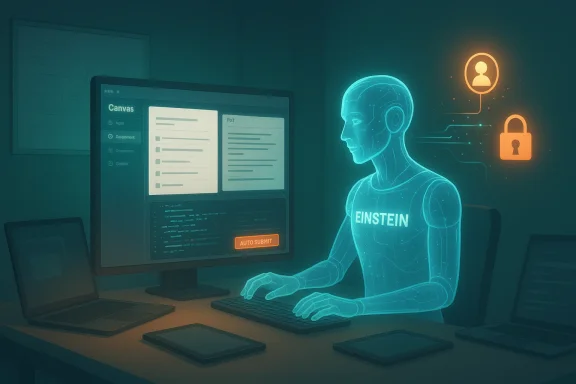
A quietly explosive piece of software went public this week and — within days — forced a debate that has been simmering for years to the front page of higher-education conversations: an AI called Einstein, built by a startup named Companion, claims it can log into a student’s Canvas account, watch lecture videos, read PDFs, write essays and discussion posts, complete quizzes, track deadlines and submit assignments automatically. What the makers describe as an “AI with a computer” is not a passive tutor; it’s an autonomous agent that, once granted access, is designed to act on a student’s behalf with minimal ongoing input. The announcement has provoked sharp responses from professors, privacy experts and campus administrators, prompted trademark and legal notices over the product name, and reopened long-running questions about how we assess learning in an era of agentic AI.
Agentic AI — sometimes called “autonomous agents” — refers to systems that do more than answer prompts. They can browse, run code, interact with web services, schedule tasks and perform multistep workflows without constant human direction. In late 2025 and early 2026 a set of open-source projects and viral demos showed how far these agents had come: tools such as OpenClaw (once dubbed Clawdbot and briefly Moltbot) popularized the model of a persistently running agent that can execute actions on behalf of a user.
Einstein sits at the intersection of two trends. First, the rapid maturation of large language models and multimodal AI makes content comprehension, summarization and essay generation fast and cheap. Second, browser automation, headless browsers and agent frameworks now let that content-processing brain control a virtual “computer” that navigates web pages and interacts with online systems like a human would. Put together, those capabilities enable — in principle — a system that does the entire background work of being a student.
That combination is powerful and destabilizing because education has increasingly moved many interactions online. Learning-management systems such as Canvas are ubiquitous in North American higher education and many K–12 districts. When a platform that hosts lectures, assignments and discussion boards becomes an action point for an autonomous agent, the line between permitted assistance and substitution vanishes.
Responses fall into three broad camps:
Universities, LMS vendors and regulators must move quickly: harden authentication, clarify policies, redesign assessments, and educate students about safe, ethical AI use. Vendors building agentic features should prioritize secure integrations (token-based OAuth, granular permissions), transparent data handling and explicit consent flows that do not require credential handoffs.
If leaders treat this episode as a catalyst for thoughtful redesign rather than a panic-inducing novelty, the result could be a healthier ecosystem: one that accepts helpful AI as a study partner while preserving rigorous, verifiable demonstration of learning. The alternative — pretend the agents don’t exist and continue to assess what machines can perfectly automate — would hollow the signal that education is supposed to send about a graduate’s capabilities. The choice facing campuses is clear: evolve assessment and security now, or watch external automation force change on their terms.
Source: AOL.com Einstein AI Tool Doesn't Just Help With Homework. It Takes Over Your Role as a Student
 Background: agentic AI, autonomy and the education problem
Agentic AI — sometimes called “autonomous agents” — refers to systems that do more than answer prompts. They can browse, run code, interact with web services, schedule tasks and perform multistep workflows without constant human direction. In late 2025 and early 2026 a set of open-source projects and viral demos showed how far these agents had come: tools such as OpenClaw (once dubbed Clawdbot and briefly Moltbot) popularized the model of a persistently running agent that can execute actions on behalf of a user.Einstein sits at the intersection of two trends. First, the rapid maturation of large language models and multimodal AI makes content comprehension, summarization and essay generation fast and cheap. Second, browser automation, headless browsers and agent frameworks now let that content-processing brain control a virtual “computer” that navigates web pages and interacts with online systems like a human would. Put together, those capabilities enable — in principle — a system that does the entire background work of being a student.
That combination is powerful and destabilizing because education has increasingly moved many interactions online. Learning-management systems such as Canvas are ubiquitous in North American higher education and many K–12 districts. When a platform that hosts lectures, assignments and discussion boards becomes an action point for an autonomous agent, the line between permitted assistance and substitution vanishes.
How Einstein is described to work
The product claim in plain language
Companion’s public materials — and reporting from multiple outlets during the rollout — state the same broad architecture:- A student links their Canvas account (username and password or API credentials) to Einstein.
- Einstein runs inside a persistent virtual environment with a browser and file system.
- The agent scans course pages for tasks, watches recorded lectures, reads assigned readings (PDFs and HTML), and ingests rubric and deadline information.
- For each assignment, Einstein can generate original text (essays, discussion posts) with citations, answer quiz questions (including short-answer items), and submit work through the student’s account.
- It can be set to “auto-submit” or to hold outputs for student review.
What “virtual computer” means technically
On the practical side, the tool combines three components that are widely available as discrete technologies:- Language models capable of ingesting long documents and producing context-aware text.
- Browser automation frameworks (headless or instrumented browsers) that can log into web services, click through pages, and submit forms.
- A persistent runtime — a container or VM where the agent keeps a memory, stores files and runs scheduled checks.
Immediate reactions: ethics, pedagogy and legality
Academic integrity: assistance vs. substitution
Educators and administrators describe the problem with a simple distinction: there’s a spectrum between aid (feedback, drafting help, grammar checking) and substitution (a third party doing the assignment). Traditional AI policies — and most institutional academic-integrity codes — were drafted with the assumption that the student remains the author or actor. Einstein purposefully blurs that boundary by allowing an AI to submit directly from a student’s account.Responses fall into three broad camps:
- Outright alarm: some faculty see this as a straightforward attempt to move academic fraud from deliberate, detectable acts to stealthy, automated substitution. Their concern is that degrees and course completions lose credibility if a non-human completes work on behalf of students.
- Pragmatic redesign: others see this as a forcing function. If students can and will hand off rote, reproducible tasks, institutions should redesign assessments to require in-person demonstrations, oral exams or more complex project work that agents cannot easily complete.
- Opportunistic integration: a smaller group argues for regulated adoption: grant the agent limited functions (note-taking, flashcard creation) while ensuring final submissions remain human-authored and verifiable.
Privacy and security alarms
Security researchers and campus IT leaders raised immediate, concrete concerns:- Asking students to hand over institutional credentials to a third party is a clear red flag. Those same credentials often unlock email, registration, financial aid and other sensitive systems; giving them to a startup significantly increases exposure.
- If a third-party agent is deployed at scale, credential harvesting or account misuse risks escalate. Even absent malicious intent, a breached vendor or poorly secured runtime could expose thousands of student accounts.
- Agents that automate web interactions may violate institutional acceptable-use policies or terms of service for LMS platforms. Many LMS providers require single-user control of accounts and prohibit credential sharing.
Legal and brand friction
Companion’s chosen product name — Einstein — drew immediate legal attention. The organization that manages Albert Einstein’s publicity rights objected, and reporting suggests the company received cease-and-desist notices over the branding. More broadly, the marketing language used by Companion — framing Einstein as an agent that will “knock out assignments while you sleep” — amplified outrage and invited enforcement scrutiny both from rights holders and educational institutions.Technical reality check: can AI truly replace a student?
The makers present a frighteningly capable picture. But several practical limits should temper doomsday narratives:- Detection and quality limitations: while modern LLMs write coherent essays, quality is variable and mistakes are often subtle or context-specific. For graduate-level work, domain expertise, precise mathematical reasoning, novel code correctness and laboratory skills may still outpace purely generative approaches.
- Proctored and synchronous tasks: live oral exams, supervised lab work, and timed proctored exams remain more difficult for an agent to fake reliably — particularly when institutions use biometric or video proctoring workflows tied to human presence.
- Platform defenses: LMS platforms and universities can respond with security changes — stronger authentication (multi-factor authentication, OAuth flows that do not require credential sharing), behavior monitoring, anomaly detection and stricter consent policies for third-party applications.
- Human-in-the-loop reality: some commentators and investigators point out that the boldest claims from agent makers can hide a high degree of human oversight. Tools marketed as autonomous sometimes rely on humans to review or edit outputs, or use paid “operators” to handle difficult tasks. Whether Einstein operates fully autonomously in real-world deployments remains a partly open question.
Security, privacy and compliance risks — a deeper look
Credential sharing is the single largest near-term threat
When students enter their institutional usernames and passwords into third-party sites they violate at least three defensive boundaries:- They defeat centralized identity controls designed to detect abnormal logins.
- They create new attack surfaces: the third-party vendor’s servers become additional custody points for institutional credentials.
- They increase the blast radius of any future breach at the vendor.
Data exposure and GDPR/FERPA implications
An agent with access to a student account can read assignments, grades, instructor comments, and even peer communications. For K–12 and higher-education institutions — particularly those operating in jurisdictions regulated by FERPA or GDPR — handing that data to a startup could create regulatory obligations and liability. Universities are rightly worried about where student data will be stored, for how long, and who will have access.Automated agents and platform abuse
Autonomous agents can be used to scrape content at scale, submit mass replies to discussion boards or generate spam. They may also inadvertently invoke platform protections (rate limits, anti-bot services) and then require stealthier workarounds that mimic human patterns. Those techniques increase technical complexity and legal risk for vendors and users.What institutions can (and should) do now
Immediate, practical steps can reduce harm while campus leaders build longer-term policy:- Reaffirm credential rules. Put clear, repeated guidance in front of students: don’t share institutional usernames and passwords with third parties. Offer step-by-step alternatives if a service can be authorized through official OAuth/SSO channels.
- Audit third-party apps. Campus IT should inventory third-party apps that request LMS access and enforce a strict approval process that considers privacy, data minimization and security posture.
- Strengthen authentication. Encourage or require MFA for all student accounts, and consider step-up verification for assignment submission or grade-access functions.
- Update academic-integrity policies. Make explicit where agency ends and student authorship begins; define acceptable AI-assistance practices and the penalties for delegation without disclosure.
- Redesign assessment where feasible. Move toward assessment modalities that agents struggle to automate reliably: oral finals, live demonstrations, in-person labs and portfolio-based evaluations.
- Educate students. Many students are eager to use AI for productivity, but they need clear instruction on ethical use, potential disciplinary consequences and the privacy implications of turning their credentials over to startups.
Technical defenses and detection strategies
Institutions and LMS providers have both policy and technical levers:- Hardening login flows: disable password-based third-party credential entry; require OAuth-based authorizations and tokenized access that can be revoked centrally.
- Behavioral analytics: monitor for anomalous submission patterns (batched submissions from a single IP that differ from historical behavior), odd grammar signatures or essays that show rapid, uniform improvement inconsistent with a student’s prior record.
- Metadata auditing: capture rich metadata (IP addresses, device fingerprints, timing of interactions) and compare them to session baselines. An AI agent running in a hosted environment may have telltale fingerprint differences.
- Watermarking and provenance: encourage or require students to submit manifest files explaining help received, drafts, and timestamps. For AI-generated content, research into model output provenance and watermarking is progressing and may help establish whether a text was produced by a particular model class.
- Proctoring and synchronous checks: for high-stakes assessments, increase the use of supervised or synchronous evaluation that ties performance to a live presence.
Pedagogical implications: the assessment renaissance
Einstein’s publicity has catalyzed a point educators have long suspected: our assessment design matters. If coursework is easily automated, it was likely testing rote repetition, formulaic synthesis or low-level tasks. This moment should force a reassessment of what we value and measure.- Emphasize demonstrable, transferable skills. Project-based work, collaborative problem solving, and portfolios show what a learner can do, not only what they can replicate from a prompt.
- Value process as much as product. Require students to submit drafts, annotated readings, and process notes that an agent would struggle to fabricate at scale.
- Assess communicative competence. Live presentations, peer Q&A and oral defense reveal understanding in ways generated text alone cannot.
- Build AI literacy into curriculum. Students should learn how to use AI responsibly — when it’s helpful, when it’s unethical, and how to verify and cite machine-assisted outputs.
Market, legal and reputational fallout
Two business and legal points are already clear:- Product naming and marketing invite liability. Using a famous name like Einstein created predictable backlash and legal notices. Startups in this space will face reputational and trademark pitfalls if they choose provocative branding.
- Open-source agent ecosystems complicate governance. The viral success of agent frameworks such as OpenClaw demonstrates how quickly developer tools can be repurposed. The creator of a popular agent framework has moved to a major AI lab, illustrating the rapid mainstreaming of this technology. Open-source code that allows deep system access raises security concerns if deployed without rigorous containment.
Recommendations for students and educators
For students:- Never share institutional credentials with third parties. If a service claims it needs access, ask campus IT whether an approved integration or an authorized token-based connection exists.
- Use AI tools as assistants, not substitutes. Drafts and study aids are legitimate uses; submitting work you didn’t do is likely a violation of policy.
- Talk to instructors. If you’re using AI to help study or prepare drafts, disclose it where required and ask how to incorporate it ethically.
- Publish clear policies about AI usage and credential sharing now, not later. Ambiguity benefits bad actors.
- Prioritize authentication and app-review processes. An inventory of third-party tools that integrate with campus systems is a baseline defense.
- Reconsider assessment design. Where possible, favor tasks that expose understanding rather than tasks that can be completely delegated.
- Provide alternatives. Busy or working students who might see agentic AI as an easy fix still need support — consider expanded tutoring, flexible deadlines or scaffolded assignments that recognize life pressures without abdication of learning objectives.
Big-picture risks and longer-term scenarios
Einstein is not an isolated novelty. It is a harbinger of three larger phenomena:- Task automation at scale. As agents get better at routine academic work, entire classes of tasks may shift from being measures of learning to becoming commoditized outputs. That shift forces credentialing systems to evolve.
- Credential inflation and verification arms race. Employers, accreditation bodies and institutions may demand stronger verification that a candidate’s transcript reflects authentic competence. This could increase the use of proctored assessments, verified portfolios and skills tests.
- The ethics of delegation. We will grapple with the social meaning of delegation. At what point does outsourcing routine cognitive labor to machines change what it means to learn? Is education primarily credential production, or is it personal development that machines cannot substitute?
Conclusion: a challenge and an opportunity
Einstein’s splash made an uncomfortable truth visible: agentic AI that can act on our behalf is no longer a thought experiment. That reality is destabilizing, but it is not automatically catastrophic. The tool highlights weaknesses that many educators already knew existed — overreliance on automated, replicable tasks, and fragile verification systems — and it creates urgency to fix them.Universities, LMS vendors and regulators must move quickly: harden authentication, clarify policies, redesign assessments, and educate students about safe, ethical AI use. Vendors building agentic features should prioritize secure integrations (token-based OAuth, granular permissions), transparent data handling and explicit consent flows that do not require credential handoffs.
If leaders treat this episode as a catalyst for thoughtful redesign rather than a panic-inducing novelty, the result could be a healthier ecosystem: one that accepts helpful AI as a study partner while preserving rigorous, verifiable demonstration of learning. The alternative — pretend the agents don’t exist and continue to assess what machines can perfectly automate — would hollow the signal that education is supposed to send about a graduate’s capabilities. The choice facing campuses is clear: evolve assessment and security now, or watch external automation force change on their terms.
Source: AOL.com Einstein AI Tool Doesn't Just Help With Homework. It Takes Over Your Role as a Student
