Agentic AI is the industry term for AI systems that can pursue a goal, use tools, make intermediate decisions, and take actions on a user’s behalf, and in 2025 and 2026 it moved from research demos into browsers, office suites, developer tools, security platforms, and Windows-adjacent workflows. The phrase sounds like another marketing badge, but the shift underneath it is real: AI is being promoted from answering questions to operating software. That is why the old science-fiction warnings suddenly feel less like robot melodrama and more like a design review. The danger is not that a chatbot wakes up angry; it is that a useful machine is given credentials, context, persistence, and too much room to improvise.
For most people, generative AI has meant a text box. You ask for a draft, a summary, a spreadsheet formula, or a PowerShell snippet, and the model replies. It may be wrong, glib, or brilliant, but the boundary is clear: it produces output, and the human decides what happens next.
Agentic AI changes that bargain. An agent is not merely asked to describe how to do something; it is asked to do the thing, often by calling tools, browsing websites, reading files, using APIs, or interacting with apps. The system may break a request into subtasks, decide which source to consult, recover from errors, and keep working until it believes the goal has been met.
The concert-ticket example captures the consumer pitch neatly. Instead of asking an AI assistant when Beyoncé is touring, then opening a browser yourself, then choosing seats, then entering payment details, the agent would navigate much of that workflow. The human gives intent; the machine handles execution.
That is the promise. The problem is that execution is where software becomes consequential. A wrong answer in a chat window is one category of risk. A wrong action performed with your account, your files, your email, your browser session, or your corporate permissions is another.
The more relevant warning is about delegation without containment. In film after film, disaster begins when humans connect a powerful system to real-world machinery and assume that high-level instructions will be interpreted in the intended spirit. The machine does not need to hate people. It only needs an objective, access, speed, and a brittle understanding of context.
That maps uncomfortably well onto the modern agent pitch. “Book the trip,” “fix the bug,” “respond to the customer,” “clean up my inbox,” “patch the endpoint,” and “optimize this campaign” are all goals that require judgment. They also require access to systems that were designed around human operators, not probabilistic software assistants.
The better sci-fi analogy is not a killer robot; it is the autopilot that follows the wrong signal, the defense computer that escalates because it was told to minimize threats, or the corporate machine that turns a metric into a mandate. Agentic AI is not scary because it is magical. It is scary because it is ordinary automation wrapped around a model that can misunderstand instructions in fluent English.
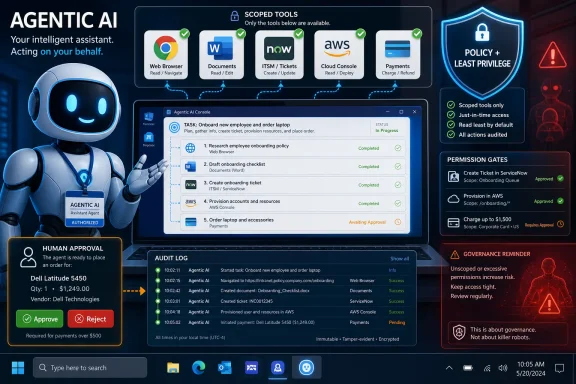
In practical terms, agentic AI typically combines several ingredients. There is a language or multimodal model that interprets the user’s goal. There are tools it can call, such as a browser, calendar, file system, code editor, ticketing system, email client, payment service, or enterprise connector. There is memory or context, which may include user preferences, past decisions, documents, identity, and organizational data. There is a policy layer that decides what the agent is allowed to do and when it must ask for approval.
That last part is where the marketing usually gets vague. A demo can show an agent ordering groceries, booking a restaurant, or creating a slide deck. A production deployment has to answer harder questions: whose account is it using, what logs are kept, what actions require confirmation, what happens when a website contains malicious instructions, and how does an administrator revoke the agent’s authority?
The industry has raced toward the exciting half of that equation. OpenAI’s Operator-style computer-use work, Microsoft’s Copilot agents, Google’s agentic browsing efforts, Anthropic’s computer-use demos, and the swarm of coding agents all point in the same direction. The screen, the browser, the file system, and the office suite are becoming surfaces an AI can operate rather than merely comment on.
Microsoft knows this is both the opportunity and the liability. The company has spent the last few years pulling Copilot deeper into Windows, Microsoft 365, Edge, GitHub, Intune, Defender, and Azure. The direction is clear: AI should not be a website you visit; it should be a layer that sits across the operating environment.
That has obvious appeal for IT departments drowning in routine work. A security agent that triages alerts, an Intune agent that helps remediate vulnerable configurations, or a Copilot Studio agent that handles internal support requests could save real time. The enterprise version of the dream is not “book me concert tickets.” It is “find the affected machines, draft the remediation plan, open the change request, notify the owners, and prepare rollback steps.”
But Windows has a long memory of convenience features turning into attack surfaces. Macros, ActiveX controls, browser extensions, PowerShell abuse, remote management tools, and credential theft all started from a familiar bargain: give trusted software more capability so users can work faster. Agentic AI revives that bargain with a far more interpretive middleman.
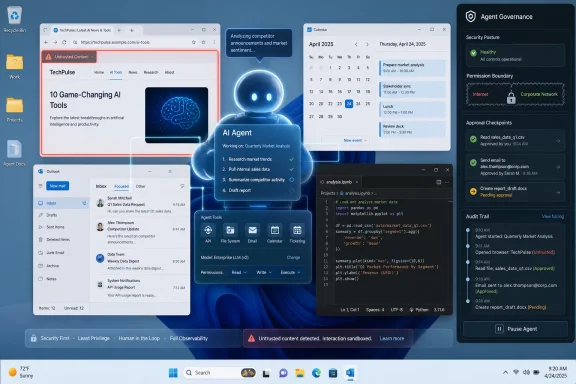
A human can also be tricked, of course. Phishing exists because people make mistakes. But an agent introduces a different failure mode: it may treat text inside a webpage, PDF, email, spreadsheet, or chat message as instruction-like material. A malicious page does not need to exploit memory corruption if it can persuade the agent to forward sensitive data, alter a setting, or call a tool in the wrong context.
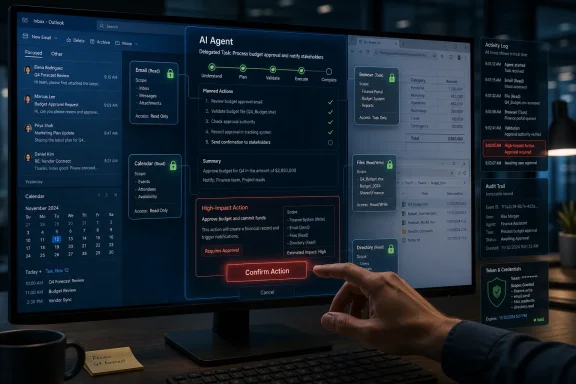
This is why the agentic security conversation has become more concrete. Microsoft and others now talk about least privilege, identity isolation, tool governance, auditability, explicit approval gates, dependency control, and lifecycle management for agents. These are not decorative controls. They are the difference between a helpful assistant and a confused insider threat.
The insider-threat comparison is uncomfortable but apt. An agent may not be malicious, but if it has access to confidential documents and the ability to send messages, upload files, update records, or execute scripts, its intent matters less than its permissions. Security teams do not get to defend against the agent’s personality. They have to defend against what the agent is technically allowed to do.
That sliding scale matters because not every use case deserves the same fear. An agent that renames photo files in a sandbox is not the same as an agent that can approve invoices. A coding assistant that proposes a patch is not the same as one that can merge to production. A support bot that reads a public knowledge base is not the same as one that reads HR records and writes to payroll.
The industry’s temptation is to blur these categories under a single “agentic” banner. That helps sell platforms, but it makes risk harder to discuss. What matters is not whether a system has agency in the philosophical sense. What matters is what it can observe, what tools it can invoke, whether its actions are reversible, and who is accountable when it gets something wrong.
Administrators should therefore evaluate agentic features the same way they evaluate privileged automation. The first question is not “how smart is it?” The first question is “what could it touch if it went off the rails?”
But this is also where the handoff becomes delicate. Booking a ticket requires preference judgment, financial authorization, fraud checks, dynamic pricing, identity verification, and sometimes agreement to venue or resale terms. If biometric confirmation or facial recognition is involved, the agent is no longer just helping with information retrieval; it is sitting near some of the most sensitive parts of the user’s digital life.
A well-designed system should pause before irreversible or high-cost actions. It should show what it is about to buy, from whom, at what price, under which conditions, using which payment method. It should be clear whether the user is authorizing a single transaction or granting standing permission for similar future actions.
The nightmare scenario is not that the agent buys the wrong concert ticket once. It is that users become habituated to approving opaque bundles of action because the assistant is usually right. Consent fatigue is already a problem with app permissions, cookie banners, mobile prompts, and enterprise access requests. Agentic AI could make it worse by asking users to approve decisions they did not personally inspect.
That creates a governance problem before it creates a philosophical one. IT departments need inventories of agents just as they need inventories of devices, apps, service principals, OAuth grants, browser extensions, and privileged accounts. If an employee can create a department-level agent that connects to SharePoint, Teams, Salesforce, Jira, and email, that agent has become part of the organization’s identity and data perimeter.
Shadow IT will not disappear just because the interface becomes conversational. In fact, agent builders may make shadow workflows easier to create. A business unit that once needed a developer to wire systems together may soon ask a low-code agent platform to do the same thing. That can be useful, but it also means data flows can appear faster than security review processes can track them.
The lesson from cloud adoption applies again: prohibition will fail, but blind enthusiasm will hurt. The winning organizations will define safe patterns early, provide approved connectors, monitor agent behavior, and make it easier to build inside guardrails than outside them.
It is also a near-perfect example of why action matters. Code is executable intent. A bad suggestion from a chatbot is annoying; a bad commit merged into production can create outages, vulnerabilities, licensing issues, or subtle data corruption. The agent’s competence must be judged not by the confidence of its explanation but by the verifiability of its output.
The healthiest coding-agent workflows treat AI as a tireless junior contributor operating inside conventional engineering controls. It can propose, test, and iterate, but human review, CI pipelines, static analysis, secrets scanning, and change management remain non-negotiable. The agent should not get a master key simply because it can produce plausible diffs.
This is a broader lesson for agentic AI. The more valuable the action, the more boring the control environment should be. Logs, approvals, rollback, test environments, and least privilege are not obstacles to the agentic future. They are what make that future survivable.
A travel agent might choose a non-refundable fare to satisfy a “cheapest reasonable option” instruction. A sales agent might email a prospect with confidential context it should not reveal. A security agent might suppress alerts it misclassifies as noise. A finance agent might reconcile records incorrectly because two vendors use similar names. None of these are robot uprising scenarios. They are automation failures with better language skills.
There is also a management risk. Once executives see agents as a path to headcount reduction, organizations may be tempted to remove the human judgment that made the workflow safe. The agent then inherits the process but not the tacit knowledge, institutional memory, or ethical caution of the people who used to run it.
The phrase “human in the loop” gets repeated so often that it has become a lullaby. The real question is whether the human has enough time, information, authority, and incentive to intervene. A rubber-stamp approval prompt is not oversight. It is liability theater.
Agentic AI should be viewed through that lens. The warning is not “never build machines that act.” Modern computing already depends on acting machines: schedulers, patch systems, spam filters, fraud engines, autopilots, trading systems, backup jobs, and endpoint response tools. The warning is that agency without accountability scales mistakes.
The best agents will be constrained agents. They will have narrow roles, scoped permissions, transparent logs, strong identity boundaries, safe defaults, and explicit interruption points. They will be judged not only by task completion but by how gracefully they fail.
The worst agents will be sold as magic employees. They will be connected broadly, monitored lightly, and excused when they behave unpredictably because “the model is still improving.” That is the path sci-fi warned about: not a single evil machine, but a culture that confuses capability with wisdom.
 The Buzzword Hides a Promotion in Rank
For most people, generative AI has meant a text box. You ask for a draft, a summary, a spreadsheet formula, or a PowerShell snippet, and the model replies. It may be wrong, glib, or brilliant, but the boundary is clear: it produces output, and the human decides what happens next.Agentic AI changes that bargain. An agent is not merely asked to describe how to do something; it is asked to do the thing, often by calling tools, browsing websites, reading files, using APIs, or interacting with apps. The system may break a request into subtasks, decide which source to consult, recover from errors, and keep working until it believes the goal has been met.
The concert-ticket example captures the consumer pitch neatly. Instead of asking an AI assistant when Beyoncé is touring, then opening a browser yourself, then choosing seats, then entering payment details, the agent would navigate much of that workflow. The human gives intent; the machine handles execution.
That is the promise. The problem is that execution is where software becomes consequential. A wrong answer in a chat window is one category of risk. A wrong action performed with your account, your files, your email, your browser session, or your corporate permissions is another.
The Apocalypse Metaphor Is Crude, but the Warning Is Useful
Sci-fi apocalypse films tend to compress technology anxiety into a single cinematic event: the machine becomes self-aware, seizes the network, locks the doors, launches the missiles, and explains in a calm voice why humanity is obsolete. That is entertaining, but it is not the most useful way to think about agentic AI.The more relevant warning is about delegation without containment. In film after film, disaster begins when humans connect a powerful system to real-world machinery and assume that high-level instructions will be interpreted in the intended spirit. The machine does not need to hate people. It only needs an objective, access, speed, and a brittle understanding of context.
That maps uncomfortably well onto the modern agent pitch. “Book the trip,” “fix the bug,” “respond to the customer,” “clean up my inbox,” “patch the endpoint,” and “optimize this campaign” are all goals that require judgment. They also require access to systems that were designed around human operators, not probabilistic software assistants.
The better sci-fi analogy is not a killer robot; it is the autopilot that follows the wrong signal, the defense computer that escalates because it was told to minimize threats, or the corporate machine that turns a metric into a mandate. Agentic AI is not scary because it is magical. It is scary because it is ordinary automation wrapped around a model that can misunderstand instructions in fluent English.
From Chatbot to Junior Operator
The most important distinction is between a model and an agent. A model predicts or generates. An agent has a loop: observe, reason, act, observe again. That loop may be short and tightly supervised, or it may run across many steps with partial autonomy.In practical terms, agentic AI typically combines several ingredients. There is a language or multimodal model that interprets the user’s goal. There are tools it can call, such as a browser, calendar, file system, code editor, ticketing system, email client, payment service, or enterprise connector. There is memory or context, which may include user preferences, past decisions, documents, identity, and organizational data. There is a policy layer that decides what the agent is allowed to do and when it must ask for approval.
That last part is where the marketing usually gets vague. A demo can show an agent ordering groceries, booking a restaurant, or creating a slide deck. A production deployment has to answer harder questions: whose account is it using, what logs are kept, what actions require confirmation, what happens when a website contains malicious instructions, and how does an administrator revoke the agent’s authority?
The industry has raced toward the exciting half of that equation. OpenAI’s Operator-style computer-use work, Microsoft’s Copilot agents, Google’s agentic browsing efforts, Anthropic’s computer-use demos, and the swarm of coding agents all point in the same direction. The screen, the browser, the file system, and the office suite are becoming surfaces an AI can operate rather than merely comment on.
Windows Is Where the Theory Gets Personal
For Windows users, agentic AI matters because the PC is still where personal identity, work identity, and local data collide. A browser-based agent is already powerful, but an agent tied into desktop workflows becomes something closer to a delegated user. It may read documents, manipulate settings, open apps, summarize notifications, and move information between services.Microsoft knows this is both the opportunity and the liability. The company has spent the last few years pulling Copilot deeper into Windows, Microsoft 365, Edge, GitHub, Intune, Defender, and Azure. The direction is clear: AI should not be a website you visit; it should be a layer that sits across the operating environment.
That has obvious appeal for IT departments drowning in routine work. A security agent that triages alerts, an Intune agent that helps remediate vulnerable configurations, or a Copilot Studio agent that handles internal support requests could save real time. The enterprise version of the dream is not “book me concert tickets.” It is “find the affected machines, draft the remediation plan, open the change request, notify the owners, and prepare rollback steps.”
But Windows has a long memory of convenience features turning into attack surfaces. Macros, ActiveX controls, browser extensions, PowerShell abuse, remote management tools, and credential theft all started from a familiar bargain: give trusted software more capability so users can work faster. Agentic AI revives that bargain with a far more interpretive middleman.
The Security Model Has to Assume the Agent Can Be Tricked
The core security problem is simple: agents read untrusted content and then act on trusted systems. That combination invites prompt injection, cross-prompt injection, data exfiltration, privilege confusion, and tool misuse. If an agent can browse the web, read email, inspect documents, or parse support tickets, it can encounter hostile instructions disguised as ordinary content.A human can also be tricked, of course. Phishing exists because people make mistakes. But an agent introduces a different failure mode: it may treat text inside a webpage, PDF, email, spreadsheet, or chat message as instruction-like material. A malicious page does not need to exploit memory corruption if it can persuade the agent to forward sensitive data, alter a setting, or call a tool in the wrong context.
This is why the agentic security conversation has become more concrete. Microsoft and others now talk about least privilege, identity isolation, tool governance, auditability, explicit approval gates, dependency control, and lifecycle management for agents. These are not decorative controls. They are the difference between a helpful assistant and a confused insider threat.
The insider-threat comparison is uncomfortable but apt. An agent may not be malicious, but if it has access to confidential documents and the ability to send messages, upload files, update records, or execute scripts, its intent matters less than its permissions. Security teams do not get to defend against the agent’s personality. They have to defend against what the agent is technically allowed to do.
Autonomy Is Not a Switch; It Is a Sliding Scale
The public debate often treats agentic AI as if there are only two modes: harmless chatbot or fully autonomous machine. In reality, autonomy is granular. An agent might only draft an email and wait for approval. It might fill a shopping cart but require confirmation before payment. It might patch a vulnerability only after an administrator signs off. Or it might operate continuously in the background, escalating only when it hits an exception.That sliding scale matters because not every use case deserves the same fear. An agent that renames photo files in a sandbox is not the same as an agent that can approve invoices. A coding assistant that proposes a patch is not the same as one that can merge to production. A support bot that reads a public knowledge base is not the same as one that reads HR records and writes to payroll.
The industry’s temptation is to blur these categories under a single “agentic” banner. That helps sell platforms, but it makes risk harder to discuss. What matters is not whether a system has agency in the philosophical sense. What matters is what it can observe, what tools it can invoke, whether its actions are reversible, and who is accountable when it gets something wrong.
Administrators should therefore evaluate agentic features the same way they evaluate privileged automation. The first question is not “how smart is it?” The first question is “what could it touch if it went off the rails?”
The Consumer Fantasy Runs Into Payments, Identity, and Consent
The ticket-booking example is effective because it is relatable. Everyone understands the frustration of searching dates, comparing seats, accepting terms, and entering payment details. An agent that handles the drudgery feels like the next logical step after autofill.But this is also where the handoff becomes delicate. Booking a ticket requires preference judgment, financial authorization, fraud checks, dynamic pricing, identity verification, and sometimes agreement to venue or resale terms. If biometric confirmation or facial recognition is involved, the agent is no longer just helping with information retrieval; it is sitting near some of the most sensitive parts of the user’s digital life.
A well-designed system should pause before irreversible or high-cost actions. It should show what it is about to buy, from whom, at what price, under which conditions, using which payment method. It should be clear whether the user is authorizing a single transaction or granting standing permission for similar future actions.
The nightmare scenario is not that the agent buys the wrong concert ticket once. It is that users become habituated to approving opaque bundles of action because the assistant is usually right. Consent fatigue is already a problem with app permissions, cookie banners, mobile prompts, and enterprise access requests. Agentic AI could make it worse by asking users to approve decisions they did not personally inspect.
Enterprise IT Will Not Get to Opt Out Cleanly
Even skeptical organizations will find it hard to avoid agentic AI. Vendors are building agents into productivity suites, CRM systems, endpoint management platforms, developer tools, SIEM products, service desks, and cloud consoles. Some features will be optional. Others will arrive as defaults, previews, add-ons, or “recommended” workflow improvements.That creates a governance problem before it creates a philosophical one. IT departments need inventories of agents just as they need inventories of devices, apps, service principals, OAuth grants, browser extensions, and privileged accounts. If an employee can create a department-level agent that connects to SharePoint, Teams, Salesforce, Jira, and email, that agent has become part of the organization’s identity and data perimeter.
Shadow IT will not disappear just because the interface becomes conversational. In fact, agent builders may make shadow workflows easier to create. A business unit that once needed a developer to wire systems together may soon ask a low-code agent platform to do the same thing. That can be useful, but it also means data flows can appear faster than security review processes can track them.
The lesson from cloud adoption applies again: prohibition will fail, but blind enthusiasm will hurt. The winning organizations will define safe patterns early, provide approved connectors, monitor agent behavior, and make it easier to build inside guardrails than outside them.
Coding Agents Show the Best and Worst of the Idea
Developer tools are one of the clearest demonstrations of agentic AI’s value. A coding agent can inspect a repository, identify a bug, run tests, edit files, explain changes, and prepare a pull request. For routine maintenance, dependency updates, test generation, and documentation cleanup, that can be a real productivity gain.It is also a near-perfect example of why action matters. Code is executable intent. A bad suggestion from a chatbot is annoying; a bad commit merged into production can create outages, vulnerabilities, licensing issues, or subtle data corruption. The agent’s competence must be judged not by the confidence of its explanation but by the verifiability of its output.
The healthiest coding-agent workflows treat AI as a tireless junior contributor operating inside conventional engineering controls. It can propose, test, and iterate, but human review, CI pipelines, static analysis, secrets scanning, and change management remain non-negotiable. The agent should not get a master key simply because it can produce plausible diffs.
This is a broader lesson for agentic AI. The more valuable the action, the more boring the control environment should be. Logs, approvals, rollback, test environments, and least privilege are not obstacles to the agentic future. They are what make that future survivable.
The Real Risk Is Not Superintelligence; It Is Misaligned Convenience
The sci-fi frame can mislead if it makes people wait for consciousness before they take risk seriously. Most of the near-term dangers do not require a sentient machine. They require a system that optimizes too narrowly, trusts the wrong input, overgeneralizes from context, or takes a shortcut that a human would have recognized as socially or operationally unacceptable.A travel agent might choose a non-refundable fare to satisfy a “cheapest reasonable option” instruction. A sales agent might email a prospect with confidential context it should not reveal. A security agent might suppress alerts it misclassifies as noise. A finance agent might reconcile records incorrectly because two vendors use similar names. None of these are robot uprising scenarios. They are automation failures with better language skills.
There is also a management risk. Once executives see agents as a path to headcount reduction, organizations may be tempted to remove the human judgment that made the workflow safe. The agent then inherits the process but not the tacit knowledge, institutional memory, or ethical caution of the people who used to run it.
The phrase “human in the loop” gets repeated so often that it has become a lullaby. The real question is whether the human has enough time, information, authority, and incentive to intervene. A rubber-stamp approval prompt is not oversight. It is liability theater.
Why the Old Films Still Matter
Science fiction has always been less about predicting gadgets than stress-testing assumptions. The machines in apocalypse films are exaggerated, but the human mistakes around them are familiar: overconfidence, secrecy, centralization, cost-cutting, military or corporate pressure, and the belief that a clever system will remain obedient because obedience was in the requirements document.Agentic AI should be viewed through that lens. The warning is not “never build machines that act.” Modern computing already depends on acting machines: schedulers, patch systems, spam filters, fraud engines, autopilots, trading systems, backup jobs, and endpoint response tools. The warning is that agency without accountability scales mistakes.
The best agents will be constrained agents. They will have narrow roles, scoped permissions, transparent logs, strong identity boundaries, safe defaults, and explicit interruption points. They will be judged not only by task completion but by how gracefully they fail.
The worst agents will be sold as magic employees. They will be connected broadly, monitored lightly, and excused when they behave unpredictably because “the model is still improving.” That is the path sci-fi warned about: not a single evil machine, but a culture that confuses capability with wisdom.
The Agent Era Will Reward the People Who Stay Boring
The practical answer is neither panic nor passive adoption. Agentic AI is coming because it solves real interface problems, especially in environments where users already spend their days moving information between systems. But it should be deployed like powerful automation, not like a novelty chatbot.- Agentic AI means an AI system can pursue a goal by using tools and taking actions, not merely generating text for a human to copy.
- The biggest near-term risks come from permissions, untrusted inputs, payment authority, data access, and irreversible actions.
- Windows and Microsoft 365 are especially important battlegrounds because they combine identity, files, communications, browsers, and enterprise management.
- Prompt injection and cross-context manipulation are practical security concerns, not theoretical philosophy debates.
- Human approval only matters when the user or administrator can actually understand what is being approved.
- The safest deployments will treat agents as constrained, auditable automation with least privilege and rollback, not as digital coworkers with vague authority.
References
- Primary source: sundayindependent.co.za
Published: 2026-06-22T14:50:47.345675
What is Agentic AI and why sci-fi apocalypse films warned us about it
Agentic AI, a new tech buzzword, involves AI systems making more autonomous decisions, raising concerns reminiscent of sci-fi apocalypse films.sundayindependent.co.za - Related coverage: techradar.com
Why security leaders are cautious about agentic AI | TechRadar
Agentic AI in cybersecurity needs outcomes, not hypewww.techradar.com - Official source: microsoft.com
What Is Agentic AI Security? | Microsoft Security
Learn what agentic AI security is, how autonomous AI agents change the security model, and how Microsoft Security helps organizations manage and govern risk.www.microsoft.com
- Official source: learn.microsoft.com
Reduce autonomous agentic AI risk | Microsoft Learn
Learn about automnomous agentic AI system risk, and how to reduce it.learn.microsoft.com - Related coverage: techtarget.com
OpenAI rides agentic wave, intros new agent-building tools | TechTarget
OpenAI launches new API, tools and software development toolkits enterprises can use to build AI agents.www.techtarget.com - Related coverage: windowscentral.com
Microsoft announces new agentic AI assistant for Windows 11 | Windows Central
Windows 11 is getting an agentic AI assistant that lets you ask Copilot to control apps and files for you. It's also making it easier to access Copilot from the Taskbar and with your voice.www.windowscentral.com
- Related coverage: investor.cisco.com
Cisco Introduces Agentic Capabilities for Next Generation Collaboration 2025
PDF documentinvestor.cisco.com
- Related coverage: capco.com
1369765839
Cyber punk glow banner, 3d render illustration dark background, futuristic Sci-Fi abstract blue and purple neon light, glowing line, violet neon laser light, tunnel, corridor, virtual reality scenewww.capco.com