

Companies are quietly preparing for what many executives now describe as a planned “realignment” of labour around agentic AI — shifting people out of over-capacity roles and into AI‑adjacent jobs, rather than simply relying on mass layoffs — even as questions persist about the timing, ROI, and human cost of that transition.
The conversation about AI and jobs has moved beyond binary arguments of mass unemployment versus utopian augmentation. Over the past year, corporate planning documents, consultant reports, and executive surveys have converged on a more operational framing: agentic AI — systems designed to learn, reason, and take multi‑step actions autonomously — is expected to create both pockets of severe over‑capacity in routine work and acute shortages of new, specialised skills required to manage, govern, and extend those agents.
That framing helps explain why many companies report simultaneous strategies that look contradictory at first glance: reducing effort in repetitive, low‑value roles while massively investing in upskilling, redeployment programs, and new hires for AI supervision and model operations. The shift is less a sudden jobless future and more an organisational redesign that trades volume of headcount for specialised capability — assuming the reskilling and redeployment bets pay off.
Companies that treat workforce transition as a design problem — investing in secure sandboxes, measurable reskilling, and internal mobility — will be positioned to capture competitive advantages while limiting reputational and operational harms. Those that shortcut the human side for short‑term cost savings risk longer‑term damage: degraded reliability, talent flight, and regulatory scrutiny.
The realignment is underway. The important test for leaders now is whether they will manage it sustainably — not merely by cutting headcount to chase immediate efficiency, but by investing in the people and processes that turn agentic AI from an expense into a durable, governed capability.
Source: Consultancy.uk Companies planning for great realignment of labour for AI age
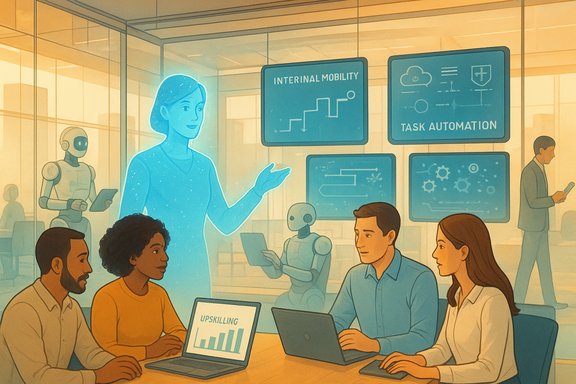 Background / Overview
The conversation about AI and jobs has moved beyond binary arguments of mass unemployment versus utopian augmentation. Over the past year, corporate planning documents, consultant reports, and executive surveys have converged on a more operational framing: agentic AI — systems designed to learn, reason, and take multi‑step actions autonomously — is expected to create both pockets of severe over‑capacity in routine work and acute shortages of new, specialised skills required to manage, govern, and extend those agents.That framing helps explain why many companies report simultaneous strategies that look contradictory at first glance: reducing effort in repetitive, low‑value roles while massively investing in upskilling, redeployment programs, and new hires for AI supervision and model operations. The shift is less a sudden jobless future and more an organisational redesign that trades volume of headcount for specialised capability — assuming the reskilling and redeployment bets pay off.
The data: what the surveys and reports actually say
Key findings executives are citing
- A substantial consulting survey of C‑level executives found that many firms expect at least 10% over‑capacity within three years because of agentic AI, with nearly half forecasting 30%–50% excess capacity in specific functions. This has pushed workforce planning into boardrooms and forced new strategies around internal mobility and reskilling.
- Executives also report significant talent shortages for AI‑centric roles: many estimate that shortages of staff who can work effectively with AI sit in the 20%–60% range, depending on role category. That shortage spans prompt engineers, model trainers, agentic workflow designers, and AI ethics and governance specialists.
- In practice, two-thirds of firms referenced in recent consulting work said they are prioritising upskilling and reskilling initiatives and a majority have established more frequent reviews of workforce plans to manage the expected realignment. These measures are the default corporate playbook so far — even if some firms elsewhere have pursued large layoffs without sizeable redeployment programs.
How to read the numbers (caveats)
Survey methodologies differ in sample, sector, and timing; headline percentages are indicative of sentiment and planning posture rather than exact forecasts for any single company. Where precise figures from third‑party surveys are quoted, they should be treated as directional unless the original dataset or methodology is published. Several analysts explicitly warn that ROI time horizons and expected labour impacts vary widely by industry and digital maturity.Why agentic AI changes the calculus
Agentic AI differs from earlier waves of automation in two ways that matter for workforce strategy:- It expands the scope of tasks that can be executed end‑to‑end, not just assisted. Where traditional automation replaced narrowly defined rule‑based steps, agentic systems can manage multi‑step workflows and make decisions across those steps — compressing entire job functions into a single automated flow. That makes some role definitions obsolete faster.
- It increases the need for human roles that orchestrate intelligence rather than perform routine labour: building and maintaining agent behaviors, securing data flows, auditing outputs, and supervising human‑in‑the‑loop checkpoints. Those are higher‑value, higher‑skill, and harder to scale quickly.
What companies are actually doing: the corporate playbook
1) Reskilling, upskilling and internal mobility
- 66% of firms in recent consulting samples reported prioritising training programs and redeployment pathways to shift employees from over‑capacity functions into AI‑adjacent roles. These programs include structured learning time, micro‑credentials, sandbox environments, and mentorship cohorts.
- Practical program elements many firms adopt:
- Enterprise AI sandboxes and protected training instances.
- Role‑based micro‑learning tied to promotion criteria.
- Paid apprenticeship rotations to preserve entry pathways.
2) Workforce planning and repeated reviews
Regular reviews of workforce plans have become commonplace, with HR and People teams running scenario models for task automation, tracking internal mobility windows, and mapping skills to future demand. This is framed as an alternative to immediate layoffs — though in practice organisations vary widely in how much they fund these efforts.3) Selective hiring for scarce skills
While many firms slow hiring for roles deemed automatable, they simultaneously invest in targeted recruitment for roles that are difficult to automate:- Model operations (ModelOps / MLOps)
- AI productisation and systems engineering
- AI ethics, compliance, and model audit teams
- Solution engineers who translate model capabilities into business outcomes.
4) Redeployment, severance and transitional support
Companies that announce reductions often package internal mobility windows, redeployment periods, severance packages, and outplacement support. The quality and scale of these programs are uneven; some firms provide robust re‑training stipends and rehiring commitments, others provide only basic notices.The occupations likely to shrink — and those that will grow
At risk (near term)
- Routine back‑office and clerical functions (data entry, reconciliations).
- Basic contact‑centre first‑line support that follows scripted trees.
- Mid‑level maintenance and legacy application support where tasks are repeatable.
- Entry‑level roles that historically served as apprenticeship pathways into organisations.
In demand (growing)
- Prompt engineers, domain‑specific model trainers, and agent workflow designers.
- Data engineers, platform engineers, and inference/ops specialists.
- AI governance, safety, and ethics professionals.
- Solution engineers and technical account managers who can operationalise agentic workflows for customers.
Risks and second‑order effects companies must manage
1) Institutional knowledge loss and operational fragility
Rapid cuts can remove the tacit knowledge needed to run complex systems. Rebuilding that expertise often costs more and takes longer than expected, and system reliability (SLOs, incident response) can degrade if staffing reductions outpace capability building.2) Morale and “survivor” syndrome
Firms that reduce headcount without clear redeployment pathways risk higher attrition among the remaining workforce. Increased workload, reduced psychological safety, and a tarnished employer brand can produce a long tail of recruitment difficulty.3) Apprenticeship and pipeline shrinkage
When routine tasks vanish, so do many on‑the‑job learning opportunities that historically trained junior staff. Without deliberate apprenticeships or paid rotational programs, the talent pipeline for mid‑career leaders narrows — a structural problem for future leadership diversity and capability.4) Bias, fairness and reputational risk
Automated systems trained on biased data can amplify representational harms, particularly in hiring, marketing, and customer-facing outputs. Continuous bias testing, model audits, and remediation workflows are required to limit reputational and legal exposure.5) Concentration and vendor lock‑in
Heavy dependence on a few hyperscalers for model hosting and agent runtime increases systemic risk: outages or supply‑chain shocks at a single provider can cascade. Procurement must account for operational continuity, SLAs, and contractual protections.A practical playbook for IT, HR, and leadership
Below is a condensed operational checklist for organisations planning to adopt agentic AI while responsibly managing workforce realignment.- Map tasks at the task‑level, not just roles. Label tasks as automatable, augmentable, or human‑critical and preserve learning tasks for juniors.
- Build secure AI sandboxes and enterprise instances; avoid uncontrolled use of consumer tools with proprietary data.
- Fund structured learning time and micro‑credentials tied to promotion and performance evaluation.
- Create internal mobility windows and paid apprenticeships that replace lost on‑the‑job learning.
- Embed governance: audit trails, human‑in‑the‑loop signoffs for critical outputs, and continuous bias testing.
- Protect institutional memory: document runbooks, onboard cross‑functional pairings, and maintain senior‑junior mentorships during transitions.
- Plan procurement with operational contingency: insist on exportable logs, contractual data‑use promises, and clear incident response SLAs from vendors.
Policy and ecosystem implications
The private sector playbook is necessary but not sufficient. Several policy levers and ecosystem responsibilities are already prominent in consultancies’ recommendations:- Public–private partnerships to scale recognised AI fluency credentials and fund apprenticeships in regions with concentrated job losses.
- Regulatory requirements for transparency and human oversight where AI materially affects hiring, promotions, or customer decisions — to limit unfair outcomes and provide enforceable guardrails.
- Investment in community colleges and vocational programs to embed AI literacy and verification skills (not just model building), preserving broad access to upward mobility.
What remains uncertain — and what to watch next
- Exact timing and magnitude of job reductions remain conditional on ROI and macroeconomic health. Many executives now expect benefits to materialise over a multi‑year horizon; a minority expect one‑to‑two‑year payback windows. That range reflects genuine uncertainty about operationalising agentic architectures at scale. Where precise percentages are cited publicly, readers should treat them as indicative until underlying survey methodologies and raw data are released.
- Re‑hiring patterns: will firms actually replace reduced headcount with AI‑centric engineers at scale, or will hiring lag? Public hiring flows and regulatory filings will provide the canonical record over the next 12–24 months.
- Model governance and systemic risk: increased reliance on a handful of model and cloud vendors concentrates risk. Watch for outages, incident post‑mortems, and contractual changes that reveal how vendors and customers share operational responsibility.
- Apprenticeship and pipeline effects: the long‑term leadership pipeline is at risk if entry pathways disappear. Companies that fail to replace apprenticeship functions with paid alternatives will likely see narrowing diversity and leadership pipelines.
Conclusion
Agentic AI has moved labour realignment from a theoretical risk to a concrete operational challenge. The sensible — and humane — corporate response is not binary. It requires disciplined execution across three dimensions: technological foundations, governance and procurement rigour, and an explicit human‑capital strategy that preserves learning pathways while building new capabilities.Companies that treat workforce transition as a design problem — investing in secure sandboxes, measurable reskilling, and internal mobility — will be positioned to capture competitive advantages while limiting reputational and operational harms. Those that shortcut the human side for short‑term cost savings risk longer‑term damage: degraded reliability, talent flight, and regulatory scrutiny.
The realignment is underway. The important test for leaders now is whether they will manage it sustainably — not merely by cutting headcount to chase immediate efficiency, but by investing in the people and processes that turn agentic AI from an expense into a durable, governed capability.
Source: Consultancy.uk Companies planning for great realignment of labour for AI age
