

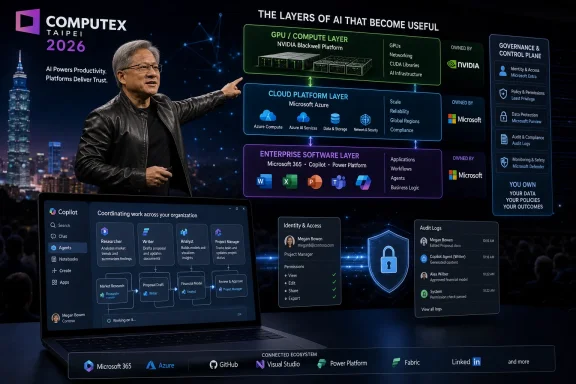
Nvidia CEO Jensen Huang used Computex 2026 in Taiwan to reject the idea that agentic AI will wipe out major software companies, arguing instead that the technology will expand the value of software platforms such as Microsoft’s cloud, productivity, and developer businesses. That matters because the AI panic around software is no longer theoretical; it is visible in valuation debates, enterprise buying decisions, and the way investors talk about the future of SaaS. Huang’s answer is self-interested, but it is not obviously wrong. The more serious question is not whether AI kills software, but who owns the layer where AI becomes useful.
Jensen Huang has every reason to sound bullish about AI. Nvidia sells the compute infrastructure beneath the boom, and a world in which AI agents colonize every workflow is a world that needs more GPUs, more networking, more inference capacity, and more software tuned to Nvidia’s stack. Skepticism is therefore mandatory.
But Huang’s Computex message lands because it pushes against a fashionable simplification. The easy story says that agentic AI turns software into a commodity: users describe what they want, agents assemble workflows on the fly, and the old application vendors find themselves bypassed. In that version of the future, Microsoft 365, Salesforce, ServiceNow, Adobe, Atlassian, and the rest become expensive databases with legacy user interfaces attached.
Huang’s counterargument is that the arrival of AI agents makes software companies more valuable, not less. If agents need context, permissions, identity, documents, data pipelines, workflow histories, compliance boundaries, and integrations, then the incumbent platforms are not sitting ducks. They are the terrain.
That is the part investors should take seriously. AI does not float above enterprise software like a magic layer of abstraction. It needs data it can trust, APIs it can call, governance it can obey, and customers who will pay for it inside systems they already use. The companies that own those systems may be disrupted, but they are also in the best position to package AI into something enterprises can actually deploy.
The apocalyptic argument assumes that once agents can operate software, users will stop caring about the software itself. If an agent can generate a report, update a CRM record, reconcile invoices, or summarize a project, why pay separately for the application where those tasks once lived? That is the leap Huang is challenging.
The problem with the leap is that enterprise software has never been merely a collection of screens. It is a bundle of permissions, audit trails, shared data models, business logic, contracts, procurement relationships, and organizational habits. The user interface can change dramatically without destroying the underlying vendor.
Windows itself is the obvious historical example for this audience. Microsoft survived the browser, mobile, cloud, and open-source waves not because every product remained dominant, but because the company repeatedly found ways to reposition its platforms around the next layer of computing. Sometimes it was late. Sometimes it was clumsy. But the enterprise stack is sticky in ways consumer app metaphors routinely underestimate.
Agentic AI may reduce the value of some interface-heavy software. It may punish products that are little more than wrappers around simple workflows. It may compress margins for vendors whose differentiation was always thin. But that is not the same as saying the largest software companies go out of business.
That makes Microsoft more than a software vendor in the AI era. It makes the company one of the principal owners of enterprise context. An AI assistant that can draft a memo is useful; an AI assistant that knows the relevant files, the meeting history, the customer record, the security policy, and the user’s permissions is something else entirely.
This is why Copilot is strategically important even when individual product reviews are mixed. Microsoft does not need every early Copilot experience to feel magical for the long-term thesis to hold. It needs to keep improving the agent layer while tying it tightly to the data and workflow privileges enterprises already grant to Microsoft.
The company’s recent numbers reinforce the point. Microsoft’s fiscal third quarter of 2026, ended March 31, produced $82.9 billion in revenue, up 18 percent year over year. Azure and other cloud services revenue grew 40 percent, while Microsoft said its AI business had surpassed a $37 billion annual revenue run rate. Those are not the numbers of a company being melted by AI substitution.
They are also not proof that every AI investment will earn an attractive return. Microsoft is spending heavily on infrastructure, and AI workloads pressure margins in ways traditional software did not. The company’s cloud backlog and remaining performance obligations show demand, but demand at scale does not automatically settle the profit question. The AI era is great for revenue visibility; it is less forgiving on capital discipline.
That backlog matters because AI adoption in the enterprise is rarely a clean rip-and-replace event. Large organizations do not wake up one morning, cancel their productivity suite, rewrite their security model, abandon their data estate, and trust an agentic startup with regulated workflows. They run pilots, expand contracts, add consumption, negotiate governance, and force new tools through old procurement machinery.
Microsoft is built for that machinery. It knows how to sell through enterprise agreements, security reviews, compliance requirements, partner channels, and CIO politics. That may not sound glamorous compared with the idea of autonomous agents reinventing work overnight, but it is exactly how most business technology gets deployed.
The cloud backlog also points to a deeper dynamic: AI increases the importance of cloud platforms because agents need scalable compute, storage, orchestration, and access to enterprise data. If agentic systems become more capable, they may consume more cloud resources, not fewer. That is the part of the story Huang, Nadella, and Wall Street can all agree on.
The catch is that cloud concentration could also sharpen competition. Amazon, Google, Oracle, and specialized AI infrastructure providers are not standing still. Enterprises may use AI as leverage to renegotiate cloud commitments or diversify workloads. Microsoft’s backlog is powerful, but it is not a moat against every pricing and architecture shift.
Nvidia’s vision of agentic AI requires enormous compute growth across data centers, PCs, edge devices, robotics, and enterprise systems. Microsoft’s vision requires that AI become a normal feature of work rather than a novelty bolted onto search boxes. Both companies benefit if customers believe AI expands software usage instead of replacing it.
That shared story should not be mistaken for charity. Nvidia would prefer a world in which every software company becomes more compute-hungry. Microsoft would prefer a world in which every enterprise AI project flows through Azure, Microsoft 365, GitHub, or Windows. Huang’s rejection of the AI threat narrative is also a defense of Nvidia’s customer base.
This is one reason the “AI will destroy software” thesis has always been too blunt. If AI destroys the revenue base of software companies, it also destroys one of the most important channels through which AI compute gets monetized. Nvidia’s boom depends not only on model labs, but on thousands of businesses finding productive reasons to run AI workloads every day.
The more plausible future is not software extinction. It is software recomposition. Features become agents, agents become interfaces, interfaces become orchestration layers, and the companies that once sold seats try to sell outcomes, consumption, or premium intelligence.
That does not mean the old desktop model is coming back unchanged. The AI PC pitch is about local inference, privacy-sensitive processing, lower latency, and agents that can coordinate across applications. The hardware vendors want a refresh cycle. Microsoft wants Windows to feel like the natural home for AI-assisted work. Nvidia wants accelerated local compute to matter beyond gaming and creative workloads.
This is a meaningful shift. For much of the cloud era, Windows was the access point, not the destination. Users opened browsers, connected to SaaS apps, joined Teams calls, synced files, and lived inside cloud-backed services. If agentic AI becomes a system-level capability, the operating system regains strategic importance because it mediates identity, permissions, app access, local files, input, and security boundaries.
That is also where the risk concentrates. An agent that can act across applications is useful only if users and administrators can constrain it. The history of Windows security is, in part, the history of powerful automation being abused: macros, scripts, remote management tools, credential theft, and living-off-the-land techniques. AI agents add a friendlier interface to a familiar problem.
Microsoft’s challenge is therefore bigger than making Copilot more capable. It has to make agentic action auditable, reversible, policy-aware, and understandable to administrators. If the next Windows era is full of agents clicking, querying, summarizing, and executing tasks, IT departments will need controls that are far more granular than “on” or “off.”
That favors Microsoft. The company has footholds in finance departments, HR workflows, sales operations, legal review, IT administration, software development, customer support, and executive reporting. Many of these areas are not looking for an autonomous digital employee. They are looking for a system that saves 20 minutes, reduces a backlog, prepares a draft, flags anomalies, or turns a meeting into follow-up actions.
That kind of AI does not kill software. It embeds itself inside software procurement. A finance team does not necessarily want a new vendor to reinvent Excel; it wants better forecasting, cleanup, reconciliation, and explanation inside the tools and data structures it already trusts. A developer team does not necessarily want to abandon GitHub; it wants code suggestions, reviews, issue triage, and documentation closer to the repository.
The economic upside comes from millions of these modest improvements becoming normal. That is less cinematic than the idea of agents replacing whole companies, but it is more compatible with how enterprise technology adoption actually works. It is also easier for incumbents to monetize.
Still, the incumbents should not get too comfortable. If AI makes users less dependent on traditional navigation, it weakens one source of lock-in. If agents can move data across systems more easily, switching costs may fall. If startups build better domain-specific agents, they can attack profit pools that broad platforms overlook.
Microsoft is better positioned than most companies to absorb that cost because it owns cloud infrastructure, has enormous purchasing power, and can optimize across hardware, models, and applications. But even Microsoft is not immune to the arithmetic. If customers expect AI features to be bundled into existing subscriptions, vendors may face higher costs without equivalent pricing power.
This is where the market’s nervousness is rational. A software company can grow revenue and still become a less attractive business if margins compress, capex rises, and competition forces constant reinvestment. AI can be a growth driver and a profitability challenge at the same time.
Microsoft’s scale gives it options. It can charge premium Copilot subscriptions, bundle selectively, drive Azure consumption, sell developer tooling, and use AI to defend existing products. Smaller SaaS vendors may have fewer levers. They may be squeezed between hyperscaler platforms, model providers, and customers who assume AI should be included.
That distinction is crucial. Huang’s “exactly the opposite” may be broadly true for the strongest software platforms while being painfully false for weaker ones. AI can lift the giants and crush the middle. The software sector is not a single organism.
Microsoft wants Copilot to become that execution layer for work. Nvidia wants the compute layer beneath it to expand everywhere. OpenAI, Anthropic, Google, Amazon, Meta, Salesforce, ServiceNow, Adobe, and many others are fighting to define where agents live and how they call tools. The answer will determine whether AI becomes a feature, a platform, or a new distribution channel.
This is why Huang’s defense of software companies is partly a prediction about architecture. If agents are embedded inside existing software suites, incumbents win. If agents become independent brokers that sit above applications and reduce them to interchangeable databases, incumbents lose power. If agents remain unreliable for high-stakes work, the whole transition moves more slowly than the hype implies.
Microsoft is hedging across those outcomes. It has the productivity apps, the developer platform, the cloud, the operating system, the identity layer, the security business, and a major partnership with OpenAI. Few companies have that many shots on goal.
But breadth can also create complexity. Microsoft’s AI branding already sprawls across consumer Copilot, Microsoft 365 Copilot, GitHub Copilot, Copilot Studio, Security Copilot, Windows experiences, Azure AI services, and partner integrations. The company must make this feel coherent to customers who do not care about internal product boundaries.
That is another reason incumbents have an advantage. A CIO may distrust broad AI claims but still prefer buying from a vendor already bound by enterprise contracts and security commitments. Microsoft can walk into that conversation with Entra, Purview, Defender, Intune, Azure, and Microsoft 365 already on the table.
For administrators, the agentic turn will create a new management burden. Policies will need to specify which agents can access which data, which actions require confirmation, which logs must be retained, and which workflows are too sensitive for automation. The old model of application permissions may not map neatly to autonomous or semi-autonomous behavior.
Users will also need new instincts. A generated summary is not the same as a record. An automated action is not the same as an approved decision. A helpful agent can still be wrong, overconfident, or manipulated by poisoned inputs. The more AI disappears into normal software, the easier it becomes to forget that it requires supervision.
The winners in this phase will be the vendors that treat trust as infrastructure, not marketing. Microsoft has the pieces to do that, but it will be judged by implementation. Enterprises will forgive imperfect magic sooner than they will forgive silent data exposure or uncontrolled actions.
The middle of the market is less safe. Products that automate narrow workflows without owning unique data, deep integrations, or regulatory trust may find themselves copied, bundled, or abstracted away. AI lowers the cost of building software-like experiences, which means some vendors will face more competition even if software as a category grows.
This is the paradox Huang glides past. AI can be good for software and bad for many software companies. The cloud was good for software too, but it did not save every on-prem vendor. Mobile expanded computing, but it also reordered power around app stores and ecosystems. Platform shifts create winners by creating losers.
For Microsoft investors, the relevant issue is not whether AI threatens software in the abstract. It is whether Microsoft can convert its installed base into AI revenue while preserving enough margin and trust to justify the investment. The fiscal 2026 numbers suggest the company has momentum. They do not guarantee the destination.
For Windows users and administrators, the practical issue is how much autonomy will be introduced into systems that already demand careful management. If agents become another layer of enterprise automation, they will need patching, policy, logging, incident response, and user education. The AI future will look less like science fiction and more like another platform migration with better demos.
That does not make the transition painless. AI may pressure margins, flatten weak products, accelerate vendor consolidation, and force IT teams to rethink permissions and governance. Microsoft’s scale makes it a likely winner, but not a passive one.
 Huang Is Selling Optimism, but Not Just Hype
Jensen Huang has every reason to sound bullish about AI. Nvidia sells the compute infrastructure beneath the boom, and a world in which AI agents colonize every workflow is a world that needs more GPUs, more networking, more inference capacity, and more software tuned to Nvidia’s stack. Skepticism is therefore mandatory.But Huang’s Computex message lands because it pushes against a fashionable simplification. The easy story says that agentic AI turns software into a commodity: users describe what they want, agents assemble workflows on the fly, and the old application vendors find themselves bypassed. In that version of the future, Microsoft 365, Salesforce, ServiceNow, Adobe, Atlassian, and the rest become expensive databases with legacy user interfaces attached.
Huang’s counterargument is that the arrival of AI agents makes software companies more valuable, not less. If agents need context, permissions, identity, documents, data pipelines, workflow histories, compliance boundaries, and integrations, then the incumbent platforms are not sitting ducks. They are the terrain.
That is the part investors should take seriously. AI does not float above enterprise software like a magic layer of abstraction. It needs data it can trust, APIs it can call, governance it can obey, and customers who will pay for it inside systems they already use. The companies that own those systems may be disrupted, but they are also in the best position to package AI into something enterprises can actually deploy.
The SaaS Apocalypse Narrative Confuses Interface With Business Model
The phrase agentic AI has become a convenient container for almost every hope and fear in tech. In its stronger form, it describes software that can pursue goals across steps: gather information, use tools, revise its approach, and complete work with less human prompting. In its weaker form, it is a chatbot with a workflow diagram.The apocalyptic argument assumes that once agents can operate software, users will stop caring about the software itself. If an agent can generate a report, update a CRM record, reconcile invoices, or summarize a project, why pay separately for the application where those tasks once lived? That is the leap Huang is challenging.
The problem with the leap is that enterprise software has never been merely a collection of screens. It is a bundle of permissions, audit trails, shared data models, business logic, contracts, procurement relationships, and organizational habits. The user interface can change dramatically without destroying the underlying vendor.
Windows itself is the obvious historical example for this audience. Microsoft survived the browser, mobile, cloud, and open-source waves not because every product remained dominant, but because the company repeatedly found ways to reposition its platforms around the next layer of computing. Sometimes it was late. Sometimes it was clumsy. But the enterprise stack is sticky in ways consumer app metaphors routinely underestimate.
Agentic AI may reduce the value of some interface-heavy software. It may punish products that are little more than wrappers around simple workflows. It may compress margins for vendors whose differentiation was always thin. But that is not the same as saying the largest software companies go out of business.
Microsoft Is the Test Case Because It Owns the Workday
Microsoft is the obvious beneficiary of Huang’s argument because it sits at the center of the modern enterprise workday. Outlook, Teams, Word, Excel, PowerPoint, SharePoint, OneDrive, Entra, GitHub, Dynamics, Power Platform, Windows, and Azure are not isolated products. They are a dense mesh of identity, documents, meetings, code, devices, policies, and business processes.That makes Microsoft more than a software vendor in the AI era. It makes the company one of the principal owners of enterprise context. An AI assistant that can draft a memo is useful; an AI assistant that knows the relevant files, the meeting history, the customer record, the security policy, and the user’s permissions is something else entirely.
This is why Copilot is strategically important even when individual product reviews are mixed. Microsoft does not need every early Copilot experience to feel magical for the long-term thesis to hold. It needs to keep improving the agent layer while tying it tightly to the data and workflow privileges enterprises already grant to Microsoft.
The company’s recent numbers reinforce the point. Microsoft’s fiscal third quarter of 2026, ended March 31, produced $82.9 billion in revenue, up 18 percent year over year. Azure and other cloud services revenue grew 40 percent, while Microsoft said its AI business had surpassed a $37 billion annual revenue run rate. Those are not the numbers of a company being melted by AI substitution.
They are also not proof that every AI investment will earn an attractive return. Microsoft is spending heavily on infrastructure, and AI workloads pressure margins in ways traditional software did not. The company’s cloud backlog and remaining performance obligations show demand, but demand at scale does not automatically settle the profit question. The AI era is great for revenue visibility; it is less forgiving on capital discipline.
The Cloud Backlog Is the Real Investor Story
Huang’s comments may read like a vote of confidence in Microsoft, but Microsoft’s own backlog tells a more concrete story. A commercial remaining performance obligation of $627 billion is not merely a bragging number. It is evidence that enterprises are committing to multi-year cloud and software contracts at a moment when AI is supposed to be making the old model obsolete.That backlog matters because AI adoption in the enterprise is rarely a clean rip-and-replace event. Large organizations do not wake up one morning, cancel their productivity suite, rewrite their security model, abandon their data estate, and trust an agentic startup with regulated workflows. They run pilots, expand contracts, add consumption, negotiate governance, and force new tools through old procurement machinery.
Microsoft is built for that machinery. It knows how to sell through enterprise agreements, security reviews, compliance requirements, partner channels, and CIO politics. That may not sound glamorous compared with the idea of autonomous agents reinventing work overnight, but it is exactly how most business technology gets deployed.
The cloud backlog also points to a deeper dynamic: AI increases the importance of cloud platforms because agents need scalable compute, storage, orchestration, and access to enterprise data. If agentic systems become more capable, they may consume more cloud resources, not fewer. That is the part of the story Huang, Nadella, and Wall Street can all agree on.
The catch is that cloud concentration could also sharpen competition. Amazon, Google, Oracle, and specialized AI infrastructure providers are not standing still. Enterprises may use AI as leverage to renegotiate cloud commitments or diversify workloads. Microsoft’s backlog is powerful, but it is not a moat against every pricing and architecture shift.
Nvidia Needs Microsoft as Much as Microsoft Needs Nvidia
The Huang-Microsoft alignment is not accidental. Nvidia needs software giants to translate accelerated computing into durable demand, and Microsoft needs Nvidia-class infrastructure to keep Azure relevant for AI training and inference. Their incentives overlap even when their margins compete.Nvidia’s vision of agentic AI requires enormous compute growth across data centers, PCs, edge devices, robotics, and enterprise systems. Microsoft’s vision requires that AI become a normal feature of work rather than a novelty bolted onto search boxes. Both companies benefit if customers believe AI expands software usage instead of replacing it.
That shared story should not be mistaken for charity. Nvidia would prefer a world in which every software company becomes more compute-hungry. Microsoft would prefer a world in which every enterprise AI project flows through Azure, Microsoft 365, GitHub, or Windows. Huang’s rejection of the AI threat narrative is also a defense of Nvidia’s customer base.
This is one reason the “AI will destroy software” thesis has always been too blunt. If AI destroys the revenue base of software companies, it also destroys one of the most important channels through which AI compute gets monetized. Nvidia’s boom depends not only on model labs, but on thousands of businesses finding productive reasons to run AI workloads every day.
The more plausible future is not software extinction. It is software recomposition. Features become agents, agents become interfaces, interfaces become orchestration layers, and the companies that once sold seats try to sell outcomes, consumption, or premium intelligence.
Windows Becomes a Front Line Again
For WindowsForum readers, the most interesting part of the AI software debate is not the stock-market angle. It is what this does to the PC. Nvidia’s Computex messaging around agentic computing and AI PCs suggests that the local device is being pulled back into the center of the story after years in which cloud services seemed to absorb everything.That does not mean the old desktop model is coming back unchanged. The AI PC pitch is about local inference, privacy-sensitive processing, lower latency, and agents that can coordinate across applications. The hardware vendors want a refresh cycle. Microsoft wants Windows to feel like the natural home for AI-assisted work. Nvidia wants accelerated local compute to matter beyond gaming and creative workloads.
This is a meaningful shift. For much of the cloud era, Windows was the access point, not the destination. Users opened browsers, connected to SaaS apps, joined Teams calls, synced files, and lived inside cloud-backed services. If agentic AI becomes a system-level capability, the operating system regains strategic importance because it mediates identity, permissions, app access, local files, input, and security boundaries.
That is also where the risk concentrates. An agent that can act across applications is useful only if users and administrators can constrain it. The history of Windows security is, in part, the history of powerful automation being abused: macros, scripts, remote management tools, credential theft, and living-off-the-land techniques. AI agents add a friendlier interface to a familiar problem.
Microsoft’s challenge is therefore bigger than making Copilot more capable. It has to make agentic action auditable, reversible, policy-aware, and understandable to administrators. If the next Windows era is full of agents clicking, querying, summarizing, and executing tasks, IT departments will need controls that are far more granular than “on” or “off.”
The First Winners May Be Boring Departments
One reason the AI threat narrative gets overstated is that it focuses on spectacular demos rather than dull workflows. Enterprise software does not usually get transformed first in the most glamorous places. It changes where labor is repetitive, data is structured enough to be useful, and mistakes can be contained.That favors Microsoft. The company has footholds in finance departments, HR workflows, sales operations, legal review, IT administration, software development, customer support, and executive reporting. Many of these areas are not looking for an autonomous digital employee. They are looking for a system that saves 20 minutes, reduces a backlog, prepares a draft, flags anomalies, or turns a meeting into follow-up actions.
That kind of AI does not kill software. It embeds itself inside software procurement. A finance team does not necessarily want a new vendor to reinvent Excel; it wants better forecasting, cleanup, reconciliation, and explanation inside the tools and data structures it already trusts. A developer team does not necessarily want to abandon GitHub; it wants code suggestions, reviews, issue triage, and documentation closer to the repository.
The economic upside comes from millions of these modest improvements becoming normal. That is less cinematic than the idea of agents replacing whole companies, but it is more compatible with how enterprise technology adoption actually works. It is also easier for incumbents to monetize.
Still, the incumbents should not get too comfortable. If AI makes users less dependent on traditional navigation, it weakens one source of lock-in. If agents can move data across systems more easily, switching costs may fall. If startups build better domain-specific agents, they can attack profit pools that broad platforms overlook.
The Margin Problem Is the Bear Case That Still Works
The strongest critique of Huang’s optimism is not that software revenue disappears. It is that AI changes the economics of software in ways investors have not fully priced. Traditional SaaS enjoyed attractive gross margins because serving one more user was relatively cheap. AI features can be much more expensive to deliver, especially when they depend on large models, heavy inference, retrieval systems, and constant experimentation.Microsoft is better positioned than most companies to absorb that cost because it owns cloud infrastructure, has enormous purchasing power, and can optimize across hardware, models, and applications. But even Microsoft is not immune to the arithmetic. If customers expect AI features to be bundled into existing subscriptions, vendors may face higher costs without equivalent pricing power.
This is where the market’s nervousness is rational. A software company can grow revenue and still become a less attractive business if margins compress, capex rises, and competition forces constant reinvestment. AI can be a growth driver and a profitability challenge at the same time.
Microsoft’s scale gives it options. It can charge premium Copilot subscriptions, bundle selectively, drive Azure consumption, sell developer tooling, and use AI to defend existing products. Smaller SaaS vendors may have fewer levers. They may be squeezed between hyperscaler platforms, model providers, and customers who assume AI should be included.
That distinction is crucial. Huang’s “exactly the opposite” may be broadly true for the strongest software platforms while being painfully false for weaker ones. AI can lift the giants and crush the middle. The software sector is not a single organism.
Investors Are Really Pricing Control of the Agent Layer
The phrase “agentic AI” sounds technical, but the investor question is brutally simple: who gets paid when work gets delegated to software? In the browser era, search engines and web platforms captured enormous value because they mediated discovery. In the mobile era, Apple and Google captured value because they controlled app distribution, identity, payments, and device integration. In the agent era, the prize is control over execution.Microsoft wants Copilot to become that execution layer for work. Nvidia wants the compute layer beneath it to expand everywhere. OpenAI, Anthropic, Google, Amazon, Meta, Salesforce, ServiceNow, Adobe, and many others are fighting to define where agents live and how they call tools. The answer will determine whether AI becomes a feature, a platform, or a new distribution channel.
This is why Huang’s defense of software companies is partly a prediction about architecture. If agents are embedded inside existing software suites, incumbents win. If agents become independent brokers that sit above applications and reduce them to interchangeable databases, incumbents lose power. If agents remain unreliable for high-stakes work, the whole transition moves more slowly than the hype implies.
Microsoft is hedging across those outcomes. It has the productivity apps, the developer platform, the cloud, the operating system, the identity layer, the security business, and a major partnership with OpenAI. Few companies have that many shots on goal.
But breadth can also create complexity. Microsoft’s AI branding already sprawls across consumer Copilot, Microsoft 365 Copilot, GitHub Copilot, Copilot Studio, Security Copilot, Windows experiences, Azure AI services, and partner integrations. The company must make this feel coherent to customers who do not care about internal product boundaries.
IT Departments Will Decide How Fast the Future Arrives
The AI debate often treats adoption as if CEOs announce it and the future follows. In reality, IT departments, security teams, compliance officers, procurement managers, and line-of-business owners determine the pace. Their concerns are practical: data leakage, hallucinated output, unclear accountability, license sprawl, shadow AI, model governance, and user training.That is another reason incumbents have an advantage. A CIO may distrust broad AI claims but still prefer buying from a vendor already bound by enterprise contracts and security commitments. Microsoft can walk into that conversation with Entra, Purview, Defender, Intune, Azure, and Microsoft 365 already on the table.
For administrators, the agentic turn will create a new management burden. Policies will need to specify which agents can access which data, which actions require confirmation, which logs must be retained, and which workflows are too sensitive for automation. The old model of application permissions may not map neatly to autonomous or semi-autonomous behavior.
Users will also need new instincts. A generated summary is not the same as a record. An automated action is not the same as an approved decision. A helpful agent can still be wrong, overconfident, or manipulated by poisoned inputs. The more AI disappears into normal software, the easier it becomes to forget that it requires supervision.
The winners in this phase will be the vendors that treat trust as infrastructure, not marketing. Microsoft has the pieces to do that, but it will be judged by implementation. Enterprises will forgive imperfect magic sooner than they will forgive silent data exposure or uncontrolled actions.
The Computex Sound Bite Hides a More Uneven Future
Huang’s rejection of the software-doom narrative is persuasive at the top of the market. Microsoft, Google, Adobe, ServiceNow, Salesforce, and other entrenched vendors have distribution, data gravity, and workflow depth that AI can amplify. Their platforms may become more valuable as agents need places to live and things to do.The middle of the market is less safe. Products that automate narrow workflows without owning unique data, deep integrations, or regulatory trust may find themselves copied, bundled, or abstracted away. AI lowers the cost of building software-like experiences, which means some vendors will face more competition even if software as a category grows.
This is the paradox Huang glides past. AI can be good for software and bad for many software companies. The cloud was good for software too, but it did not save every on-prem vendor. Mobile expanded computing, but it also reordered power around app stores and ecosystems. Platform shifts create winners by creating losers.
For Microsoft investors, the relevant issue is not whether AI threatens software in the abstract. It is whether Microsoft can convert its installed base into AI revenue while preserving enough margin and trust to justify the investment. The fiscal 2026 numbers suggest the company has momentum. They do not guarantee the destination.
For Windows users and administrators, the practical issue is how much autonomy will be introduced into systems that already demand careful management. If agents become another layer of enterprise automation, they will need patching, policy, logging, incident response, and user education. The AI future will look less like science fiction and more like another platform migration with better demos.
The Signal Inside Huang’s Microsoft-Friendly Message
The useful read on Huang’s comments is neither blind optimism nor cynical dismissal. His argument captures a real structural point: agentic AI needs software platforms more than the apocalypse narrative admits. The strongest incumbents own the data, identity, workflows, and enterprise trust that agents require.That does not make the transition painless. AI may pressure margins, flatten weak products, accelerate vendor consolidation, and force IT teams to rethink permissions and governance. Microsoft’s scale makes it a likely winner, but not a passive one.
- Microsoft’s fiscal third-quarter results show that AI and cloud demand are already large enough to matter financially, not merely strategically.
- Azure’s 40 percent growth suggests enterprises are expanding the infrastructure layer that agentic AI will depend on.
- Microsoft’s $627 billion commercial backlog gives the company visibility that many AI-native challengers cannot match.
- Nvidia benefits when software companies thrive because AI-rich applications create sustained demand for accelerated computing.
- The biggest risk for customers is not that AI arrives too slowly, but that agentic features arrive faster than governance models mature.
- The software companies most exposed are those with thin workflow ownership, weak data moats, and products that can be reduced to a prompt-driven feature.
References
- Primary source: foreignpolicyjournal.com
Published: 2026-06-17T12:30:21.313509
Nvidia CEO Jensen Huang Pushes Back On AI Threat Narrative, Delivers Boost To Microsoft (NASDAQ: MSFT) Investors
Nvidia CEO Jensen Huang has publicly dismissed the growing fear that agentic AI will destroy major software companies, offering a bullish outlook for thewww.foreignpolicyjournal.com - Related coverage: techradar.com
The AI industry’s latest hot take: Jensen Huang says CEOs are using AI as a convenient excuse for layoffs — 'I think the narrative that connects AI to job loss for many of the CEOs that are doing it, it is just too lazy' | TechRadar
The Nvidia chief has touched a nerve in the layoffs debatewww.techradar.com - Official source: microsoft.com
FY26 Q3 - Press Releases - Investor Relations - Microsoft
FY26 Q3 - Press Releases - Investor Relations - Microsoftwww.microsoft.com
- Related coverage: businesschief.com
NVIDIA CEO says it’s an ‘Incredible Time’ for Software Firms | Business Chief
NVIDIA CEO Jensen Huang dismisses AI concerns in the SaaS industry, suggesting that the need for AI tools will actually increase demand for software businesschief.com
- Related coverage: themarketcontext.com
Microsoft Hits $37B AI Run Rate as Azure Grows 40 Percent and Cloud Backlog Doubles to $627B (MSFT) – The Market Context
Microsoft reported $82.9 billion in Q3 fiscal 2026 revenue, up 18 percent, with the AI business hitting a $37 billion annual run rate. themarketcontext.com
- Related coverage: aimagazine.com
NVIDIA Chief Says AI is Boom Time For Software Firms | AI Magazine
Jensen Huang, CEO at NVIDIA, says AI agents will amplify software firms, not replace them, as markets rally and leaders urge adaptation amid SaaS fears aimagazine.com
- Related coverage: tomshardware.com
Nvidia unveils RTX Spark Superchip for laptops and desktop PCs at Computex 2026 – new platform promises to turn Windows into an agentic AI OS with Arm CPU, Blackwell GPU, and 128GB unified memory | Tom's Hardware
Over 30 laptops and 10 desktops coming this fall with "the most efficent platform ever built"www.tomshardware.com - Related coverage: doolpa.com
Microsoft Q3 FY26: $82.9B Revenue, Azure +40%, AI Hits $37B Run-Rate | Doolpa
Microsoft posted $82.89B Q3 FY26 revenue April 29 2026: Azure +40%, AI run-rate $37B (+123% YoY), capex $31.9B. Shares slipped 3% despite the beat.doolpa.com - Related coverage: constellationr.com
Microsoft Azure revenue up 40% in fiscal Q3 | Constellation Research
Microsoft said its cloud revenue in the fiscal third quarter was up 29% from a year ago and Microsoft Azure revenue surged 40%. The company reported third quarter net income of $31.8 billion, or $4.27 a share, on revenue of $82.9 billion, up 18%. Wall Street was expecting Microsoft to report...www.constellationr.com
- Related coverage: axios.com
Nvidia chips to reap $1 trillion, CEO Jensen Huang says at Nvidia GTC
Nvidia CEO Jensen Huang says he expects the company to reap "at least" $1 trillion in revenue for its newest chips through 2027.www.axios.com
- Related coverage: pcgamer.com
'Reinventing the PC' is the concept Nvidia wanted to get across this Computex, but I'm not sure the AI room is being read | PC Gamer
Your agentic AI PC is coming.www.pcgamer.com - Related coverage: techxplore.com
- Related coverage: wire.expertini.com
NVIDIA CEO Jensen Huang Will Deliver First Keynote at COMPUTEX 2025, Sharing Latest AI Advancements and Breakthroughs — Expertini Wire
NVIDIA CEO Jensen Huang Will Deliver First Keynote at COMPUTEX 2025, Sharing Latest AI Advancements and Breakthroughs. Read the full press release on...wire.expertini.com - Related coverage: nvidianews.nvidia.com
