

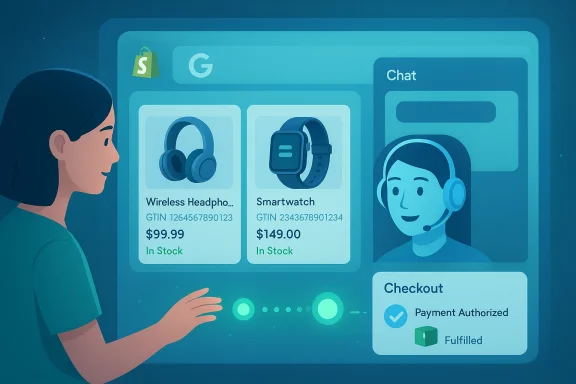
Shopify and Google’s announcement of the Universal Commerce Protocol (UCP) marks a decisive step toward a world where AI agents not only recommend products but complete purchases, manage subscriptions, and handle post‑purchase support — all inside conversational interfaces. For small businesses that depend on discovery, conversion, and customer trust, the move from click‑through commerce to agentic commerce changes where, how, and with whom you compete. This article explains what UCP is, how Shopify’s complementary Agentic offerings and Microsoft’s Copilot Checkout fit into the picture, and — critically — what small businesses must do now to turn the opportunity into revenue while avoiding common pitfalls.
The Universal Commerce Protocol is an open standard designed to establish a common language between AI agents and commerce systems across discovery, checkout, and post‑purchase workflows. Co‑developed by Google and Shopify and introduced publicly at a major retail event, UCP aims to let shoppers buy directly inside AI environments such as Google Search AI Mode and the Gemini app, as well as through other conversational platforms.
Shopify has rolled UCP into a broader push it calls agentic commerce, introducing administrative tooling (Agentic Storefronts), a new offering that opens Shopify’s Catalog to non‑Shopify merchants (branded internally as the Agentic plan), and expanded integrations — including an embedded checkout for Microsoft Copilot known as Copilot Checkout. Microsoft, payment platforms, and major retailers are providing matching infrastructure and onboarding pathways so that merchant products appear and transact inside several AI channels with minimal bespoke integration.
This shift is significant: it collapses discovery, decision, and purchase into single conversational flows. For businesses, that means higher potential conversion at the moment of intent — and new operational, technical, and legal obligations to make those transactions reliable, secure, and brand‑consistent.
The immediate priorities for merchants are clear:
Agentic commerce is arriving quickly and will only accelerate. Small businesses that act now — by auditing data, testing tokenized payments, and piloting agentic lists — will be best positioned to convert the promise of AI shopping into repeatable growth.
Source: Small Business Trends Shopify and Google Launch Universal Commerce Protocol to Transform AI Shopping
 Overview
The Universal Commerce Protocol is an open standard designed to establish a common language between AI agents and commerce systems across discovery, checkout, and post‑purchase workflows. Co‑developed by Google and Shopify and introduced publicly at a major retail event, UCP aims to let shoppers buy directly inside AI environments such as Google Search AI Mode and the Gemini app, as well as through other conversational platforms.Shopify has rolled UCP into a broader push it calls agentic commerce, introducing administrative tooling (Agentic Storefronts), a new offering that opens Shopify’s Catalog to non‑Shopify merchants (branded internally as the Agentic plan), and expanded integrations — including an embedded checkout for Microsoft Copilot known as Copilot Checkout. Microsoft, payment platforms, and major retailers are providing matching infrastructure and onboarding pathways so that merchant products appear and transact inside several AI channels with minimal bespoke integration.
This shift is significant: it collapses discovery, decision, and purchase into single conversational flows. For businesses, that means higher potential conversion at the moment of intent — and new operational, technical, and legal obligations to make those transactions reliable, secure, and brand‑consistent.
Background: why now and what “agentic commerce” means
AI agents are maturing quickly. Rather than serving as passive recommenders, agents increasingly act on behalf of users — comparing options, applying rules (preferences, budgets, loyalty), and executing purchases. The industry labels this capability agentic commerce.- AI user adoption has moved from experimentation to everyday use across search, chat, and assistant apps.
- Major platform players want agents to complete the purchase without bouncing the user to an external storefront, reducing friction and increasing conversion.
- Multiple stakeholders (platforms, payment processors, large retailers) therefore need a shared protocol so every agent does not require a bespoke connection to every merchant.
What is the Universal Commerce Protocol (UCP)?
High‑level purpose
UCP defines a cookbook of operations and data models that let an AI agent:- Discover and present products with accurate pricing and availability.
- Assemble a cart according to merchant‑specific checkout rules.
- Exchange payment tokens and confirm authorization.
- Communicate shipping, delivery scheduling, subscription terms, and returns policies.
- Trigger post‑purchase support and status updates.
Technical design and compatibility
UCP accommodates multiple transport and integration approaches. Implementers can use RESTful APIs, or layer UCP semantics on top of other agent protocols and transports (for example, model context protocols or agent‑to‑agent primitives). Key technical capabilities include:- Structured product schema: standardized attributes for variant handling, GTINs, dimensions, and fulfillment constraints.
- Checkout primitives: discount code application, loyalty credential verification, subscription cadence selection.
- Payment tokenization: agentic commerce uses shared payment tokens so agents do not handle raw payment credentials.
- Post‑purchase events: standardized status updates, returns/refund workflows, and support channels.
What UCP does not (yet) promise
- Guaranteed identical UX across every AI surface. UCP enables capability parity but actual UX will still vary by platform.
- A single regulatory regime or liability allocation — merchants must still manage tax, compliance, and returns within their legal jurisdiction.
- Instant global availability for every platform; rollout and payment options vary by market and partner.
Shopify’s agentic strategy: Agentic Storefronts, Catalog, and the Agentic plan
Shopify is positioning itself as the commerce layer for agentic shopping. The company’s recent announcements combine protocol work (UCP co‑development) with practical merchant tools:- Agentic Storefronts: A management surface in Shopify admin that connects a merchant’s product data to multiple AI channels (ChatGPT, Microsoft Copilot, Google AI Mode, Gemini, and others). It centralizes the routing, schemas, and attribution for agentic orders.
- Shopify Catalog open via Agentic plan: Shopify is offering a new pathway for merchants who do not run a Shopify storefront to list products in Shopify’s Catalog. Those listings are then made available to agentic channels that integrate with Shopify’s ecosystem.
- Expanded payment and checkout support: Shopify’s UCP implementation is payment‑processor agnostic, meaning merchants can accept payments through Shopify Payments or alternate processors available in the AI surface.
Microsoft: Copilot Checkout and brand agent integrations
Microsoft’s response centers on enabling purchases inside Copilot. Key elements include:- Copilot Checkout (embedded checkout): A checkout flow that executes inside the Copilot conversation so users can buy without navigating away. This is powered by partnerships with payment providers and commerce platforms (Shopify, Stripe, PayPal).
- Brand Agents: Interactive brand presences within Copilot that act as virtual sales associates, able to answer product‑specific questions and present shopable options.
- Merchant onboarding: Shopify merchants are automatically enrolled into Copilot Checkout (subject to merchant controls); non‑Shopify merchants can apply via payment partners or Microsoft Merchant Center.
Early pilots, partners, and what the rollouts look like
Several brands and platforms are named as early participants in agentic commerce pilots and first waves:- Fashion and lifestyle brands such as Monos, Gymshark, and Everlane have been cited as brands planning to make products available in AI Mode on Google and other AI channels.
- Merchants like Keen, Pura Vida, and Kyte Baby appear in early Microsoft Copilot Checkout listings.
- Payment providers and processor partners — including Stripe, PayPal, and major card networks — are participating to support secure tokenized payments in conversational flows.
Why this matters to small businesses: opportunities and advantages
Agentic commerce can create sizeable benefits for small and medium businesses when implemented correctly:- Meet customers at intent: AI agents can surface your product at the precise moment a buyer expresses intent, reducing purchase friction and increasing conversion.
- Broader reach without a full platform migration: The Agentic plan lets merchants on other platforms become discoverable in AI channels without moving their entire storefront to Shopify.
- Faster discovery cycles: Agents use structured product truth to match queries rapidly — good data = better match = more sales opportunities.
- Embedded checkout reduces drop‑off: Completing payment within the agent conversation leverages momentum and reduces abandonment from context switching.
- New attribution signals: Agentic orders can be tracked back to AI surfaces, giving merchants fresh data on where their customers are discovered.
The risks and operational downsides small businesses must consider
While the upside is real, the transition introduces multiple non‑trivial risks:- Data quality and product representation: Agents rely on structured, canonical product data. Incomplete or inconsistent metadata means poor matches, mispriced items, or incorrect variants.
- Control of brand experience: Selling inside an AI agent removes parts of your owned customer experience (upsells, packaging messages, post‑order landing pages).
- Fraud and chargebacks: Embedded checkouts reduce friction but can increase abuse if anti‑fraud controls are not updated for tokenized, agent‑driven flows.
- Privacy and data flows: Orders initiated inside AI platforms involve new data sharing patterns — merchants must audit what data is retained, how it’s shared with AI platforms, and whether customer consent flows comply with law.
- Operational strain: Sudden elevation in conversion rates can stress fulfillment, inventory sync, and CX teams.
- Legal and tax complexity: Selling across agent platforms can trigger new nexus and tax obligations, or create disputes over merchant‑of‑record responsibilities.
- Platform dependence: Listing through a platform’s catalog can reduce direct traffic to your website and increase reliance on platform rules and fee changes.
- Misinformation and hallucination: AI agents may misrepresent product details if their training or contextual inputs are flawed; this leads to confusion, returns, and reputational harm.
Practical readiness checklist for small businesses (technical and operational)
- Product data audit
- Ensure every SKU has canonical identifiers (GTIN/UPC), accurate attributes, clear titles, and clean descriptions.
- Provide high‑quality images and size/spec tables where applicable.
- Inventory & fulfillment synchronization
- Confirm real‑time inventory feeds to any catalog/agentic layer to avoid oversells.
- Define delivery constraints, regional shipping rules, and options for scheduling where applicable.
- Payment & fraud controls
- Implement tokenized payments through supported partners (Stripe, PayPal, Shopify Payments).
- Update fraud filters to account for agentic flows and tokenized checkouts.
- Returns, subscriptions & policy clarity
- Standardize refund/return policies and subscription terms in machine‑readable form.
- Ensure agents can surface these policies in conversation.
- Legal & tax review
- Confirm merchant‑of‑record responsibilities and tax collection for agentic transactions.
- Update privacy policies to disclose conversational commerce data practices.
- Customer support integration
- Connect post‑purchase events to CRM and support workflows so buyers receive consistent updates.
- Ensure human escalation paths are obvious and fast.
- Monitoring & attribution
- Instrument analytics to capture AI‑channel attribution and conversion metrics.
- Track metrics such as time‑to‑purchase, average order value, cart abandonment inside agent flows, and post‑purchase return rates.
- Brand protection and testing
- Test agentic purchase flows thoroughly before broad rollout.
- Maintain control over how your brand voice and product claims are represented to prevent hallucination or misrepresentation.
Payments, tokenization, and merchant responsibilities
Agentic commerce uses tokenization to minimize exposure of sensitive payment credentials to agents. Typical flow:- The agent requests authorization; a payment token is generated by the payment platform (token provider) after buyer consent.
- The token is passed to the merchant to complete the authorization, without exposing raw card data to the agent.
- The merchant remains the merchant of record in most current implementations and thus typically bears fulfillment, returns, tax, and chargeback liability.
Security, privacy, and compliance considerations
- Verify what personal data is shared with each AI platform and how long it is retained.
- Confirm encryption and token lifetimes for payment and authentication tokens.
- Ensure data processing agreements and vendor contracts reflect agentic data flows and provide for audits when necessary.
- For subscription or recurring billing, confirm explicit customer consent is captured and stored in a way that’s auditable.
- Maintain clear logs for dispute resolution and comply with consumer protection laws that apply to conversational commerce.
Competitive implications and the fragmented protocol landscape
UCP is not the only agentic standard emerging. Multiple companies are launching complementary or competing protocols and product discovery standards. This opens up two strategic realities:- Short term: fragmentation will persist, meaning businesses must support multiple integrations and provider toolchains.
- Long term: standardization (or dominant platform adoption) could consolidate discovery and commerce into a few agentic channels, making early positioning valuable.
Mitigation strategies: reducing rollout risk
- Start small: pilot a subset of SKUs or a brand collection to validate agentic flows.
- Prioritize best sellers and low‑return items for initial tests to limit operational risk.
- Use phased inventory caps and automated throttles to prevent overselling during initial discovery spikes.
- Require explicit consent for recurring payments and high‑value purchases.
- Maintain clear, machine‑readable policy metadata that agents can surface automatically.
- Negotiate commercial terms and revenue sharing clearly with platform partners before scaling.
What to watch in the next 6–12 months
- Adoption and authorization models: which payment providers and markets expand agentic support fastest.
- Consumer trust metrics: return rates, complaints, and dispute volumes from agentic purchases.
- Regulatory scrutiny: consumer protection or privacy regulators may update rules to cover agent‑initiated purchases specifically.
- Protocol consolidation: whether UCP or competing standards gain dominant adoption across retailers and AI platforms.
- Merchant economics: how fees, attribution, and incremental conversion change CAC and LTV for small businesses.
Final analysis: how to treat agentic commerce strategically
The Universal Commerce Protocol and the surrounding agentic infrastructure represent a real inflection point for digital commerce. For small businesses, the transition offers a tangible path to reach buyers at the moment of intent, but the path is not without complexity.The immediate priorities for merchants are clear:
- Treat agentic commerce as a new channel: apply the same rigor used for marketplaces, paid search, or social commerce.
- Invest in product truth — structured, authoritative product data will be the differentiator in agentic discovery.
- Harden payments, fraud, and fulfillment systems before scaling to avoid costly operational failures.
- Update legal and privacy frameworks proactively to reflect new conversational data flows.
Agentic commerce is arriving quickly and will only accelerate. Small businesses that act now — by auditing data, testing tokenized payments, and piloting agentic lists — will be best positioned to convert the promise of AI shopping into repeatable growth.
Source: Small Business Trends Shopify and Google Launch Universal Commerce Protocol to Transform AI Shopping
